Peymanai105mm lens
105mm lens
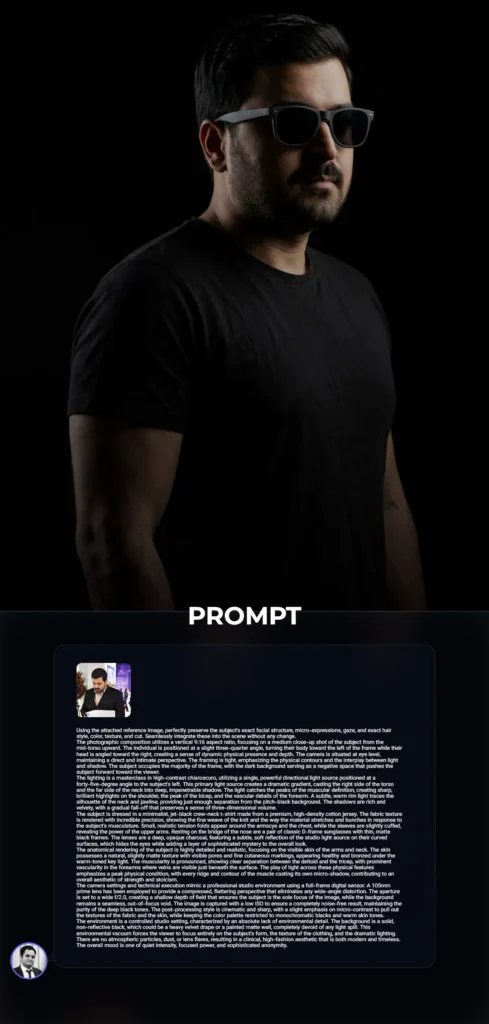
Cinematic Chiaroscuro Portrait: High-Contrast Studio Photography PromptUsing the attached reference image, perfectly preserve the subject's exact facial structure, micro-expressions, gaze, and exact hair style, color, texture, and cut. Seamlessly integrate these into the scene without any change.
The photographic composition utilizes a vertical 9:16 aspect ratio, focusing on a medium close-up shot of the subject from the mid-torso upward. The individual is positioned at a slight three-quarter angle, turning their body toward the left of the frame while their head is angled toward the right, creating a sense of dynamic physical presence and depth. The camera is situated at eye level, maintaining a direct and intimate perspective. The framing is tight, emphasizing the physical contours and the interplay between light and shadow. The subject occupies the majority of the frame, with the dark background serving as a negative space that pushes the subject forward toward the viewer.
The lighting is a masterclass in high-contrast chiaroscuro, utilizing a single, powerful directional light source positioned at a forty-five-degree angle to the subject's left. This primary light source creates a dramatic gradient, casting the right side of the torso and the far side of the neck into deep, impenetrable shadow. The light catches the peaks of the muscular definition, creating sharp, brilliant highlights on the shoulder, the peak of the bicep, and the vascular details of the forearm. A subtle, warm rim light traces the silhouette of the neck and jawline, providing just enough separation from the pitch-black background. The shadows are rich and velvety, with a gradual fall-off that preserves a sense of three-dimensional volume.
The subject is dressed in a minimalist, jet-black crew-neck t-shirt made from a premium, high-density cotton jersey. The fabric texture is rendered with incredible precision, showing the fine weave of the knit and the way the material stretches and bunches in response to the subject's musculature. Small, realistic tension folds appear around the armscye and the chest, while the sleeves are slightly cuffed, revealing the power of the upper arms. Resting on the bridge of the nose are a pair of classic D-frame sunglasses with thin, matte black frames. The lenses are a deep, opaque charcoal, featuring a subtle, soft reflection of the studio light source on their curved surfaces, which hides the eyes while adding a layer of sophisticated mystery to the overall look.
The anatomical rendering of the subject is highly detailed and realistic, focusing on the visible skin of the arms and neck. The skin possesses a natural, slightly matte texture with visible pores and fine cutaneous markings, appearing healthy and bronzed under the warm-toned key light. The muscularity is pronounced, showing clear separation between the deltoid and the tricep, with prominent vascularity in the forearms where veins are visible just beneath the surface. The play of light across these physical features emphasizes a peak physical condition, with every ridge and contour of the muscle casting its own micro-shadow, contributing to an overall aesthetic of strength and stoicism.
The camera settings and technical execution mimic a professional studio environment using a full-frame digital sensor. A 105mm prime lens has been employed to provide a compressed, flattering perspective that eliminates any wide-angle distortion. The aperture is set to a wide f/2.0, creating a shallow depth of field that ensures the subject is the sole focus of the image, while the background remains a seamless, out-of-focus void. The image is captured with a low ISO to ensure a completely noise-free result, maintaining the purity of the deep black tones. The post-processing style is cinematic and sharp, with a slight emphasis on micro-contrast to pull out the textures of the fabric and the skin, while keeping the color palette restricted to monochromatic blacks and warm skin tones.
The environment is a controlled studio setting, characterized by an absolute lack of environmental detail. The background is a solid, non-reflective black, which could be a heavy velvet drape or a painted matte wall, completely devoid of any light spill. This environmental vacuum forces the viewer to focus entirely on the subject's form, the texture of the clothing, and the dramatic lighting. There are no atmospheric particles, dust, or lens flares, resulting in a clinical, high-fashion aesthetic that is both modern and timeless. The overall mood is one of quiet intensity, focused power, and sophisticated anonymity.

Dramatic Monochrome Chiaroscuro Cinematic PortraitUsing the attached reference image, perfectly preserve the subject's exact facial structure, micro-expressions, gaze, and exact hair style, color, texture, and cut. Seamlessly integrate these into the scene without any change.
The photographic style must be a masterful execution of high-contrast monochrome cinematography, specifically emulating the aesthetic of a mid-20th-century silver gelatin print. The color palette is strictly limited to a sophisticated spectrum of blacks, whites, and varying degrees of charcoal and slate grays. There should be an intentional application of fine, organic film grain throughout the entire frame, avoiding any digital smoothness to maintain an authentic, raw, and tactile analog quality. The tonal range should be pushed to create a dramatic chiaroscuro effect, where the highlights are crisp and luminous without blowing out, and the shadows are deep, rich, and ink-like, providing a sense of profound depth and three-dimensionality to the subject.
The lighting is the primary architectural element of this composition, featuring a singular, directional light source positioned at a high angle to the right of the camera. This light must cast a sharp, defined illumination across the side of the subject's face and the prominent anatomy of the neck, while leaving the opposite side in a heavy, atmospheric shadow. The light should catch the subtle textures of the skin and the fabric of the clothing, creating a brilliant rim-light effect along the contours of the individual's silhouette. The transition between the brightest highlights and the deepest shadows must be deliberate and sculpted, emphasizing the physical presence of the individual against the more neutral, softly lit background.
The composition is a tight, intimate bust-length portrait captured from a slightly low-angle perspective to emphasize the dramatic upward tilt of the head. The individual is positioned in a three-quarter profile, with the neck elongated and the chin pointed toward the upper right corner of the frame, suggesting a moment of intense introspection, surrender, or yearning. The framing should be slightly off-center to allow for a sense of dynamic movement within the stillness of the pose. The negative space provided by the background should be utilized to balance the heavy, dark mass of the subject's torso and jacket, ensuring that the viewer's focus is drawn immediately to the illuminated portions of the skin and the sharp lines of the posture.
The technical camera settings should simulate a professional portrait setup using a 105mm telephoto prime lens to provide a subtle compression of the features and a flattering perspective. The aperture should be set to approximately f/4.0, ensuring that the subject's entire profile remains in tack-sharp focus while allowing the background to fall into a gentle, non-distracting blur. The shutter speed should be fast enough to capture the stillness of the moment with absolute clarity, and the simulated ISO should be high enough to introduce that characteristic silver halide grain that defines the filmic look. Every micro-detail, from the tiny pores on the skin to the individual fibers of the clothing, must be rendered with high-fidelity precision within the focal plane.
The wardrobe consists of a heavy, structured jacket crafted from a dark, rugged textile such as a high-density denim or a thick canvas. The fabric must exhibit a rich, matte texture that absorbs light, with visible weaving patterns and subtle distressing along the seams. The collar of the jacket is turned up slightly, framing the base of the neck and adding a layer of architectural complexity to the lower third of the image. The deep black of the garment should act as a solid anchor for the composition, providing a stark contrast against the pale, neutral background. The background itself should be a minimalist, non-descript wall with a very fine, plaster-like texture, catching just enough light to appear as a soft, luminous gray that gradients slightly darker toward the edges of the frame to create a subtle vignette effect.
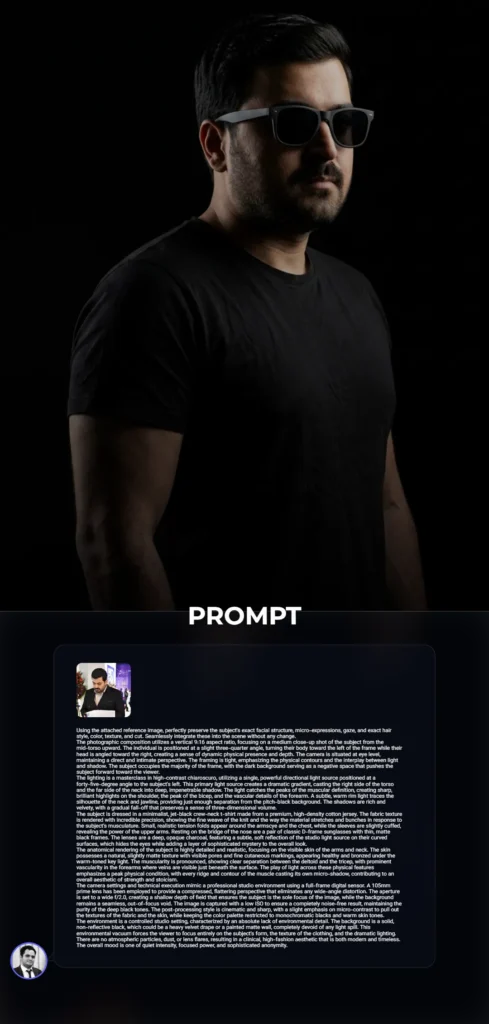
Cinematic Chiaroscuro Portrait: High-Contrast Studio Photography PromptUsing the attached reference image, perfectly preserve the subject's exact facial structure, micro-expressions, gaze, and exact hair style, color, texture, and cut. Seamlessly integrate these into the scene without any change.
The photographic composition utilizes a vertical 9:16 aspect ratio, focusing on a medium close-up shot of the subject from the mid-torso upward. The individual is positioned at a slight three-quarter angle, turning their body toward the left of the frame while their head is angled toward the right, creating a sense of dynamic physical presence and depth. The camera is situated at eye level, maintaining a direct and intimate perspective. The framing is tight, emphasizing the physical contours and the interplay between light and shadow. The subject occupies the majority of the frame, with the dark background serving as a negative space that pushes the subject forward toward the viewer.
The lighting is a masterclass in high-contrast chiaroscuro, utilizing a single, powerful directional light source positioned at a forty-five-degree angle to the subject's left. This primary light source creates a dramatic gradient, casting the right side of the torso and the far side of the neck into deep, impenetrable shadow. The light catches the peaks of the muscular definition, creating sharp, brilliant highlights on the shoulder, the peak of the bicep, and the vascular details of the forearm. A subtle, warm rim light traces the silhouette of the neck and jawline, providing just enough separation from the pitch-black background. The shadows are rich and velvety, with a gradual fall-off that preserves a sense of three-dimensional volume.
The subject is dressed in a minimalist, jet-black crew-neck t-shirt made from a premium, high-density cotton jersey. The fabric texture is rendered with incredible precision, showing the fine weave of the knit and the way the material stretches and bunches in response to the subject's musculature. Small, realistic tension folds appear around the armscye and the chest, while the sleeves are slightly cuffed, revealing the power of the upper arms. Resting on the bridge of the nose are a pair of classic D-frame sunglasses with thin, matte black frames. The lenses are a deep, opaque charcoal, featuring a subtle, soft reflection of the studio light source on their curved surfaces, which hides the eyes while adding a layer of sophisticated mystery to the overall look.
The anatomical rendering of the subject is highly detailed and realistic, focusing on the visible skin of the arms and neck. The skin possesses a natural, slightly matte texture with visible pores and fine cutaneous markings, appearing healthy and bronzed under the warm-toned key light. The muscularity is pronounced, showing clear separation between the deltoid and the tricep, with prominent vascularity in the forearms where veins are visible just beneath the surface. The play of light across these physical features emphasizes a peak physical condition, with every ridge and contour of the muscle casting its own micro-shadow, contributing to an overall aesthetic of strength and stoicism.
The camera settings and technical execution mimic a professional studio environment using a full-frame digital sensor. A 105mm prime lens has been employed to provide a compressed, flattering perspective that eliminates any wide-angle distortion. The aperture is set to a wide f/2.0, creating a shallow depth of field that ensures the subject is the sole focus of the image, while the background remains a seamless, out-of-focus void. The image is captured with a low ISO to ensure a completely noise-free result, maintaining the purity of the deep black tones. The post-processing style is cinematic and sharp, with a slight emphasis on micro-contrast to pull out the textures of the fabric and the skin, while keeping the color palette restricted to monochromatic blacks and warm skin tones.
The environment is a controlled studio setting, characterized by an absolute lack of environmental detail. The background is a solid, non-reflective black, which could be a heavy velvet drape or a painted matte wall, completely devoid of any light spill. This environmental vacuum forces the viewer to focus entirely on the subject's form, the texture of the clothing, and the dramatic lighting. There are no atmospheric particles, dust, or lens flares, resulting in a clinical, high-fashion aesthetic that is both modern and timeless. The overall mood is one of quiet intensity, focused power, and sophisticated anonymity.

Dramatic Monochrome Chiaroscuro Cinematic PortraitUsing the attached reference image, perfectly preserve the subject's exact facial structure, micro-expressions, gaze, and exact hair style, color, texture, and cut. Seamlessly integrate these into the scene without any change.
The photographic style must be a masterful execution of high-contrast monochrome cinematography, specifically emulating the aesthetic of a mid-20th-century silver gelatin print. The color palette is strictly limited to a sophisticated spectrum of blacks, whites, and varying degrees of charcoal and slate grays. There should be an intentional application of fine, organic film grain throughout the entire frame, avoiding any digital smoothness to maintain an authentic, raw, and tactile analog quality. The tonal range should be pushed to create a dramatic chiaroscuro effect, where the highlights are crisp and luminous without blowing out, and the shadows are deep, rich, and ink-like, providing a sense of profound depth and three-dimensionality to the subject.
The lighting is the primary architectural element of this composition, featuring a singular, directional light source positioned at a high angle to the right of the camera. This light must cast a sharp, defined illumination across the side of the subject's face and the prominent anatomy of the neck, while leaving the opposite side in a heavy, atmospheric shadow. The light should catch the subtle textures of the skin and the fabric of the clothing, creating a brilliant rim-light effect along the contours of the individual's silhouette. The transition between the brightest highlights and the deepest shadows must be deliberate and sculpted, emphasizing the physical presence of the individual against the more neutral, softly lit background.
The composition is a tight, intimate bust-length portrait captured from a slightly low-angle perspective to emphasize the dramatic upward tilt of the head. The individual is positioned in a three-quarter profile, with the neck elongated and the chin pointed toward the upper right corner of the frame, suggesting a moment of intense introspection, surrender, or yearning. The framing should be slightly off-center to allow for a sense of dynamic movement within the stillness of the pose. The negative space provided by the background should be utilized to balance the heavy, dark mass of the subject's torso and jacket, ensuring that the viewer's focus is drawn immediately to the illuminated portions of the skin and the sharp lines of the posture.
The technical camera settings should simulate a professional portrait setup using a 105mm telephoto prime lens to provide a subtle compression of the features and a flattering perspective. The aperture should be set to approximately f/4.0, ensuring that the subject's entire profile remains in tack-sharp focus while allowing the background to fall into a gentle, non-distracting blur. The shutter speed should be fast enough to capture the stillness of the moment with absolute clarity, and the simulated ISO should be high enough to introduce that characteristic silver halide grain that defines the filmic look. Every micro-detail, from the tiny pores on the skin to the individual fibers of the clothing, must be rendered with high-fidelity precision within the focal plane.
The wardrobe consists of a heavy, structured jacket crafted from a dark, rugged textile such as a high-density denim or a thick canvas. The fabric must exhibit a rich, matte texture that absorbs light, with visible weaving patterns and subtle distressing along the seams. The collar of the jacket is turned up slightly, framing the base of the neck and adding a layer of architectural complexity to the lower third of the image. The deep black of the garment should act as a solid anchor for the composition, providing a stark contrast against the pale, neutral background. The background itself should be a minimalist, non-descript wall with a very fine, plaster-like texture, catching just enough light to appear as a soft, luminous gray that gradients slightly darker toward the edges of the frame to create a subtle vignette effect.
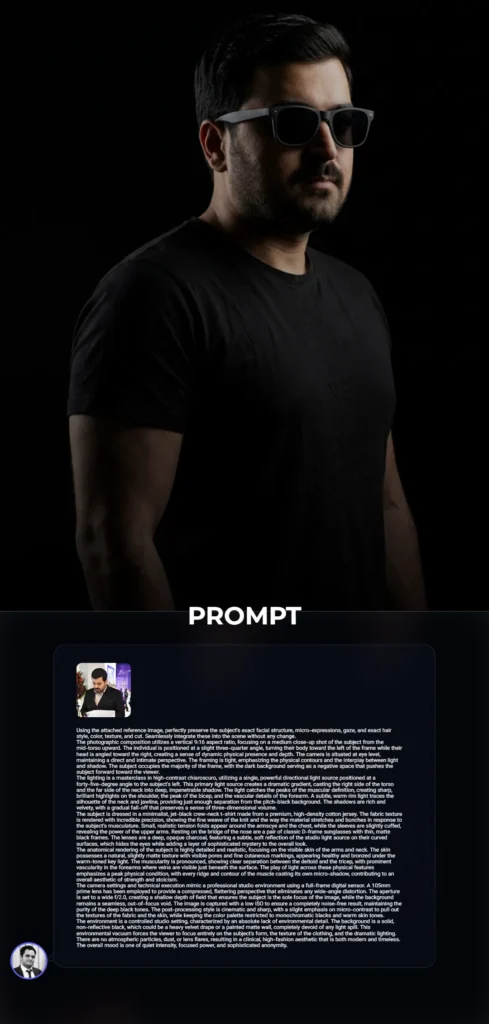
Cinematic Chiaroscuro Portrait: High-Contrast Studio Photography PromptUsing the attached reference image, perfectly preserve the subject's exact facial structure, micro-expressions, gaze, and exact hair style, color, texture, and cut. Seamlessly integrate these into the scene without any change.
The photographic composition utilizes a vertical 9:16 aspect ratio, focusing on a medium close-up shot of the subject from the mid-torso upward. The individual is positioned at a slight three-quarter angle, turning their body toward the left of the frame while their head is angled toward the right, creating a sense of dynamic physical presence and depth. The camera is situated at eye level, maintaining a direct and intimate perspective. The framing is tight, emphasizing the physical contours and the interplay between light and shadow. The subject occupies the majority of the frame, with the dark background serving as a negative space that pushes the subject forward toward the viewer.
The lighting is a masterclass in high-contrast chiaroscuro, utilizing a single, powerful directional light source positioned at a forty-five-degree angle to the subject's left. This primary light source creates a dramatic gradient, casting the right side of the torso and the far side of the neck into deep, impenetrable shadow. The light catches the peaks of the muscular definition, creating sharp, brilliant highlights on the shoulder, the peak of the bicep, and the vascular details of the forearm. A subtle, warm rim light traces the silhouette of the neck and jawline, providing just enough separation from the pitch-black background. The shadows are rich and velvety, with a gradual fall-off that preserves a sense of three-dimensional volume.
The subject is dressed in a minimalist, jet-black crew-neck t-shirt made from a premium, high-density cotton jersey. The fabric texture is rendered with incredible precision, showing the fine weave of the knit and the way the material stretches and bunches in response to the subject's musculature. Small, realistic tension folds appear around the armscye and the chest, while the sleeves are slightly cuffed, revealing the power of the upper arms. Resting on the bridge of the nose are a pair of classic D-frame sunglasses with thin, matte black frames. The lenses are a deep, opaque charcoal, featuring a subtle, soft reflection of the studio light source on their curved surfaces, which hides the eyes while adding a layer of sophisticated mystery to the overall look.
The anatomical rendering of the subject is highly detailed and realistic, focusing on the visible skin of the arms and neck. The skin possesses a natural, slightly matte texture with visible pores and fine cutaneous markings, appearing healthy and bronzed under the warm-toned key light. The muscularity is pronounced, showing clear separation between the deltoid and the tricep, with prominent vascularity in the forearms where veins are visible just beneath the surface. The play of light across these physical features emphasizes a peak physical condition, with every ridge and contour of the muscle casting its own micro-shadow, contributing to an overall aesthetic of strength and stoicism.
The camera settings and technical execution mimic a professional studio environment using a full-frame digital sensor. A 105mm prime lens has been employed to provide a compressed, flattering perspective that eliminates any wide-angle distortion. The aperture is set to a wide f/2.0, creating a shallow depth of field that ensures the subject is the sole focus of the image, while the background remains a seamless, out-of-focus void. The image is captured with a low ISO to ensure a completely noise-free result, maintaining the purity of the deep black tones. The post-processing style is cinematic and sharp, with a slight emphasis on micro-contrast to pull out the textures of the fabric and the skin, while keeping the color palette restricted to monochromatic blacks and warm skin tones.
The environment is a controlled studio setting, characterized by an absolute lack of environmental detail. The background is a solid, non-reflective black, which could be a heavy velvet drape or a painted matte wall, completely devoid of any light spill. This environmental vacuum forces the viewer to focus entirely on the subject's form, the texture of the clothing, and the dramatic lighting. There are no atmospheric particles, dust, or lens flares, resulting in a clinical, high-fashion aesthetic that is both modern and timeless. The overall mood is one of quiet intensity, focused power, and sophisticated anonymity.
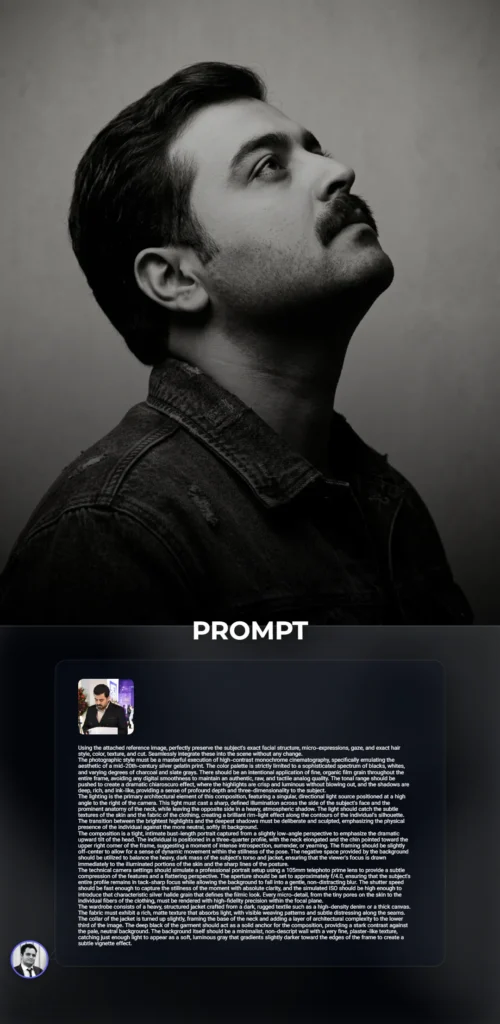
Dramatic Monochrome Chiaroscuro Cinematic PortraitUsing the attached reference image, perfectly preserve the subject's exact facial structure, micro-expressions, gaze, and exact hair style, color, texture, and cut. Seamlessly integrate these into the scene without any change.
The photographic style must be a masterful execution of high-contrast monochrome cinematography, specifically emulating the aesthetic of a mid-20th-century silver gelatin print. The color palette is strictly limited to a sophisticated spectrum of blacks, whites, and varying degrees of charcoal and slate grays. There should be an intentional application of fine, organic film grain throughout the entire frame, avoiding any digital smoothness to maintain an authentic, raw, and tactile analog quality. The tonal range should be pushed to create a dramatic chiaroscuro effect, where the highlights are crisp and luminous without blowing out, and the shadows are deep, rich, and ink-like, providing a sense of profound depth and three-dimensionality to the subject.
The lighting is the primary architectural element of this composition, featuring a singular, directional light source positioned at a high angle to the right of the camera. This light must cast a sharp, defined illumination across the side of the subject's face and the prominent anatomy of the neck, while leaving the opposite side in a heavy, atmospheric shadow. The light should catch the subtle textures of the skin and the fabric of the clothing, creating a brilliant rim-light effect along the contours of the individual's silhouette. The transition between the brightest highlights and the deepest shadows must be deliberate and sculpted, emphasizing the physical presence of the individual against the more neutral, softly lit background.
The composition is a tight, intimate bust-length portrait captured from a slightly low-angle perspective to emphasize the dramatic upward tilt of the head. The individual is positioned in a three-quarter profile, with the neck elongated and the chin pointed toward the upper right corner of the frame, suggesting a moment of intense introspection, surrender, or yearning. The framing should be slightly off-center to allow for a sense of dynamic movement within the stillness of the pose. The negative space provided by the background should be utilized to balance the heavy, dark mass of the subject's torso and jacket, ensuring that the viewer's focus is drawn immediately to the illuminated portions of the skin and the sharp lines of the posture.
The technical camera settings should simulate a professional portrait setup using a 105mm telephoto prime lens to provide a subtle compression of the features and a flattering perspective. The aperture should be set to approximately f/4.0, ensuring that the subject's entire profile remains in tack-sharp focus while allowing the background to fall into a gentle, non-distracting blur. The shutter speed should be fast enough to capture the stillness of the moment with absolute clarity, and the simulated ISO should be high enough to introduce that characteristic silver halide grain that defines the filmic look. Every micro-detail, from the tiny pores on the skin to the individual fibers of the clothing, must be rendered with high-fidelity precision within the focal plane.
The wardrobe consists of a heavy, structured jacket crafted from a dark, rugged textile such as a high-density denim or a thick canvas. The fabric must exhibit a rich, matte texture that absorbs light, with visible weaving patterns and subtle distressing along the seams. The collar of the jacket is turned up slightly, framing the base of the neck and adding a layer of architectural complexity to the lower third of the image. The deep black of the garment should act as a solid anchor for the composition, providing a stark contrast against the pale, neutral background. The background itself should be a minimalist, non-descript wall with a very fine, plaster-like texture, catching just enough light to appear as a soft, luminous gray that gradients slightly darker toward the edges of the frame to create a subtle vignette effect.