
Peymanai35mm Film Grain
35mm Film Grain

Cinematic 35mm Portrait: Golden Chiaroscuro in Red SilkUsing the attached reference image, perfectly preserve the subject's exact facial structure, micro-expressions, gaze, and exact hair style, color, texture, and cut. Seamlessly integrate these into the scene without any change.
The camera composition and framing for this image must follow a vertical orientation, specifically a 9:16 aspect ratio, focusing on a medium close-up of the subject from the mid-chest upward. The lens used should emulate a high-end prime lens with a focal length between 50mm and 85mm, providing a naturalistic perspective that closely mimics human vision but with a compressed depth of field. The aperture is set very wide, approximately f/1.8, resulting in a shallow depth of field where the individual is the primary focus while the background is rendered into a creamy, indistinct bokeh. The camera is positioned at a slight low-angle, looking up toward the subject, which emphasizes the sculptural lines of the neck and the prominence of the collarbones. The framing is intimate and tight, leaving very little negative space around the individual, which creates a sense of proximity and candid vulnerability.
The lighting and color palette are centered on warm, incandescent tones and a dramatic high-contrast lighting setup. A single, powerful light source is positioned to the upper side of the subject, casting a golden, amber glow that washes over the skin and highlights the physical contours. This creates a chiaroscuro effect, where one side of the frame is brilliantly illuminated with warm highlights while the opposite side, particularly the neck and the area under the chin, is cast into deep, rich shadows. The color temperature is heavily weighted toward the warm end of the spectrum, with dominant hues of burnt orange, deep red, and golden yellow. The shadows are not deep black but rather a warm, dark brown, maintaining detail even in the lower-exposure areas. The overall color grading is cinematic and nostalgic, reminiscent of golden hour photography or an interior lit by candlelight.
Regarding the material textures and clothing details, the individual is wearing a garment made of a vibrant, crimson-red fabric that appears to be silk or a high-quality satin, giving it a subtle, light-reflecting sheen. The edges of this garment are meticulously trimmed with intricate, fine-gauge lace featuring delicate floral and leaf motifs. This lace trim is a slightly darker, more saturated red and adds a complex layer of tactile texture to the image. A thin, delicate spaghetti strap of the same red material rests over the shoulder, catching the light and casting a faint shadow on the skin. A single, thin, circular gold hoop earring is visible, rendered with a soft metallic luster that reflects the warm ambient light. The texture of the skin is captured with extreme realism, showing a soft, dewy glow on the areas hit by the light, with a visible but natural grain that suggests the absence of heavy digital smoothing.
The atmospheric and rendering style must perfectly replicate the look and feel of 35mm analog film. This includes a pervasive layer of fine-grained film noise that is consistently distributed across both the highlights and shadows, providing a gritty, organic quality to the digital render. The image should lack clinical digital sharpness, opting instead for a softer, more evocative rendering style where edges are defined but not overly processed. There is a sense of warmth and coziness in the atmosphere, as if the shot was taken in a private, dimly lit interior space. The background consists of soft-focus vertical elements that suggest curtains or interior architectural details, blurred into a wash of dark, warm tones that prevent any distractions from the subject. The final output must feel like a captured moment in time, emphasizing the play of golden light on fabric and skin with a timeless, cinematic aesthetic.
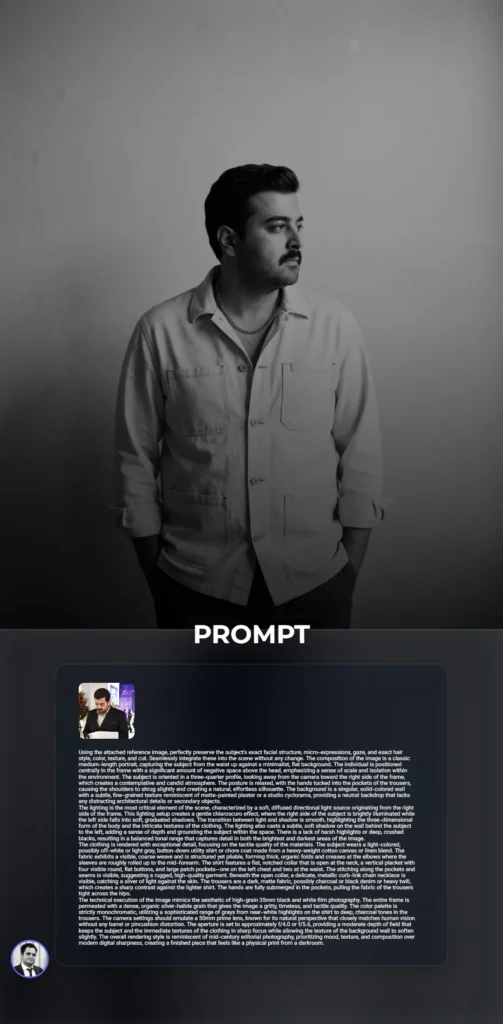
High-Grain 35mm Monochrome Portrait Prompt for Cinematic Minimalist Photography StylesUsing the attached reference image, perfectly preserve the subject's exact facial structure, micro-expressions, gaze, and exact hair style, color, texture, and cut. Seamlessly integrate these into the scene without any change. The composition of the image is a classic medium-length portrait, capturing the subject from the waist up against a minimalist, flat background. The individual is positioned centrally in the frame with a significant amount of negative space above the head, emphasizing a sense of scale and isolation within the environment. The subject is oriented in a three-quarter profile, looking away from the camera toward the right side of the frame, which creates a contemplative and candid atmosphere. The posture is relaxed, with the hands tucked into the pockets of the trousers, causing the shoulders to shrug slightly and creating a natural, effortless silhouette. The background is a singular, solid-colored wall with a subtle, fine-grained texture reminiscent of matte-painted plaster or a studio cyclorama, providing a neutral backdrop that lacks any distracting architectural details or secondary objects.
The lighting is the most critical element of the scene, characterized by a soft, diffused directional light source originating from the right side of the frame. This lighting setup creates a gentle chiaroscuro effect, where the right side of the subject is brightly illuminated while the left side falls into soft, graduated shadows. The transition between light and shadow is smooth, highlighting the three-dimensional form of the body and the intricate textures of the clothing. The lighting also casts a subtle, soft shadow on the wall behind the subject to the left, adding a sense of depth and grounding the subject within the space. There is a lack of harsh highlights or deep, crushed blacks, resulting in a balanced tonal range that captures detail in both the brightest and darkest areas of the image.
The clothing is rendered with exceptional detail, focusing on the tactile quality of the materials. The subject wears a light-colored, possibly off-white or light gray, button-down utility shirt or chore coat made from a heavy-weight cotton canvas or linen blend. The fabric exhibits a visible, coarse weave and is structured yet pliable, forming thick, organic folds and creases at the elbows where the sleeves are roughly rolled up to the mid-forearm. The shirt features a flat, notched collar that is open at the neck, a vertical placket with four visible round, flat buttons, and large patch pockets—one on the left chest and two at the waist. The stitching along the pockets and seams is visible, suggesting a rugged, high-quality garment. Beneath the open collar, a delicate, metallic curb-link chain necklace is visible, catching a sliver of light against the skin. The trousers are a dark, matte fabric, possibly charcoal or black denim or heavy twill, which creates a sharp contrast against the lighter shirt. The hands are fully submerged in the pockets, pulling the fabric of the trousers tight across the hips.
The technical execution of the image mimics the aesthetic of high-grain 35mm black and white film photography. The entire frame is permeated with a dense, organic silver-halide grain that gives the image a gritty, timeless, and tactile quality. The color palette is strictly monochromatic, utilizing a sophisticated range of grays from near-white highlights on the shirt to deep, charcoal tones in the trousers. The camera settings should emulate a 50mm prime lens, known for its natural perspective that closely matches human vision without any barrel or pincushion distortion. The aperture is set to approximately f/4.0 or f/5.6, providing a moderate depth of field that keeps the subject and the immediate textures of the clothing in sharp focus while allowing the texture of the background wall to soften slightly. The overall rendering style is reminiscent of mid-century editorial photography, prioritizing mood, texture, and composition over modern digital sharpness, creating a finished piece that feels like a physical print from a darkroom.

Cinematic Chiaroscuro Monochromatic Portrait with Silver-Gelatin AestheticsUsing the attached reference image, perfectly preserve the subject's exact facial structure, micro-expressions, gaze, and exact hair style, color, texture, and cut. Seamlessly integrate these into the scene without any change. The lighting for this recreation must be a masterclass in high-contrast monochromatic cinematography, specifically emulating the look of classic silver-gelatin black-and-white photography. The primary illumination is a singular, directional light source positioned at a high angle to the subject's right, which creates a dramatic chiaroscuro effect. This lighting strategy leaves large portions of the scene in deep, rich blacks while highlighting the prominent surfaces of the subject's shoulder, the top of the hand, and the edge of the face with a soft, diffused glow. The transition between light and shadow is not harsh but possesses a smooth, painterly gradient that emphasizes the three-dimensional volume of the subject. The tonal range must be exceptionally broad, capturing every nuance from the darkest charcoal shadows in the recesses of the clothing to the bright, luminous grays on the highlights of the skin.
The camera composition is a medium shot captured from a slightly elevated downward angle, which enhances the mood of quiet introspection and vulnerability. A 50mm prime lens is utilized to provide a naturalistic perspective without the distortion typical of wider angles, ensuring the proportions of the subject and the surrounding environment feel grounded and realistic. The aperture is set to a wide f/2.8 to create a shallow depth of field, which keeps the subject in razor-sharp focus while allowing the background architectural elements to softly blur into the distance. The final image should incorporate a fine, organic film grain characteristic of high-speed 35mm film stock, such as Tri-X 400, adding a tactile, gritty quality to the render that avoids the sterile cleanliness of modern digital sensors. The focus is placed precisely on the subject's near eye, ensuring that the micro-expressions and contemplative gaze are the focal point of the entire composition.
The background setting consists of a wooden structure featuring traditional horizontal lap siding. These wooden planks are rendered with a weathered, matte texture, showing subtle variations in the grain and slight imperfections in the wood's surface. The horizontal lines of the siding create a rhythmic, geometric backdrop that contrasts with the organic, curved shapes of the subject. Below the subject, the floor of the deck is composed of thick wooden boards laid out with visible gaps between them, capturing the play of light and shadow in the crevices. The subject is seated in a classic Adirondack chair, which is defined by its wide, flat wooden armrests and its distinctive fan-shaped backrest made of vertical slats. The wood of the chair appears smooth and well-worn, with its natural grain visible under the high-contrast light, and it is angled away from the camera to create a sense of depth and perspective.
The subject's attire and posture are critical to the atmospheric success of the recreation. The subject is wearing a heavy, oversized, dark-toned garment, likely a high-density cotton or fleece hoodie, which has a matte, light-absorbing texture. The fabric is thick enough to hold deep, structural folds, particularly around the elbows and the chest, where the light catches the ridges of the material to reveal the weave and density of the cloth. The subject is posed in a relaxed, slumped-back position, leaning into the corner of the Adirondack chair. One arm is bent at the elbow with the hand raised toward the head, fingers slightly curled in a gesture of thought. A simple, wide-band metallic ring with a brushed, non-reflective finish is worn on one finger, catching a subtle highlight that adds a touch of detail to the hand's placement. The overall mood is one of stillness and cinematic drama, where the silence of the scene is palpable through the careful balance of shadow and light.
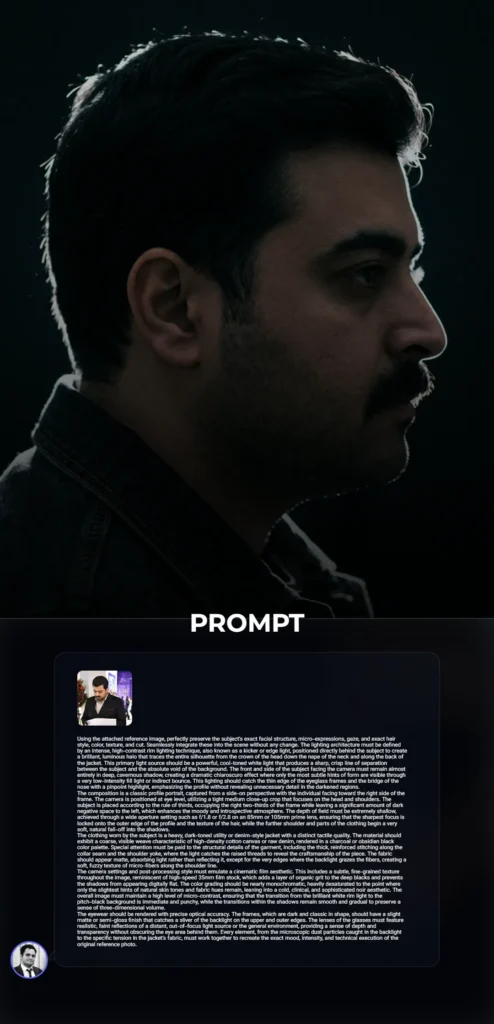
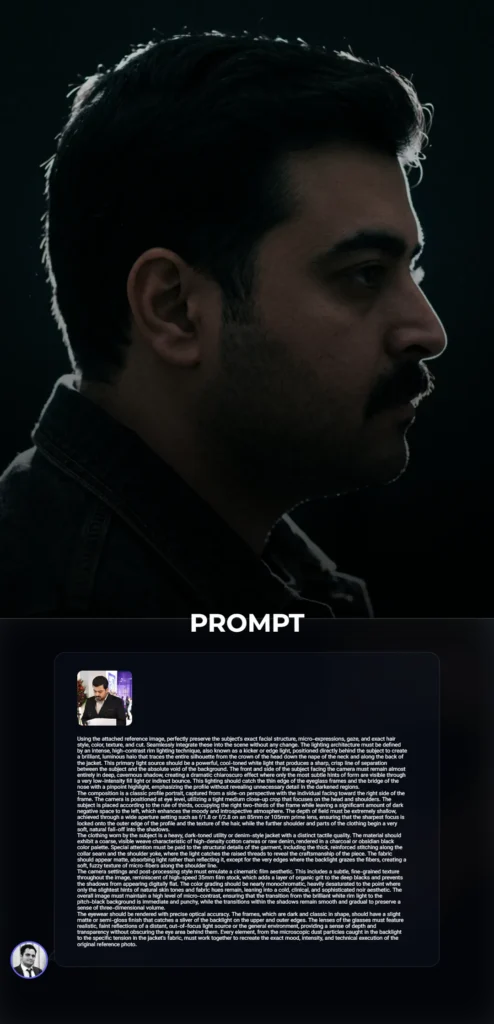
Cinematic Noir Profile Portrait with Intense Rim LightingUsing the attached reference image, perfectly preserve the subject's exact facial structure, micro-expressions, gaze, and exact hair style, color, texture, and cut. Seamlessly integrate these into the scene without any change. The lighting architecture must be defined by an intense, high-contrast rim lighting technique, also known as a kicker or edge light, positioned directly behind the subject to create a brilliant, luminous halo that traces the entire silhouette from the crown of the head down the nape of the neck and along the back of the jacket. This primary light source should be a powerful, cool-toned white light that produces a sharp, crisp line of separation between the subject and the absolute void of the background. The front and side of the subject facing the camera must remain almost entirely in deep, cavernous shadow, creating a dramatic chiaroscuro effect where only the most subtle hints of form are visible through a very low-intensity fill light or indirect bounce. This lighting should catch the thin edge of the eyeglass frames and the bridge of the nose with a pinpoint highlight, emphasizing the profile without revealing unnecessary detail in the darkened regions.
The composition is a classic profile portrait, captured from a side-on perspective with the individual facing toward the right side of the frame. The camera is positioned at eye level, utilizing a tight medium close-up crop that focuses on the head and shoulders. The subject is placed according to the rule of thirds, occupying the right two-thirds of the frame while leaving a significant amount of dark negative space to the left, which enhances the moody and introspective atmosphere. The depth of field must be extremely shallow, achieved through a wide aperture setting such as f/1.8 or f/2.8 on an 85mm or 105mm prime lens, ensuring that the sharpest focus is locked onto the outer edge of the profile and the texture of the hair, while the further shoulder and parts of the clothing begin a very soft, natural fall-off into the shadows.
The clothing worn by the subject is a heavy, dark-toned utility or denim-style jacket with a distinct tactile quality. The material should exhibit a coarse, visible weave characteristic of high-density cotton canvas or raw denim, rendered in a charcoal or obsidian black color palette. Special attention must be paid to the structural details of the garment, including the thick, reinforced stitching along the collar seam and the shoulder yoke, where the light catches the raised threads to reveal the craftsmanship of the piece. The fabric should appear matte, absorbing light rather than reflecting it, except for the very edges where the backlight grazes the fibers, creating a soft, fuzzy texture of micro-fibers along the shoulder line.
The camera settings and post-processing style must emulate a cinematic film aesthetic. This includes a subtle, fine-grained texture throughout the image, reminiscent of high-speed 35mm film stock, which adds a layer of organic grit to the deep blacks and prevents the shadows from appearing digitally flat. The color grading should be nearly monochromatic, heavily desaturated to the point where only the slightest hints of natural skin tones and fabric hues remain, leaning into a cold, clinical, and sophisticated noir aesthetic. The overall image must maintain a high level of micro-contrast, ensuring that the transition from the brilliant white rim light to the pitch-black background is immediate and punchy, while the transitions within the shadows remain smooth and gradual to preserve a sense of three-dimensional volume.
The eyewear should be rendered with precise optical accuracy. The frames, which are dark and classic in shape, should have a slight matte or semi-gloss finish that catches a sliver of the backlight on the upper and outer edges. The lenses of the glasses must feature realistic, faint reflections of a distant, out-of-focus light source or the general environment, providing a sense of depth and transparency without obscuring the eye area behind them. Every element, from the microscopic dust particles caught in the backlight to the specific tension in the jacket's fabric, must work together to recreate the exact mood, intensity, and technical execution of the original reference photo.

Cinematic Noir Profile Portrait with Window Light ProjectionUsing the attached reference image, perfectly preserve the subject's exact facial structure, micro-expressions, gaze, and exact hair style, color, texture, and cut. Seamlessly integrate these into the scene without any change.
The photographic composition is a masterful exercise in balance and negative space, featuring the subject positioned in the lower-left quadrant of the frame. The individual is captured in a sharp, clean profile, seated in a minimalist chair and leaning back at a relaxed angle that suggests a state of deep contemplation. The camera is positioned at a medium-low height, slightly below the subject's eye level, which creates a subtle upward perspective that adds a sense of importance to the figure against the vast, empty background. The framing is wide enough to capture the upper half of the subject's body, including the arms and the lap, while leaving significant room on the right side of the image for the dramatic interplay of light and shadow on the wall. The spatial relationship between the subject on the left and the large geometric light projection on the right creates a powerful visual tension and a sense of narrative weight.
The lighting setup is extremely specific and high-contrast, designed to evoke a classic cinematic or film noir aesthetic. A primary directional light source is positioned at a sharp angle from the right side of the frame, filtered through a physical stencil or gobo to project a crisp, six-pane window pattern onto the flat background wall. This projected light is bright and distinct, with the vertical and horizontal bars of the faux window creating a rigid grid. Inside this brightly illuminated area on the wall, a soft, diffused shadow of the subject is cast, appearing as a larger, more ethereal silhouette that mirrors the subject's profile. Crucially, the subject themselves remains almost entirely in shadow, save for a precise, thin, horizontal strip of light that illuminates only the upper portion of the brow and forehead area. This sliver of light acts as the primary focal point, drawing the eye directly to the subject's thoughtful expression while the rest of the torso and clothing blend into deep, rich blacks.
The image is rendered in a sophisticated monochromatic palette, eschewing color entirely to focus on texture, form, and tonal range. This is not a high-contrast digital black and white, but rather a soft, filmic rendering that mimics the characteristics of professional 35mm black and white film stock, such as Ilford Delta or Kodak Tri-X. The tonal transitions are smooth and gradual, particularly in the gray areas of the shadow on the wall. There is a noticeable but fine-grained texture across the entire image, giving it a tangible, organic quality that feels historical and artistic. The blacks are deep and velvety but retain enough information to suggest the folds in the clothing, while the whites of the window projection are bright without being blown out, maintaining a soft, diffused glow that interacts naturally with the texture of the wall.
Technical camera settings are tuned to achieve a specific depth of field and sharpness. A 50mm prime lens is utilized to provide a natural, distortion-free perspective that closely mimics human vision. The aperture is set to a moderately wide f/2.8, creating a selective focus where the subject's profile is rendered with biting sharpness, while the wall behind them and the light projection have a very subtle, creamy softness. This shallow depth of field helps to separate the subject from the background, making the shadow on the wall feel like it exists in a slightly different spatial plane. The exposure is keyed specifically to the highlights of the window projection, allowing the subject's dark clothing to underexpose into deep shadow, which emphasizes the dramatic, moody atmosphere of the scene.
The textures within the frame are highly detailed and contribute significantly to the realism of the recreation. The subject is wearing a heavy, dark-toned turtleneck sweater made of a dense knit material, possibly wool or cashmere. In the areas where the light grazes the fabric, such as the shoulder and the neck, the fine fibers and the weave of the knit are clearly visible, showing a tactile, slightly fuzzy surface. The chair on which the individual sits has a simple, utilitarian design with a dark metallic frame; the curved backrest catches a faint, specular highlight that reveals a smooth, semi-matte finish. The background wall is not perfectly flat but has a subtle, plaster-like grain that catches the projected light unevenly, adding a sense of physical space and depth to the environment. Even the dark pants worn by the subject show subtle variations in texture, suggesting a heavy cotton or denim material that absorbs light.
The overall atmosphere is one of profound, quiet introspection and cinematic melancholy. The environment feels like a sparse, high-ceilinged studio or a minimalist living space where the air is still and silent. The use of heavy shadows and the isolation of the subject within the frame evoke a sense of loneliness or deep thought. The film grain adds a layer of nostalgia and timelessness, making the image feel as though it could have been taken in the mid-20th century or the modern day. Every element, from the way the subject's hand rests near the lap to the precise angle of the shadow on the wall, is carefully choreographed to produce a mood of sophisticated, artistic gloom and intellectual weight. There are no distracting elements or atmospheric dust; the focus is entirely on the geometry of the light and the stillness of the individual.

High-Grain 35mm Monochrome Portrait Prompt for Cinematic Minimalist Photography StylesUsing the attached reference image, perfectly preserve the subject's exact facial structure, micro-expressions, gaze, and exact hair style, color, texture, and cut. Seamlessly integrate these into the scene without any change. The composition of the image is a classic medium-length portrait, capturing the subject from the waist up against a minimalist, flat background. The individual is positioned centrally in the frame with a significant amount of negative space above the head, emphasizing a sense of scale and isolation within the environment. The subject is oriented in a three-quarter profile, looking away from the camera toward the right side of the frame, which creates a contemplative and candid atmosphere. The posture is relaxed, with the hands tucked into the pockets of the trousers, causing the shoulders to shrug slightly and creating a natural, effortless silhouette. The background is a singular, solid-colored wall with a subtle, fine-grained texture reminiscent of matte-painted plaster or a studio cyclorama, providing a neutral backdrop that lacks any distracting architectural details or secondary objects.
The lighting is the most critical element of the scene, characterized by a soft, diffused directional light source originating from the right side of the frame. This lighting setup creates a gentle chiaroscuro effect, where the right side of the subject is brightly illuminated while the left side falls into soft, graduated shadows. The transition between light and shadow is smooth, highlighting the three-dimensional form of the body and the intricate textures of the clothing. The lighting also casts a subtle, soft shadow on the wall behind the subject to the left, adding a sense of depth and grounding the subject within the space. There is a lack of harsh highlights or deep, crushed blacks, resulting in a balanced tonal range that captures detail in both the brightest and darkest areas of the image.
The clothing is rendered with exceptional detail, focusing on the tactile quality of the materials. The subject wears a light-colored, possibly off-white or light gray, button-down utility shirt or chore coat made from a heavy-weight cotton canvas or linen blend. The fabric exhibits a visible, coarse weave and is structured yet pliable, forming thick, organic folds and creases at the elbows where the sleeves are roughly rolled up to the mid-forearm. The shirt features a flat, notched collar that is open at the neck, a vertical placket with four visible round, flat buttons, and large patch pockets—one on the left chest and two at the waist. The stitching along the pockets and seams is visible, suggesting a rugged, high-quality garment. Beneath the open collar, a delicate, metallic curb-link chain necklace is visible, catching a sliver of light against the skin. The trousers are a dark, matte fabric, possibly charcoal or black denim or heavy twill, which creates a sharp contrast against the lighter shirt. The hands are fully submerged in the pockets, pulling the fabric of the trousers tight across the hips.
The technical execution of the image mimics the aesthetic of high-grain 35mm black and white film photography. The entire frame is permeated with a dense, organic silver-halide grain that gives the image a gritty, timeless, and tactile quality. The color palette is strictly monochromatic, utilizing a sophisticated range of grays from near-white highlights on the shirt to deep, charcoal tones in the trousers. The camera settings should emulate a 50mm prime lens, known for its natural perspective that closely matches human vision without any barrel or pincushion distortion. The aperture is set to approximately f/4.0 or f/5.6, providing a moderate depth of field that keeps the subject and the immediate textures of the clothing in sharp focus while allowing the texture of the background wall to soften slightly. The overall rendering style is reminiscent of mid-century editorial photography, prioritizing mood, texture, and composition over modern digital sharpness, creating a finished piece that feels like a physical print from a darkroom.

Cinematic Chiaroscuro Monochromatic Portrait with Silver-Gelatin AestheticsUsing the attached reference image, perfectly preserve the subject's exact facial structure, micro-expressions, gaze, and exact hair style, color, texture, and cut. Seamlessly integrate these into the scene without any change. The lighting for this recreation must be a masterclass in high-contrast monochromatic cinematography, specifically emulating the look of classic silver-gelatin black-and-white photography. The primary illumination is a singular, directional light source positioned at a high angle to the subject's right, which creates a dramatic chiaroscuro effect. This lighting strategy leaves large portions of the scene in deep, rich blacks while highlighting the prominent surfaces of the subject's shoulder, the top of the hand, and the edge of the face with a soft, diffused glow. The transition between light and shadow is not harsh but possesses a smooth, painterly gradient that emphasizes the three-dimensional volume of the subject. The tonal range must be exceptionally broad, capturing every nuance from the darkest charcoal shadows in the recesses of the clothing to the bright, luminous grays on the highlights of the skin.
The camera composition is a medium shot captured from a slightly elevated downward angle, which enhances the mood of quiet introspection and vulnerability. A 50mm prime lens is utilized to provide a naturalistic perspective without the distortion typical of wider angles, ensuring the proportions of the subject and the surrounding environment feel grounded and realistic. The aperture is set to a wide f/2.8 to create a shallow depth of field, which keeps the subject in razor-sharp focus while allowing the background architectural elements to softly blur into the distance. The final image should incorporate a fine, organic film grain characteristic of high-speed 35mm film stock, such as Tri-X 400, adding a tactile, gritty quality to the render that avoids the sterile cleanliness of modern digital sensors. The focus is placed precisely on the subject's near eye, ensuring that the micro-expressions and contemplative gaze are the focal point of the entire composition.
The background setting consists of a wooden structure featuring traditional horizontal lap siding. These wooden planks are rendered with a weathered, matte texture, showing subtle variations in the grain and slight imperfections in the wood's surface. The horizontal lines of the siding create a rhythmic, geometric backdrop that contrasts with the organic, curved shapes of the subject. Below the subject, the floor of the deck is composed of thick wooden boards laid out with visible gaps between them, capturing the play of light and shadow in the crevices. The subject is seated in a classic Adirondack chair, which is defined by its wide, flat wooden armrests and its distinctive fan-shaped backrest made of vertical slats. The wood of the chair appears smooth and well-worn, with its natural grain visible under the high-contrast light, and it is angled away from the camera to create a sense of depth and perspective.
The subject's attire and posture are critical to the atmospheric success of the recreation. The subject is wearing a heavy, oversized, dark-toned garment, likely a high-density cotton or fleece hoodie, which has a matte, light-absorbing texture. The fabric is thick enough to hold deep, structural folds, particularly around the elbows and the chest, where the light catches the ridges of the material to reveal the weave and density of the cloth. The subject is posed in a relaxed, slumped-back position, leaning into the corner of the Adirondack chair. One arm is bent at the elbow with the hand raised toward the head, fingers slightly curled in a gesture of thought. A simple, wide-band metallic ring with a brushed, non-reflective finish is worn on one finger, catching a subtle highlight that adds a touch of detail to the hand's placement. The overall mood is one of stillness and cinematic drama, where the silence of the scene is palpable through the careful balance of shadow and light.

Cinematic Noir Profile Portrait with Intense Rim LightingUsing the attached reference image, perfectly preserve the subject's exact facial structure, micro-expressions, gaze, and exact hair style, color, texture, and cut. Seamlessly integrate these into the scene without any change. The lighting architecture must be defined by an intense, high-contrast rim lighting technique, also known as a kicker or edge light, positioned directly behind the subject to create a brilliant, luminous halo that traces the entire silhouette from the crown of the head down the nape of the neck and along the back of the jacket. This primary light source should be a powerful, cool-toned white light that produces a sharp, crisp line of separation between the subject and the absolute void of the background. The front and side of the subject facing the camera must remain almost entirely in deep, cavernous shadow, creating a dramatic chiaroscuro effect where only the most subtle hints of form are visible through a very low-intensity fill light or indirect bounce. This lighting should catch the thin edge of the eyeglass frames and the bridge of the nose with a pinpoint highlight, emphasizing the profile without revealing unnecessary detail in the darkened regions.
The composition is a classic profile portrait, captured from a side-on perspective with the individual facing toward the right side of the frame. The camera is positioned at eye level, utilizing a tight medium close-up crop that focuses on the head and shoulders. The subject is placed according to the rule of thirds, occupying the right two-thirds of the frame while leaving a significant amount of dark negative space to the left, which enhances the moody and introspective atmosphere. The depth of field must be extremely shallow, achieved through a wide aperture setting such as f/1.8 or f/2.8 on an 85mm or 105mm prime lens, ensuring that the sharpest focus is locked onto the outer edge of the profile and the texture of the hair, while the further shoulder and parts of the clothing begin a very soft, natural fall-off into the shadows.
The clothing worn by the subject is a heavy, dark-toned utility or denim-style jacket with a distinct tactile quality. The material should exhibit a coarse, visible weave characteristic of high-density cotton canvas or raw denim, rendered in a charcoal or obsidian black color palette. Special attention must be paid to the structural details of the garment, including the thick, reinforced stitching along the collar seam and the shoulder yoke, where the light catches the raised threads to reveal the craftsmanship of the piece. The fabric should appear matte, absorbing light rather than reflecting it, except for the very edges where the backlight grazes the fibers, creating a soft, fuzzy texture of micro-fibers along the shoulder line.
The camera settings and post-processing style must emulate a cinematic film aesthetic. This includes a subtle, fine-grained texture throughout the image, reminiscent of high-speed 35mm film stock, which adds a layer of organic grit to the deep blacks and prevents the shadows from appearing digitally flat. The color grading should be nearly monochromatic, heavily desaturated to the point where only the slightest hints of natural skin tones and fabric hues remain, leaning into a cold, clinical, and sophisticated noir aesthetic. The overall image must maintain a high level of micro-contrast, ensuring that the transition from the brilliant white rim light to the pitch-black background is immediate and punchy, while the transitions within the shadows remain smooth and gradual to preserve a sense of three-dimensional volume.
The eyewear should be rendered with precise optical accuracy. The frames, which are dark and classic in shape, should have a slight matte or semi-gloss finish that catches a sliver of the backlight on the upper and outer edges. The lenses of the glasses must feature realistic, faint reflections of a distant, out-of-focus light source or the general environment, providing a sense of depth and transparency without obscuring the eye area behind them. Every element, from the microscopic dust particles caught in the backlight to the specific tension in the jacket's fabric, must work together to recreate the exact mood, intensity, and technical execution of the original reference photo.

Cinematic Noir Profile Portrait with Window Light ProjectionUsing the attached reference image, perfectly preserve the subject's exact facial structure, micro-expressions, gaze, and exact hair style, color, texture, and cut. Seamlessly integrate these into the scene without any change.
The photographic composition is a masterful exercise in balance and negative space, featuring the subject positioned in the lower-left quadrant of the frame. The individual is captured in a sharp, clean profile, seated in a minimalist chair and leaning back at a relaxed angle that suggests a state of deep contemplation. The camera is positioned at a medium-low height, slightly below the subject's eye level, which creates a subtle upward perspective that adds a sense of importance to the figure against the vast, empty background. The framing is wide enough to capture the upper half of the subject's body, including the arms and the lap, while leaving significant room on the right side of the image for the dramatic interplay of light and shadow on the wall. The spatial relationship between the subject on the left and the large geometric light projection on the right creates a powerful visual tension and a sense of narrative weight.
The lighting setup is extremely specific and high-contrast, designed to evoke a classic cinematic or film noir aesthetic. A primary directional light source is positioned at a sharp angle from the right side of the frame, filtered through a physical stencil or gobo to project a crisp, six-pane window pattern onto the flat background wall. This projected light is bright and distinct, with the vertical and horizontal bars of the faux window creating a rigid grid. Inside this brightly illuminated area on the wall, a soft, diffused shadow of the subject is cast, appearing as a larger, more ethereal silhouette that mirrors the subject's profile. Crucially, the subject themselves remains almost entirely in shadow, save for a precise, thin, horizontal strip of light that illuminates only the upper portion of the brow and forehead area. This sliver of light acts as the primary focal point, drawing the eye directly to the subject's thoughtful expression while the rest of the torso and clothing blend into deep, rich blacks.
The image is rendered in a sophisticated monochromatic palette, eschewing color entirely to focus on texture, form, and tonal range. This is not a high-contrast digital black and white, but rather a soft, filmic rendering that mimics the characteristics of professional 35mm black and white film stock, such as Ilford Delta or Kodak Tri-X. The tonal transitions are smooth and gradual, particularly in the gray areas of the shadow on the wall. There is a noticeable but fine-grained texture across the entire image, giving it a tangible, organic quality that feels historical and artistic. The blacks are deep and velvety but retain enough information to suggest the folds in the clothing, while the whites of the window projection are bright without being blown out, maintaining a soft, diffused glow that interacts naturally with the texture of the wall.
Technical camera settings are tuned to achieve a specific depth of field and sharpness. A 50mm prime lens is utilized to provide a natural, distortion-free perspective that closely mimics human vision. The aperture is set to a moderately wide f/2.8, creating a selective focus where the subject's profile is rendered with biting sharpness, while the wall behind them and the light projection have a very subtle, creamy softness. This shallow depth of field helps to separate the subject from the background, making the shadow on the wall feel like it exists in a slightly different spatial plane. The exposure is keyed specifically to the highlights of the window projection, allowing the subject's dark clothing to underexpose into deep shadow, which emphasizes the dramatic, moody atmosphere of the scene.
The textures within the frame are highly detailed and contribute significantly to the realism of the recreation. The subject is wearing a heavy, dark-toned turtleneck sweater made of a dense knit material, possibly wool or cashmere. In the areas where the light grazes the fabric, such as the shoulder and the neck, the fine fibers and the weave of the knit are clearly visible, showing a tactile, slightly fuzzy surface. The chair on which the individual sits has a simple, utilitarian design with a dark metallic frame; the curved backrest catches a faint, specular highlight that reveals a smooth, semi-matte finish. The background wall is not perfectly flat but has a subtle, plaster-like grain that catches the projected light unevenly, adding a sense of physical space and depth to the environment. Even the dark pants worn by the subject show subtle variations in texture, suggesting a heavy cotton or denim material that absorbs light.
The overall atmosphere is one of profound, quiet introspection and cinematic melancholy. The environment feels like a sparse, high-ceilinged studio or a minimalist living space where the air is still and silent. The use of heavy shadows and the isolation of the subject within the frame evoke a sense of loneliness or deep thought. The film grain adds a layer of nostalgia and timelessness, making the image feel as though it could have been taken in the mid-20th century or the modern day. Every element, from the way the subject's hand rests near the lap to the precise angle of the shadow on the wall, is carefully choreographed to produce a mood of sophisticated, artistic gloom and intellectual weight. There are no distracting elements or atmospheric dust; the focus is entirely on the geometry of the light and the stillness of the individual.
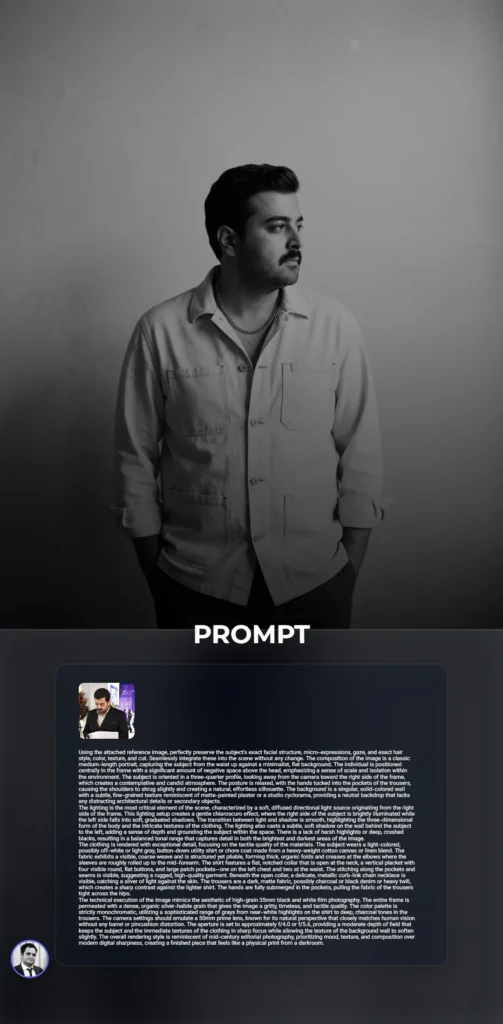
High-Grain 35mm Monochrome Portrait Prompt for Cinematic Minimalist Photography StylesUsing the attached reference image, perfectly preserve the subject's exact facial structure, micro-expressions, gaze, and exact hair style, color, texture, and cut. Seamlessly integrate these into the scene without any change. The composition of the image is a classic medium-length portrait, capturing the subject from the waist up against a minimalist, flat background. The individual is positioned centrally in the frame with a significant amount of negative space above the head, emphasizing a sense of scale and isolation within the environment. The subject is oriented in a three-quarter profile, looking away from the camera toward the right side of the frame, which creates a contemplative and candid atmosphere. The posture is relaxed, with the hands tucked into the pockets of the trousers, causing the shoulders to shrug slightly and creating a natural, effortless silhouette. The background is a singular, solid-colored wall with a subtle, fine-grained texture reminiscent of matte-painted plaster or a studio cyclorama, providing a neutral backdrop that lacks any distracting architectural details or secondary objects.
The lighting is the most critical element of the scene, characterized by a soft, diffused directional light source originating from the right side of the frame. This lighting setup creates a gentle chiaroscuro effect, where the right side of the subject is brightly illuminated while the left side falls into soft, graduated shadows. The transition between light and shadow is smooth, highlighting the three-dimensional form of the body and the intricate textures of the clothing. The lighting also casts a subtle, soft shadow on the wall behind the subject to the left, adding a sense of depth and grounding the subject within the space. There is a lack of harsh highlights or deep, crushed blacks, resulting in a balanced tonal range that captures detail in both the brightest and darkest areas of the image.
The clothing is rendered with exceptional detail, focusing on the tactile quality of the materials. The subject wears a light-colored, possibly off-white or light gray, button-down utility shirt or chore coat made from a heavy-weight cotton canvas or linen blend. The fabric exhibits a visible, coarse weave and is structured yet pliable, forming thick, organic folds and creases at the elbows where the sleeves are roughly rolled up to the mid-forearm. The shirt features a flat, notched collar that is open at the neck, a vertical placket with four visible round, flat buttons, and large patch pockets—one on the left chest and two at the waist. The stitching along the pockets and seams is visible, suggesting a rugged, high-quality garment. Beneath the open collar, a delicate, metallic curb-link chain necklace is visible, catching a sliver of light against the skin. The trousers are a dark, matte fabric, possibly charcoal or black denim or heavy twill, which creates a sharp contrast against the lighter shirt. The hands are fully submerged in the pockets, pulling the fabric of the trousers tight across the hips.
The technical execution of the image mimics the aesthetic of high-grain 35mm black and white film photography. The entire frame is permeated with a dense, organic silver-halide grain that gives the image a gritty, timeless, and tactile quality. The color palette is strictly monochromatic, utilizing a sophisticated range of grays from near-white highlights on the shirt to deep, charcoal tones in the trousers. The camera settings should emulate a 50mm prime lens, known for its natural perspective that closely matches human vision without any barrel or pincushion distortion. The aperture is set to approximately f/4.0 or f/5.6, providing a moderate depth of field that keeps the subject and the immediate textures of the clothing in sharp focus while allowing the texture of the background wall to soften slightly. The overall rendering style is reminiscent of mid-century editorial photography, prioritizing mood, texture, and composition over modern digital sharpness, creating a finished piece that feels like a physical print from a darkroom.
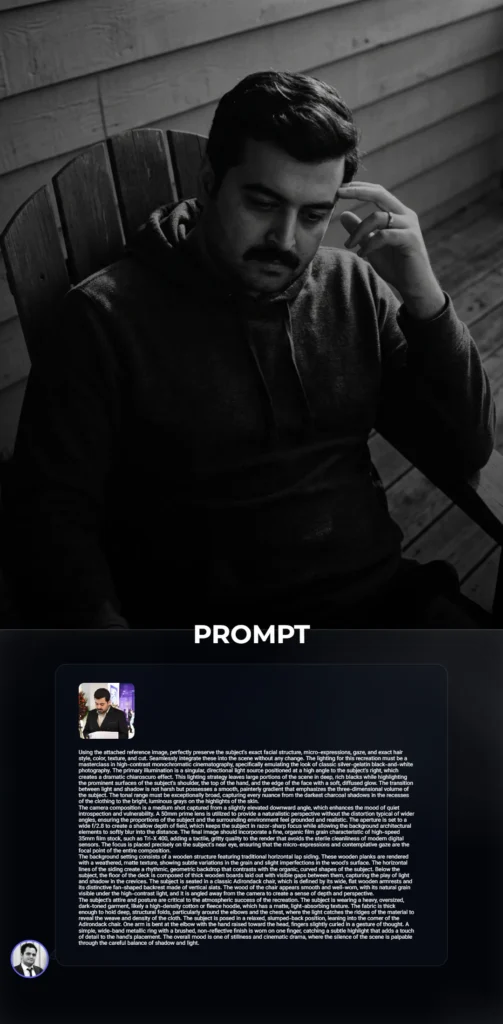
Cinematic Chiaroscuro Monochromatic Portrait with Silver-Gelatin AestheticsUsing the attached reference image, perfectly preserve the subject's exact facial structure, micro-expressions, gaze, and exact hair style, color, texture, and cut. Seamlessly integrate these into the scene without any change. The lighting for this recreation must be a masterclass in high-contrast monochromatic cinematography, specifically emulating the look of classic silver-gelatin black-and-white photography. The primary illumination is a singular, directional light source positioned at a high angle to the subject's right, which creates a dramatic chiaroscuro effect. This lighting strategy leaves large portions of the scene in deep, rich blacks while highlighting the prominent surfaces of the subject's shoulder, the top of the hand, and the edge of the face with a soft, diffused glow. The transition between light and shadow is not harsh but possesses a smooth, painterly gradient that emphasizes the three-dimensional volume of the subject. The tonal range must be exceptionally broad, capturing every nuance from the darkest charcoal shadows in the recesses of the clothing to the bright, luminous grays on the highlights of the skin.
The camera composition is a medium shot captured from a slightly elevated downward angle, which enhances the mood of quiet introspection and vulnerability. A 50mm prime lens is utilized to provide a naturalistic perspective without the distortion typical of wider angles, ensuring the proportions of the subject and the surrounding environment feel grounded and realistic. The aperture is set to a wide f/2.8 to create a shallow depth of field, which keeps the subject in razor-sharp focus while allowing the background architectural elements to softly blur into the distance. The final image should incorporate a fine, organic film grain characteristic of high-speed 35mm film stock, such as Tri-X 400, adding a tactile, gritty quality to the render that avoids the sterile cleanliness of modern digital sensors. The focus is placed precisely on the subject's near eye, ensuring that the micro-expressions and contemplative gaze are the focal point of the entire composition.
The background setting consists of a wooden structure featuring traditional horizontal lap siding. These wooden planks are rendered with a weathered, matte texture, showing subtle variations in the grain and slight imperfections in the wood's surface. The horizontal lines of the siding create a rhythmic, geometric backdrop that contrasts with the organic, curved shapes of the subject. Below the subject, the floor of the deck is composed of thick wooden boards laid out with visible gaps between them, capturing the play of light and shadow in the crevices. The subject is seated in a classic Adirondack chair, which is defined by its wide, flat wooden armrests and its distinctive fan-shaped backrest made of vertical slats. The wood of the chair appears smooth and well-worn, with its natural grain visible under the high-contrast light, and it is angled away from the camera to create a sense of depth and perspective.
The subject's attire and posture are critical to the atmospheric success of the recreation. The subject is wearing a heavy, oversized, dark-toned garment, likely a high-density cotton or fleece hoodie, which has a matte, light-absorbing texture. The fabric is thick enough to hold deep, structural folds, particularly around the elbows and the chest, where the light catches the ridges of the material to reveal the weave and density of the cloth. The subject is posed in a relaxed, slumped-back position, leaning into the corner of the Adirondack chair. One arm is bent at the elbow with the hand raised toward the head, fingers slightly curled in a gesture of thought. A simple, wide-band metallic ring with a brushed, non-reflective finish is worn on one finger, catching a subtle highlight that adds a touch of detail to the hand's placement. The overall mood is one of stillness and cinematic drama, where the silence of the scene is palpable through the careful balance of shadow and light.
Cinematic Noir Profile Portrait with Intense Rim LightingUsing the attached reference image, perfectly preserve the subject's exact facial structure, micro-expressions, gaze, and exact hair style, color, texture, and cut. Seamlessly integrate these into the scene without any change. The lighting architecture must be defined by an intense, high-contrast rim lighting technique, also known as a kicker or edge light, positioned directly behind the subject to create a brilliant, luminous halo that traces the entire silhouette from the crown of the head down the nape of the neck and along the back of the jacket. This primary light source should be a powerful, cool-toned white light that produces a sharp, crisp line of separation between the subject and the absolute void of the background. The front and side of the subject facing the camera must remain almost entirely in deep, cavernous shadow, creating a dramatic chiaroscuro effect where only the most subtle hints of form are visible through a very low-intensity fill light or indirect bounce. This lighting should catch the thin edge of the eyeglass frames and the bridge of the nose with a pinpoint highlight, emphasizing the profile without revealing unnecessary detail in the darkened regions.
The composition is a classic profile portrait, captured from a side-on perspective with the individual facing toward the right side of the frame. The camera is positioned at eye level, utilizing a tight medium close-up crop that focuses on the head and shoulders. The subject is placed according to the rule of thirds, occupying the right two-thirds of the frame while leaving a significant amount of dark negative space to the left, which enhances the moody and introspective atmosphere. The depth of field must be extremely shallow, achieved through a wide aperture setting such as f/1.8 or f/2.8 on an 85mm or 105mm prime lens, ensuring that the sharpest focus is locked onto the outer edge of the profile and the texture of the hair, while the further shoulder and parts of the clothing begin a very soft, natural fall-off into the shadows.
The clothing worn by the subject is a heavy, dark-toned utility or denim-style jacket with a distinct tactile quality. The material should exhibit a coarse, visible weave characteristic of high-density cotton canvas or raw denim, rendered in a charcoal or obsidian black color palette. Special attention must be paid to the structural details of the garment, including the thick, reinforced stitching along the collar seam and the shoulder yoke, where the light catches the raised threads to reveal the craftsmanship of the piece. The fabric should appear matte, absorbing light rather than reflecting it, except for the very edges where the backlight grazes the fibers, creating a soft, fuzzy texture of micro-fibers along the shoulder line.
The camera settings and post-processing style must emulate a cinematic film aesthetic. This includes a subtle, fine-grained texture throughout the image, reminiscent of high-speed 35mm film stock, which adds a layer of organic grit to the deep blacks and prevents the shadows from appearing digitally flat. The color grading should be nearly monochromatic, heavily desaturated to the point where only the slightest hints of natural skin tones and fabric hues remain, leaning into a cold, clinical, and sophisticated noir aesthetic. The overall image must maintain a high level of micro-contrast, ensuring that the transition from the brilliant white rim light to the pitch-black background is immediate and punchy, while the transitions within the shadows remain smooth and gradual to preserve a sense of three-dimensional volume.
The eyewear should be rendered with precise optical accuracy. The frames, which are dark and classic in shape, should have a slight matte or semi-gloss finish that catches a sliver of the backlight on the upper and outer edges. The lenses of the glasses must feature realistic, faint reflections of a distant, out-of-focus light source or the general environment, providing a sense of depth and transparency without obscuring the eye area behind them. Every element, from the microscopic dust particles caught in the backlight to the specific tension in the jacket's fabric, must work together to recreate the exact mood, intensity, and technical execution of the original reference photo.

Cinematic Noir Profile Portrait with Window Light ProjectionUsing the attached reference image, perfectly preserve the subject's exact facial structure, micro-expressions, gaze, and exact hair style, color, texture, and cut. Seamlessly integrate these into the scene without any change.
The photographic composition is a masterful exercise in balance and negative space, featuring the subject positioned in the lower-left quadrant of the frame. The individual is captured in a sharp, clean profile, seated in a minimalist chair and leaning back at a relaxed angle that suggests a state of deep contemplation. The camera is positioned at a medium-low height, slightly below the subject's eye level, which creates a subtle upward perspective that adds a sense of importance to the figure against the vast, empty background. The framing is wide enough to capture the upper half of the subject's body, including the arms and the lap, while leaving significant room on the right side of the image for the dramatic interplay of light and shadow on the wall. The spatial relationship between the subject on the left and the large geometric light projection on the right creates a powerful visual tension and a sense of narrative weight.
The lighting setup is extremely specific and high-contrast, designed to evoke a classic cinematic or film noir aesthetic. A primary directional light source is positioned at a sharp angle from the right side of the frame, filtered through a physical stencil or gobo to project a crisp, six-pane window pattern onto the flat background wall. This projected light is bright and distinct, with the vertical and horizontal bars of the faux window creating a rigid grid. Inside this brightly illuminated area on the wall, a soft, diffused shadow of the subject is cast, appearing as a larger, more ethereal silhouette that mirrors the subject's profile. Crucially, the subject themselves remains almost entirely in shadow, save for a precise, thin, horizontal strip of light that illuminates only the upper portion of the brow and forehead area. This sliver of light acts as the primary focal point, drawing the eye directly to the subject's thoughtful expression while the rest of the torso and clothing blend into deep, rich blacks.
The image is rendered in a sophisticated monochromatic palette, eschewing color entirely to focus on texture, form, and tonal range. This is not a high-contrast digital black and white, but rather a soft, filmic rendering that mimics the characteristics of professional 35mm black and white film stock, such as Ilford Delta or Kodak Tri-X. The tonal transitions are smooth and gradual, particularly in the gray areas of the shadow on the wall. There is a noticeable but fine-grained texture across the entire image, giving it a tangible, organic quality that feels historical and artistic. The blacks are deep and velvety but retain enough information to suggest the folds in the clothing, while the whites of the window projection are bright without being blown out, maintaining a soft, diffused glow that interacts naturally with the texture of the wall.
Technical camera settings are tuned to achieve a specific depth of field and sharpness. A 50mm prime lens is utilized to provide a natural, distortion-free perspective that closely mimics human vision. The aperture is set to a moderately wide f/2.8, creating a selective focus where the subject's profile is rendered with biting sharpness, while the wall behind them and the light projection have a very subtle, creamy softness. This shallow depth of field helps to separate the subject from the background, making the shadow on the wall feel like it exists in a slightly different spatial plane. The exposure is keyed specifically to the highlights of the window projection, allowing the subject's dark clothing to underexpose into deep shadow, which emphasizes the dramatic, moody atmosphere of the scene.
The textures within the frame are highly detailed and contribute significantly to the realism of the recreation. The subject is wearing a heavy, dark-toned turtleneck sweater made of a dense knit material, possibly wool or cashmere. In the areas where the light grazes the fabric, such as the shoulder and the neck, the fine fibers and the weave of the knit are clearly visible, showing a tactile, slightly fuzzy surface. The chair on which the individual sits has a simple, utilitarian design with a dark metallic frame; the curved backrest catches a faint, specular highlight that reveals a smooth, semi-matte finish. The background wall is not perfectly flat but has a subtle, plaster-like grain that catches the projected light unevenly, adding a sense of physical space and depth to the environment. Even the dark pants worn by the subject show subtle variations in texture, suggesting a heavy cotton or denim material that absorbs light.
The overall atmosphere is one of profound, quiet introspection and cinematic melancholy. The environment feels like a sparse, high-ceilinged studio or a minimalist living space where the air is still and silent. The use of heavy shadows and the isolation of the subject within the frame evoke a sense of loneliness or deep thought. The film grain adds a layer of nostalgia and timelessness, making the image feel as though it could have been taken in the mid-20th century or the modern day. Every element, from the way the subject's hand rests near the lap to the precise angle of the shadow on the wall, is carefully choreographed to produce a mood of sophisticated, artistic gloom and intellectual weight. There are no distracting elements or atmospheric dust; the focus is entirely on the geometry of the light and the stillness of the individual.