Peymanaiblack and white photography
black and white photography
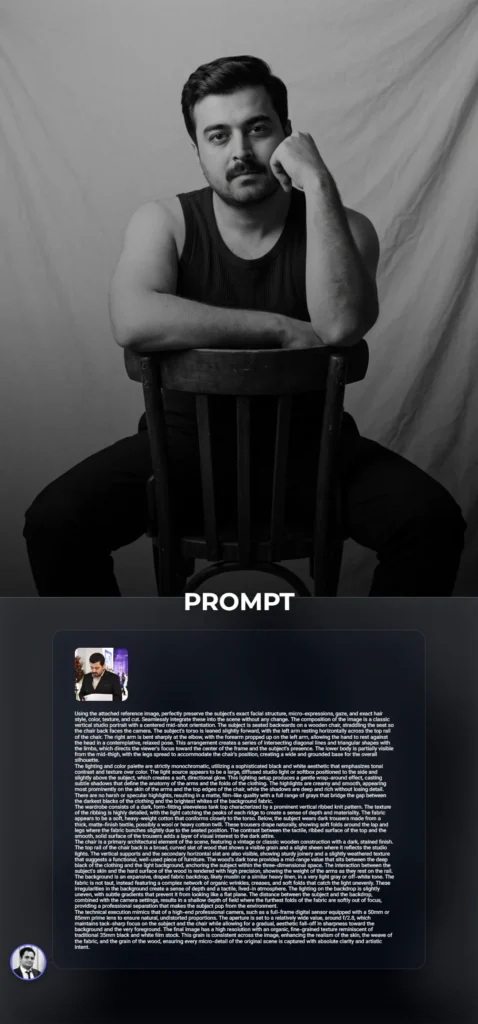
Cinematic Black and White Studio Portrait on Vintage Wooden ChairUsing the attached reference image, perfectly preserve the subject's exact facial structure, micro-expressions, gaze, and exact hair style, color, texture, and cut. Seamlessly integrate these into the scene without any change. The composition of the image is a classic vertical studio portrait with a centered mid-shot orientation. The subject is seated backwards on a wooden chair, straddling the seat so the chair back faces the camera. The subject's torso is leaned slightly forward, with the left arm resting horizontally across the top rail of the chair. The right arm is bent sharply at the elbow, with the forearm propped up on the left arm, allowing the hand to rest against the head in a contemplative, relaxed pose. This arrangement creates a series of intersecting diagonal lines and triangular shapes with the limbs, which directs the viewer's focus toward the center of the frame and the subject's presence. The lower body is partially visible from the mid-thigh, with the legs spread to accommodate the chair's position, creating a wide and grounded base for the overall silhouette.
The lighting and color palette are strictly monochromatic, utilizing a sophisticated black and white aesthetic that emphasizes tonal contrast and texture over color. The light source appears to be a large, diffused studio light or softbox positioned to the side and slightly above the subject, which creates a soft, directional glow. This lighting setup produces a gentle wrap-around effect, casting subtle shadows that define the anatomy of the arms and the folds of the clothing. The highlights are creamy and smooth, appearing most prominently on the skin of the arms and the top edges of the chair, while the shadows are deep and rich without losing detail. There are no harsh or specular highlights, resulting in a matte, film-like quality with a full range of grays that bridge the gap between the darkest blacks of the clothing and the brightest whites of the background fabric.
The wardrobe consists of a dark, form-fitting sleeveless tank top characterized by a prominent vertical ribbed knit pattern. The texture of the ribbing is highly detailed, with the light catching the peaks of each ridge to create a sense of depth and materiality. The fabric appears to be a soft, heavy-weight cotton that conforms closely to the torso. Below, the subject wears dark trousers made from a thick, matte-finish textile, possibly a wool or heavy cotton twill. These trousers drape naturally, showing soft folds around the lap and legs where the fabric bunches slightly due to the seated position. The contrast between the tactile, ribbed surface of the top and the smooth, solid surface of the trousers adds a layer of visual interest to the dark attire.
The chair is a primary architectural element of the scene, featuring a vintage or classic wooden construction with a dark, stained finish. The top rail of the chair back is a broad, curved slat of wood that shows a visible grain and a slight sheen where it reflects the studio lights. The vertical supports and the secondary horizontal slat are also visible, showing sturdy joinery and a slightly weathered texture that suggests a functional, well-used piece of furniture. The wood's dark tone provides a mid-range value that sits between the deep black of the clothing and the light background, anchoring the subject within the three-dimensional space. The interaction between the subject's skin and the hard surface of the wood is rendered with high precision, showing the weight of the arms as they rest on the rail.
The background is an expansive, draped fabric backdrop, likely muslin or a similar heavy linen, in a very light gray or off-white tone. The fabric is not taut, instead featuring a complex network of organic wrinkles, creases, and soft folds that catch the light unevenly. These irregularities in the background create a sense of depth and a tactile, lived-in atmosphere. The lighting on the backdrop is slightly uneven, with subtle gradients that prevent it from looking like a flat plane. The distance between the subject and the backdrop, combined with the camera settings, results in a shallow depth of field where the furthest folds of the fabric are softly out of focus, providing a professional separation that makes the subject pop from the environment.
The technical execution mimics that of a high-end professional camera, such as a full-frame digital sensor equipped with a 50mm or 85mm prime lens to ensure natural, undistorted proportions. The aperture is set to a relatively wide value, around f/2.8, which maintains tack-sharp focus on the subject and the chair while allowing for a gradual, aesthetic fall-off in sharpness toward the background and the very foreground. The final image has a high resolution with an organic, fine-grained texture reminiscent of traditional 35mm black and white film stock. This grain is consistent across the image, enhancing the realism of the skin, the weave of the fabric, and the grain of the wood, ensuring every micro-detail of the original scene is captured with absolute clarity and artistic intent.
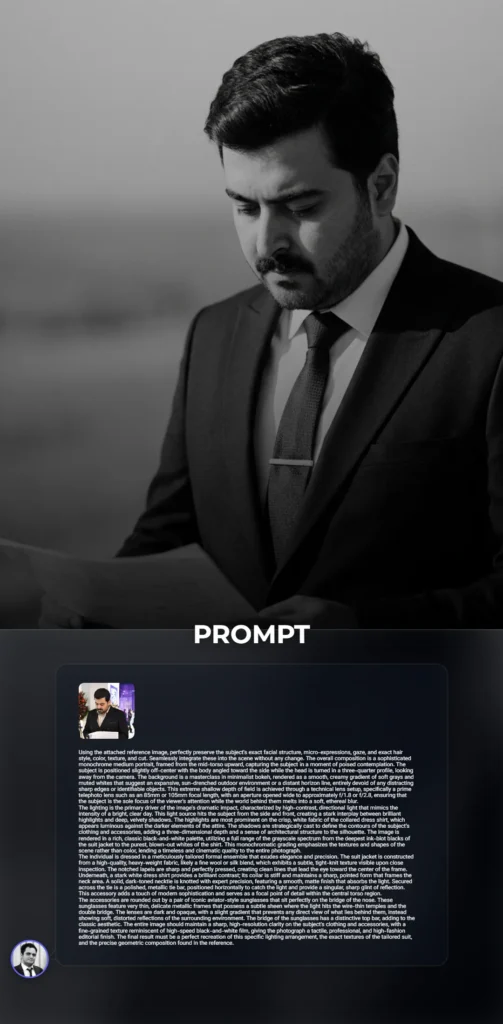
Sophisticated Monochrome Tailored Suit Portrait with Aviator SunglassesUsing the attached reference image, perfectly preserve the subject's exact facial structure, micro-expressions, gaze, and exact hair style, color, texture, and cut. Seamlessly integrate these into the scene without any change. The overall composition is a sophisticated monochrome medium portrait, framed from the mid-torso upward, capturing the subject in a moment of poised contemplation. The subject is positioned slightly off-center with the body angled toward the side while the head is turned in a three-quarter profile, looking away from the camera. The background is a masterclass in minimalist bokeh, rendered as a smooth, creamy gradient of soft grays and muted whites that suggest an expansive, sun-drenched outdoor environment or a distant horizon line, entirely devoid of any distracting sharp edges or identifiable objects. This extreme shallow depth of field is achieved through a technical lens setup, specifically a prime telephoto lens such as an 85mm or 105mm focal length, with an aperture opened wide to approximately f/1.8 or f/2.8, ensuring that the subject is the sole focus of the viewer's attention while the world behind them melts into a soft, ethereal blur.
The lighting is the primary driver of the image's dramatic impact, characterized by high-contrast, directional light that mimics the intensity of a bright, clear day. This light source hits the subject from the side and front, creating a stark interplay between brilliant highlights and deep, velvety shadows. The highlights are most prominent on the crisp, white fabric of the collared dress shirt, which appears luminous against the darker elements of the attire. The shadows are strategically cast to define the contours of the subject’s clothing and accessories, adding a three-dimensional depth and a sense of architectural structure to the silhouette. The image is rendered in a rich, classic black-and-white palette, utilizing a full range of the grayscale spectrum from the deepest ink-blot blacks of the suit jacket to the purest, blown-out whites of the shirt. This monochromatic grading emphasizes the textures and shapes of the scene rather than color, lending a timeless and cinematic quality to the entire photograph.
The individual is dressed in a meticulously tailored formal ensemble that exudes elegance and precision. The suit jacket is constructed from a high-quality, heavy-weight fabric, likely a fine wool or silk blend, which exhibits a subtle, tight-knit texture visible upon close inspection. The notched lapels are sharp and perfectly pressed, creating clean lines that lead the eye toward the center of the frame. Underneath, a stark white dress shirt provides a brilliant contrast; its collar is stiff and maintains a sharp, pointed form that frames the neck area. A solid, dark-toned necktie is knotted with expert precision, featuring a smooth, matte finish that absorbs the light. Secured across the tie is a polished, metallic tie bar, positioned horizontally to catch the light and provide a singular, sharp glint of reflection. This accessory adds a touch of modern sophistication and serves as a focal point of detail within the central torso region.
The accessories are rounded out by a pair of iconic aviator-style sunglasses that sit perfectly on the bridge of the nose. These sunglasses feature very thin, delicate metallic frames that possess a subtle sheen where the light hits the wire-thin temples and the double bridge. The lenses are dark and opaque, with a slight gradient that prevents any direct view of what lies behind them, instead showing soft, distorted reflections of the surrounding environment. The bridge of the sunglasses has a distinctive top bar, adding to the classic aesthetic. The entire image should maintain a sharp, high-resolution clarity on the subject's clothing and accessories, with a fine-grained texture reminiscent of high-speed black-and-white film, giving the photograph a tactile, professional, and high-fashion editorial finish. The final result must be a perfect recreation of this specific lighting arrangement, the exact textures of the tailored suit, and the precise geometric composition found in the reference.

Professional Monochromatic Studio Portrait with Fine Detail and Runic TattooUsing the attached reference image, perfectly preserve the subject's exact facial structure, micro-expressions, gaze, and exact hair style, color, texture, and cut. Seamlessly integrate these into the scene without any change.
The lighting for this composition is a masterclass in monochromatic studio portraiture, utilizing a sophisticated three-point lighting setup translated into a grayscale palette. The primary key light is positioned at a forty-five-degree angle from the upper right, creating a soft, diffused illumination that wraps around the contours of the subject’s form. This light produces a gentle highlight on the right side of the individual’s features while casting soft, cinematic shadows that define the jawline and the musculature of the arms. A subtle fill light is employed from the opposite side to lift the shadows just enough to retain intricate detail in the darker regions of the clothing and hair, ensuring no information is lost to pure black. The overall contrast ratio is medium-high, emphasizing the tactile quality of every surface, from the matte finish of the eyewear to the subtle sheen of the skin. The background is lit with a separate, low-intensity light to create a very subtle circular gradient, preventing the subject from blending into the backdrop and providing a three-dimensional depth to the frame.
The camera composition is a classic medium close-up, captured at a slight downward angle that emphasizes the subject's leaning posture. The lens used is likely an 85mm prime with a wide aperture of approximately f/2.8, which produces a razor-sharp focus on the subject's eyes while allowing for a graceful, shallow depth-of-field fall-off. This focus depth is meticulously controlled so that the clasped hands in the foreground are slightly softer than the facial features, drawing the viewer's eye upward. The framing is tight and intimate, with the individual’s torso filling the lower half of the frame and the arms forming a triangular base that leads the eye toward the center. The image exhibits a fine, professional film grain that adds a timeless, organic texture to the digital capture, avoiding an overly clinical digital look. There is a slight, naturalistic vignetting toward the corners of the frame which serves to further centralize the focus on the subject's presence and expression.
The individual is adorned with specific accessories and attire that are critical to the image's aesthetic. The subject wears thick, black acetate-framed glasses with a rounded pantos shape and visible silver hinge pins at the temples. The frames have a slight satin-to-gloss finish that catches the studio lights. On the left ring finger, there is a wide, substantial metallic ring with a flat top and a recessed dark square stone or inlay. On the left wrist, a classic analog timepiece is visible, featuring a circular silver-toned stainless steel case, a light-colored dial with thin baton indices, and a dark, textured leather strap. The subject is wearing a dark, charcoal or black long-sleeved crewneck sweater made of a fine-gauge knit material, possibly a merino wool or high-quality cotton blend. The sleeves are pushed up to the mid-forearm, revealing a specific tattoo on the inner right forearm consisting of five distinct, linear, runic-style characters or symbols oriented vertically toward the wrist.
The textures throughout the image are rendered with extreme high-fidelity detail. The knit of the sweater shows a distinct weave pattern, especially where the fabric bunches at the elbows and wrists. The skin texture on the hands and forearms is highly detailed, showing natural pores, fine lines at the knuckles, and the subtle variations in skin tone that occur in a black and white medium. The tattoo ink appears slightly faded into the skin, suggesting it is not brand new, and the edges of the symbols follow the natural curvature of the forearm. The clasped hands are positioned with the fingers of the right hand interlaced over the left, creating a complex series of highlights and shadows across the knuckles and palms. The background is a seamless, non-reflective studio paper or painted wall with a smooth, matte texture that transitionally gradients from a medium charcoal gray on the left to a slightly lighter slate gray on the right, providing a clean and distraction-free environment that prioritizes the subject’s form and accessories.
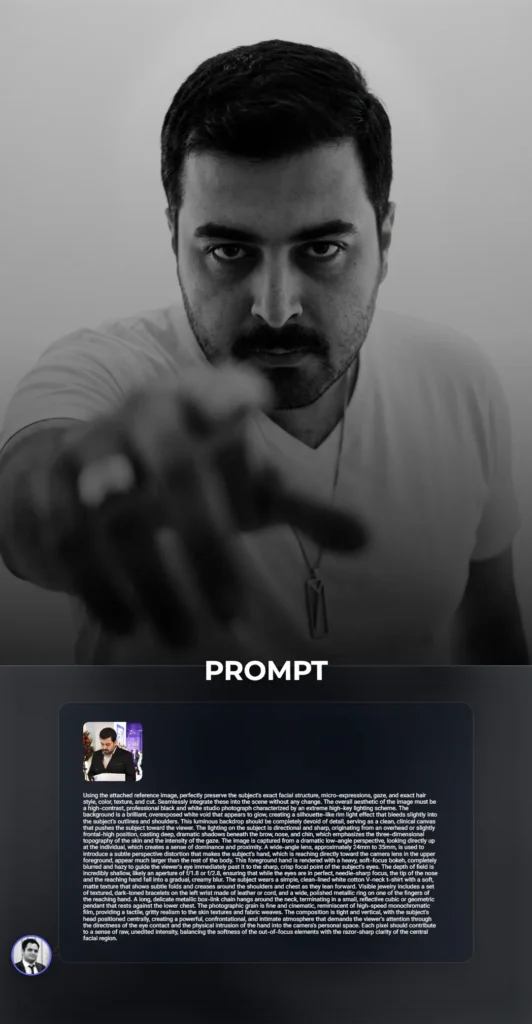
High-Key Black and White Intense Portrait with Reaching HandUsing the attached reference image, perfectly preserve the subject's exact facial structure, micro-expressions, gaze, and exact hair style, color, texture, and cut. Seamlessly integrate these into the scene without any change. The overall aesthetic of the image must be a high-contrast, professional black and white studio photograph characterized by an extreme high-key lighting scheme. The background is a brilliant, overexposed white void that appears to glow, creating a silhouette-like rim light effect that bleeds slightly into the subject's outlines and shoulders. This luminous backdrop should be completely devoid of detail, serving as a clean, clinical canvas that pushes the subject toward the viewer. The lighting on the subject is directional and sharp, originating from an overhead or slightly frontal-high position, casting deep, dramatic shadows beneath the brow, nose, and chin, which emphasizes the three-dimensional topography of the skin and the intensity of the gaze. The image is captured from a dramatic low-angle perspective, looking directly up at the individual, which creates a sense of dominance and proximity. A wide-angle lens, approximately 24mm to 35mm, is used to introduce a subtle perspective distortion that makes the subject's hand, which is reaching directly toward the camera lens in the upper foreground, appear much larger than the rest of the body. This foreground hand is rendered with a heavy, soft-focus bokeh, completely blurred and hazy to guide the viewer's eye immediately past it to the sharp, crisp focal point of the subject's eyes. The depth of field is incredibly shallow, likely an aperture of f/1.8 or f/2.8, ensuring that while the eyes are in perfect, needle-sharp focus, the tip of the nose and the reaching hand fall into a gradual, creamy blur. The subject wears a simple, clean-lined white cotton V-neck t-shirt with a soft, matte texture that shows subtle folds and creases around the shoulders and chest as they lean forward. Visible jewelry includes a set of textured, dark-toned bracelets on the left wrist made of leather or cord, and a wide, polished metallic ring on one of the fingers of the reaching hand. A long, delicate metallic box-link chain hangs around the neck, terminating in a small, reflective cubic or geometric pendant that rests against the lower chest. The photographic grain is fine and cinematic, reminiscent of high-speed monochromatic film, providing a tactile, gritty realism to the skin textures and fabric weaves. The composition is tight and vertical, with the subject's head positioned centrally, creating a powerful, confrontational, and intimate atmosphere that demands the viewer's attention through the directness of the eye contact and the physical intrusion of the hand into the camera's personal space. Each pixel should contribute to a sense of raw, unedited intensity, balancing the softness of the out-of-focus elements with the razor-sharp clarity of the central facial region.
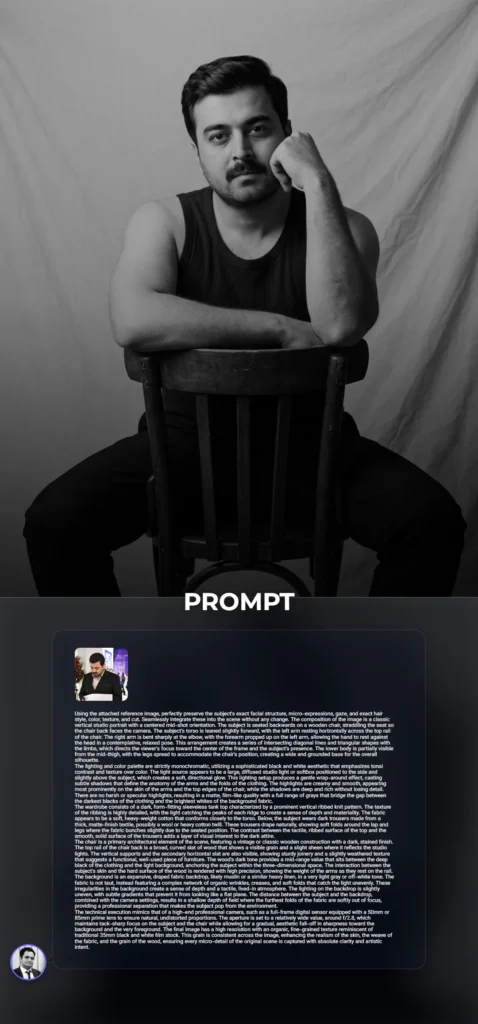
Cinematic Black and White Studio Portrait on Vintage Wooden ChairUsing the attached reference image, perfectly preserve the subject's exact facial structure, micro-expressions, gaze, and exact hair style, color, texture, and cut. Seamlessly integrate these into the scene without any change. The composition of the image is a classic vertical studio portrait with a centered mid-shot orientation. The subject is seated backwards on a wooden chair, straddling the seat so the chair back faces the camera. The subject's torso is leaned slightly forward, with the left arm resting horizontally across the top rail of the chair. The right arm is bent sharply at the elbow, with the forearm propped up on the left arm, allowing the hand to rest against the head in a contemplative, relaxed pose. This arrangement creates a series of intersecting diagonal lines and triangular shapes with the limbs, which directs the viewer's focus toward the center of the frame and the subject's presence. The lower body is partially visible from the mid-thigh, with the legs spread to accommodate the chair's position, creating a wide and grounded base for the overall silhouette.
The lighting and color palette are strictly monochromatic, utilizing a sophisticated black and white aesthetic that emphasizes tonal contrast and texture over color. The light source appears to be a large, diffused studio light or softbox positioned to the side and slightly above the subject, which creates a soft, directional glow. This lighting setup produces a gentle wrap-around effect, casting subtle shadows that define the anatomy of the arms and the folds of the clothing. The highlights are creamy and smooth, appearing most prominently on the skin of the arms and the top edges of the chair, while the shadows are deep and rich without losing detail. There are no harsh or specular highlights, resulting in a matte, film-like quality with a full range of grays that bridge the gap between the darkest blacks of the clothing and the brightest whites of the background fabric.
The wardrobe consists of a dark, form-fitting sleeveless tank top characterized by a prominent vertical ribbed knit pattern. The texture of the ribbing is highly detailed, with the light catching the peaks of each ridge to create a sense of depth and materiality. The fabric appears to be a soft, heavy-weight cotton that conforms closely to the torso. Below, the subject wears dark trousers made from a thick, matte-finish textile, possibly a wool or heavy cotton twill. These trousers drape naturally, showing soft folds around the lap and legs where the fabric bunches slightly due to the seated position. The contrast between the tactile, ribbed surface of the top and the smooth, solid surface of the trousers adds a layer of visual interest to the dark attire.
The chair is a primary architectural element of the scene, featuring a vintage or classic wooden construction with a dark, stained finish. The top rail of the chair back is a broad, curved slat of wood that shows a visible grain and a slight sheen where it reflects the studio lights. The vertical supports and the secondary horizontal slat are also visible, showing sturdy joinery and a slightly weathered texture that suggests a functional, well-used piece of furniture. The wood's dark tone provides a mid-range value that sits between the deep black of the clothing and the light background, anchoring the subject within the three-dimensional space. The interaction between the subject's skin and the hard surface of the wood is rendered with high precision, showing the weight of the arms as they rest on the rail.
The background is an expansive, draped fabric backdrop, likely muslin or a similar heavy linen, in a very light gray or off-white tone. The fabric is not taut, instead featuring a complex network of organic wrinkles, creases, and soft folds that catch the light unevenly. These irregularities in the background create a sense of depth and a tactile, lived-in atmosphere. The lighting on the backdrop is slightly uneven, with subtle gradients that prevent it from looking like a flat plane. The distance between the subject and the backdrop, combined with the camera settings, results in a shallow depth of field where the furthest folds of the fabric are softly out of focus, providing a professional separation that makes the subject pop from the environment.
The technical execution mimics that of a high-end professional camera, such as a full-frame digital sensor equipped with a 50mm or 85mm prime lens to ensure natural, undistorted proportions. The aperture is set to a relatively wide value, around f/2.8, which maintains tack-sharp focus on the subject and the chair while allowing for a gradual, aesthetic fall-off in sharpness toward the background and the very foreground. The final image has a high resolution with an organic, fine-grained texture reminiscent of traditional 35mm black and white film stock. This grain is consistent across the image, enhancing the realism of the skin, the weave of the fabric, and the grain of the wood, ensuring every micro-detail of the original scene is captured with absolute clarity and artistic intent.
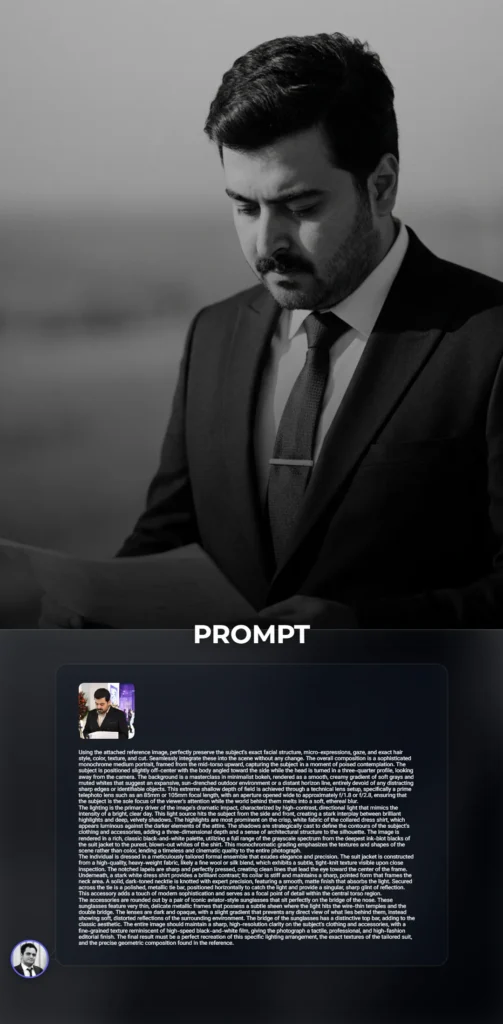
Sophisticated Monochrome Tailored Suit Portrait with Aviator SunglassesUsing the attached reference image, perfectly preserve the subject's exact facial structure, micro-expressions, gaze, and exact hair style, color, texture, and cut. Seamlessly integrate these into the scene without any change. The overall composition is a sophisticated monochrome medium portrait, framed from the mid-torso upward, capturing the subject in a moment of poised contemplation. The subject is positioned slightly off-center with the body angled toward the side while the head is turned in a three-quarter profile, looking away from the camera. The background is a masterclass in minimalist bokeh, rendered as a smooth, creamy gradient of soft grays and muted whites that suggest an expansive, sun-drenched outdoor environment or a distant horizon line, entirely devoid of any distracting sharp edges or identifiable objects. This extreme shallow depth of field is achieved through a technical lens setup, specifically a prime telephoto lens such as an 85mm or 105mm focal length, with an aperture opened wide to approximately f/1.8 or f/2.8, ensuring that the subject is the sole focus of the viewer's attention while the world behind them melts into a soft, ethereal blur.
The lighting is the primary driver of the image's dramatic impact, characterized by high-contrast, directional light that mimics the intensity of a bright, clear day. This light source hits the subject from the side and front, creating a stark interplay between brilliant highlights and deep, velvety shadows. The highlights are most prominent on the crisp, white fabric of the collared dress shirt, which appears luminous against the darker elements of the attire. The shadows are strategically cast to define the contours of the subject’s clothing and accessories, adding a three-dimensional depth and a sense of architectural structure to the silhouette. The image is rendered in a rich, classic black-and-white palette, utilizing a full range of the grayscale spectrum from the deepest ink-blot blacks of the suit jacket to the purest, blown-out whites of the shirt. This monochromatic grading emphasizes the textures and shapes of the scene rather than color, lending a timeless and cinematic quality to the entire photograph.
The individual is dressed in a meticulously tailored formal ensemble that exudes elegance and precision. The suit jacket is constructed from a high-quality, heavy-weight fabric, likely a fine wool or silk blend, which exhibits a subtle, tight-knit texture visible upon close inspection. The notched lapels are sharp and perfectly pressed, creating clean lines that lead the eye toward the center of the frame. Underneath, a stark white dress shirt provides a brilliant contrast; its collar is stiff and maintains a sharp, pointed form that frames the neck area. A solid, dark-toned necktie is knotted with expert precision, featuring a smooth, matte finish that absorbs the light. Secured across the tie is a polished, metallic tie bar, positioned horizontally to catch the light and provide a singular, sharp glint of reflection. This accessory adds a touch of modern sophistication and serves as a focal point of detail within the central torso region.
The accessories are rounded out by a pair of iconic aviator-style sunglasses that sit perfectly on the bridge of the nose. These sunglasses feature very thin, delicate metallic frames that possess a subtle sheen where the light hits the wire-thin temples and the double bridge. The lenses are dark and opaque, with a slight gradient that prevents any direct view of what lies behind them, instead showing soft, distorted reflections of the surrounding environment. The bridge of the sunglasses has a distinctive top bar, adding to the classic aesthetic. The entire image should maintain a sharp, high-resolution clarity on the subject's clothing and accessories, with a fine-grained texture reminiscent of high-speed black-and-white film, giving the photograph a tactile, professional, and high-fashion editorial finish. The final result must be a perfect recreation of this specific lighting arrangement, the exact textures of the tailored suit, and the precise geometric composition found in the reference.
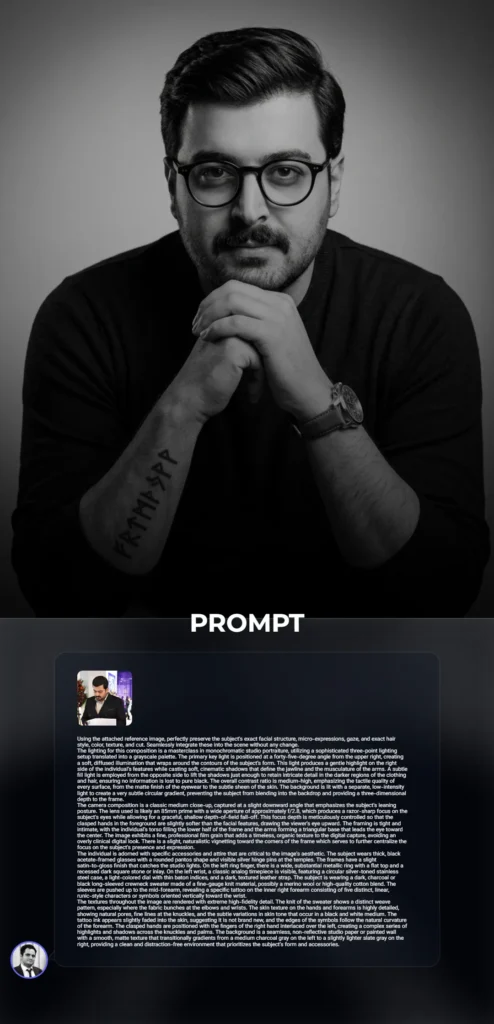
Professional Monochromatic Studio Portrait with Fine Detail and Runic TattooUsing the attached reference image, perfectly preserve the subject's exact facial structure, micro-expressions, gaze, and exact hair style, color, texture, and cut. Seamlessly integrate these into the scene without any change.
The lighting for this composition is a masterclass in monochromatic studio portraiture, utilizing a sophisticated three-point lighting setup translated into a grayscale palette. The primary key light is positioned at a forty-five-degree angle from the upper right, creating a soft, diffused illumination that wraps around the contours of the subject’s form. This light produces a gentle highlight on the right side of the individual’s features while casting soft, cinematic shadows that define the jawline and the musculature of the arms. A subtle fill light is employed from the opposite side to lift the shadows just enough to retain intricate detail in the darker regions of the clothing and hair, ensuring no information is lost to pure black. The overall contrast ratio is medium-high, emphasizing the tactile quality of every surface, from the matte finish of the eyewear to the subtle sheen of the skin. The background is lit with a separate, low-intensity light to create a very subtle circular gradient, preventing the subject from blending into the backdrop and providing a three-dimensional depth to the frame.
The camera composition is a classic medium close-up, captured at a slight downward angle that emphasizes the subject's leaning posture. The lens used is likely an 85mm prime with a wide aperture of approximately f/2.8, which produces a razor-sharp focus on the subject's eyes while allowing for a graceful, shallow depth-of-field fall-off. This focus depth is meticulously controlled so that the clasped hands in the foreground are slightly softer than the facial features, drawing the viewer's eye upward. The framing is tight and intimate, with the individual’s torso filling the lower half of the frame and the arms forming a triangular base that leads the eye toward the center. The image exhibits a fine, professional film grain that adds a timeless, organic texture to the digital capture, avoiding an overly clinical digital look. There is a slight, naturalistic vignetting toward the corners of the frame which serves to further centralize the focus on the subject's presence and expression.
The individual is adorned with specific accessories and attire that are critical to the image's aesthetic. The subject wears thick, black acetate-framed glasses with a rounded pantos shape and visible silver hinge pins at the temples. The frames have a slight satin-to-gloss finish that catches the studio lights. On the left ring finger, there is a wide, substantial metallic ring with a flat top and a recessed dark square stone or inlay. On the left wrist, a classic analog timepiece is visible, featuring a circular silver-toned stainless steel case, a light-colored dial with thin baton indices, and a dark, textured leather strap. The subject is wearing a dark, charcoal or black long-sleeved crewneck sweater made of a fine-gauge knit material, possibly a merino wool or high-quality cotton blend. The sleeves are pushed up to the mid-forearm, revealing a specific tattoo on the inner right forearm consisting of five distinct, linear, runic-style characters or symbols oriented vertically toward the wrist.
The textures throughout the image are rendered with extreme high-fidelity detail. The knit of the sweater shows a distinct weave pattern, especially where the fabric bunches at the elbows and wrists. The skin texture on the hands and forearms is highly detailed, showing natural pores, fine lines at the knuckles, and the subtle variations in skin tone that occur in a black and white medium. The tattoo ink appears slightly faded into the skin, suggesting it is not brand new, and the edges of the symbols follow the natural curvature of the forearm. The clasped hands are positioned with the fingers of the right hand interlaced over the left, creating a complex series of highlights and shadows across the knuckles and palms. The background is a seamless, non-reflective studio paper or painted wall with a smooth, matte texture that transitionally gradients from a medium charcoal gray on the left to a slightly lighter slate gray on the right, providing a clean and distraction-free environment that prioritizes the subject’s form and accessories.

High-Key Black and White Intense Portrait with Reaching HandUsing the attached reference image, perfectly preserve the subject's exact facial structure, micro-expressions, gaze, and exact hair style, color, texture, and cut. Seamlessly integrate these into the scene without any change. The overall aesthetic of the image must be a high-contrast, professional black and white studio photograph characterized by an extreme high-key lighting scheme. The background is a brilliant, overexposed white void that appears to glow, creating a silhouette-like rim light effect that bleeds slightly into the subject's outlines and shoulders. This luminous backdrop should be completely devoid of detail, serving as a clean, clinical canvas that pushes the subject toward the viewer. The lighting on the subject is directional and sharp, originating from an overhead or slightly frontal-high position, casting deep, dramatic shadows beneath the brow, nose, and chin, which emphasizes the three-dimensional topography of the skin and the intensity of the gaze. The image is captured from a dramatic low-angle perspective, looking directly up at the individual, which creates a sense of dominance and proximity. A wide-angle lens, approximately 24mm to 35mm, is used to introduce a subtle perspective distortion that makes the subject's hand, which is reaching directly toward the camera lens in the upper foreground, appear much larger than the rest of the body. This foreground hand is rendered with a heavy, soft-focus bokeh, completely blurred and hazy to guide the viewer's eye immediately past it to the sharp, crisp focal point of the subject's eyes. The depth of field is incredibly shallow, likely an aperture of f/1.8 or f/2.8, ensuring that while the eyes are in perfect, needle-sharp focus, the tip of the nose and the reaching hand fall into a gradual, creamy blur. The subject wears a simple, clean-lined white cotton V-neck t-shirt with a soft, matte texture that shows subtle folds and creases around the shoulders and chest as they lean forward. Visible jewelry includes a set of textured, dark-toned bracelets on the left wrist made of leather or cord, and a wide, polished metallic ring on one of the fingers of the reaching hand. A long, delicate metallic box-link chain hangs around the neck, terminating in a small, reflective cubic or geometric pendant that rests against the lower chest. The photographic grain is fine and cinematic, reminiscent of high-speed monochromatic film, providing a tactile, gritty realism to the skin textures and fabric weaves. The composition is tight and vertical, with the subject's head positioned centrally, creating a powerful, confrontational, and intimate atmosphere that demands the viewer's attention through the directness of the eye contact and the physical intrusion of the hand into the camera's personal space. Each pixel should contribute to a sense of raw, unedited intensity, balancing the softness of the out-of-focus elements with the razor-sharp clarity of the central facial region.
Cinematic Black and White Studio Portrait on Vintage Wooden ChairUsing the attached reference image, perfectly preserve the subject's exact facial structure, micro-expressions, gaze, and exact hair style, color, texture, and cut. Seamlessly integrate these into the scene without any change. The composition of the image is a classic vertical studio portrait with a centered mid-shot orientation. The subject is seated backwards on a wooden chair, straddling the seat so the chair back faces the camera. The subject's torso is leaned slightly forward, with the left arm resting horizontally across the top rail of the chair. The right arm is bent sharply at the elbow, with the forearm propped up on the left arm, allowing the hand to rest against the head in a contemplative, relaxed pose. This arrangement creates a series of intersecting diagonal lines and triangular shapes with the limbs, which directs the viewer's focus toward the center of the frame and the subject's presence. The lower body is partially visible from the mid-thigh, with the legs spread to accommodate the chair's position, creating a wide and grounded base for the overall silhouette.
The lighting and color palette are strictly monochromatic, utilizing a sophisticated black and white aesthetic that emphasizes tonal contrast and texture over color. The light source appears to be a large, diffused studio light or softbox positioned to the side and slightly above the subject, which creates a soft, directional glow. This lighting setup produces a gentle wrap-around effect, casting subtle shadows that define the anatomy of the arms and the folds of the clothing. The highlights are creamy and smooth, appearing most prominently on the skin of the arms and the top edges of the chair, while the shadows are deep and rich without losing detail. There are no harsh or specular highlights, resulting in a matte, film-like quality with a full range of grays that bridge the gap between the darkest blacks of the clothing and the brightest whites of the background fabric.
The wardrobe consists of a dark, form-fitting sleeveless tank top characterized by a prominent vertical ribbed knit pattern. The texture of the ribbing is highly detailed, with the light catching the peaks of each ridge to create a sense of depth and materiality. The fabric appears to be a soft, heavy-weight cotton that conforms closely to the torso. Below, the subject wears dark trousers made from a thick, matte-finish textile, possibly a wool or heavy cotton twill. These trousers drape naturally, showing soft folds around the lap and legs where the fabric bunches slightly due to the seated position. The contrast between the tactile, ribbed surface of the top and the smooth, solid surface of the trousers adds a layer of visual interest to the dark attire.
The chair is a primary architectural element of the scene, featuring a vintage or classic wooden construction with a dark, stained finish. The top rail of the chair back is a broad, curved slat of wood that shows a visible grain and a slight sheen where it reflects the studio lights. The vertical supports and the secondary horizontal slat are also visible, showing sturdy joinery and a slightly weathered texture that suggests a functional, well-used piece of furniture. The wood's dark tone provides a mid-range value that sits between the deep black of the clothing and the light background, anchoring the subject within the three-dimensional space. The interaction between the subject's skin and the hard surface of the wood is rendered with high precision, showing the weight of the arms as they rest on the rail.
The background is an expansive, draped fabric backdrop, likely muslin or a similar heavy linen, in a very light gray or off-white tone. The fabric is not taut, instead featuring a complex network of organic wrinkles, creases, and soft folds that catch the light unevenly. These irregularities in the background create a sense of depth and a tactile, lived-in atmosphere. The lighting on the backdrop is slightly uneven, with subtle gradients that prevent it from looking like a flat plane. The distance between the subject and the backdrop, combined with the camera settings, results in a shallow depth of field where the furthest folds of the fabric are softly out of focus, providing a professional separation that makes the subject pop from the environment.
The technical execution mimics that of a high-end professional camera, such as a full-frame digital sensor equipped with a 50mm or 85mm prime lens to ensure natural, undistorted proportions. The aperture is set to a relatively wide value, around f/2.8, which maintains tack-sharp focus on the subject and the chair while allowing for a gradual, aesthetic fall-off in sharpness toward the background and the very foreground. The final image has a high resolution with an organic, fine-grained texture reminiscent of traditional 35mm black and white film stock. This grain is consistent across the image, enhancing the realism of the skin, the weave of the fabric, and the grain of the wood, ensuring every micro-detail of the original scene is captured with absolute clarity and artistic intent.
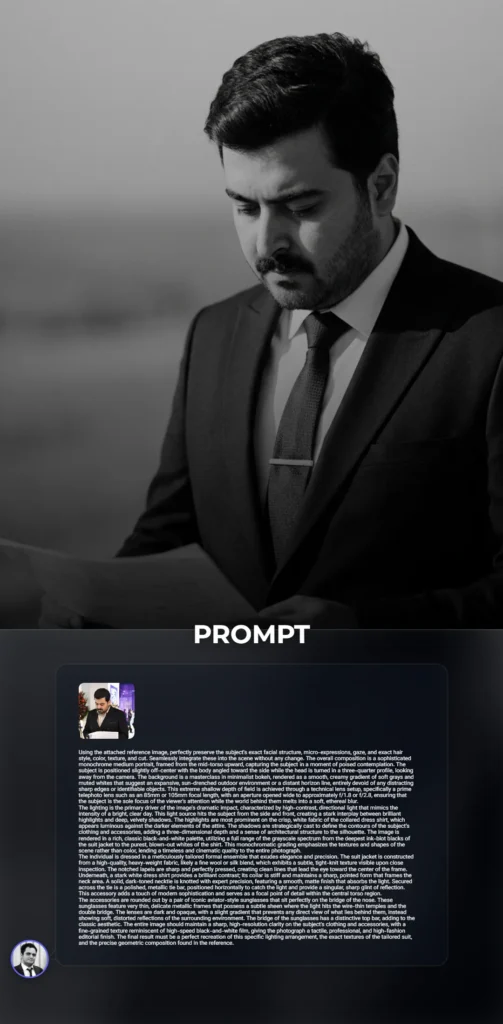
Sophisticated Monochrome Tailored Suit Portrait with Aviator SunglassesUsing the attached reference image, perfectly preserve the subject's exact facial structure, micro-expressions, gaze, and exact hair style, color, texture, and cut. Seamlessly integrate these into the scene without any change. The overall composition is a sophisticated monochrome medium portrait, framed from the mid-torso upward, capturing the subject in a moment of poised contemplation. The subject is positioned slightly off-center with the body angled toward the side while the head is turned in a three-quarter profile, looking away from the camera. The background is a masterclass in minimalist bokeh, rendered as a smooth, creamy gradient of soft grays and muted whites that suggest an expansive, sun-drenched outdoor environment or a distant horizon line, entirely devoid of any distracting sharp edges or identifiable objects. This extreme shallow depth of field is achieved through a technical lens setup, specifically a prime telephoto lens such as an 85mm or 105mm focal length, with an aperture opened wide to approximately f/1.8 or f/2.8, ensuring that the subject is the sole focus of the viewer's attention while the world behind them melts into a soft, ethereal blur.
The lighting is the primary driver of the image's dramatic impact, characterized by high-contrast, directional light that mimics the intensity of a bright, clear day. This light source hits the subject from the side and front, creating a stark interplay between brilliant highlights and deep, velvety shadows. The highlights are most prominent on the crisp, white fabric of the collared dress shirt, which appears luminous against the darker elements of the attire. The shadows are strategically cast to define the contours of the subject’s clothing and accessories, adding a three-dimensional depth and a sense of architectural structure to the silhouette. The image is rendered in a rich, classic black-and-white palette, utilizing a full range of the grayscale spectrum from the deepest ink-blot blacks of the suit jacket to the purest, blown-out whites of the shirt. This monochromatic grading emphasizes the textures and shapes of the scene rather than color, lending a timeless and cinematic quality to the entire photograph.
The individual is dressed in a meticulously tailored formal ensemble that exudes elegance and precision. The suit jacket is constructed from a high-quality, heavy-weight fabric, likely a fine wool or silk blend, which exhibits a subtle, tight-knit texture visible upon close inspection. The notched lapels are sharp and perfectly pressed, creating clean lines that lead the eye toward the center of the frame. Underneath, a stark white dress shirt provides a brilliant contrast; its collar is stiff and maintains a sharp, pointed form that frames the neck area. A solid, dark-toned necktie is knotted with expert precision, featuring a smooth, matte finish that absorbs the light. Secured across the tie is a polished, metallic tie bar, positioned horizontally to catch the light and provide a singular, sharp glint of reflection. This accessory adds a touch of modern sophistication and serves as a focal point of detail within the central torso region.
The accessories are rounded out by a pair of iconic aviator-style sunglasses that sit perfectly on the bridge of the nose. These sunglasses feature very thin, delicate metallic frames that possess a subtle sheen where the light hits the wire-thin temples and the double bridge. The lenses are dark and opaque, with a slight gradient that prevents any direct view of what lies behind them, instead showing soft, distorted reflections of the surrounding environment. The bridge of the sunglasses has a distinctive top bar, adding to the classic aesthetic. The entire image should maintain a sharp, high-resolution clarity on the subject's clothing and accessories, with a fine-grained texture reminiscent of high-speed black-and-white film, giving the photograph a tactile, professional, and high-fashion editorial finish. The final result must be a perfect recreation of this specific lighting arrangement, the exact textures of the tailored suit, and the precise geometric composition found in the reference.
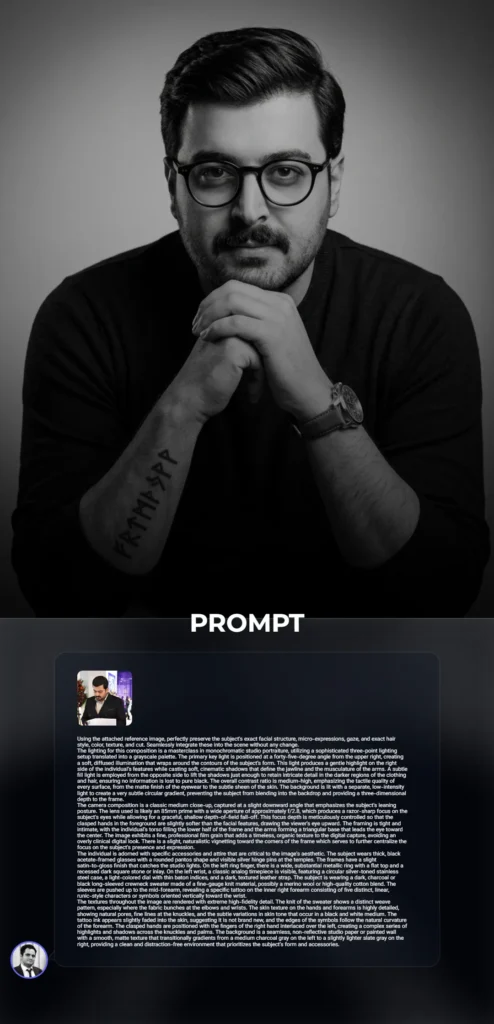
Professional Monochromatic Studio Portrait with Fine Detail and Runic TattooUsing the attached reference image, perfectly preserve the subject's exact facial structure, micro-expressions, gaze, and exact hair style, color, texture, and cut. Seamlessly integrate these into the scene without any change.
The lighting for this composition is a masterclass in monochromatic studio portraiture, utilizing a sophisticated three-point lighting setup translated into a grayscale palette. The primary key light is positioned at a forty-five-degree angle from the upper right, creating a soft, diffused illumination that wraps around the contours of the subject’s form. This light produces a gentle highlight on the right side of the individual’s features while casting soft, cinematic shadows that define the jawline and the musculature of the arms. A subtle fill light is employed from the opposite side to lift the shadows just enough to retain intricate detail in the darker regions of the clothing and hair, ensuring no information is lost to pure black. The overall contrast ratio is medium-high, emphasizing the tactile quality of every surface, from the matte finish of the eyewear to the subtle sheen of the skin. The background is lit with a separate, low-intensity light to create a very subtle circular gradient, preventing the subject from blending into the backdrop and providing a three-dimensional depth to the frame.
The camera composition is a classic medium close-up, captured at a slight downward angle that emphasizes the subject's leaning posture. The lens used is likely an 85mm prime with a wide aperture of approximately f/2.8, which produces a razor-sharp focus on the subject's eyes while allowing for a graceful, shallow depth-of-field fall-off. This focus depth is meticulously controlled so that the clasped hands in the foreground are slightly softer than the facial features, drawing the viewer's eye upward. The framing is tight and intimate, with the individual’s torso filling the lower half of the frame and the arms forming a triangular base that leads the eye toward the center. The image exhibits a fine, professional film grain that adds a timeless, organic texture to the digital capture, avoiding an overly clinical digital look. There is a slight, naturalistic vignetting toward the corners of the frame which serves to further centralize the focus on the subject's presence and expression.
The individual is adorned with specific accessories and attire that are critical to the image's aesthetic. The subject wears thick, black acetate-framed glasses with a rounded pantos shape and visible silver hinge pins at the temples. The frames have a slight satin-to-gloss finish that catches the studio lights. On the left ring finger, there is a wide, substantial metallic ring with a flat top and a recessed dark square stone or inlay. On the left wrist, a classic analog timepiece is visible, featuring a circular silver-toned stainless steel case, a light-colored dial with thin baton indices, and a dark, textured leather strap. The subject is wearing a dark, charcoal or black long-sleeved crewneck sweater made of a fine-gauge knit material, possibly a merino wool or high-quality cotton blend. The sleeves are pushed up to the mid-forearm, revealing a specific tattoo on the inner right forearm consisting of five distinct, linear, runic-style characters or symbols oriented vertically toward the wrist.
The textures throughout the image are rendered with extreme high-fidelity detail. The knit of the sweater shows a distinct weave pattern, especially where the fabric bunches at the elbows and wrists. The skin texture on the hands and forearms is highly detailed, showing natural pores, fine lines at the knuckles, and the subtle variations in skin tone that occur in a black and white medium. The tattoo ink appears slightly faded into the skin, suggesting it is not brand new, and the edges of the symbols follow the natural curvature of the forearm. The clasped hands are positioned with the fingers of the right hand interlaced over the left, creating a complex series of highlights and shadows across the knuckles and palms. The background is a seamless, non-reflective studio paper or painted wall with a smooth, matte texture that transitionally gradients from a medium charcoal gray on the left to a slightly lighter slate gray on the right, providing a clean and distraction-free environment that prioritizes the subject’s form and accessories.
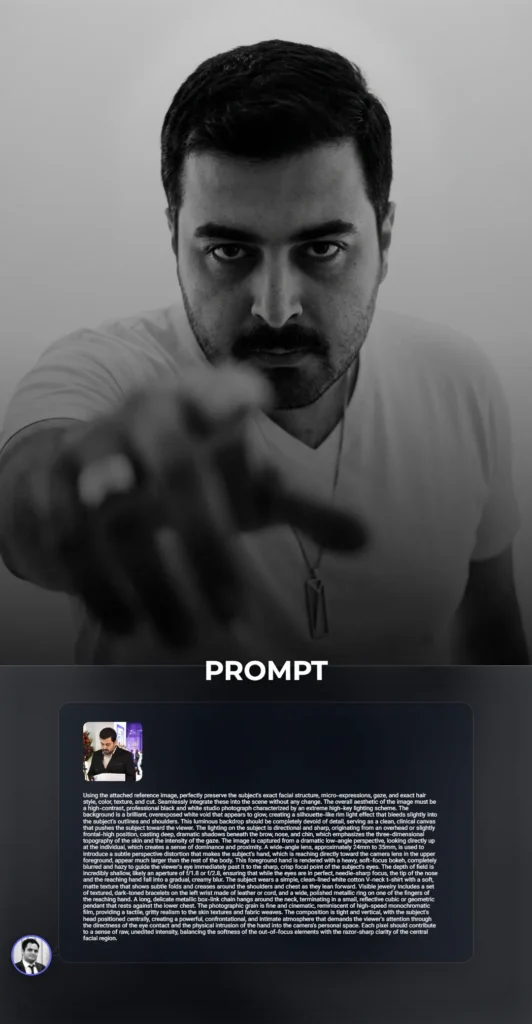
High-Key Black and White Intense Portrait with Reaching HandUsing the attached reference image, perfectly preserve the subject's exact facial structure, micro-expressions, gaze, and exact hair style, color, texture, and cut. Seamlessly integrate these into the scene without any change. The overall aesthetic of the image must be a high-contrast, professional black and white studio photograph characterized by an extreme high-key lighting scheme. The background is a brilliant, overexposed white void that appears to glow, creating a silhouette-like rim light effect that bleeds slightly into the subject's outlines and shoulders. This luminous backdrop should be completely devoid of detail, serving as a clean, clinical canvas that pushes the subject toward the viewer. The lighting on the subject is directional and sharp, originating from an overhead or slightly frontal-high position, casting deep, dramatic shadows beneath the brow, nose, and chin, which emphasizes the three-dimensional topography of the skin and the intensity of the gaze. The image is captured from a dramatic low-angle perspective, looking directly up at the individual, which creates a sense of dominance and proximity. A wide-angle lens, approximately 24mm to 35mm, is used to introduce a subtle perspective distortion that makes the subject's hand, which is reaching directly toward the camera lens in the upper foreground, appear much larger than the rest of the body. This foreground hand is rendered with a heavy, soft-focus bokeh, completely blurred and hazy to guide the viewer's eye immediately past it to the sharp, crisp focal point of the subject's eyes. The depth of field is incredibly shallow, likely an aperture of f/1.8 or f/2.8, ensuring that while the eyes are in perfect, needle-sharp focus, the tip of the nose and the reaching hand fall into a gradual, creamy blur. The subject wears a simple, clean-lined white cotton V-neck t-shirt with a soft, matte texture that shows subtle folds and creases around the shoulders and chest as they lean forward. Visible jewelry includes a set of textured, dark-toned bracelets on the left wrist made of leather or cord, and a wide, polished metallic ring on one of the fingers of the reaching hand. A long, delicate metallic box-link chain hangs around the neck, terminating in a small, reflective cubic or geometric pendant that rests against the lower chest. The photographic grain is fine and cinematic, reminiscent of high-speed monochromatic film, providing a tactile, gritty realism to the skin textures and fabric weaves. The composition is tight and vertical, with the subject's head positioned centrally, creating a powerful, confrontational, and intimate atmosphere that demands the viewer's attention through the directness of the eye contact and the physical intrusion of the hand into the camera's personal space. Each pixel should contribute to a sense of raw, unedited intensity, balancing the softness of the out-of-focus elements with the razor-sharp clarity of the central facial region.