
Peymanaicinematic realism
cinematic realism

Cinematic Golden Hour Portrait with Chiaroscuro Lighting and Industrial MinimalismUsing the attached reference image, perfectly preserve the subject's exact facial structure, micro-expressions, gaze, and exact hair style, color, texture, and cut. Seamlessly integrate these into the scene without any change.
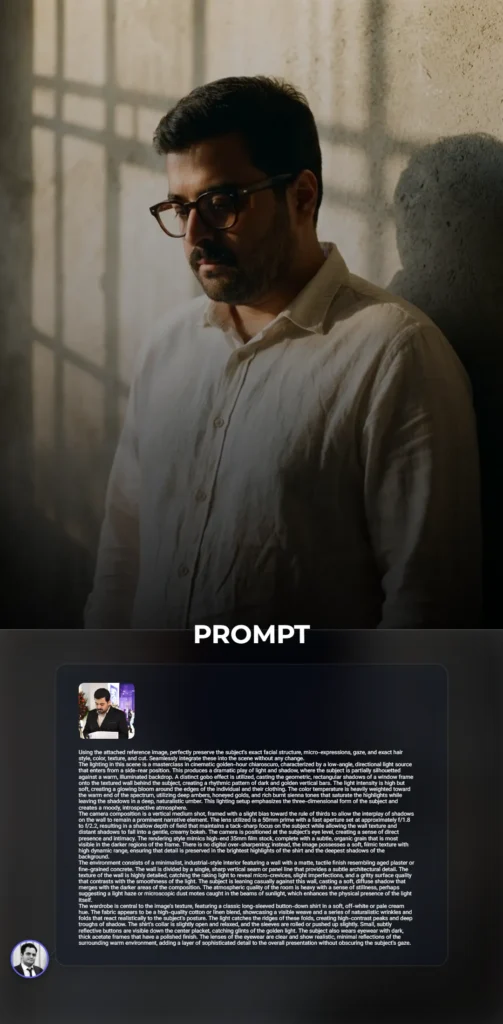
The lighting in this scene is a masterclass in cinematic golden-hour chiaroscuro, characterized by a low-angle, directional light source that enters from a side-rear position. This produces a dramatic play of light and shadow, where the subject is partially silhouetted against a warm, illuminated backdrop. A distinct gobo effect is utilized, casting the geometric, rectangular shadows of a window frame onto the textured wall behind the subject, creating a rhythmic pattern of dark and golden vertical bars. The light intensity is high but soft, creating a glowing bloom around the edges of the individual and their clothing. The color temperature is heavily weighted toward the warm end of the spectrum, utilizing deep ambers, honeyed golds, and rich burnt sienna tones that saturate the highlights while leaving the shadows in a deep, naturalistic umber. This lighting setup emphasizes the three-dimensional form of the subject and creates a moody, introspective atmosphere.
The camera composition is a vertical medium shot, framed with a slight bias toward the rule of thirds to allow the interplay of shadows on the wall to remain a prominent narrative element. The lens utilized is a 50mm prime with a fast aperture set at approximately f/1.8 to f/2.2, resulting in a shallow depth of field that maintains a tack-sharp focus on the subject while allowing the wall texture and distant shadows to fall into a gentle, creamy bokeh. The camera is positioned at the subject's eye level, creating a sense of direct presence and intimacy. The rendering style mimics high-end 35mm film stock, complete with a subtle, organic grain that is most visible in the darker regions of the frame. There is no digital over-sharpening; instead, the image possesses a soft, filmic texture with high dynamic range, ensuring that detail is preserved in the brightest highlights of the shirt and the deepest shadows of the background.
The environment consists of a minimalist, industrial-style interior featuring a wall with a matte, tactile finish resembling aged plaster or fine-grained concrete. The wall is divided by a single, sharp vertical seam or panel line that provides a subtle architectural detail. The texture of the wall is highly detailed, catching the raking light to reveal micro-crevices, slight imperfections, and a gritty surface quality that contrasts with the smoothness of the light. The subject is leaning casually against this wall, casting a soft, diffuse shadow that merges with the darker areas of the composition. The atmospheric quality of the room is heavy with a sense of stillness, perhaps suggesting a light haze or microscopic dust motes caught in the beams of sunlight, which enhances the physical presence of the light itself.
The wardrobe is central to the image's texture, featuring a classic long-sleeved button-down shirt in a soft, off-white or pale cream hue. The fabric appears to be a high-quality cotton or linen blend, showcasing a visible weave and a series of naturalistic wrinkles and folds that react realistically to the subject's posture. The light catches the ridges of these folds, creating high-contrast peaks and deep troughs of shadow. The shirt's collar is slightly open and relaxed, and the sleeves are rolled or pushed up slightly. Small, subtly reflective buttons are visible down the center placket, catching glints of the golden light. The subject also wears eyewear with dark, thick acetate frames that have a polished finish. The lenses of the eyewear are clear and show realistic, minimal reflections of the surrounding warm environment, adding a layer of sophisticated detail to the overall presentation without obscuring the subject's gaze.
Cinematic Golden Hour Portrait with Chiaroscuro Lighting and Industrial MinimalismUsing the attached reference image, perfectly preserve the subject's exact facial structure, micro-expressions, gaze, and exact hair style, color, texture, and cut. Seamlessly integrate these into the scene without any change.
The lighting in this scene is a masterclass in cinematic golden-hour chiaroscuro, characterized by a low-angle, directional light source that enters from a side-rear position. This produces a dramatic play of light and shadow, where the subject is partially silhouetted against a warm, illuminated backdrop. A distinct gobo effect is utilized, casting the geometric, rectangular shadows of a window frame onto the textured wall behind the subject, creating a rhythmic pattern of dark and golden vertical bars. The light intensity is high but soft, creating a glowing bloom around the edges of the individual and their clothing. The color temperature is heavily weighted toward the warm end of the spectrum, utilizing deep ambers, honeyed golds, and rich burnt sienna tones that saturate the highlights while leaving the shadows in a deep, naturalistic umber. This lighting setup emphasizes the three-dimensional form of the subject and creates a moody, introspective atmosphere.
The camera composition is a vertical medium shot, framed with a slight bias toward the rule of thirds to allow the interplay of shadows on the wall to remain a prominent narrative element. The lens utilized is a 50mm prime with a fast aperture set at approximately f/1.8 to f/2.2, resulting in a shallow depth of field that maintains a tack-sharp focus on the subject while allowing the wall texture and distant shadows to fall into a gentle, creamy bokeh. The camera is positioned at the subject's eye level, creating a sense of direct presence and intimacy. The rendering style mimics high-end 35mm film stock, complete with a subtle, organic grain that is most visible in the darker regions of the frame. There is no digital over-sharpening; instead, the image possesses a soft, filmic texture with high dynamic range, ensuring that detail is preserved in the brightest highlights of the shirt and the deepest shadows of the background.
The environment consists of a minimalist, industrial-style interior featuring a wall with a matte, tactile finish resembling aged plaster or fine-grained concrete. The wall is divided by a single, sharp vertical seam or panel line that provides a subtle architectural detail. The texture of the wall is highly detailed, catching the raking light to reveal micro-crevices, slight imperfections, and a gritty surface quality that contrasts with the smoothness of the light. The subject is leaning casually against this wall, casting a soft, diffuse shadow that merges with the darker areas of the composition. The atmospheric quality of the room is heavy with a sense of stillness, perhaps suggesting a light haze or microscopic dust motes caught in the beams of sunlight, which enhances the physical presence of the light itself.
The wardrobe is central to the image's texture, featuring a classic long-sleeved button-down shirt in a soft, off-white or pale cream hue. The fabric appears to be a high-quality cotton or linen blend, showcasing a visible weave and a series of naturalistic wrinkles and folds that react realistically to the subject's posture. The light catches the ridges of these folds, creating high-contrast peaks and deep troughs of shadow. The shirt's collar is slightly open and relaxed, and the sleeves are rolled or pushed up slightly. Small, subtly reflective buttons are visible down the center placket, catching glints of the golden light. The subject also wears eyewear with dark, thick acetate frames that have a polished finish. The lenses of the eyewear are clear and show realistic, minimal reflections of the surrounding warm environment, adding a layer of sophisticated detail to the overall presentation without obscuring the subject's gaze.