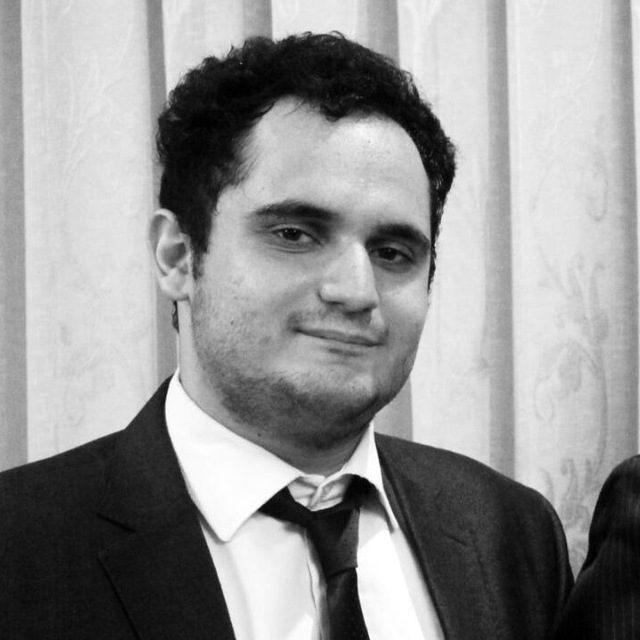
Peymanaicontemplative pose
contemplative pose

Cinematic Chiaroscuro Portrait in Modern Luxury InteriorUsing the attached reference image, perfectly preserve the subject's exact facial structure, micro-expressions, gaze, and exact hair style, color, texture, and cut. Seamlessly integrate these into the scene without any change. The composition of the image is a vertical portrait captured from a medium-close-up perspective, framing the individual from the mid-torso upward. The subject is positioned centrally within the frame, creating a sense of balance against the structured, geometric lines of the background. The camera is positioned at eye level, but because the subject is looking down, the perspective feels intimate and introspective. The depth of field is shallow, achieved through a wide aperture setting, which ensures that the subject remains the singular point of focus while the background elements melt into a soft, professional bokeh. Every edge of the subject's silhouette is crisp and well-defined against the dark environment, emphasizing the separation between the individual and the architectural backdrop.
The lighting is a masterclass in low-key, dramatic chiaroscuro, utilizing a singular primary light source situated above and slightly to the side of the subject. This creates a sharp downward cast of light that illuminates the top of the cap and the bridge of the nose, while leaving the majority of the face in deep, cinematic shadow beneath the brim. The shadows are rich and inky, with a gradual fall-off that preserves the subtle contours of the neck and the texture of the clothing. In the background, there is a distinct, horizontal band of warm, golden-orange light that provides a necessary color contrast to the otherwise monochromatic and dark scene. this light source appears to be an integrated architectural glow, perhaps from a recessed LED strip or a backlit counter, which casts a soft amber reflection on the polished surfaces and adds a three-dimensional quality to the space.
The environment is a sleek, modern interior, likely an elevator or a high-end corporate lobby, characterized by dark, reflective vertical panels. These panels, possibly made of smoked glass or polished obsidian-toned metal, feature subtle vertical seams that create a sense of height and rigid structure. The reflections on these surfaces are blurred and elongated, catching distant, out-of-focus light sources that suggest a larger, sophisticated space beyond the immediate frame. The floor and ceiling are barely visible, lost to the shadows, which concentrates all visual energy on the intersection of the subject and the horizontal warm light strip behind them. The overall atmosphere is one of quiet luxury, solitude, and contemporary elegance.
The textures within the frame are rendered with extreme precision. The subject wears a high-quality, matte black turtleneck sweater made of a fine-gauge knit. The weave of the fabric is visible under close inspection, showing the soft, non-reflective quality of premium wool or cotton. The folds of the sleeves and the collar create rhythmic shadows that define the subject's physical form. On the head is a structured, six-panel baseball cap in a matching matte black fabric, featuring a prominent, sky-blue square rubberized or fabric patch on the front with fine white typography. The stiffness of the cap's brim is evident, casting a hard-edged shadow. On the wrist, a stainless steel watch with a multi-link bracelet catches the overhead light, displaying sharp, specular highlights on its polished edges and a dark, refined watch face that reflects the surrounding environment.
The individual is captured in a contemplative, guarded pose. Their right arm is raised, with the hand partially tucked into the top of the turtleneck collar, the fingers curved naturally as if adjusting the fabric or resting in a moment of thought. The left arm is crossed over the midsection, providing a foundation for the right elbow. This body language is closed and reflective, enhanced by the downward tilt of the head which obscures the eyes and focuses the viewer's attention on the interplay of light and shadow across the jawline and hand. The skin texture on the visible hand is realistic, showing subtle veins, knuckle details, and a natural matte finish under the dim lighting. The entire scene is rendered with a clean, high-resolution aesthetic, devoid of digital noise, maintaining the high-contrast, moody integrity of a professional studio or location-based fashion editorial.
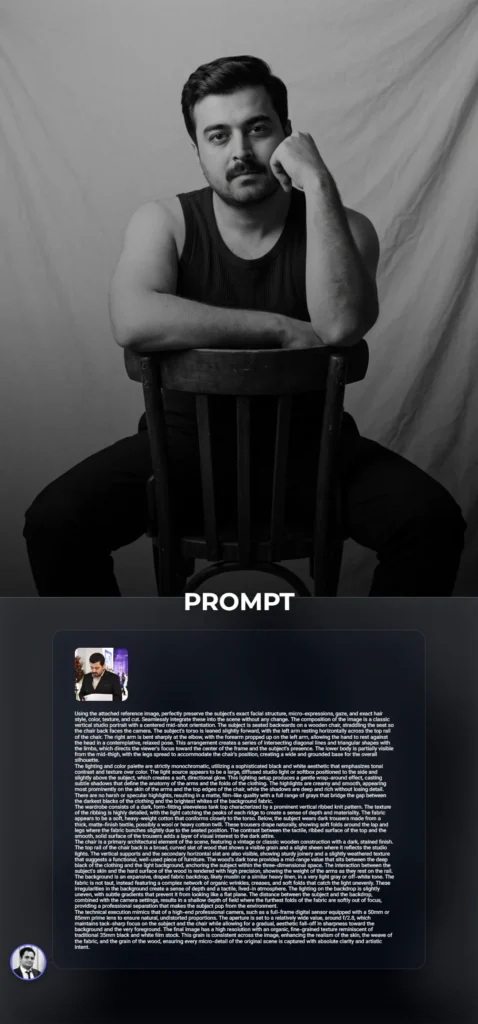
Cinematic Black and White Studio Portrait on Vintage Wooden ChairUsing the attached reference image, perfectly preserve the subject's exact facial structure, micro-expressions, gaze, and exact hair style, color, texture, and cut. Seamlessly integrate these into the scene without any change. The composition of the image is a classic vertical studio portrait with a centered mid-shot orientation. The subject is seated backwards on a wooden chair, straddling the seat so the chair back faces the camera. The subject's torso is leaned slightly forward, with the left arm resting horizontally across the top rail of the chair. The right arm is bent sharply at the elbow, with the forearm propped up on the left arm, allowing the hand to rest against the head in a contemplative, relaxed pose. This arrangement creates a series of intersecting diagonal lines and triangular shapes with the limbs, which directs the viewer's focus toward the center of the frame and the subject's presence. The lower body is partially visible from the mid-thigh, with the legs spread to accommodate the chair's position, creating a wide and grounded base for the overall silhouette.
The lighting and color palette are strictly monochromatic, utilizing a sophisticated black and white aesthetic that emphasizes tonal contrast and texture over color. The light source appears to be a large, diffused studio light or softbox positioned to the side and slightly above the subject, which creates a soft, directional glow. This lighting setup produces a gentle wrap-around effect, casting subtle shadows that define the anatomy of the arms and the folds of the clothing. The highlights are creamy and smooth, appearing most prominently on the skin of the arms and the top edges of the chair, while the shadows are deep and rich without losing detail. There are no harsh or specular highlights, resulting in a matte, film-like quality with a full range of grays that bridge the gap between the darkest blacks of the clothing and the brightest whites of the background fabric.
The wardrobe consists of a dark, form-fitting sleeveless tank top characterized by a prominent vertical ribbed knit pattern. The texture of the ribbing is highly detailed, with the light catching the peaks of each ridge to create a sense of depth and materiality. The fabric appears to be a soft, heavy-weight cotton that conforms closely to the torso. Below, the subject wears dark trousers made from a thick, matte-finish textile, possibly a wool or heavy cotton twill. These trousers drape naturally, showing soft folds around the lap and legs where the fabric bunches slightly due to the seated position. The contrast between the tactile, ribbed surface of the top and the smooth, solid surface of the trousers adds a layer of visual interest to the dark attire.
The chair is a primary architectural element of the scene, featuring a vintage or classic wooden construction with a dark, stained finish. The top rail of the chair back is a broad, curved slat of wood that shows a visible grain and a slight sheen where it reflects the studio lights. The vertical supports and the secondary horizontal slat are also visible, showing sturdy joinery and a slightly weathered texture that suggests a functional, well-used piece of furniture. The wood's dark tone provides a mid-range value that sits between the deep black of the clothing and the light background, anchoring the subject within the three-dimensional space. The interaction between the subject's skin and the hard surface of the wood is rendered with high precision, showing the weight of the arms as they rest on the rail.
The background is an expansive, draped fabric backdrop, likely muslin or a similar heavy linen, in a very light gray or off-white tone. The fabric is not taut, instead featuring a complex network of organic wrinkles, creases, and soft folds that catch the light unevenly. These irregularities in the background create a sense of depth and a tactile, lived-in atmosphere. The lighting on the backdrop is slightly uneven, with subtle gradients that prevent it from looking like a flat plane. The distance between the subject and the backdrop, combined with the camera settings, results in a shallow depth of field where the furthest folds of the fabric are softly out of focus, providing a professional separation that makes the subject pop from the environment.
The technical execution mimics that of a high-end professional camera, such as a full-frame digital sensor equipped with a 50mm or 85mm prime lens to ensure natural, undistorted proportions. The aperture is set to a relatively wide value, around f/2.8, which maintains tack-sharp focus on the subject and the chair while allowing for a gradual, aesthetic fall-off in sharpness toward the background and the very foreground. The final image has a high resolution with an organic, fine-grained texture reminiscent of traditional 35mm black and white film stock. This grain is consistent across the image, enhancing the realism of the skin, the weave of the fabric, and the grain of the wood, ensuring every micro-detail of the original scene is captured with absolute clarity and artistic intent.
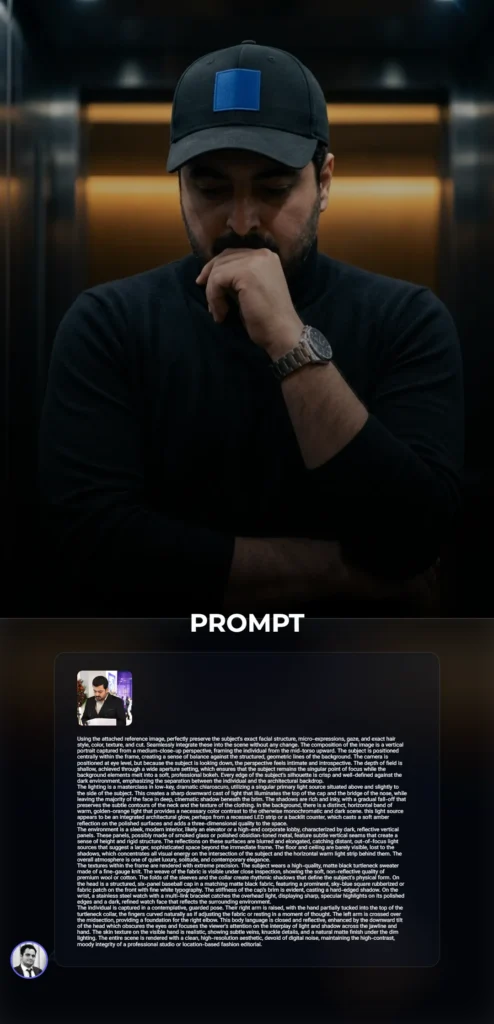
Cinematic Chiaroscuro Portrait in Modern Luxury InteriorUsing the attached reference image, perfectly preserve the subject's exact facial structure, micro-expressions, gaze, and exact hair style, color, texture, and cut. Seamlessly integrate these into the scene without any change. The composition of the image is a vertical portrait captured from a medium-close-up perspective, framing the individual from the mid-torso upward. The subject is positioned centrally within the frame, creating a sense of balance against the structured, geometric lines of the background. The camera is positioned at eye level, but because the subject is looking down, the perspective feels intimate and introspective. The depth of field is shallow, achieved through a wide aperture setting, which ensures that the subject remains the singular point of focus while the background elements melt into a soft, professional bokeh. Every edge of the subject's silhouette is crisp and well-defined against the dark environment, emphasizing the separation between the individual and the architectural backdrop.
The lighting is a masterclass in low-key, dramatic chiaroscuro, utilizing a singular primary light source situated above and slightly to the side of the subject. This creates a sharp downward cast of light that illuminates the top of the cap and the bridge of the nose, while leaving the majority of the face in deep, cinematic shadow beneath the brim. The shadows are rich and inky, with a gradual fall-off that preserves the subtle contours of the neck and the texture of the clothing. In the background, there is a distinct, horizontal band of warm, golden-orange light that provides a necessary color contrast to the otherwise monochromatic and dark scene. this light source appears to be an integrated architectural glow, perhaps from a recessed LED strip or a backlit counter, which casts a soft amber reflection on the polished surfaces and adds a three-dimensional quality to the space.
The environment is a sleek, modern interior, likely an elevator or a high-end corporate lobby, characterized by dark, reflective vertical panels. These panels, possibly made of smoked glass or polished obsidian-toned metal, feature subtle vertical seams that create a sense of height and rigid structure. The reflections on these surfaces are blurred and elongated, catching distant, out-of-focus light sources that suggest a larger, sophisticated space beyond the immediate frame. The floor and ceiling are barely visible, lost to the shadows, which concentrates all visual energy on the intersection of the subject and the horizontal warm light strip behind them. The overall atmosphere is one of quiet luxury, solitude, and contemporary elegance.
The textures within the frame are rendered with extreme precision. The subject wears a high-quality, matte black turtleneck sweater made of a fine-gauge knit. The weave of the fabric is visible under close inspection, showing the soft, non-reflective quality of premium wool or cotton. The folds of the sleeves and the collar create rhythmic shadows that define the subject's physical form. On the head is a structured, six-panel baseball cap in a matching matte black fabric, featuring a prominent, sky-blue square rubberized or fabric patch on the front with fine white typography. The stiffness of the cap's brim is evident, casting a hard-edged shadow. On the wrist, a stainless steel watch with a multi-link bracelet catches the overhead light, displaying sharp, specular highlights on its polished edges and a dark, refined watch face that reflects the surrounding environment.
The individual is captured in a contemplative, guarded pose. Their right arm is raised, with the hand partially tucked into the top of the turtleneck collar, the fingers curved naturally as if adjusting the fabric or resting in a moment of thought. The left arm is crossed over the midsection, providing a foundation for the right elbow. This body language is closed and reflective, enhanced by the downward tilt of the head which obscures the eyes and focuses the viewer's attention on the interplay of light and shadow across the jawline and hand. The skin texture on the visible hand is realistic, showing subtle veins, knuckle details, and a natural matte finish under the dim lighting. The entire scene is rendered with a clean, high-resolution aesthetic, devoid of digital noise, maintaining the high-contrast, moody integrity of a professional studio or location-based fashion editorial.
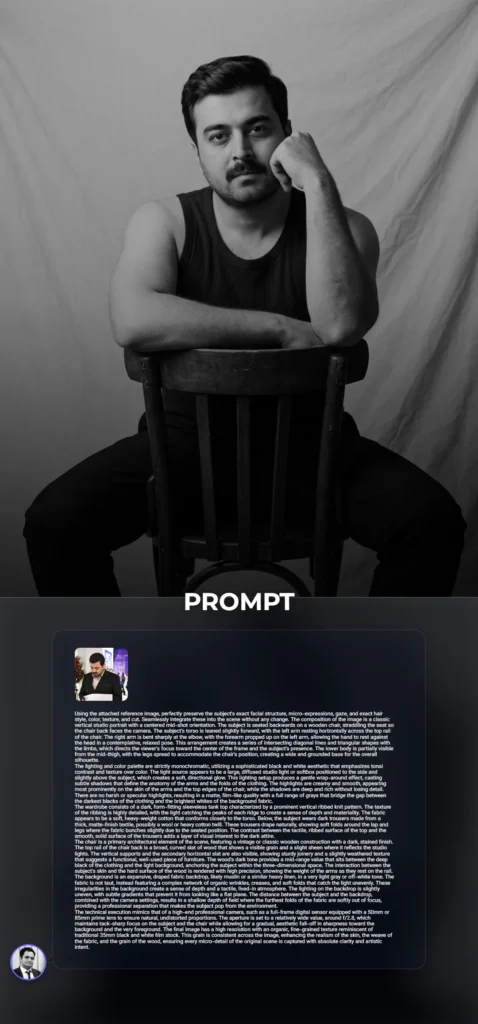
Cinematic Black and White Studio Portrait on Vintage Wooden ChairUsing the attached reference image, perfectly preserve the subject's exact facial structure, micro-expressions, gaze, and exact hair style, color, texture, and cut. Seamlessly integrate these into the scene without any change. The composition of the image is a classic vertical studio portrait with a centered mid-shot orientation. The subject is seated backwards on a wooden chair, straddling the seat so the chair back faces the camera. The subject's torso is leaned slightly forward, with the left arm resting horizontally across the top rail of the chair. The right arm is bent sharply at the elbow, with the forearm propped up on the left arm, allowing the hand to rest against the head in a contemplative, relaxed pose. This arrangement creates a series of intersecting diagonal lines and triangular shapes with the limbs, which directs the viewer's focus toward the center of the frame and the subject's presence. The lower body is partially visible from the mid-thigh, with the legs spread to accommodate the chair's position, creating a wide and grounded base for the overall silhouette.
The lighting and color palette are strictly monochromatic, utilizing a sophisticated black and white aesthetic that emphasizes tonal contrast and texture over color. The light source appears to be a large, diffused studio light or softbox positioned to the side and slightly above the subject, which creates a soft, directional glow. This lighting setup produces a gentle wrap-around effect, casting subtle shadows that define the anatomy of the arms and the folds of the clothing. The highlights are creamy and smooth, appearing most prominently on the skin of the arms and the top edges of the chair, while the shadows are deep and rich without losing detail. There are no harsh or specular highlights, resulting in a matte, film-like quality with a full range of grays that bridge the gap between the darkest blacks of the clothing and the brightest whites of the background fabric.
The wardrobe consists of a dark, form-fitting sleeveless tank top characterized by a prominent vertical ribbed knit pattern. The texture of the ribbing is highly detailed, with the light catching the peaks of each ridge to create a sense of depth and materiality. The fabric appears to be a soft, heavy-weight cotton that conforms closely to the torso. Below, the subject wears dark trousers made from a thick, matte-finish textile, possibly a wool or heavy cotton twill. These trousers drape naturally, showing soft folds around the lap and legs where the fabric bunches slightly due to the seated position. The contrast between the tactile, ribbed surface of the top and the smooth, solid surface of the trousers adds a layer of visual interest to the dark attire.
The chair is a primary architectural element of the scene, featuring a vintage or classic wooden construction with a dark, stained finish. The top rail of the chair back is a broad, curved slat of wood that shows a visible grain and a slight sheen where it reflects the studio lights. The vertical supports and the secondary horizontal slat are also visible, showing sturdy joinery and a slightly weathered texture that suggests a functional, well-used piece of furniture. The wood's dark tone provides a mid-range value that sits between the deep black of the clothing and the light background, anchoring the subject within the three-dimensional space. The interaction between the subject's skin and the hard surface of the wood is rendered with high precision, showing the weight of the arms as they rest on the rail.
The background is an expansive, draped fabric backdrop, likely muslin or a similar heavy linen, in a very light gray or off-white tone. The fabric is not taut, instead featuring a complex network of organic wrinkles, creases, and soft folds that catch the light unevenly. These irregularities in the background create a sense of depth and a tactile, lived-in atmosphere. The lighting on the backdrop is slightly uneven, with subtle gradients that prevent it from looking like a flat plane. The distance between the subject and the backdrop, combined with the camera settings, results in a shallow depth of field where the furthest folds of the fabric are softly out of focus, providing a professional separation that makes the subject pop from the environment.
The technical execution mimics that of a high-end professional camera, such as a full-frame digital sensor equipped with a 50mm or 85mm prime lens to ensure natural, undistorted proportions. The aperture is set to a relatively wide value, around f/2.8, which maintains tack-sharp focus on the subject and the chair while allowing for a gradual, aesthetic fall-off in sharpness toward the background and the very foreground. The final image has a high resolution with an organic, fine-grained texture reminiscent of traditional 35mm black and white film stock. This grain is consistent across the image, enhancing the realism of the skin, the weave of the fabric, and the grain of the wood, ensuring every micro-detail of the original scene is captured with absolute clarity and artistic intent.
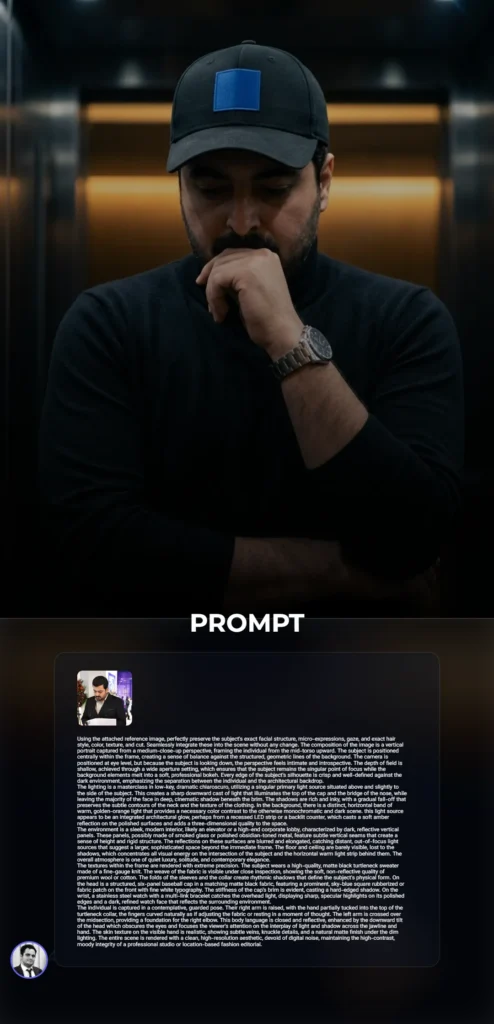
Cinematic Chiaroscuro Portrait in Modern Luxury InteriorUsing the attached reference image, perfectly preserve the subject's exact facial structure, micro-expressions, gaze, and exact hair style, color, texture, and cut. Seamlessly integrate these into the scene without any change. The composition of the image is a vertical portrait captured from a medium-close-up perspective, framing the individual from the mid-torso upward. The subject is positioned centrally within the frame, creating a sense of balance against the structured, geometric lines of the background. The camera is positioned at eye level, but because the subject is looking down, the perspective feels intimate and introspective. The depth of field is shallow, achieved through a wide aperture setting, which ensures that the subject remains the singular point of focus while the background elements melt into a soft, professional bokeh. Every edge of the subject's silhouette is crisp and well-defined against the dark environment, emphasizing the separation between the individual and the architectural backdrop.
The lighting is a masterclass in low-key, dramatic chiaroscuro, utilizing a singular primary light source situated above and slightly to the side of the subject. This creates a sharp downward cast of light that illuminates the top of the cap and the bridge of the nose, while leaving the majority of the face in deep, cinematic shadow beneath the brim. The shadows are rich and inky, with a gradual fall-off that preserves the subtle contours of the neck and the texture of the clothing. In the background, there is a distinct, horizontal band of warm, golden-orange light that provides a necessary color contrast to the otherwise monochromatic and dark scene. this light source appears to be an integrated architectural glow, perhaps from a recessed LED strip or a backlit counter, which casts a soft amber reflection on the polished surfaces and adds a three-dimensional quality to the space.
The environment is a sleek, modern interior, likely an elevator or a high-end corporate lobby, characterized by dark, reflective vertical panels. These panels, possibly made of smoked glass or polished obsidian-toned metal, feature subtle vertical seams that create a sense of height and rigid structure. The reflections on these surfaces are blurred and elongated, catching distant, out-of-focus light sources that suggest a larger, sophisticated space beyond the immediate frame. The floor and ceiling are barely visible, lost to the shadows, which concentrates all visual energy on the intersection of the subject and the horizontal warm light strip behind them. The overall atmosphere is one of quiet luxury, solitude, and contemporary elegance.
The textures within the frame are rendered with extreme precision. The subject wears a high-quality, matte black turtleneck sweater made of a fine-gauge knit. The weave of the fabric is visible under close inspection, showing the soft, non-reflective quality of premium wool or cotton. The folds of the sleeves and the collar create rhythmic shadows that define the subject's physical form. On the head is a structured, six-panel baseball cap in a matching matte black fabric, featuring a prominent, sky-blue square rubberized or fabric patch on the front with fine white typography. The stiffness of the cap's brim is evident, casting a hard-edged shadow. On the wrist, a stainless steel watch with a multi-link bracelet catches the overhead light, displaying sharp, specular highlights on its polished edges and a dark, refined watch face that reflects the surrounding environment.
The individual is captured in a contemplative, guarded pose. Their right arm is raised, with the hand partially tucked into the top of the turtleneck collar, the fingers curved naturally as if adjusting the fabric or resting in a moment of thought. The left arm is crossed over the midsection, providing a foundation for the right elbow. This body language is closed and reflective, enhanced by the downward tilt of the head which obscures the eyes and focuses the viewer's attention on the interplay of light and shadow across the jawline and hand. The skin texture on the visible hand is realistic, showing subtle veins, knuckle details, and a natural matte finish under the dim lighting. The entire scene is rendered with a clean, high-resolution aesthetic, devoid of digital noise, maintaining the high-contrast, moody integrity of a professional studio or location-based fashion editorial.
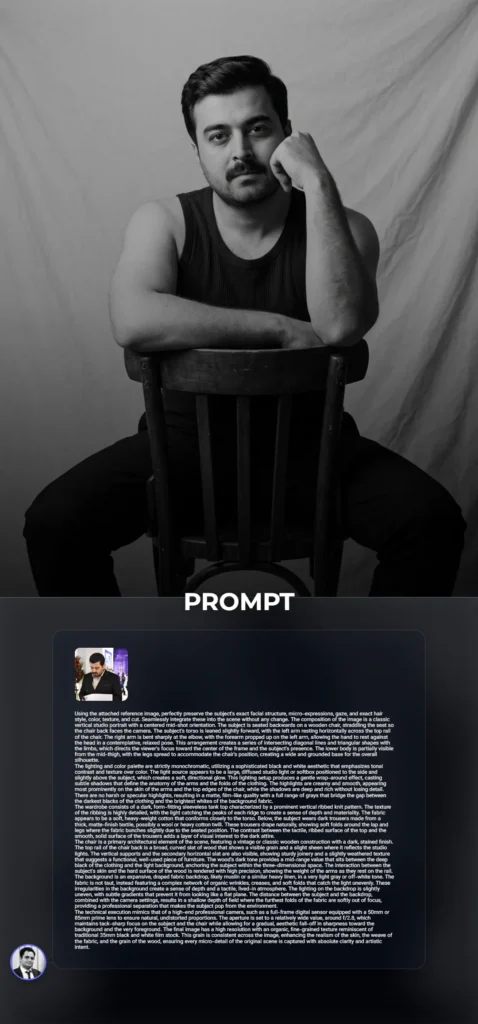
Cinematic Black and White Studio Portrait on Vintage Wooden ChairUsing the attached reference image, perfectly preserve the subject's exact facial structure, micro-expressions, gaze, and exact hair style, color, texture, and cut. Seamlessly integrate these into the scene without any change. The composition of the image is a classic vertical studio portrait with a centered mid-shot orientation. The subject is seated backwards on a wooden chair, straddling the seat so the chair back faces the camera. The subject's torso is leaned slightly forward, with the left arm resting horizontally across the top rail of the chair. The right arm is bent sharply at the elbow, with the forearm propped up on the left arm, allowing the hand to rest against the head in a contemplative, relaxed pose. This arrangement creates a series of intersecting diagonal lines and triangular shapes with the limbs, which directs the viewer's focus toward the center of the frame and the subject's presence. The lower body is partially visible from the mid-thigh, with the legs spread to accommodate the chair's position, creating a wide and grounded base for the overall silhouette.
The lighting and color palette are strictly monochromatic, utilizing a sophisticated black and white aesthetic that emphasizes tonal contrast and texture over color. The light source appears to be a large, diffused studio light or softbox positioned to the side and slightly above the subject, which creates a soft, directional glow. This lighting setup produces a gentle wrap-around effect, casting subtle shadows that define the anatomy of the arms and the folds of the clothing. The highlights are creamy and smooth, appearing most prominently on the skin of the arms and the top edges of the chair, while the shadows are deep and rich without losing detail. There are no harsh or specular highlights, resulting in a matte, film-like quality with a full range of grays that bridge the gap between the darkest blacks of the clothing and the brightest whites of the background fabric.
The wardrobe consists of a dark, form-fitting sleeveless tank top characterized by a prominent vertical ribbed knit pattern. The texture of the ribbing is highly detailed, with the light catching the peaks of each ridge to create a sense of depth and materiality. The fabric appears to be a soft, heavy-weight cotton that conforms closely to the torso. Below, the subject wears dark trousers made from a thick, matte-finish textile, possibly a wool or heavy cotton twill. These trousers drape naturally, showing soft folds around the lap and legs where the fabric bunches slightly due to the seated position. The contrast between the tactile, ribbed surface of the top and the smooth, solid surface of the trousers adds a layer of visual interest to the dark attire.
The chair is a primary architectural element of the scene, featuring a vintage or classic wooden construction with a dark, stained finish. The top rail of the chair back is a broad, curved slat of wood that shows a visible grain and a slight sheen where it reflects the studio lights. The vertical supports and the secondary horizontal slat are also visible, showing sturdy joinery and a slightly weathered texture that suggests a functional, well-used piece of furniture. The wood's dark tone provides a mid-range value that sits between the deep black of the clothing and the light background, anchoring the subject within the three-dimensional space. The interaction between the subject's skin and the hard surface of the wood is rendered with high precision, showing the weight of the arms as they rest on the rail.
The background is an expansive, draped fabric backdrop, likely muslin or a similar heavy linen, in a very light gray or off-white tone. The fabric is not taut, instead featuring a complex network of organic wrinkles, creases, and soft folds that catch the light unevenly. These irregularities in the background create a sense of depth and a tactile, lived-in atmosphere. The lighting on the backdrop is slightly uneven, with subtle gradients that prevent it from looking like a flat plane. The distance between the subject and the backdrop, combined with the camera settings, results in a shallow depth of field where the furthest folds of the fabric are softly out of focus, providing a professional separation that makes the subject pop from the environment.
The technical execution mimics that of a high-end professional camera, such as a full-frame digital sensor equipped with a 50mm or 85mm prime lens to ensure natural, undistorted proportions. The aperture is set to a relatively wide value, around f/2.8, which maintains tack-sharp focus on the subject and the chair while allowing for a gradual, aesthetic fall-off in sharpness toward the background and the very foreground. The final image has a high resolution with an organic, fine-grained texture reminiscent of traditional 35mm black and white film stock. This grain is consistent across the image, enhancing the realism of the skin, the weave of the fabric, and the grain of the wood, ensuring every micro-detail of the original scene is captured with absolute clarity and artistic intent.