
Peymanaidenim jacket
denim jacket
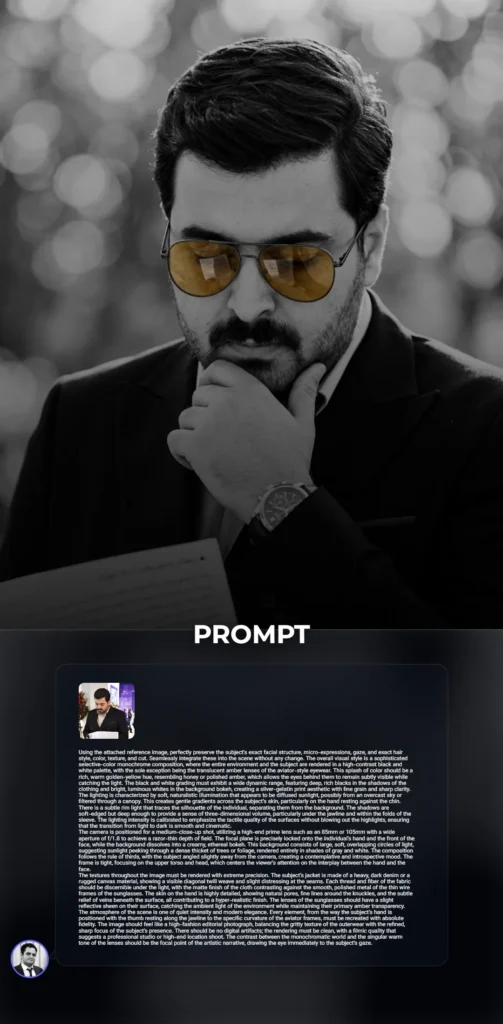
Selective Color Amber Aviator Monochrome Editorial PortraitUsing the attached reference image, perfectly preserve the subject's exact facial structure, micro-expressions, gaze, and exact hair style, color, texture, and cut. Seamlessly integrate these into the scene without any change. The overall visual style is a sophisticated selective-color monochrome composition, where the entire environment and the subject are rendered in a high-contrast black and white palette, with the sole exception being the translucent amber lenses of the aviator-style eyewear. This splash of color should be a rich, warm golden-yellow hue, resembling honey or polished amber, which allows the eyes behind them to remain subtly visible while catching the light. The black and white grading must exhibit a wide dynamic range, featuring deep, rich blacks in the shadows of the clothing and bright, luminous whites in the background bokeh, creating a silver-gelatin print aesthetic with fine grain and sharp clarity.
The lighting is characterized by soft, naturalistic illumination that appears to be diffused sunlight, possibly from an overcast sky or filtered through a canopy. This creates gentle gradients across the subject’s skin, particularly on the hand resting against the chin. There is a subtle rim light that traces the silhouette of the individual, separating them from the background. The shadows are soft-edged but deep enough to provide a sense of three-dimensional volume, particularly under the jawline and within the folds of the sleeve. The lighting intensity is calibrated to emphasize the tactile quality of the surfaces without blowing out the highlights, ensuring that the transition from light to dark is smooth and cinematic.
The camera is positioned for a medium-close-up shot, utilizing a high-end prime lens such as an 85mm or 105mm with a wide aperture of f/1.8 to achieve a razor-thin depth of field. The focal plane is precisely locked onto the individual’s hand and the front of the face, while the background dissolves into a creamy, ethereal bokeh. This background consists of large, soft, overlapping circles of light, suggesting sunlight peeking through a dense thicket of trees or foliage, rendered entirely in shades of gray and white. The composition follows the rule of thirds, with the subject angled slightly away from the camera, creating a contemplative and introspective mood. The frame is tight, focusing on the upper torso and head, which centers the viewer’s attention on the interplay between the hand and the face.
The textures throughout the image must be rendered with extreme precision. The subject’s jacket is made of a heavy, dark denim or a rugged canvas material, showing a visible diagonal twill weave and slight distressing at the seams. Each thread and fiber of the fabric should be discernible under the light, with the matte finish of the cloth contrasting against the smooth, polished metal of the thin wire frames of the sunglasses. The skin on the hand is highly detailed, showing natural pores, fine lines around the knuckles, and the subtle relief of veins beneath the surface, all contributing to a hyper-realistic finish. The lenses of the sunglasses should have a slight reflective sheen on their surface, catching the ambient light of the environment while maintaining their primary amber transparency.
The atmosphere of the scene is one of quiet intensity and modern elegance. Every element, from the way the subject’s hand is positioned with the thumb resting along the jawline to the specific curvature of the aviator frames, must be recreated with absolute fidelity. The image should feel like a high-fashion editorial photograph, balancing the gritty texture of the outerwear with the refined, sharp focus of the subject’s presence. There should be no digital artifacts; the rendering must be clean, with a filmic quality that suggests a professional studio or high-end location shoot. The contrast between the monochromatic world and the singular warm tone of the lenses should be the focal point of the artistic narrative, drawing the eye immediately to the subject’s gaze.
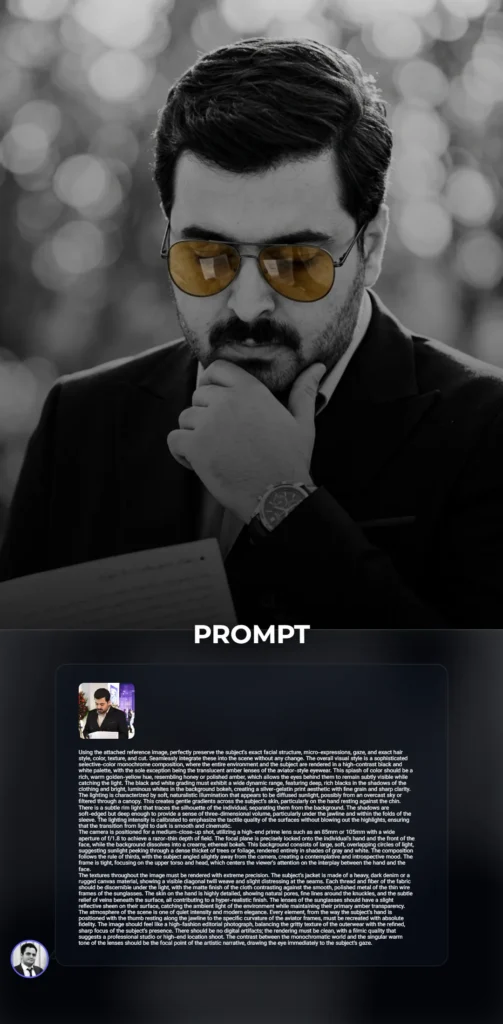
Selective Color Amber Aviator Monochrome Editorial PortraitUsing the attached reference image, perfectly preserve the subject's exact facial structure, micro-expressions, gaze, and exact hair style, color, texture, and cut. Seamlessly integrate these into the scene without any change. The overall visual style is a sophisticated selective-color monochrome composition, where the entire environment and the subject are rendered in a high-contrast black and white palette, with the sole exception being the translucent amber lenses of the aviator-style eyewear. This splash of color should be a rich, warm golden-yellow hue, resembling honey or polished amber, which allows the eyes behind them to remain subtly visible while catching the light. The black and white grading must exhibit a wide dynamic range, featuring deep, rich blacks in the shadows of the clothing and bright, luminous whites in the background bokeh, creating a silver-gelatin print aesthetic with fine grain and sharp clarity.
The lighting is characterized by soft, naturalistic illumination that appears to be diffused sunlight, possibly from an overcast sky or filtered through a canopy. This creates gentle gradients across the subject’s skin, particularly on the hand resting against the chin. There is a subtle rim light that traces the silhouette of the individual, separating them from the background. The shadows are soft-edged but deep enough to provide a sense of three-dimensional volume, particularly under the jawline and within the folds of the sleeve. The lighting intensity is calibrated to emphasize the tactile quality of the surfaces without blowing out the highlights, ensuring that the transition from light to dark is smooth and cinematic.
The camera is positioned for a medium-close-up shot, utilizing a high-end prime lens such as an 85mm or 105mm with a wide aperture of f/1.8 to achieve a razor-thin depth of field. The focal plane is precisely locked onto the individual’s hand and the front of the face, while the background dissolves into a creamy, ethereal bokeh. This background consists of large, soft, overlapping circles of light, suggesting sunlight peeking through a dense thicket of trees or foliage, rendered entirely in shades of gray and white. The composition follows the rule of thirds, with the subject angled slightly away from the camera, creating a contemplative and introspective mood. The frame is tight, focusing on the upper torso and head, which centers the viewer’s attention on the interplay between the hand and the face.
The textures throughout the image must be rendered with extreme precision. The subject’s jacket is made of a heavy, dark denim or a rugged canvas material, showing a visible diagonal twill weave and slight distressing at the seams. Each thread and fiber of the fabric should be discernible under the light, with the matte finish of the cloth contrasting against the smooth, polished metal of the thin wire frames of the sunglasses. The skin on the hand is highly detailed, showing natural pores, fine lines around the knuckles, and the subtle relief of veins beneath the surface, all contributing to a hyper-realistic finish. The lenses of the sunglasses should have a slight reflective sheen on their surface, catching the ambient light of the environment while maintaining their primary amber transparency.
The atmosphere of the scene is one of quiet intensity and modern elegance. Every element, from the way the subject’s hand is positioned with the thumb resting along the jawline to the specific curvature of the aviator frames, must be recreated with absolute fidelity. The image should feel like a high-fashion editorial photograph, balancing the gritty texture of the outerwear with the refined, sharp focus of the subject’s presence. There should be no digital artifacts; the rendering must be clean, with a filmic quality that suggests a professional studio or high-end location shoot. The contrast between the monochromatic world and the singular warm tone of the lenses should be the focal point of the artistic narrative, drawing the eye immediately to the subject’s gaze.
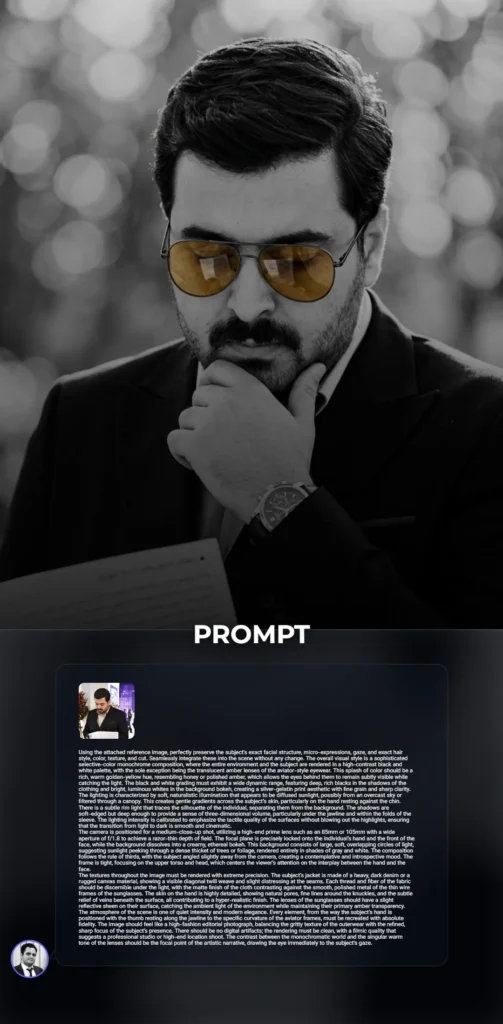
Selective Color Amber Aviator Monochrome Editorial PortraitUsing the attached reference image, perfectly preserve the subject's exact facial structure, micro-expressions, gaze, and exact hair style, color, texture, and cut. Seamlessly integrate these into the scene without any change. The overall visual style is a sophisticated selective-color monochrome composition, where the entire environment and the subject are rendered in a high-contrast black and white palette, with the sole exception being the translucent amber lenses of the aviator-style eyewear. This splash of color should be a rich, warm golden-yellow hue, resembling honey or polished amber, which allows the eyes behind them to remain subtly visible while catching the light. The black and white grading must exhibit a wide dynamic range, featuring deep, rich blacks in the shadows of the clothing and bright, luminous whites in the background bokeh, creating a silver-gelatin print aesthetic with fine grain and sharp clarity.
The lighting is characterized by soft, naturalistic illumination that appears to be diffused sunlight, possibly from an overcast sky or filtered through a canopy. This creates gentle gradients across the subject’s skin, particularly on the hand resting against the chin. There is a subtle rim light that traces the silhouette of the individual, separating them from the background. The shadows are soft-edged but deep enough to provide a sense of three-dimensional volume, particularly under the jawline and within the folds of the sleeve. The lighting intensity is calibrated to emphasize the tactile quality of the surfaces without blowing out the highlights, ensuring that the transition from light to dark is smooth and cinematic.
The camera is positioned for a medium-close-up shot, utilizing a high-end prime lens such as an 85mm or 105mm with a wide aperture of f/1.8 to achieve a razor-thin depth of field. The focal plane is precisely locked onto the individual’s hand and the front of the face, while the background dissolves into a creamy, ethereal bokeh. This background consists of large, soft, overlapping circles of light, suggesting sunlight peeking through a dense thicket of trees or foliage, rendered entirely in shades of gray and white. The composition follows the rule of thirds, with the subject angled slightly away from the camera, creating a contemplative and introspective mood. The frame is tight, focusing on the upper torso and head, which centers the viewer’s attention on the interplay between the hand and the face.
The textures throughout the image must be rendered with extreme precision. The subject’s jacket is made of a heavy, dark denim or a rugged canvas material, showing a visible diagonal twill weave and slight distressing at the seams. Each thread and fiber of the fabric should be discernible under the light, with the matte finish of the cloth contrasting against the smooth, polished metal of the thin wire frames of the sunglasses. The skin on the hand is highly detailed, showing natural pores, fine lines around the knuckles, and the subtle relief of veins beneath the surface, all contributing to a hyper-realistic finish. The lenses of the sunglasses should have a slight reflective sheen on their surface, catching the ambient light of the environment while maintaining their primary amber transparency.
The atmosphere of the scene is one of quiet intensity and modern elegance. Every element, from the way the subject’s hand is positioned with the thumb resting along the jawline to the specific curvature of the aviator frames, must be recreated with absolute fidelity. The image should feel like a high-fashion editorial photograph, balancing the gritty texture of the outerwear with the refined, sharp focus of the subject’s presence. There should be no digital artifacts; the rendering must be clean, with a filmic quality that suggests a professional studio or high-end location shoot. The contrast between the monochromatic world and the singular warm tone of the lenses should be the focal point of the artistic narrative, drawing the eye immediately to the subject’s gaze.