
Peymanaifine art
fine art

Vibrant Electric Blue Artistic Portrait - Cinematic Fine Art PhotographyUsing the attached reference image, perfectly preserve the subject's exact facial structure, micro-expressions, gaze, and exact hair style, color, texture, and cut. Seamlessly integrate these into the scene without any change.
The subject is positioned in a central, vertical orientation within the frame, captured from the chest up in a tight, intimate portrait composition. The arms are raised, with the hands making deliberate and artistic contact with the head. One hand is splayed across the upper portion of the visage, with the index and middle fingers framing the bridge of the nose and forehead, while the ring finger partially obscures one eye. The other hand rests against the lower jawline and neck, fingers pointing upward. This creates a complex, intertwined geometry of limbs and digits that draws the viewer's eye toward the central features. The composition uses a tight crop to emphasize the tactile nature of the scene, leaving minimal negative space around the upper torso and head, which forces a confrontation with the subject's presence.
The skin is heavily adorned with thick, expressive applications of vibrant, electric blue paint, ranging in hue from deep cobalt to bright azure. The pigment varies in its physical state across the body; some areas show a wet, viscous sheen that reflects the light with a glossy finish, while other patches appear more matte and textured as if the paint has begun to dry or has been blotted. The application is deliberately messy and artistic, with visible streaks, smudges, and heavy impasto-like fingerprints where the paint has been dragged across the skin. Traces of the same intense blue are found on the fingernails and embedded into the cuticles, creating a cohesive color story. The paint doesn't just cover the skin but interacts with it, highlighting the natural textures, pores, and fine lines of the dermis beneath, creating a stark contrast between the organic body and the synthetic, vivid pigment.
The lighting is dramatic and highly directional, coming from a high angle above the subject, reminiscent of a classic studio spotlight or chiaroscuro technique. This creates a sharp distinction between the illuminated surfaces and the deep, rich shadows cast by the fingers across the skin. The light catches the peaks of the paint's texture, creating tiny, brilliant specular highlights that give the substance a three-dimensional, tactile quality. The shadows are soft-edged but deep, providing a sense of volume and depth to the hands and the overall form. The light is calibrated to bring out the maximum saturation of the blue without washing out the natural flesh tones, resulting in a high-contrast visual that feels moody and intense. Every contour of the skin is mapped by the interplay of light and dark, emphasizing the physical relief of the paint and the underlying skeletal structure.
This image is captured using a high-end full-frame sensor paired with a telephoto or macro lens, likely in the 85mm to 105mm range, to minimize facial distortion and provide a flattering, compressed perspective. The aperture is set to a shallow depth of field, approximately f/2.8, which ensures that the primary hand and the center of the subject's face are in tack-sharp focus while allowing the ears and the back of the head to fall into a smooth, creamy blur. The shutter speed is fast enough to freeze any movement, preserving every micro-detail of the skin's grain and the paint's edges. The image has a clean, digital clarity with zero perceptible noise, though a very fine, film-like grain is present to add a sense of professional cinematic quality. The white balance is neutral, leaning slightly toward cooler tones to complement the dominant blue elements.
The background is a solid, non-reflective, dark charcoal or obsidian grey, providing a stark and clean negative space that allows the subject to pop forward with extreme clarity. There are no distracting environmental elements or architectural features; the focus is entirely on the person and the paint. The atmosphere is quiet and intimate, almost clinical in its precision yet raw in its artistic expression. There is no visible dust or atmospheric haze, allowing for the highest level of detail to be rendered across the textures of the paint and skin. The overall aesthetic is that of a high-fashion editorial or a fine-art photography gallery piece, emphasizing the contrast between the natural human form and the artificial, vibrant medium of the blue paint. Every detail, from the wetness of the paint to the subtle highlights on the fingertips, is rendered with hyper-realistic precision.
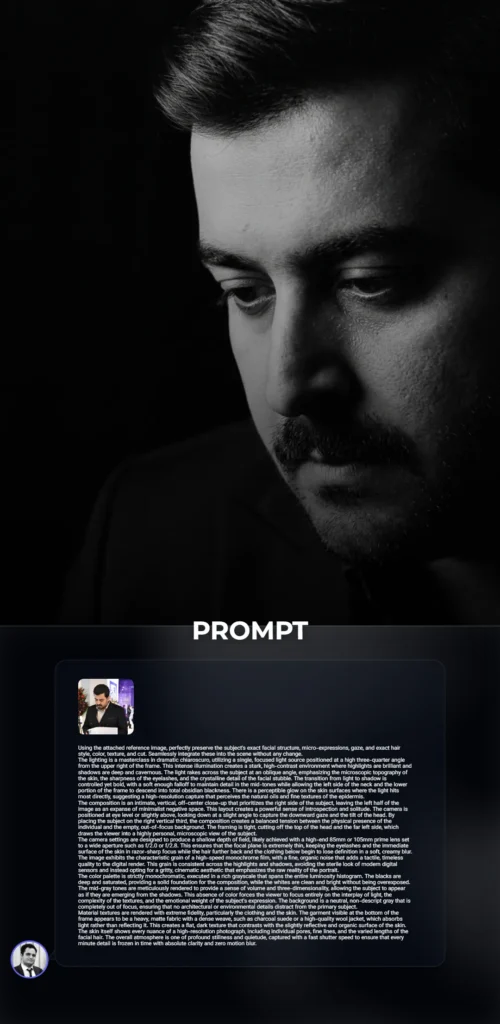
Dramatic Monochromatic Chiaroscuro Portrait Masterclass PromptUsing the attached reference image, perfectly preserve the subject's exact facial structure, micro-expressions, gaze, and exact hair style, color, texture, and cut. Seamlessly integrate these into the scene without any change.
The lighting is a masterclass in dramatic chiaroscuro, utilizing a single, focused light source positioned at a high three-quarter angle from the upper right of the frame. This intense illumination creates a stark, high-contrast environment where highlights are brilliant and shadows are deep and cavernous. The light rakes across the subject at an oblique angle, emphasizing the microscopic topography of the skin, the sharpness of the eyelashes, and the crystalline detail of the facial stubble. The transition from light to shadow is controlled yet bold, with a soft enough falloff to maintain detail in the mid-tones while allowing the left side of the neck and the lower portion of the frame to descend into total obsidian blackness. There is a perceptible glow on the skin surfaces where the light hits most directly, suggesting a high-resolution capture that perceives the natural oils and fine textures of the epidermis.
The composition is an intimate, vertical, off-center close-up that prioritizes the right side of the subject, leaving the left half of the image as an expanse of minimalist negative space. This layout creates a powerful sense of introspection and solitude. The camera is positioned at eye level or slightly above, looking down at a slight angle to capture the downward gaze and the tilt of the head. By placing the subject on the right vertical third, the composition creates a balanced tension between the physical presence of the individual and the empty, out-of-focus background. The framing is tight, cutting off the top of the head and the far left side, which draws the viewer into a highly personal, microscopic view of the subject.
The camera settings are designed to produce a shallow depth of field, likely achieved with a high-end 85mm or 105mm prime lens set to a wide aperture such as f/2.0 or f/2.8. This ensures that the focal plane is extremely thin, keeping the eyelashes and the immediate surface of the skin in razor-sharp focus while the hair further back and the clothing below begin to lose definition in a soft, creamy blur. The image exhibits the characteristic grain of a high-speed monochrome film, with a fine, organic noise that adds a tactile, timeless quality to the digital render. This grain is consistent across the highlights and shadows, avoiding the sterile look of modern digital sensors and instead opting for a gritty, cinematic aesthetic that emphasizes the raw reality of the portrait.
The color palette is strictly monochromatic, executed in a rich grayscale that spans the entire luminosity histogram. The blacks are deep and saturated, providing a solid foundation for the composition, while the whites are clean and bright without being overexposed. The mid-gray tones are meticulously rendered to provide a sense of volume and three-dimensionality, allowing the subject to appear as if they are emerging from the shadows. This absence of color forces the viewer to focus entirely on the interplay of light, the complexity of the textures, and the emotional weight of the subject's expression. The background is a neutral, non-descript gray that is completely out of focus, ensuring that no architectural or environmental details distract from the primary subject.
Material textures are rendered with extreme fidelity, particularly the clothing and the skin. The garment visible at the bottom of the frame appears to be a heavy, matte fabric with a dense weave, such as charcoal suede or a high-quality wool jacket, which absorbs light rather than reflecting it. This creates a flat, dark texture that contrasts with the slightly reflective and organic surface of the skin. The skin itself shows every nuance of a high-resolution photograph, including individual pores, fine lines, and the varied lengths of the facial hair. The overall atmosphere is one of profound stillness and quietude, captured with a fast shutter speed to ensure that every minute detail is frozen in time with absolute clarity and zero motion blur.

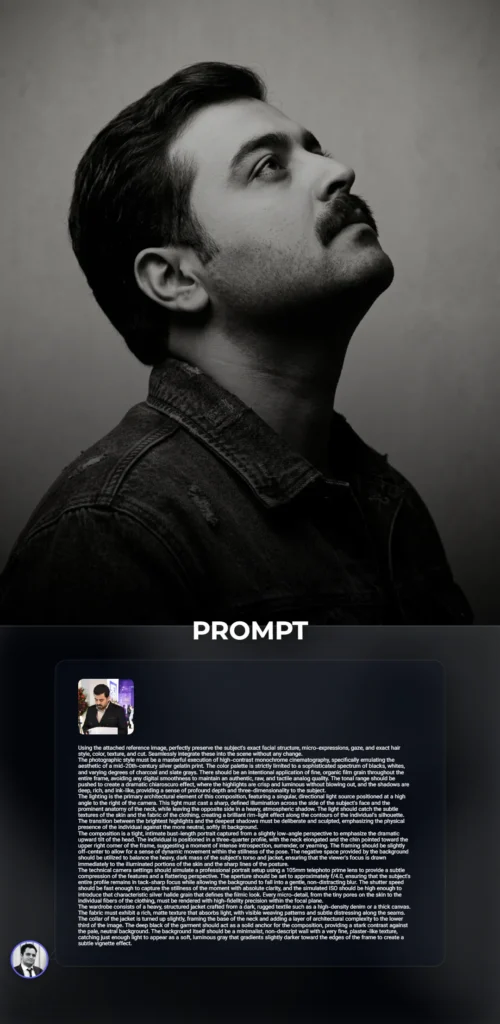
Dramatic Monochrome Chiaroscuro Cinematic PortraitUsing the attached reference image, perfectly preserve the subject's exact facial structure, micro-expressions, gaze, and exact hair style, color, texture, and cut. Seamlessly integrate these into the scene without any change.
The photographic style must be a masterful execution of high-contrast monochrome cinematography, specifically emulating the aesthetic of a mid-20th-century silver gelatin print. The color palette is strictly limited to a sophisticated spectrum of blacks, whites, and varying degrees of charcoal and slate grays. There should be an intentional application of fine, organic film grain throughout the entire frame, avoiding any digital smoothness to maintain an authentic, raw, and tactile analog quality. The tonal range should be pushed to create a dramatic chiaroscuro effect, where the highlights are crisp and luminous without blowing out, and the shadows are deep, rich, and ink-like, providing a sense of profound depth and three-dimensionality to the subject.
The lighting is the primary architectural element of this composition, featuring a singular, directional light source positioned at a high angle to the right of the camera. This light must cast a sharp, defined illumination across the side of the subject's face and the prominent anatomy of the neck, while leaving the opposite side in a heavy, atmospheric shadow. The light should catch the subtle textures of the skin and the fabric of the clothing, creating a brilliant rim-light effect along the contours of the individual's silhouette. The transition between the brightest highlights and the deepest shadows must be deliberate and sculpted, emphasizing the physical presence of the individual against the more neutral, softly lit background.
The composition is a tight, intimate bust-length portrait captured from a slightly low-angle perspective to emphasize the dramatic upward tilt of the head. The individual is positioned in a three-quarter profile, with the neck elongated and the chin pointed toward the upper right corner of the frame, suggesting a moment of intense introspection, surrender, or yearning. The framing should be slightly off-center to allow for a sense of dynamic movement within the stillness of the pose. The negative space provided by the background should be utilized to balance the heavy, dark mass of the subject's torso and jacket, ensuring that the viewer's focus is drawn immediately to the illuminated portions of the skin and the sharp lines of the posture.
The technical camera settings should simulate a professional portrait setup using a 105mm telephoto prime lens to provide a subtle compression of the features and a flattering perspective. The aperture should be set to approximately f/4.0, ensuring that the subject's entire profile remains in tack-sharp focus while allowing the background to fall into a gentle, non-distracting blur. The shutter speed should be fast enough to capture the stillness of the moment with absolute clarity, and the simulated ISO should be high enough to introduce that characteristic silver halide grain that defines the filmic look. Every micro-detail, from the tiny pores on the skin to the individual fibers of the clothing, must be rendered with high-fidelity precision within the focal plane.
The wardrobe consists of a heavy, structured jacket crafted from a dark, rugged textile such as a high-density denim or a thick canvas. The fabric must exhibit a rich, matte texture that absorbs light, with visible weaving patterns and subtle distressing along the seams. The collar of the jacket is turned up slightly, framing the base of the neck and adding a layer of architectural complexity to the lower third of the image. The deep black of the garment should act as a solid anchor for the composition, providing a stark contrast against the pale, neutral background. The background itself should be a minimalist, non-descript wall with a very fine, plaster-like texture, catching just enough light to appear as a soft, luminous gray that gradients slightly darker toward the edges of the frame to create a subtle vignette effect.
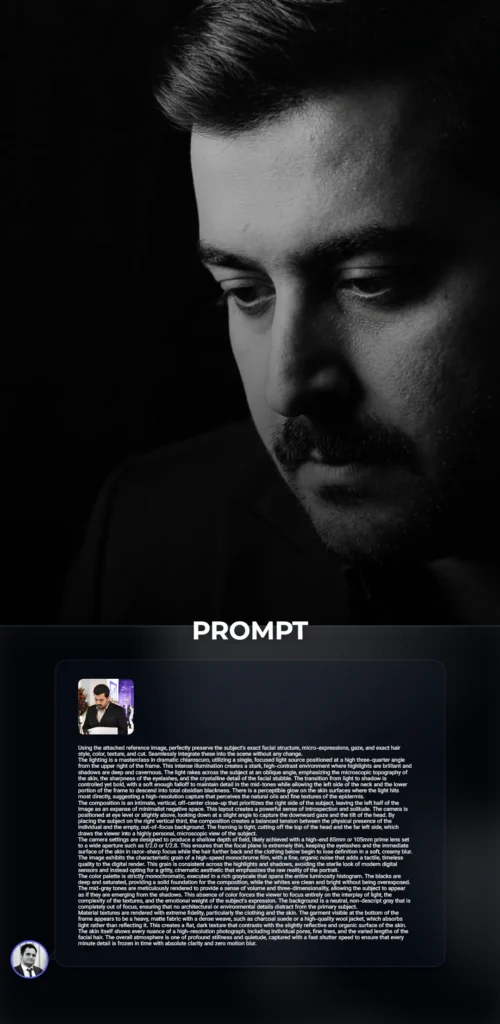
Dramatic Monochromatic Chiaroscuro Portrait Masterclass PromptUsing the attached reference image, perfectly preserve the subject's exact facial structure, micro-expressions, gaze, and exact hair style, color, texture, and cut. Seamlessly integrate these into the scene without any change.
The lighting is a masterclass in dramatic chiaroscuro, utilizing a single, focused light source positioned at a high three-quarter angle from the upper right of the frame. This intense illumination creates a stark, high-contrast environment where highlights are brilliant and shadows are deep and cavernous. The light rakes across the subject at an oblique angle, emphasizing the microscopic topography of the skin, the sharpness of the eyelashes, and the crystalline detail of the facial stubble. The transition from light to shadow is controlled yet bold, with a soft enough falloff to maintain detail in the mid-tones while allowing the left side of the neck and the lower portion of the frame to descend into total obsidian blackness. There is a perceptible glow on the skin surfaces where the light hits most directly, suggesting a high-resolution capture that perceives the natural oils and fine textures of the epidermis.
The composition is an intimate, vertical, off-center close-up that prioritizes the right side of the subject, leaving the left half of the image as an expanse of minimalist negative space. This layout creates a powerful sense of introspection and solitude. The camera is positioned at eye level or slightly above, looking down at a slight angle to capture the downward gaze and the tilt of the head. By placing the subject on the right vertical third, the composition creates a balanced tension between the physical presence of the individual and the empty, out-of-focus background. The framing is tight, cutting off the top of the head and the far left side, which draws the viewer into a highly personal, microscopic view of the subject.
The camera settings are designed to produce a shallow depth of field, likely achieved with a high-end 85mm or 105mm prime lens set to a wide aperture such as f/2.0 or f/2.8. This ensures that the focal plane is extremely thin, keeping the eyelashes and the immediate surface of the skin in razor-sharp focus while the hair further back and the clothing below begin to lose definition in a soft, creamy blur. The image exhibits the characteristic grain of a high-speed monochrome film, with a fine, organic noise that adds a tactile, timeless quality to the digital render. This grain is consistent across the highlights and shadows, avoiding the sterile look of modern digital sensors and instead opting for a gritty, cinematic aesthetic that emphasizes the raw reality of the portrait.
The color palette is strictly monochromatic, executed in a rich grayscale that spans the entire luminosity histogram. The blacks are deep and saturated, providing a solid foundation for the composition, while the whites are clean and bright without being overexposed. The mid-gray tones are meticulously rendered to provide a sense of volume and three-dimensionality, allowing the subject to appear as if they are emerging from the shadows. This absence of color forces the viewer to focus entirely on the interplay of light, the complexity of the textures, and the emotional weight of the subject's expression. The background is a neutral, non-descript gray that is completely out of focus, ensuring that no architectural or environmental details distract from the primary subject.
Material textures are rendered with extreme fidelity, particularly the clothing and the skin. The garment visible at the bottom of the frame appears to be a heavy, matte fabric with a dense weave, such as charcoal suede or a high-quality wool jacket, which absorbs light rather than reflecting it. This creates a flat, dark texture that contrasts with the slightly reflective and organic surface of the skin. The skin itself shows every nuance of a high-resolution photograph, including individual pores, fine lines, and the varied lengths of the facial hair. The overall atmosphere is one of profound stillness and quietude, captured with a fast shutter speed to ensure that every minute detail is frozen in time with absolute clarity and zero motion blur.
Dramatic Monochrome Chiaroscuro Cinematic PortraitUsing the attached reference image, perfectly preserve the subject's exact facial structure, micro-expressions, gaze, and exact hair style, color, texture, and cut. Seamlessly integrate these into the scene without any change.
The photographic style must be a masterful execution of high-contrast monochrome cinematography, specifically emulating the aesthetic of a mid-20th-century silver gelatin print. The color palette is strictly limited to a sophisticated spectrum of blacks, whites, and varying degrees of charcoal and slate grays. There should be an intentional application of fine, organic film grain throughout the entire frame, avoiding any digital smoothness to maintain an authentic, raw, and tactile analog quality. The tonal range should be pushed to create a dramatic chiaroscuro effect, where the highlights are crisp and luminous without blowing out, and the shadows are deep, rich, and ink-like, providing a sense of profound depth and three-dimensionality to the subject.
The lighting is the primary architectural element of this composition, featuring a singular, directional light source positioned at a high angle to the right of the camera. This light must cast a sharp, defined illumination across the side of the subject's face and the prominent anatomy of the neck, while leaving the opposite side in a heavy, atmospheric shadow. The light should catch the subtle textures of the skin and the fabric of the clothing, creating a brilliant rim-light effect along the contours of the individual's silhouette. The transition between the brightest highlights and the deepest shadows must be deliberate and sculpted, emphasizing the physical presence of the individual against the more neutral, softly lit background.
The composition is a tight, intimate bust-length portrait captured from a slightly low-angle perspective to emphasize the dramatic upward tilt of the head. The individual is positioned in a three-quarter profile, with the neck elongated and the chin pointed toward the upper right corner of the frame, suggesting a moment of intense introspection, surrender, or yearning. The framing should be slightly off-center to allow for a sense of dynamic movement within the stillness of the pose. The negative space provided by the background should be utilized to balance the heavy, dark mass of the subject's torso and jacket, ensuring that the viewer's focus is drawn immediately to the illuminated portions of the skin and the sharp lines of the posture.
The technical camera settings should simulate a professional portrait setup using a 105mm telephoto prime lens to provide a subtle compression of the features and a flattering perspective. The aperture should be set to approximately f/4.0, ensuring that the subject's entire profile remains in tack-sharp focus while allowing the background to fall into a gentle, non-distracting blur. The shutter speed should be fast enough to capture the stillness of the moment with absolute clarity, and the simulated ISO should be high enough to introduce that characteristic silver halide grain that defines the filmic look. Every micro-detail, from the tiny pores on the skin to the individual fibers of the clothing, must be rendered with high-fidelity precision within the focal plane.
The wardrobe consists of a heavy, structured jacket crafted from a dark, rugged textile such as a high-density denim or a thick canvas. The fabric must exhibit a rich, matte texture that absorbs light, with visible weaving patterns and subtle distressing along the seams. The collar of the jacket is turned up slightly, framing the base of the neck and adding a layer of architectural complexity to the lower third of the image. The deep black of the garment should act as a solid anchor for the composition, providing a stark contrast against the pale, neutral background. The background itself should be a minimalist, non-descript wall with a very fine, plaster-like texture, catching just enough light to appear as a soft, luminous gray that gradients slightly darker toward the edges of the frame to create a subtle vignette effect.