Peymanaifine-gauge knit
fine-gauge knit

Futuristic Monochromatic High-Fashion Portrait with Parametric ArchitectureUsing the attached reference image, perfectly preserve the subject's exact facial structure, micro-expressions, gaze, and exact hair style, color, texture, and cut. Seamlessly integrate these into the scene without any change. The setting consists of an ultra-modern, minimalist, and surreal architectural environment characterized by fluid, organic, and undulating wave-like structures that wrap around the subject in a complex, multi-layered arrangement. These architectural forms are reminiscent of parametric design, featuring smooth, sinuous curves and sweeping surfaces that transition seamlessly from bright, pristine whites to deep, velvety shadows. The geometry of the background is non-linear, suggesting a sculptural or liquid-inspired interior where walls and ceiling meld into one continuous, flowing form. The material of these structures appears as a semi-matte, high-grade architectural composite, catching the light in a way that emphasizes the three-dimensional volume and the graceful curvature of every fold and crest.
The lighting is a sophisticated, high-end studio arrangement that employs a high-key approach while maintaining a sense of dramatic contrast. A primary, large-scale diffused light source is positioned at an elevated three-quarter angle, casting a soft, even glow across the scene. This illumination creates delicate gradations of gray across the white background elements, highlighting the peaks of the waves and allowing the troughs to fall into a gentle, soft-focus shade. The light quality is highly directional yet soft-edged, ensuring there are no harsh glares or distracting specular highlights on the subject or the environment. This specific lighting setup emphasizes the textures of the clothing, particularly the way the light grazes the surface of the fabric to reveal its subtle weave and density.
The subject's attire is a masterclass in monochromatic minimalism. The individual is wearing a high-quality, long-sleeved black turtleneck sweater made from a fine-gauge knit material, possibly a blend of wool and cashmere, which exhibits a deep, light-absorbing matte finish. The fabric of the turtleneck is thick and structured, holding its shape perfectly around the neck and torso. Complementing the sweater are dark charcoal or black tailored trousers that feature a smooth, refined textile finish. The subject’s posture is poised and contemplative, with hands tucked naturally into the pockets of the trousers, creating a relaxed yet sophisticated silhouette. The fit of the clothing is precise, highlighting a lean and athletic frame without being overly tight, allowing for natural folds and creases to form at the elbows and the waistline where the sweater meets the trousers.
The camera composition is a vertical medium-full shot, capturing the subject from the mid-thigh upwards. The framing is centered on the subject, who is positioned in a three-quarter profile view, looking away from the camera toward the left of the frame. This creates a sense of introspection and mystery. The lens used is a high-resolution prime lens, likely a 50mm or 85mm, to provide a natural perspective with minimal distortion and a slight compression of space that brings the subject and the complex background into a harmonious relationship. The aperture is set to a moderate f/2.8 or f/4.0, which ensures the subject is in razor-sharp focus from the texture of the sweater to the edges of the clothing, while allowing the farthest layers of the undulating background to fall into a creamy, aesthetic bokeh. This depth of field emphasizes the subject as the focal point against the intricate architectural geometry.
The color palette is strictly achromatic and monochromatic, consisting of a sophisticated range of blacks, whites, and an infinite spectrum of grays. There is no hint of color, focusing entirely on form, light, and shadow. The blacks are deep and rich, providing a solid anchor for the composition, while the whites are clean and luminous. The overall image quality is characterized by a high-definition, digital photographic look with zero noise, exceptional clarity, and a smooth, professional finish. The atmosphere is one of quiet elegance, futurism, and high-fashion editorial styling, where every element of the composition, from the sweep of the background walls to the fold of the sleeves, is meticulously placed to create a visually stunning and balanced portrait.

Professional Monochromatic Studio Portrait with Fine Detail and Runic TattooUsing the attached reference image, perfectly preserve the subject's exact facial structure, micro-expressions, gaze, and exact hair style, color, texture, and cut. Seamlessly integrate these into the scene without any change.
The lighting for this composition is a masterclass in monochromatic studio portraiture, utilizing a sophisticated three-point lighting setup translated into a grayscale palette. The primary key light is positioned at a forty-five-degree angle from the upper right, creating a soft, diffused illumination that wraps around the contours of the subject’s form. This light produces a gentle highlight on the right side of the individual’s features while casting soft, cinematic shadows that define the jawline and the musculature of the arms. A subtle fill light is employed from the opposite side to lift the shadows just enough to retain intricate detail in the darker regions of the clothing and hair, ensuring no information is lost to pure black. The overall contrast ratio is medium-high, emphasizing the tactile quality of every surface, from the matte finish of the eyewear to the subtle sheen of the skin. The background is lit with a separate, low-intensity light to create a very subtle circular gradient, preventing the subject from blending into the backdrop and providing a three-dimensional depth to the frame.
The camera composition is a classic medium close-up, captured at a slight downward angle that emphasizes the subject's leaning posture. The lens used is likely an 85mm prime with a wide aperture of approximately f/2.8, which produces a razor-sharp focus on the subject's eyes while allowing for a graceful, shallow depth-of-field fall-off. This focus depth is meticulously controlled so that the clasped hands in the foreground are slightly softer than the facial features, drawing the viewer's eye upward. The framing is tight and intimate, with the individual’s torso filling the lower half of the frame and the arms forming a triangular base that leads the eye toward the center. The image exhibits a fine, professional film grain that adds a timeless, organic texture to the digital capture, avoiding an overly clinical digital look. There is a slight, naturalistic vignetting toward the corners of the frame which serves to further centralize the focus on the subject's presence and expression.
The individual is adorned with specific accessories and attire that are critical to the image's aesthetic. The subject wears thick, black acetate-framed glasses with a rounded pantos shape and visible silver hinge pins at the temples. The frames have a slight satin-to-gloss finish that catches the studio lights. On the left ring finger, there is a wide, substantial metallic ring with a flat top and a recessed dark square stone or inlay. On the left wrist, a classic analog timepiece is visible, featuring a circular silver-toned stainless steel case, a light-colored dial with thin baton indices, and a dark, textured leather strap. The subject is wearing a dark, charcoal or black long-sleeved crewneck sweater made of a fine-gauge knit material, possibly a merino wool or high-quality cotton blend. The sleeves are pushed up to the mid-forearm, revealing a specific tattoo on the inner right forearm consisting of five distinct, linear, runic-style characters or symbols oriented vertically toward the wrist.
The textures throughout the image are rendered with extreme high-fidelity detail. The knit of the sweater shows a distinct weave pattern, especially where the fabric bunches at the elbows and wrists. The skin texture on the hands and forearms is highly detailed, showing natural pores, fine lines at the knuckles, and the subtle variations in skin tone that occur in a black and white medium. The tattoo ink appears slightly faded into the skin, suggesting it is not brand new, and the edges of the symbols follow the natural curvature of the forearm. The clasped hands are positioned with the fingers of the right hand interlaced over the left, creating a complex series of highlights and shadows across the knuckles and palms. The background is a seamless, non-reflective studio paper or painted wall with a smooth, matte texture that transitionally gradients from a medium charcoal gray on the left to a slightly lighter slate gray on the right, providing a clean and distraction-free environment that prioritizes the subject’s form and accessories.

Futuristic Monochromatic High-Fashion Portrait with Parametric ArchitectureUsing the attached reference image, perfectly preserve the subject's exact facial structure, micro-expressions, gaze, and exact hair style, color, texture, and cut. Seamlessly integrate these into the scene without any change. The setting consists of an ultra-modern, minimalist, and surreal architectural environment characterized by fluid, organic, and undulating wave-like structures that wrap around the subject in a complex, multi-layered arrangement. These architectural forms are reminiscent of parametric design, featuring smooth, sinuous curves and sweeping surfaces that transition seamlessly from bright, pristine whites to deep, velvety shadows. The geometry of the background is non-linear, suggesting a sculptural or liquid-inspired interior where walls and ceiling meld into one continuous, flowing form. The material of these structures appears as a semi-matte, high-grade architectural composite, catching the light in a way that emphasizes the three-dimensional volume and the graceful curvature of every fold and crest.
The lighting is a sophisticated, high-end studio arrangement that employs a high-key approach while maintaining a sense of dramatic contrast. A primary, large-scale diffused light source is positioned at an elevated three-quarter angle, casting a soft, even glow across the scene. This illumination creates delicate gradations of gray across the white background elements, highlighting the peaks of the waves and allowing the troughs to fall into a gentle, soft-focus shade. The light quality is highly directional yet soft-edged, ensuring there are no harsh glares or distracting specular highlights on the subject or the environment. This specific lighting setup emphasizes the textures of the clothing, particularly the way the light grazes the surface of the fabric to reveal its subtle weave and density.
The subject's attire is a masterclass in monochromatic minimalism. The individual is wearing a high-quality, long-sleeved black turtleneck sweater made from a fine-gauge knit material, possibly a blend of wool and cashmere, which exhibits a deep, light-absorbing matte finish. The fabric of the turtleneck is thick and structured, holding its shape perfectly around the neck and torso. Complementing the sweater are dark charcoal or black tailored trousers that feature a smooth, refined textile finish. The subject’s posture is poised and contemplative, with hands tucked naturally into the pockets of the trousers, creating a relaxed yet sophisticated silhouette. The fit of the clothing is precise, highlighting a lean and athletic frame without being overly tight, allowing for natural folds and creases to form at the elbows and the waistline where the sweater meets the trousers.
The camera composition is a vertical medium-full shot, capturing the subject from the mid-thigh upwards. The framing is centered on the subject, who is positioned in a three-quarter profile view, looking away from the camera toward the left of the frame. This creates a sense of introspection and mystery. The lens used is a high-resolution prime lens, likely a 50mm or 85mm, to provide a natural perspective with minimal distortion and a slight compression of space that brings the subject and the complex background into a harmonious relationship. The aperture is set to a moderate f/2.8 or f/4.0, which ensures the subject is in razor-sharp focus from the texture of the sweater to the edges of the clothing, while allowing the farthest layers of the undulating background to fall into a creamy, aesthetic bokeh. This depth of field emphasizes the subject as the focal point against the intricate architectural geometry.
The color palette is strictly achromatic and monochromatic, consisting of a sophisticated range of blacks, whites, and an infinite spectrum of grays. There is no hint of color, focusing entirely on form, light, and shadow. The blacks are deep and rich, providing a solid anchor for the composition, while the whites are clean and luminous. The overall image quality is characterized by a high-definition, digital photographic look with zero noise, exceptional clarity, and a smooth, professional finish. The atmosphere is one of quiet elegance, futurism, and high-fashion editorial styling, where every element of the composition, from the sweep of the background walls to the fold of the sleeves, is meticulously placed to create a visually stunning and balanced portrait.
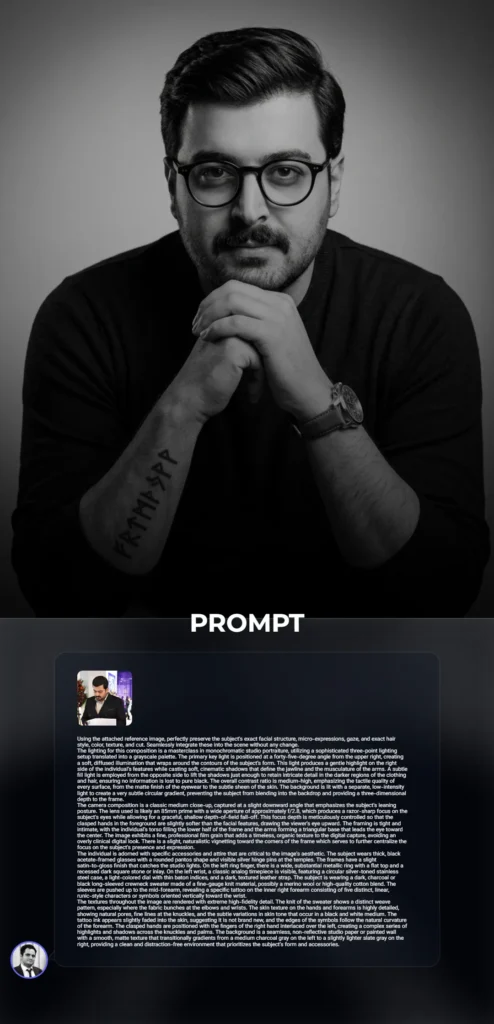
Professional Monochromatic Studio Portrait with Fine Detail and Runic TattooUsing the attached reference image, perfectly preserve the subject's exact facial structure, micro-expressions, gaze, and exact hair style, color, texture, and cut. Seamlessly integrate these into the scene without any change.
The lighting for this composition is a masterclass in monochromatic studio portraiture, utilizing a sophisticated three-point lighting setup translated into a grayscale palette. The primary key light is positioned at a forty-five-degree angle from the upper right, creating a soft, diffused illumination that wraps around the contours of the subject’s form. This light produces a gentle highlight on the right side of the individual’s features while casting soft, cinematic shadows that define the jawline and the musculature of the arms. A subtle fill light is employed from the opposite side to lift the shadows just enough to retain intricate detail in the darker regions of the clothing and hair, ensuring no information is lost to pure black. The overall contrast ratio is medium-high, emphasizing the tactile quality of every surface, from the matte finish of the eyewear to the subtle sheen of the skin. The background is lit with a separate, low-intensity light to create a very subtle circular gradient, preventing the subject from blending into the backdrop and providing a three-dimensional depth to the frame.
The camera composition is a classic medium close-up, captured at a slight downward angle that emphasizes the subject's leaning posture. The lens used is likely an 85mm prime with a wide aperture of approximately f/2.8, which produces a razor-sharp focus on the subject's eyes while allowing for a graceful, shallow depth-of-field fall-off. This focus depth is meticulously controlled so that the clasped hands in the foreground are slightly softer than the facial features, drawing the viewer's eye upward. The framing is tight and intimate, with the individual’s torso filling the lower half of the frame and the arms forming a triangular base that leads the eye toward the center. The image exhibits a fine, professional film grain that adds a timeless, organic texture to the digital capture, avoiding an overly clinical digital look. There is a slight, naturalistic vignetting toward the corners of the frame which serves to further centralize the focus on the subject's presence and expression.
The individual is adorned with specific accessories and attire that are critical to the image's aesthetic. The subject wears thick, black acetate-framed glasses with a rounded pantos shape and visible silver hinge pins at the temples. The frames have a slight satin-to-gloss finish that catches the studio lights. On the left ring finger, there is a wide, substantial metallic ring with a flat top and a recessed dark square stone or inlay. On the left wrist, a classic analog timepiece is visible, featuring a circular silver-toned stainless steel case, a light-colored dial with thin baton indices, and a dark, textured leather strap. The subject is wearing a dark, charcoal or black long-sleeved crewneck sweater made of a fine-gauge knit material, possibly a merino wool or high-quality cotton blend. The sleeves are pushed up to the mid-forearm, revealing a specific tattoo on the inner right forearm consisting of five distinct, linear, runic-style characters or symbols oriented vertically toward the wrist.
The textures throughout the image are rendered with extreme high-fidelity detail. The knit of the sweater shows a distinct weave pattern, especially where the fabric bunches at the elbows and wrists. The skin texture on the hands and forearms is highly detailed, showing natural pores, fine lines at the knuckles, and the subtle variations in skin tone that occur in a black and white medium. The tattoo ink appears slightly faded into the skin, suggesting it is not brand new, and the edges of the symbols follow the natural curvature of the forearm. The clasped hands are positioned with the fingers of the right hand interlaced over the left, creating a complex series of highlights and shadows across the knuckles and palms. The background is a seamless, non-reflective studio paper or painted wall with a smooth, matte texture that transitionally gradients from a medium charcoal gray on the left to a slightly lighter slate gray on the right, providing a clean and distraction-free environment that prioritizes the subject’s form and accessories.

Futuristic Monochromatic High-Fashion Portrait with Parametric ArchitectureUsing the attached reference image, perfectly preserve the subject's exact facial structure, micro-expressions, gaze, and exact hair style, color, texture, and cut. Seamlessly integrate these into the scene without any change. The setting consists of an ultra-modern, minimalist, and surreal architectural environment characterized by fluid, organic, and undulating wave-like structures that wrap around the subject in a complex, multi-layered arrangement. These architectural forms are reminiscent of parametric design, featuring smooth, sinuous curves and sweeping surfaces that transition seamlessly from bright, pristine whites to deep, velvety shadows. The geometry of the background is non-linear, suggesting a sculptural or liquid-inspired interior where walls and ceiling meld into one continuous, flowing form. The material of these structures appears as a semi-matte, high-grade architectural composite, catching the light in a way that emphasizes the three-dimensional volume and the graceful curvature of every fold and crest.
The lighting is a sophisticated, high-end studio arrangement that employs a high-key approach while maintaining a sense of dramatic contrast. A primary, large-scale diffused light source is positioned at an elevated three-quarter angle, casting a soft, even glow across the scene. This illumination creates delicate gradations of gray across the white background elements, highlighting the peaks of the waves and allowing the troughs to fall into a gentle, soft-focus shade. The light quality is highly directional yet soft-edged, ensuring there are no harsh glares or distracting specular highlights on the subject or the environment. This specific lighting setup emphasizes the textures of the clothing, particularly the way the light grazes the surface of the fabric to reveal its subtle weave and density.
The subject's attire is a masterclass in monochromatic minimalism. The individual is wearing a high-quality, long-sleeved black turtleneck sweater made from a fine-gauge knit material, possibly a blend of wool and cashmere, which exhibits a deep, light-absorbing matte finish. The fabric of the turtleneck is thick and structured, holding its shape perfectly around the neck and torso. Complementing the sweater are dark charcoal or black tailored trousers that feature a smooth, refined textile finish. The subject’s posture is poised and contemplative, with hands tucked naturally into the pockets of the trousers, creating a relaxed yet sophisticated silhouette. The fit of the clothing is precise, highlighting a lean and athletic frame without being overly tight, allowing for natural folds and creases to form at the elbows and the waistline where the sweater meets the trousers.
The camera composition is a vertical medium-full shot, capturing the subject from the mid-thigh upwards. The framing is centered on the subject, who is positioned in a three-quarter profile view, looking away from the camera toward the left of the frame. This creates a sense of introspection and mystery. The lens used is a high-resolution prime lens, likely a 50mm or 85mm, to provide a natural perspective with minimal distortion and a slight compression of space that brings the subject and the complex background into a harmonious relationship. The aperture is set to a moderate f/2.8 or f/4.0, which ensures the subject is in razor-sharp focus from the texture of the sweater to the edges of the clothing, while allowing the farthest layers of the undulating background to fall into a creamy, aesthetic bokeh. This depth of field emphasizes the subject as the focal point against the intricate architectural geometry.
The color palette is strictly achromatic and monochromatic, consisting of a sophisticated range of blacks, whites, and an infinite spectrum of grays. There is no hint of color, focusing entirely on form, light, and shadow. The blacks are deep and rich, providing a solid anchor for the composition, while the whites are clean and luminous. The overall image quality is characterized by a high-definition, digital photographic look with zero noise, exceptional clarity, and a smooth, professional finish. The atmosphere is one of quiet elegance, futurism, and high-fashion editorial styling, where every element of the composition, from the sweep of the background walls to the fold of the sleeves, is meticulously placed to create a visually stunning and balanced portrait.
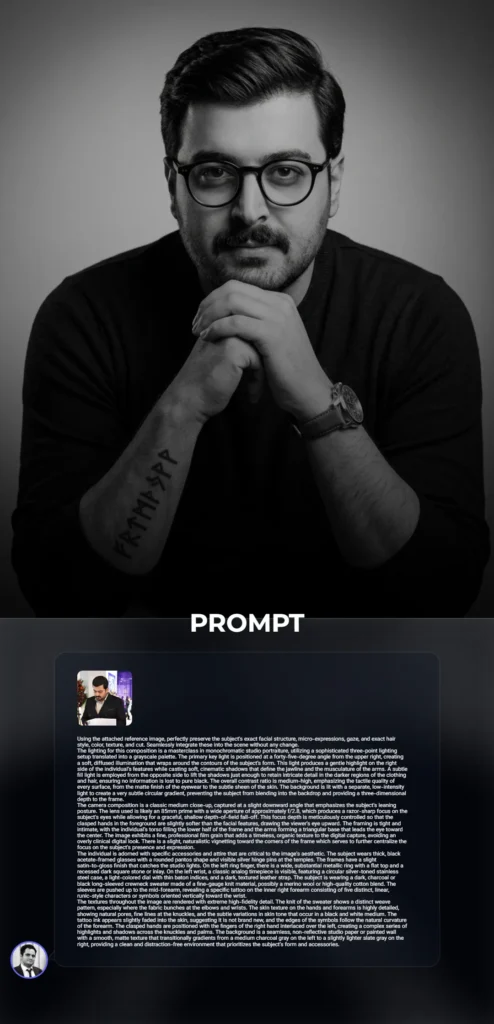
Professional Monochromatic Studio Portrait with Fine Detail and Runic TattooUsing the attached reference image, perfectly preserve the subject's exact facial structure, micro-expressions, gaze, and exact hair style, color, texture, and cut. Seamlessly integrate these into the scene without any change.
The lighting for this composition is a masterclass in monochromatic studio portraiture, utilizing a sophisticated three-point lighting setup translated into a grayscale palette. The primary key light is positioned at a forty-five-degree angle from the upper right, creating a soft, diffused illumination that wraps around the contours of the subject’s form. This light produces a gentle highlight on the right side of the individual’s features while casting soft, cinematic shadows that define the jawline and the musculature of the arms. A subtle fill light is employed from the opposite side to lift the shadows just enough to retain intricate detail in the darker regions of the clothing and hair, ensuring no information is lost to pure black. The overall contrast ratio is medium-high, emphasizing the tactile quality of every surface, from the matte finish of the eyewear to the subtle sheen of the skin. The background is lit with a separate, low-intensity light to create a very subtle circular gradient, preventing the subject from blending into the backdrop and providing a three-dimensional depth to the frame.
The camera composition is a classic medium close-up, captured at a slight downward angle that emphasizes the subject's leaning posture. The lens used is likely an 85mm prime with a wide aperture of approximately f/2.8, which produces a razor-sharp focus on the subject's eyes while allowing for a graceful, shallow depth-of-field fall-off. This focus depth is meticulously controlled so that the clasped hands in the foreground are slightly softer than the facial features, drawing the viewer's eye upward. The framing is tight and intimate, with the individual’s torso filling the lower half of the frame and the arms forming a triangular base that leads the eye toward the center. The image exhibits a fine, professional film grain that adds a timeless, organic texture to the digital capture, avoiding an overly clinical digital look. There is a slight, naturalistic vignetting toward the corners of the frame which serves to further centralize the focus on the subject's presence and expression.
The individual is adorned with specific accessories and attire that are critical to the image's aesthetic. The subject wears thick, black acetate-framed glasses with a rounded pantos shape and visible silver hinge pins at the temples. The frames have a slight satin-to-gloss finish that catches the studio lights. On the left ring finger, there is a wide, substantial metallic ring with a flat top and a recessed dark square stone or inlay. On the left wrist, a classic analog timepiece is visible, featuring a circular silver-toned stainless steel case, a light-colored dial with thin baton indices, and a dark, textured leather strap. The subject is wearing a dark, charcoal or black long-sleeved crewneck sweater made of a fine-gauge knit material, possibly a merino wool or high-quality cotton blend. The sleeves are pushed up to the mid-forearm, revealing a specific tattoo on the inner right forearm consisting of five distinct, linear, runic-style characters or symbols oriented vertically toward the wrist.
The textures throughout the image are rendered with extreme high-fidelity detail. The knit of the sweater shows a distinct weave pattern, especially where the fabric bunches at the elbows and wrists. The skin texture on the hands and forearms is highly detailed, showing natural pores, fine lines at the knuckles, and the subtle variations in skin tone that occur in a black and white medium. The tattoo ink appears slightly faded into the skin, suggesting it is not brand new, and the edges of the symbols follow the natural curvature of the forearm. The clasped hands are positioned with the fingers of the right hand interlaced over the left, creating a complex series of highlights and shadows across the knuckles and palms. The background is a seamless, non-reflective studio paper or painted wall with a smooth, matte texture that transitionally gradients from a medium charcoal gray on the left to a slightly lighter slate gray on the right, providing a clean and distraction-free environment that prioritizes the subject’s form and accessories.