Peymanaiminimalist
minimalist

Sophisticated Cinematic Cafe Portrait with High-End BokehUsing the attached reference image, perfectly preserve the subject's exact facial structure, micro-expressions, gaze, and exact hair style, color, texture, and cut. Seamlessly integrate these into the scene without any change.
The camera composition is a sophisticated vertical portrait captured with a high-end prime lens, likely an 85mm focal length, which provides a tight but natural compression of the scene. The aperture is set wide at approximately f/1.8 to create a shallow depth of field that renders the foreground and background into a creamy, soft-focus blur. In the immediate foreground, the out-of-focus back of a mustard-yellow or ochre-colored metal chair creates a framing element, with its vertical slats partially obscuring the bottom of the frame and drawing the eye directly toward the central subject. The subject is positioned in the middle ground, seated at a small circular cafe table. The camera is positioned at an eye-level height, creating an intimate, observational perspective that feels like a candid street photography moment. Every detail within the plane of focus is rendered with extreme crystalline clarity, while anything even slightly in front of or behind the subject melts into a professional bokeh effect.
The lighting and color palette are meticulously balanced to create a moody, urban atmosphere characterized by a desaturated and cinematic aesthetic. The primary light source is soft, diffused daylight, suggesting an overcast sky or a shaded outdoor area, which prevents harsh shadows on the subject. The overall color grade leans toward a teal and orange motif but in a subtle, sophisticated way; the greens of the foliage are deep, dark, and muted, while the grays of the background architecture are cool and neutralized. Contrast is high, with deep, crushed blacks in the shadows and bright, clean whites in the subject's attire. There are warm, amber highlights reflecting in the glass window behind the subject, providing a necessary color counterpoint to the cool, urban surroundings. The skin tones are rendered with high fidelity, appearing natural and warm against the cooler background environment.
The clothing and accessories worn by the individual are described through their tangible textures and materials. The subject is wearing a high-quality, heavy-gauge cotton t-shirt in a brilliant, clean white, where the micro-textures of the fabric weave and the soft folds around the arms and shoulders are clearly visible under the soft light. On the individual's wrist, a set of thin, intertwined cord bracelets in deep red and earthy brown adds a touch of personal detail. The subject is wearing a pair of modern, round-framed sunglasses with a matte charcoal or dark gray finish and slightly translucent frames, through which the eyes are faintly visible. The trousers are a dark, charcoal gray or black fabric with a matte finish, appearing crisp and well-tailored as the individual sits. The subject holds a small, white porcelain espresso cup with a clean, glossy glaze, gripped naturally as it is brought toward the face, with the steam and surface of the liquid being implied by the stillness of the pose.
The environment is an elegant outdoor cafe setting that feels both private and public. To the left of the subject, a large, lush potted plant, possibly a bay laurel or similar evergreen shrub, features waxy, dark green leaves that catch the light with a soft sheen, providing a dense organic texture that contrasts with the urban backdrop. The table is a minimalist design with a thin, white circular top and slim black metal legs. The background consists of a large, clean pane of glass that serves as a storefront or cafe window, reflecting the blurred silhouettes of European-style architecture and warm interior lights from across the street. These reflections add layers of depth and complexity to the image without distracting from the main subject. The ground and surrounding structures are rendered in various shades of slate and stone, contributing to the sophisticated, metropolitan vibe of the entire scene, which feels captured in a moment of quiet contemplation amidst a busy city.
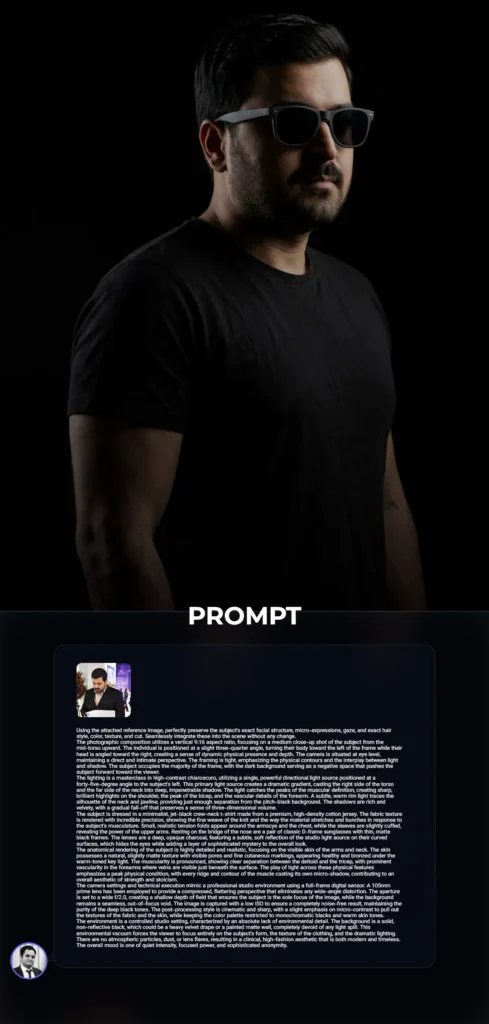
Cinematic Chiaroscuro Portrait: High-Contrast Studio Photography PromptUsing the attached reference image, perfectly preserve the subject's exact facial structure, micro-expressions, gaze, and exact hair style, color, texture, and cut. Seamlessly integrate these into the scene without any change.
The photographic composition utilizes a vertical 9:16 aspect ratio, focusing on a medium close-up shot of the subject from the mid-torso upward. The individual is positioned at a slight three-quarter angle, turning their body toward the left of the frame while their head is angled toward the right, creating a sense of dynamic physical presence and depth. The camera is situated at eye level, maintaining a direct and intimate perspective. The framing is tight, emphasizing the physical contours and the interplay between light and shadow. The subject occupies the majority of the frame, with the dark background serving as a negative space that pushes the subject forward toward the viewer.
The lighting is a masterclass in high-contrast chiaroscuro, utilizing a single, powerful directional light source positioned at a forty-five-degree angle to the subject's left. This primary light source creates a dramatic gradient, casting the right side of the torso and the far side of the neck into deep, impenetrable shadow. The light catches the peaks of the muscular definition, creating sharp, brilliant highlights on the shoulder, the peak of the bicep, and the vascular details of the forearm. A subtle, warm rim light traces the silhouette of the neck and jawline, providing just enough separation from the pitch-black background. The shadows are rich and velvety, with a gradual fall-off that preserves a sense of three-dimensional volume.
The subject is dressed in a minimalist, jet-black crew-neck t-shirt made from a premium, high-density cotton jersey. The fabric texture is rendered with incredible precision, showing the fine weave of the knit and the way the material stretches and bunches in response to the subject's musculature. Small, realistic tension folds appear around the armscye and the chest, while the sleeves are slightly cuffed, revealing the power of the upper arms. Resting on the bridge of the nose are a pair of classic D-frame sunglasses with thin, matte black frames. The lenses are a deep, opaque charcoal, featuring a subtle, soft reflection of the studio light source on their curved surfaces, which hides the eyes while adding a layer of sophisticated mystery to the overall look.
The anatomical rendering of the subject is highly detailed and realistic, focusing on the visible skin of the arms and neck. The skin possesses a natural, slightly matte texture with visible pores and fine cutaneous markings, appearing healthy and bronzed under the warm-toned key light. The muscularity is pronounced, showing clear separation between the deltoid and the tricep, with prominent vascularity in the forearms where veins are visible just beneath the surface. The play of light across these physical features emphasizes a peak physical condition, with every ridge and contour of the muscle casting its own micro-shadow, contributing to an overall aesthetic of strength and stoicism.
The camera settings and technical execution mimic a professional studio environment using a full-frame digital sensor. A 105mm prime lens has been employed to provide a compressed, flattering perspective that eliminates any wide-angle distortion. The aperture is set to a wide f/2.0, creating a shallow depth of field that ensures the subject is the sole focus of the image, while the background remains a seamless, out-of-focus void. The image is captured with a low ISO to ensure a completely noise-free result, maintaining the purity of the deep black tones. The post-processing style is cinematic and sharp, with a slight emphasis on micro-contrast to pull out the textures of the fabric and the skin, while keeping the color palette restricted to monochromatic blacks and warm skin tones.
The environment is a controlled studio setting, characterized by an absolute lack of environmental detail. The background is a solid, non-reflective black, which could be a heavy velvet drape or a painted matte wall, completely devoid of any light spill. This environmental vacuum forces the viewer to focus entirely on the subject's form, the texture of the clothing, and the dramatic lighting. There are no atmospheric particles, dust, or lens flares, resulting in a clinical, high-fashion aesthetic that is both modern and timeless. The overall mood is one of quiet intensity, focused power, and sophisticated anonymity.
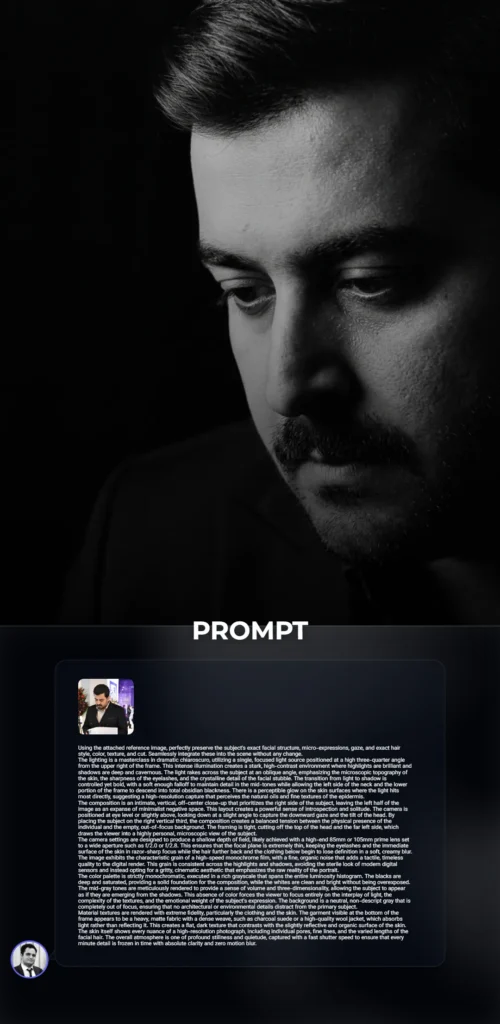
Dramatic Monochromatic Chiaroscuro Portrait Masterclass PromptUsing the attached reference image, perfectly preserve the subject's exact facial structure, micro-expressions, gaze, and exact hair style, color, texture, and cut. Seamlessly integrate these into the scene without any change.
The lighting is a masterclass in dramatic chiaroscuro, utilizing a single, focused light source positioned at a high three-quarter angle from the upper right of the frame. This intense illumination creates a stark, high-contrast environment where highlights are brilliant and shadows are deep and cavernous. The light rakes across the subject at an oblique angle, emphasizing the microscopic topography of the skin, the sharpness of the eyelashes, and the crystalline detail of the facial stubble. The transition from light to shadow is controlled yet bold, with a soft enough falloff to maintain detail in the mid-tones while allowing the left side of the neck and the lower portion of the frame to descend into total obsidian blackness. There is a perceptible glow on the skin surfaces where the light hits most directly, suggesting a high-resolution capture that perceives the natural oils and fine textures of the epidermis.
The composition is an intimate, vertical, off-center close-up that prioritizes the right side of the subject, leaving the left half of the image as an expanse of minimalist negative space. This layout creates a powerful sense of introspection and solitude. The camera is positioned at eye level or slightly above, looking down at a slight angle to capture the downward gaze and the tilt of the head. By placing the subject on the right vertical third, the composition creates a balanced tension between the physical presence of the individual and the empty, out-of-focus background. The framing is tight, cutting off the top of the head and the far left side, which draws the viewer into a highly personal, microscopic view of the subject.
The camera settings are designed to produce a shallow depth of field, likely achieved with a high-end 85mm or 105mm prime lens set to a wide aperture such as f/2.0 or f/2.8. This ensures that the focal plane is extremely thin, keeping the eyelashes and the immediate surface of the skin in razor-sharp focus while the hair further back and the clothing below begin to lose definition in a soft, creamy blur. The image exhibits the characteristic grain of a high-speed monochrome film, with a fine, organic noise that adds a tactile, timeless quality to the digital render. This grain is consistent across the highlights and shadows, avoiding the sterile look of modern digital sensors and instead opting for a gritty, cinematic aesthetic that emphasizes the raw reality of the portrait.
The color palette is strictly monochromatic, executed in a rich grayscale that spans the entire luminosity histogram. The blacks are deep and saturated, providing a solid foundation for the composition, while the whites are clean and bright without being overexposed. The mid-gray tones are meticulously rendered to provide a sense of volume and three-dimensionality, allowing the subject to appear as if they are emerging from the shadows. This absence of color forces the viewer to focus entirely on the interplay of light, the complexity of the textures, and the emotional weight of the subject's expression. The background is a neutral, non-descript gray that is completely out of focus, ensuring that no architectural or environmental details distract from the primary subject.
Material textures are rendered with extreme fidelity, particularly the clothing and the skin. The garment visible at the bottom of the frame appears to be a heavy, matte fabric with a dense weave, such as charcoal suede or a high-quality wool jacket, which absorbs light rather than reflecting it. This creates a flat, dark texture that contrasts with the slightly reflective and organic surface of the skin. The skin itself shows every nuance of a high-resolution photograph, including individual pores, fine lines, and the varied lengths of the facial hair. The overall atmosphere is one of profound stillness and quietude, captured with a fast shutter speed to ensure that every minute detail is frozen in time with absolute clarity and zero motion blur.
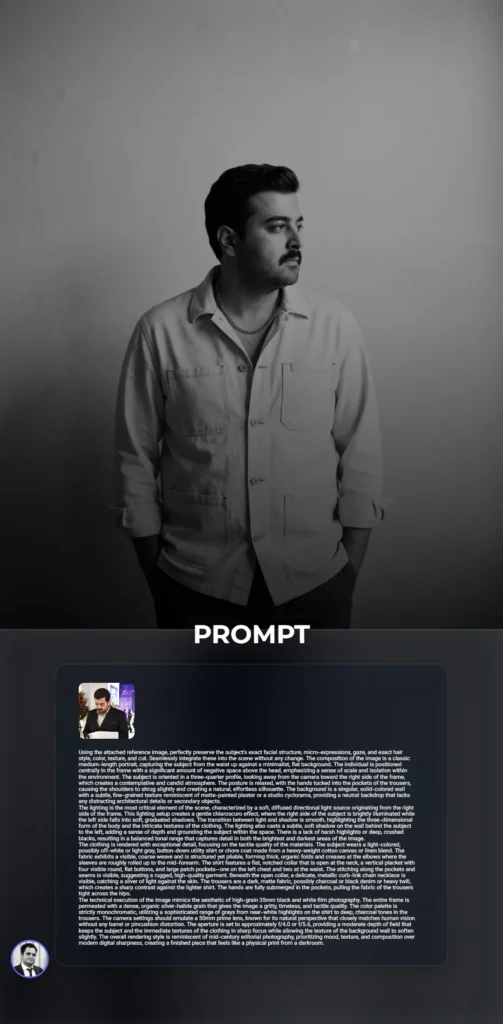
High-Grain 35mm Monochrome Portrait Prompt for Cinematic Minimalist Photography StylesUsing the attached reference image, perfectly preserve the subject's exact facial structure, micro-expressions, gaze, and exact hair style, color, texture, and cut. Seamlessly integrate these into the scene without any change. The composition of the image is a classic medium-length portrait, capturing the subject from the waist up against a minimalist, flat background. The individual is positioned centrally in the frame with a significant amount of negative space above the head, emphasizing a sense of scale and isolation within the environment. The subject is oriented in a three-quarter profile, looking away from the camera toward the right side of the frame, which creates a contemplative and candid atmosphere. The posture is relaxed, with the hands tucked into the pockets of the trousers, causing the shoulders to shrug slightly and creating a natural, effortless silhouette. The background is a singular, solid-colored wall with a subtle, fine-grained texture reminiscent of matte-painted plaster or a studio cyclorama, providing a neutral backdrop that lacks any distracting architectural details or secondary objects.
The lighting is the most critical element of the scene, characterized by a soft, diffused directional light source originating from the right side of the frame. This lighting setup creates a gentle chiaroscuro effect, where the right side of the subject is brightly illuminated while the left side falls into soft, graduated shadows. The transition between light and shadow is smooth, highlighting the three-dimensional form of the body and the intricate textures of the clothing. The lighting also casts a subtle, soft shadow on the wall behind the subject to the left, adding a sense of depth and grounding the subject within the space. There is a lack of harsh highlights or deep, crushed blacks, resulting in a balanced tonal range that captures detail in both the brightest and darkest areas of the image.
The clothing is rendered with exceptional detail, focusing on the tactile quality of the materials. The subject wears a light-colored, possibly off-white or light gray, button-down utility shirt or chore coat made from a heavy-weight cotton canvas or linen blend. The fabric exhibits a visible, coarse weave and is structured yet pliable, forming thick, organic folds and creases at the elbows where the sleeves are roughly rolled up to the mid-forearm. The shirt features a flat, notched collar that is open at the neck, a vertical placket with four visible round, flat buttons, and large patch pockets—one on the left chest and two at the waist. The stitching along the pockets and seams is visible, suggesting a rugged, high-quality garment. Beneath the open collar, a delicate, metallic curb-link chain necklace is visible, catching a sliver of light against the skin. The trousers are a dark, matte fabric, possibly charcoal or black denim or heavy twill, which creates a sharp contrast against the lighter shirt. The hands are fully submerged in the pockets, pulling the fabric of the trousers tight across the hips.
The technical execution of the image mimics the aesthetic of high-grain 35mm black and white film photography. The entire frame is permeated with a dense, organic silver-halide grain that gives the image a gritty, timeless, and tactile quality. The color palette is strictly monochromatic, utilizing a sophisticated range of grays from near-white highlights on the shirt to deep, charcoal tones in the trousers. The camera settings should emulate a 50mm prime lens, known for its natural perspective that closely matches human vision without any barrel or pincushion distortion. The aperture is set to approximately f/4.0 or f/5.6, providing a moderate depth of field that keeps the subject and the immediate textures of the clothing in sharp focus while allowing the texture of the background wall to soften slightly. The overall rendering style is reminiscent of mid-century editorial photography, prioritizing mood, texture, and composition over modern digital sharpness, creating a finished piece that feels like a physical print from a darkroom.
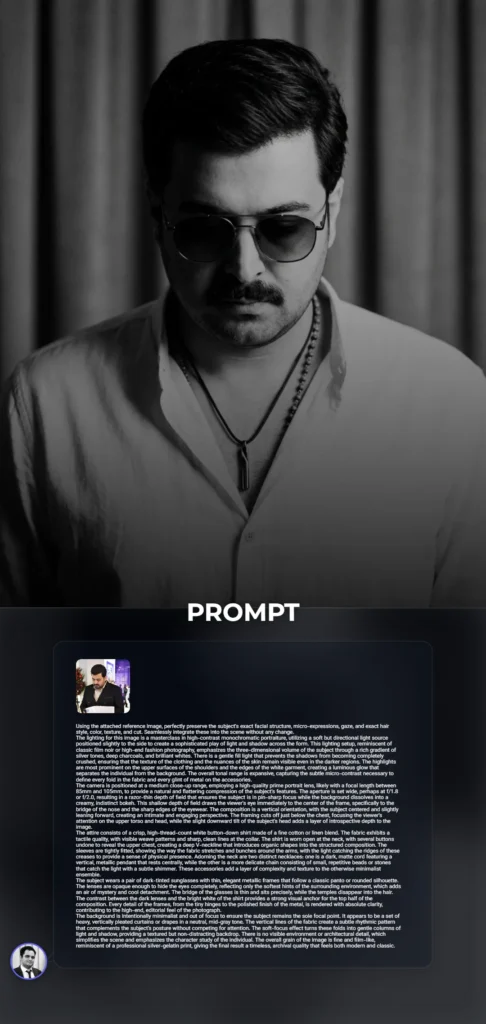
High-Contrast Noir Monochromatic Portrait with Editorial Fashion AestheticUsing the attached reference image, perfectly preserve the subject's exact facial structure, micro-expressions, gaze, and exact hair style, color, texture, and cut. Seamlessly integrate these into the scene without any change.
The lighting for this image is a masterclass in high-contrast monochromatic portraiture, utilizing a soft but directional light source positioned slightly to the side to create a sophisticated play of light and shadow across the form. This lighting setup, reminiscent of classic film noir or high-end fashion photography, emphasizes the three-dimensional volume of the subject through a rich gradient of silver tones, deep charcoals, and brilliant whites. There is a gentle fill light that prevents the shadows from becoming completely crushed, ensuring that the texture of the clothing and the nuances of the skin remain visible even in the darker regions. The highlights are most prominent on the upper surfaces of the shoulders and the edges of the white garment, creating a luminous glow that separates the individual from the background. The overall tonal range is expansive, capturing the subtle micro-contrast necessary to define every fold in the fabric and every glint of metal on the accessories.
The camera is positioned at a medium close-up range, employing a high-quality prime portrait lens, likely with a focal length between 85mm and 105mm, to provide a natural and flattering compression of the subject's features. The aperture is set wide, perhaps at f/1.8 or f/2.0, resulting in a razor-thin depth of field that ensures the subject is in pin-sharp focus while the background dissolves into a creamy, indistinct bokeh. This shallow depth of field draws the viewer's eye immediately to the center of the frame, specifically to the bridge of the nose and the sharp edges of the eyewear. The composition is a vertical orientation, with the subject centered and slightly leaning forward, creating an intimate and engaging perspective. The framing cuts off just below the chest, focusing the viewer's attention on the upper torso and head, while the slight downward tilt of the subject's head adds a layer of introspective depth to the image.
The attire consists of a crisp, high-thread-count white button-down shirt made of a fine cotton or linen blend. The fabric exhibits a tactile quality, with visible weave patterns and sharp, clean lines at the collar. The shirt is worn open at the neck, with several buttons undone to reveal the upper chest, creating a deep V-neckline that introduces organic shapes into the structured composition. The sleeves are tightly fitted, showing the way the fabric stretches and bunches around the arms, with the light catching the ridges of these creases to provide a sense of physical presence. Adorning the neck are two distinct necklaces: one is a dark, matte cord featuring a vertical, metallic pendant that rests centrally, while the other is a more delicate chain consisting of small, repetitive beads or stones that catch the light with a subtle shimmer. These accessories add a layer of complexity and texture to the otherwise minimalist ensemble.
The subject wears a pair of dark-tinted sunglasses with thin, elegant metallic frames that follow a classic panto or rounded silhouette. The lenses are opaque enough to hide the eyes completely, reflecting only the softest hints of the surrounding environment, which adds an air of mystery and cool detachment. The bridge of the glasses is thin and sits precisely, while the temples disappear into the hair. The contrast between the dark lenses and the bright white of the shirt provides a strong visual anchor for the top half of the composition. Every detail of the frames, from the tiny hinges to the polished finish of the metal, is rendered with absolute clarity, contributing to the high-end, editorial feel of the photograph.
The background is intentionally minimalist and out of focus to ensure the subject remains the sole focal point. It appears to be a set of heavy, vertically pleated curtains or drapes in a neutral, mid-gray tone. The vertical lines of the fabric create a subtle rhythmic pattern that complements the subject's posture without competing for attention. The soft-focus effect turns these folds into gentle columns of light and shadow, providing a textured but non-distracting backdrop. There is no visible environment or architectural detail, which simplifies the scene and emphasizes the character study of the individual. The overall grain of the image is fine and film-like, reminiscent of a professional silver-gelatin print, giving the final result a timeless, archival quality that feels both modern and classic.
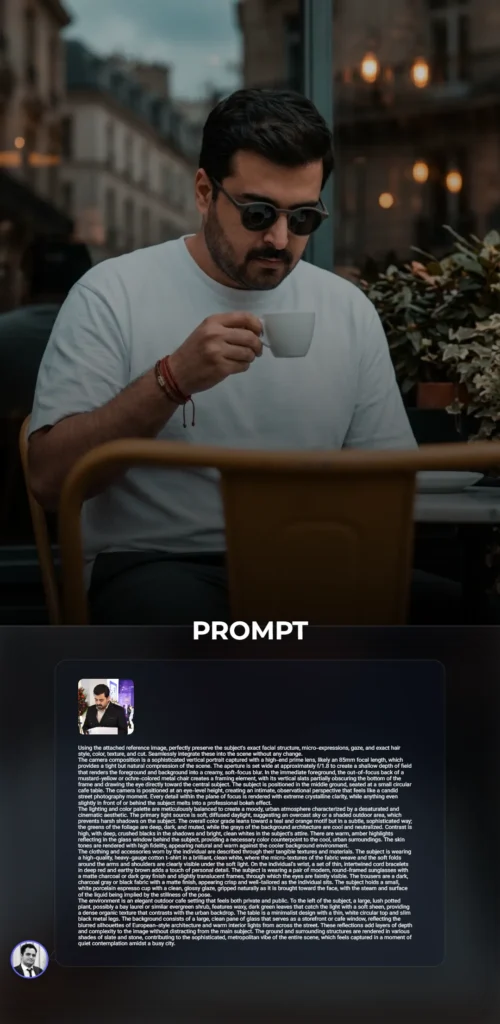
Sophisticated Cinematic Cafe Portrait with High-End BokehUsing the attached reference image, perfectly preserve the subject's exact facial structure, micro-expressions, gaze, and exact hair style, color, texture, and cut. Seamlessly integrate these into the scene without any change.
The camera composition is a sophisticated vertical portrait captured with a high-end prime lens, likely an 85mm focal length, which provides a tight but natural compression of the scene. The aperture is set wide at approximately f/1.8 to create a shallow depth of field that renders the foreground and background into a creamy, soft-focus blur. In the immediate foreground, the out-of-focus back of a mustard-yellow or ochre-colored metal chair creates a framing element, with its vertical slats partially obscuring the bottom of the frame and drawing the eye directly toward the central subject. The subject is positioned in the middle ground, seated at a small circular cafe table. The camera is positioned at an eye-level height, creating an intimate, observational perspective that feels like a candid street photography moment. Every detail within the plane of focus is rendered with extreme crystalline clarity, while anything even slightly in front of or behind the subject melts into a professional bokeh effect.
The lighting and color palette are meticulously balanced to create a moody, urban atmosphere characterized by a desaturated and cinematic aesthetic. The primary light source is soft, diffused daylight, suggesting an overcast sky or a shaded outdoor area, which prevents harsh shadows on the subject. The overall color grade leans toward a teal and orange motif but in a subtle, sophisticated way; the greens of the foliage are deep, dark, and muted, while the grays of the background architecture are cool and neutralized. Contrast is high, with deep, crushed blacks in the shadows and bright, clean whites in the subject's attire. There are warm, amber highlights reflecting in the glass window behind the subject, providing a necessary color counterpoint to the cool, urban surroundings. The skin tones are rendered with high fidelity, appearing natural and warm against the cooler background environment.
The clothing and accessories worn by the individual are described through their tangible textures and materials. The subject is wearing a high-quality, heavy-gauge cotton t-shirt in a brilliant, clean white, where the micro-textures of the fabric weave and the soft folds around the arms and shoulders are clearly visible under the soft light. On the individual's wrist, a set of thin, intertwined cord bracelets in deep red and earthy brown adds a touch of personal detail. The subject is wearing a pair of modern, round-framed sunglasses with a matte charcoal or dark gray finish and slightly translucent frames, through which the eyes are faintly visible. The trousers are a dark, charcoal gray or black fabric with a matte finish, appearing crisp and well-tailored as the individual sits. The subject holds a small, white porcelain espresso cup with a clean, glossy glaze, gripped naturally as it is brought toward the face, with the steam and surface of the liquid being implied by the stillness of the pose.
The environment is an elegant outdoor cafe setting that feels both private and public. To the left of the subject, a large, lush potted plant, possibly a bay laurel or similar evergreen shrub, features waxy, dark green leaves that catch the light with a soft sheen, providing a dense organic texture that contrasts with the urban backdrop. The table is a minimalist design with a thin, white circular top and slim black metal legs. The background consists of a large, clean pane of glass that serves as a storefront or cafe window, reflecting the blurred silhouettes of European-style architecture and warm interior lights from across the street. These reflections add layers of depth and complexity to the image without distracting from the main subject. The ground and surrounding structures are rendered in various shades of slate and stone, contributing to the sophisticated, metropolitan vibe of the entire scene, which feels captured in a moment of quiet contemplation amidst a busy city.
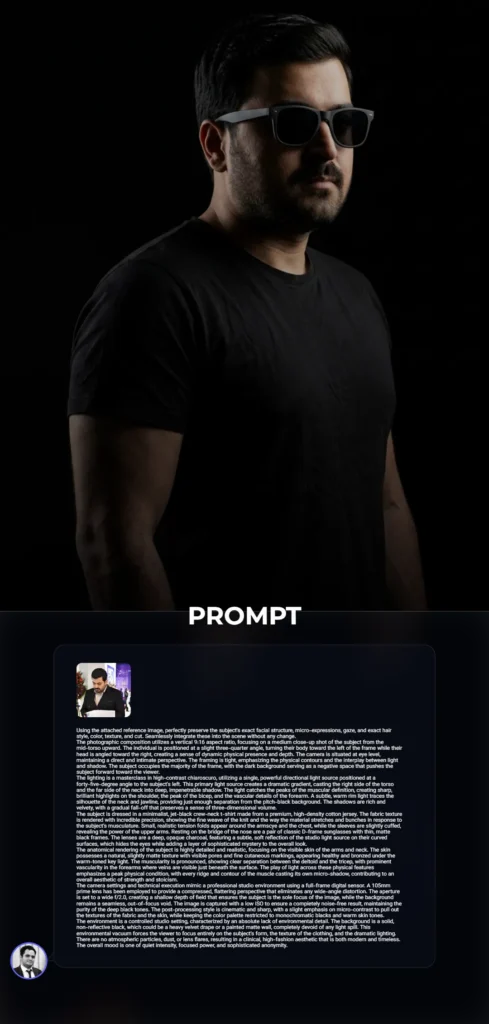
Cinematic Chiaroscuro Portrait: High-Contrast Studio Photography PromptUsing the attached reference image, perfectly preserve the subject's exact facial structure, micro-expressions, gaze, and exact hair style, color, texture, and cut. Seamlessly integrate these into the scene without any change.
The photographic composition utilizes a vertical 9:16 aspect ratio, focusing on a medium close-up shot of the subject from the mid-torso upward. The individual is positioned at a slight three-quarter angle, turning their body toward the left of the frame while their head is angled toward the right, creating a sense of dynamic physical presence and depth. The camera is situated at eye level, maintaining a direct and intimate perspective. The framing is tight, emphasizing the physical contours and the interplay between light and shadow. The subject occupies the majority of the frame, with the dark background serving as a negative space that pushes the subject forward toward the viewer.
The lighting is a masterclass in high-contrast chiaroscuro, utilizing a single, powerful directional light source positioned at a forty-five-degree angle to the subject's left. This primary light source creates a dramatic gradient, casting the right side of the torso and the far side of the neck into deep, impenetrable shadow. The light catches the peaks of the muscular definition, creating sharp, brilliant highlights on the shoulder, the peak of the bicep, and the vascular details of the forearm. A subtle, warm rim light traces the silhouette of the neck and jawline, providing just enough separation from the pitch-black background. The shadows are rich and velvety, with a gradual fall-off that preserves a sense of three-dimensional volume.
The subject is dressed in a minimalist, jet-black crew-neck t-shirt made from a premium, high-density cotton jersey. The fabric texture is rendered with incredible precision, showing the fine weave of the knit and the way the material stretches and bunches in response to the subject's musculature. Small, realistic tension folds appear around the armscye and the chest, while the sleeves are slightly cuffed, revealing the power of the upper arms. Resting on the bridge of the nose are a pair of classic D-frame sunglasses with thin, matte black frames. The lenses are a deep, opaque charcoal, featuring a subtle, soft reflection of the studio light source on their curved surfaces, which hides the eyes while adding a layer of sophisticated mystery to the overall look.
The anatomical rendering of the subject is highly detailed and realistic, focusing on the visible skin of the arms and neck. The skin possesses a natural, slightly matte texture with visible pores and fine cutaneous markings, appearing healthy and bronzed under the warm-toned key light. The muscularity is pronounced, showing clear separation between the deltoid and the tricep, with prominent vascularity in the forearms where veins are visible just beneath the surface. The play of light across these physical features emphasizes a peak physical condition, with every ridge and contour of the muscle casting its own micro-shadow, contributing to an overall aesthetic of strength and stoicism.
The camera settings and technical execution mimic a professional studio environment using a full-frame digital sensor. A 105mm prime lens has been employed to provide a compressed, flattering perspective that eliminates any wide-angle distortion. The aperture is set to a wide f/2.0, creating a shallow depth of field that ensures the subject is the sole focus of the image, while the background remains a seamless, out-of-focus void. The image is captured with a low ISO to ensure a completely noise-free result, maintaining the purity of the deep black tones. The post-processing style is cinematic and sharp, with a slight emphasis on micro-contrast to pull out the textures of the fabric and the skin, while keeping the color palette restricted to monochromatic blacks and warm skin tones.
The environment is a controlled studio setting, characterized by an absolute lack of environmental detail. The background is a solid, non-reflective black, which could be a heavy velvet drape or a painted matte wall, completely devoid of any light spill. This environmental vacuum forces the viewer to focus entirely on the subject's form, the texture of the clothing, and the dramatic lighting. There are no atmospheric particles, dust, or lens flares, resulting in a clinical, high-fashion aesthetic that is both modern and timeless. The overall mood is one of quiet intensity, focused power, and sophisticated anonymity.

Dramatic Monochromatic Chiaroscuro Portrait Masterclass PromptUsing the attached reference image, perfectly preserve the subject's exact facial structure, micro-expressions, gaze, and exact hair style, color, texture, and cut. Seamlessly integrate these into the scene without any change.
The lighting is a masterclass in dramatic chiaroscuro, utilizing a single, focused light source positioned at a high three-quarter angle from the upper right of the frame. This intense illumination creates a stark, high-contrast environment where highlights are brilliant and shadows are deep and cavernous. The light rakes across the subject at an oblique angle, emphasizing the microscopic topography of the skin, the sharpness of the eyelashes, and the crystalline detail of the facial stubble. The transition from light to shadow is controlled yet bold, with a soft enough falloff to maintain detail in the mid-tones while allowing the left side of the neck and the lower portion of the frame to descend into total obsidian blackness. There is a perceptible glow on the skin surfaces where the light hits most directly, suggesting a high-resolution capture that perceives the natural oils and fine textures of the epidermis.
The composition is an intimate, vertical, off-center close-up that prioritizes the right side of the subject, leaving the left half of the image as an expanse of minimalist negative space. This layout creates a powerful sense of introspection and solitude. The camera is positioned at eye level or slightly above, looking down at a slight angle to capture the downward gaze and the tilt of the head. By placing the subject on the right vertical third, the composition creates a balanced tension between the physical presence of the individual and the empty, out-of-focus background. The framing is tight, cutting off the top of the head and the far left side, which draws the viewer into a highly personal, microscopic view of the subject.
The camera settings are designed to produce a shallow depth of field, likely achieved with a high-end 85mm or 105mm prime lens set to a wide aperture such as f/2.0 or f/2.8. This ensures that the focal plane is extremely thin, keeping the eyelashes and the immediate surface of the skin in razor-sharp focus while the hair further back and the clothing below begin to lose definition in a soft, creamy blur. The image exhibits the characteristic grain of a high-speed monochrome film, with a fine, organic noise that adds a tactile, timeless quality to the digital render. This grain is consistent across the highlights and shadows, avoiding the sterile look of modern digital sensors and instead opting for a gritty, cinematic aesthetic that emphasizes the raw reality of the portrait.
The color palette is strictly monochromatic, executed in a rich grayscale that spans the entire luminosity histogram. The blacks are deep and saturated, providing a solid foundation for the composition, while the whites are clean and bright without being overexposed. The mid-gray tones are meticulously rendered to provide a sense of volume and three-dimensionality, allowing the subject to appear as if they are emerging from the shadows. This absence of color forces the viewer to focus entirely on the interplay of light, the complexity of the textures, and the emotional weight of the subject's expression. The background is a neutral, non-descript gray that is completely out of focus, ensuring that no architectural or environmental details distract from the primary subject.
Material textures are rendered with extreme fidelity, particularly the clothing and the skin. The garment visible at the bottom of the frame appears to be a heavy, matte fabric with a dense weave, such as charcoal suede or a high-quality wool jacket, which absorbs light rather than reflecting it. This creates a flat, dark texture that contrasts with the slightly reflective and organic surface of the skin. The skin itself shows every nuance of a high-resolution photograph, including individual pores, fine lines, and the varied lengths of the facial hair. The overall atmosphere is one of profound stillness and quietude, captured with a fast shutter speed to ensure that every minute detail is frozen in time with absolute clarity and zero motion blur.

High-Grain 35mm Monochrome Portrait Prompt for Cinematic Minimalist Photography StylesUsing the attached reference image, perfectly preserve the subject's exact facial structure, micro-expressions, gaze, and exact hair style, color, texture, and cut. Seamlessly integrate these into the scene without any change. The composition of the image is a classic medium-length portrait, capturing the subject from the waist up against a minimalist, flat background. The individual is positioned centrally in the frame with a significant amount of negative space above the head, emphasizing a sense of scale and isolation within the environment. The subject is oriented in a three-quarter profile, looking away from the camera toward the right side of the frame, which creates a contemplative and candid atmosphere. The posture is relaxed, with the hands tucked into the pockets of the trousers, causing the shoulders to shrug slightly and creating a natural, effortless silhouette. The background is a singular, solid-colored wall with a subtle, fine-grained texture reminiscent of matte-painted plaster or a studio cyclorama, providing a neutral backdrop that lacks any distracting architectural details or secondary objects.
The lighting is the most critical element of the scene, characterized by a soft, diffused directional light source originating from the right side of the frame. This lighting setup creates a gentle chiaroscuro effect, where the right side of the subject is brightly illuminated while the left side falls into soft, graduated shadows. The transition between light and shadow is smooth, highlighting the three-dimensional form of the body and the intricate textures of the clothing. The lighting also casts a subtle, soft shadow on the wall behind the subject to the left, adding a sense of depth and grounding the subject within the space. There is a lack of harsh highlights or deep, crushed blacks, resulting in a balanced tonal range that captures detail in both the brightest and darkest areas of the image.
The clothing is rendered with exceptional detail, focusing on the tactile quality of the materials. The subject wears a light-colored, possibly off-white or light gray, button-down utility shirt or chore coat made from a heavy-weight cotton canvas or linen blend. The fabric exhibits a visible, coarse weave and is structured yet pliable, forming thick, organic folds and creases at the elbows where the sleeves are roughly rolled up to the mid-forearm. The shirt features a flat, notched collar that is open at the neck, a vertical placket with four visible round, flat buttons, and large patch pockets—one on the left chest and two at the waist. The stitching along the pockets and seams is visible, suggesting a rugged, high-quality garment. Beneath the open collar, a delicate, metallic curb-link chain necklace is visible, catching a sliver of light against the skin. The trousers are a dark, matte fabric, possibly charcoal or black denim or heavy twill, which creates a sharp contrast against the lighter shirt. The hands are fully submerged in the pockets, pulling the fabric of the trousers tight across the hips.
The technical execution of the image mimics the aesthetic of high-grain 35mm black and white film photography. The entire frame is permeated with a dense, organic silver-halide grain that gives the image a gritty, timeless, and tactile quality. The color palette is strictly monochromatic, utilizing a sophisticated range of grays from near-white highlights on the shirt to deep, charcoal tones in the trousers. The camera settings should emulate a 50mm prime lens, known for its natural perspective that closely matches human vision without any barrel or pincushion distortion. The aperture is set to approximately f/4.0 or f/5.6, providing a moderate depth of field that keeps the subject and the immediate textures of the clothing in sharp focus while allowing the texture of the background wall to soften slightly. The overall rendering style is reminiscent of mid-century editorial photography, prioritizing mood, texture, and composition over modern digital sharpness, creating a finished piece that feels like a physical print from a darkroom.

High-Contrast Noir Monochromatic Portrait with Editorial Fashion AestheticUsing the attached reference image, perfectly preserve the subject's exact facial structure, micro-expressions, gaze, and exact hair style, color, texture, and cut. Seamlessly integrate these into the scene without any change.
The lighting for this image is a masterclass in high-contrast monochromatic portraiture, utilizing a soft but directional light source positioned slightly to the side to create a sophisticated play of light and shadow across the form. This lighting setup, reminiscent of classic film noir or high-end fashion photography, emphasizes the three-dimensional volume of the subject through a rich gradient of silver tones, deep charcoals, and brilliant whites. There is a gentle fill light that prevents the shadows from becoming completely crushed, ensuring that the texture of the clothing and the nuances of the skin remain visible even in the darker regions. The highlights are most prominent on the upper surfaces of the shoulders and the edges of the white garment, creating a luminous glow that separates the individual from the background. The overall tonal range is expansive, capturing the subtle micro-contrast necessary to define every fold in the fabric and every glint of metal on the accessories.
The camera is positioned at a medium close-up range, employing a high-quality prime portrait lens, likely with a focal length between 85mm and 105mm, to provide a natural and flattering compression of the subject's features. The aperture is set wide, perhaps at f/1.8 or f/2.0, resulting in a razor-thin depth of field that ensures the subject is in pin-sharp focus while the background dissolves into a creamy, indistinct bokeh. This shallow depth of field draws the viewer's eye immediately to the center of the frame, specifically to the bridge of the nose and the sharp edges of the eyewear. The composition is a vertical orientation, with the subject centered and slightly leaning forward, creating an intimate and engaging perspective. The framing cuts off just below the chest, focusing the viewer's attention on the upper torso and head, while the slight downward tilt of the subject's head adds a layer of introspective depth to the image.
The attire consists of a crisp, high-thread-count white button-down shirt made of a fine cotton or linen blend. The fabric exhibits a tactile quality, with visible weave patterns and sharp, clean lines at the collar. The shirt is worn open at the neck, with several buttons undone to reveal the upper chest, creating a deep V-neckline that introduces organic shapes into the structured composition. The sleeves are tightly fitted, showing the way the fabric stretches and bunches around the arms, with the light catching the ridges of these creases to provide a sense of physical presence. Adorning the neck are two distinct necklaces: one is a dark, matte cord featuring a vertical, metallic pendant that rests centrally, while the other is a more delicate chain consisting of small, repetitive beads or stones that catch the light with a subtle shimmer. These accessories add a layer of complexity and texture to the otherwise minimalist ensemble.
The subject wears a pair of dark-tinted sunglasses with thin, elegant metallic frames that follow a classic panto or rounded silhouette. The lenses are opaque enough to hide the eyes completely, reflecting only the softest hints of the surrounding environment, which adds an air of mystery and cool detachment. The bridge of the glasses is thin and sits precisely, while the temples disappear into the hair. The contrast between the dark lenses and the bright white of the shirt provides a strong visual anchor for the top half of the composition. Every detail of the frames, from the tiny hinges to the polished finish of the metal, is rendered with absolute clarity, contributing to the high-end, editorial feel of the photograph.
The background is intentionally minimalist and out of focus to ensure the subject remains the sole focal point. It appears to be a set of heavy, vertically pleated curtains or drapes in a neutral, mid-gray tone. The vertical lines of the fabric create a subtle rhythmic pattern that complements the subject's posture without competing for attention. The soft-focus effect turns these folds into gentle columns of light and shadow, providing a textured but non-distracting backdrop. There is no visible environment or architectural detail, which simplifies the scene and emphasizes the character study of the individual. The overall grain of the image is fine and film-like, reminiscent of a professional silver-gelatin print, giving the final result a timeless, archival quality that feels both modern and classic.
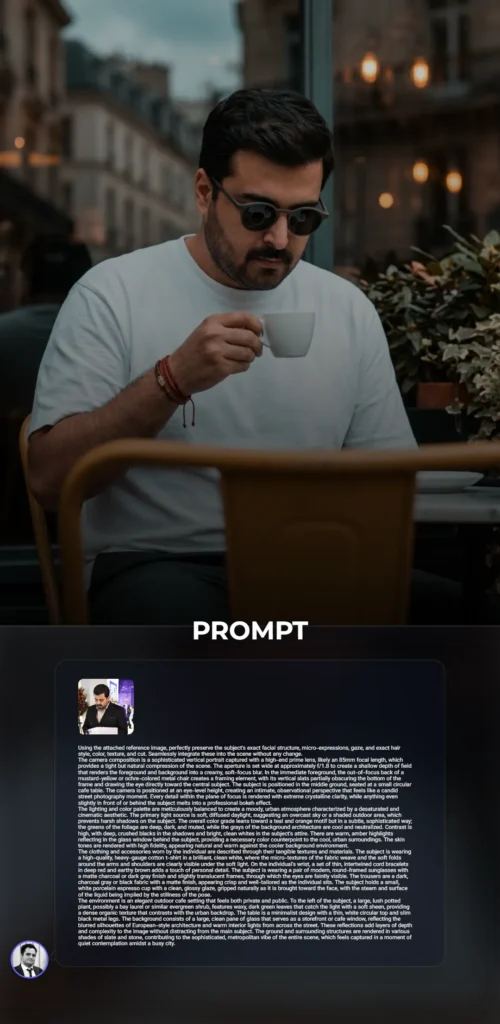
Sophisticated Cinematic Cafe Portrait with High-End BokehUsing the attached reference image, perfectly preserve the subject's exact facial structure, micro-expressions, gaze, and exact hair style, color, texture, and cut. Seamlessly integrate these into the scene without any change.
The camera composition is a sophisticated vertical portrait captured with a high-end prime lens, likely an 85mm focal length, which provides a tight but natural compression of the scene. The aperture is set wide at approximately f/1.8 to create a shallow depth of field that renders the foreground and background into a creamy, soft-focus blur. In the immediate foreground, the out-of-focus back of a mustard-yellow or ochre-colored metal chair creates a framing element, with its vertical slats partially obscuring the bottom of the frame and drawing the eye directly toward the central subject. The subject is positioned in the middle ground, seated at a small circular cafe table. The camera is positioned at an eye-level height, creating an intimate, observational perspective that feels like a candid street photography moment. Every detail within the plane of focus is rendered with extreme crystalline clarity, while anything even slightly in front of or behind the subject melts into a professional bokeh effect.
The lighting and color palette are meticulously balanced to create a moody, urban atmosphere characterized by a desaturated and cinematic aesthetic. The primary light source is soft, diffused daylight, suggesting an overcast sky or a shaded outdoor area, which prevents harsh shadows on the subject. The overall color grade leans toward a teal and orange motif but in a subtle, sophisticated way; the greens of the foliage are deep, dark, and muted, while the grays of the background architecture are cool and neutralized. Contrast is high, with deep, crushed blacks in the shadows and bright, clean whites in the subject's attire. There are warm, amber highlights reflecting in the glass window behind the subject, providing a necessary color counterpoint to the cool, urban surroundings. The skin tones are rendered with high fidelity, appearing natural and warm against the cooler background environment.
The clothing and accessories worn by the individual are described through their tangible textures and materials. The subject is wearing a high-quality, heavy-gauge cotton t-shirt in a brilliant, clean white, where the micro-textures of the fabric weave and the soft folds around the arms and shoulders are clearly visible under the soft light. On the individual's wrist, a set of thin, intertwined cord bracelets in deep red and earthy brown adds a touch of personal detail. The subject is wearing a pair of modern, round-framed sunglasses with a matte charcoal or dark gray finish and slightly translucent frames, through which the eyes are faintly visible. The trousers are a dark, charcoal gray or black fabric with a matte finish, appearing crisp and well-tailored as the individual sits. The subject holds a small, white porcelain espresso cup with a clean, glossy glaze, gripped naturally as it is brought toward the face, with the steam and surface of the liquid being implied by the stillness of the pose.
The environment is an elegant outdoor cafe setting that feels both private and public. To the left of the subject, a large, lush potted plant, possibly a bay laurel or similar evergreen shrub, features waxy, dark green leaves that catch the light with a soft sheen, providing a dense organic texture that contrasts with the urban backdrop. The table is a minimalist design with a thin, white circular top and slim black metal legs. The background consists of a large, clean pane of glass that serves as a storefront or cafe window, reflecting the blurred silhouettes of European-style architecture and warm interior lights from across the street. These reflections add layers of depth and complexity to the image without distracting from the main subject. The ground and surrounding structures are rendered in various shades of slate and stone, contributing to the sophisticated, metropolitan vibe of the entire scene, which feels captured in a moment of quiet contemplation amidst a busy city.
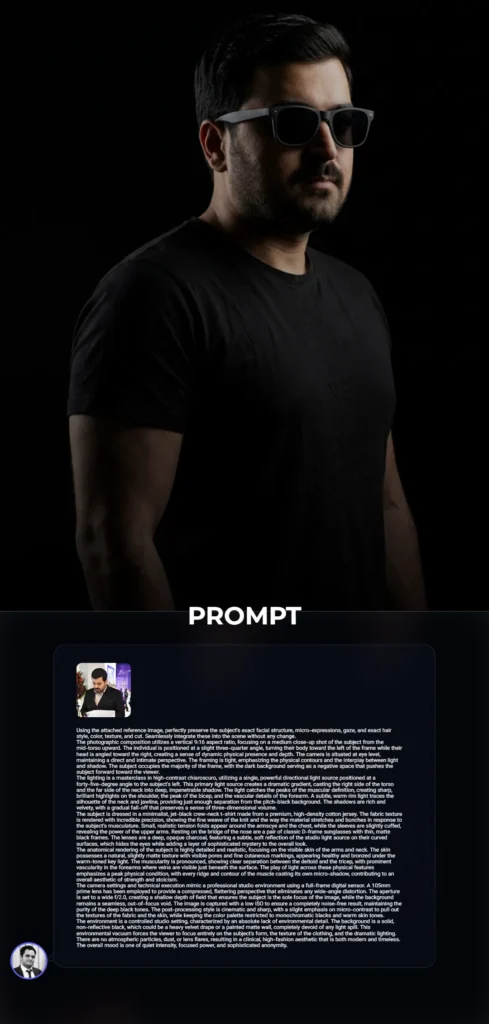
Cinematic Chiaroscuro Portrait: High-Contrast Studio Photography PromptUsing the attached reference image, perfectly preserve the subject's exact facial structure, micro-expressions, gaze, and exact hair style, color, texture, and cut. Seamlessly integrate these into the scene without any change.
The photographic composition utilizes a vertical 9:16 aspect ratio, focusing on a medium close-up shot of the subject from the mid-torso upward. The individual is positioned at a slight three-quarter angle, turning their body toward the left of the frame while their head is angled toward the right, creating a sense of dynamic physical presence and depth. The camera is situated at eye level, maintaining a direct and intimate perspective. The framing is tight, emphasizing the physical contours and the interplay between light and shadow. The subject occupies the majority of the frame, with the dark background serving as a negative space that pushes the subject forward toward the viewer.
The lighting is a masterclass in high-contrast chiaroscuro, utilizing a single, powerful directional light source positioned at a forty-five-degree angle to the subject's left. This primary light source creates a dramatic gradient, casting the right side of the torso and the far side of the neck into deep, impenetrable shadow. The light catches the peaks of the muscular definition, creating sharp, brilliant highlights on the shoulder, the peak of the bicep, and the vascular details of the forearm. A subtle, warm rim light traces the silhouette of the neck and jawline, providing just enough separation from the pitch-black background. The shadows are rich and velvety, with a gradual fall-off that preserves a sense of three-dimensional volume.
The subject is dressed in a minimalist, jet-black crew-neck t-shirt made from a premium, high-density cotton jersey. The fabric texture is rendered with incredible precision, showing the fine weave of the knit and the way the material stretches and bunches in response to the subject's musculature. Small, realistic tension folds appear around the armscye and the chest, while the sleeves are slightly cuffed, revealing the power of the upper arms. Resting on the bridge of the nose are a pair of classic D-frame sunglasses with thin, matte black frames. The lenses are a deep, opaque charcoal, featuring a subtle, soft reflection of the studio light source on their curved surfaces, which hides the eyes while adding a layer of sophisticated mystery to the overall look.
The anatomical rendering of the subject is highly detailed and realistic, focusing on the visible skin of the arms and neck. The skin possesses a natural, slightly matte texture with visible pores and fine cutaneous markings, appearing healthy and bronzed under the warm-toned key light. The muscularity is pronounced, showing clear separation between the deltoid and the tricep, with prominent vascularity in the forearms where veins are visible just beneath the surface. The play of light across these physical features emphasizes a peak physical condition, with every ridge and contour of the muscle casting its own micro-shadow, contributing to an overall aesthetic of strength and stoicism.
The camera settings and technical execution mimic a professional studio environment using a full-frame digital sensor. A 105mm prime lens has been employed to provide a compressed, flattering perspective that eliminates any wide-angle distortion. The aperture is set to a wide f/2.0, creating a shallow depth of field that ensures the subject is the sole focus of the image, while the background remains a seamless, out-of-focus void. The image is captured with a low ISO to ensure a completely noise-free result, maintaining the purity of the deep black tones. The post-processing style is cinematic and sharp, with a slight emphasis on micro-contrast to pull out the textures of the fabric and the skin, while keeping the color palette restricted to monochromatic blacks and warm skin tones.
The environment is a controlled studio setting, characterized by an absolute lack of environmental detail. The background is a solid, non-reflective black, which could be a heavy velvet drape or a painted matte wall, completely devoid of any light spill. This environmental vacuum forces the viewer to focus entirely on the subject's form, the texture of the clothing, and the dramatic lighting. There are no atmospheric particles, dust, or lens flares, resulting in a clinical, high-fashion aesthetic that is both modern and timeless. The overall mood is one of quiet intensity, focused power, and sophisticated anonymity.
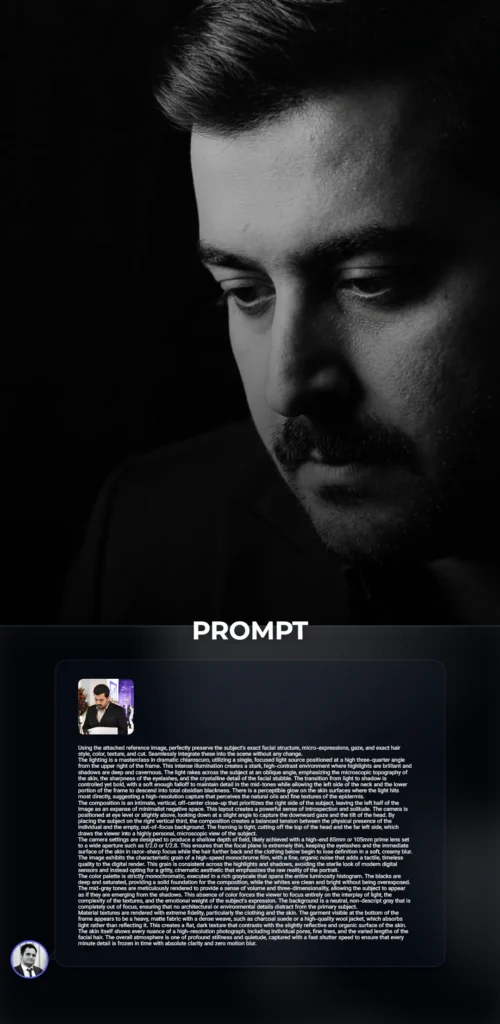
Dramatic Monochromatic Chiaroscuro Portrait Masterclass PromptUsing the attached reference image, perfectly preserve the subject's exact facial structure, micro-expressions, gaze, and exact hair style, color, texture, and cut. Seamlessly integrate these into the scene without any change.
The lighting is a masterclass in dramatic chiaroscuro, utilizing a single, focused light source positioned at a high three-quarter angle from the upper right of the frame. This intense illumination creates a stark, high-contrast environment where highlights are brilliant and shadows are deep and cavernous. The light rakes across the subject at an oblique angle, emphasizing the microscopic topography of the skin, the sharpness of the eyelashes, and the crystalline detail of the facial stubble. The transition from light to shadow is controlled yet bold, with a soft enough falloff to maintain detail in the mid-tones while allowing the left side of the neck and the lower portion of the frame to descend into total obsidian blackness. There is a perceptible glow on the skin surfaces where the light hits most directly, suggesting a high-resolution capture that perceives the natural oils and fine textures of the epidermis.
The composition is an intimate, vertical, off-center close-up that prioritizes the right side of the subject, leaving the left half of the image as an expanse of minimalist negative space. This layout creates a powerful sense of introspection and solitude. The camera is positioned at eye level or slightly above, looking down at a slight angle to capture the downward gaze and the tilt of the head. By placing the subject on the right vertical third, the composition creates a balanced tension between the physical presence of the individual and the empty, out-of-focus background. The framing is tight, cutting off the top of the head and the far left side, which draws the viewer into a highly personal, microscopic view of the subject.
The camera settings are designed to produce a shallow depth of field, likely achieved with a high-end 85mm or 105mm prime lens set to a wide aperture such as f/2.0 or f/2.8. This ensures that the focal plane is extremely thin, keeping the eyelashes and the immediate surface of the skin in razor-sharp focus while the hair further back and the clothing below begin to lose definition in a soft, creamy blur. The image exhibits the characteristic grain of a high-speed monochrome film, with a fine, organic noise that adds a tactile, timeless quality to the digital render. This grain is consistent across the highlights and shadows, avoiding the sterile look of modern digital sensors and instead opting for a gritty, cinematic aesthetic that emphasizes the raw reality of the portrait.
The color palette is strictly monochromatic, executed in a rich grayscale that spans the entire luminosity histogram. The blacks are deep and saturated, providing a solid foundation for the composition, while the whites are clean and bright without being overexposed. The mid-gray tones are meticulously rendered to provide a sense of volume and three-dimensionality, allowing the subject to appear as if they are emerging from the shadows. This absence of color forces the viewer to focus entirely on the interplay of light, the complexity of the textures, and the emotional weight of the subject's expression. The background is a neutral, non-descript gray that is completely out of focus, ensuring that no architectural or environmental details distract from the primary subject.
Material textures are rendered with extreme fidelity, particularly the clothing and the skin. The garment visible at the bottom of the frame appears to be a heavy, matte fabric with a dense weave, such as charcoal suede or a high-quality wool jacket, which absorbs light rather than reflecting it. This creates a flat, dark texture that contrasts with the slightly reflective and organic surface of the skin. The skin itself shows every nuance of a high-resolution photograph, including individual pores, fine lines, and the varied lengths of the facial hair. The overall atmosphere is one of profound stillness and quietude, captured with a fast shutter speed to ensure that every minute detail is frozen in time with absolute clarity and zero motion blur.
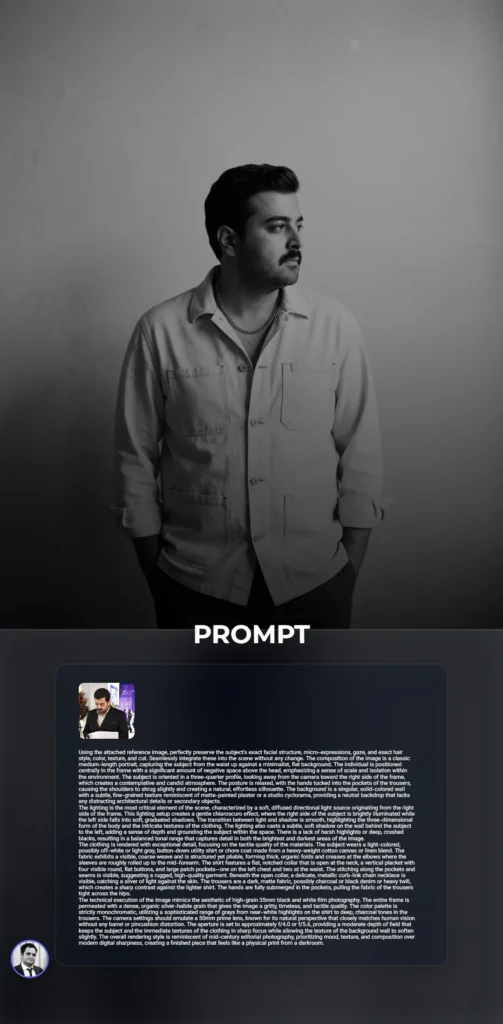
High-Grain 35mm Monochrome Portrait Prompt for Cinematic Minimalist Photography StylesUsing the attached reference image, perfectly preserve the subject's exact facial structure, micro-expressions, gaze, and exact hair style, color, texture, and cut. Seamlessly integrate these into the scene without any change. The composition of the image is a classic medium-length portrait, capturing the subject from the waist up against a minimalist, flat background. The individual is positioned centrally in the frame with a significant amount of negative space above the head, emphasizing a sense of scale and isolation within the environment. The subject is oriented in a three-quarter profile, looking away from the camera toward the right side of the frame, which creates a contemplative and candid atmosphere. The posture is relaxed, with the hands tucked into the pockets of the trousers, causing the shoulders to shrug slightly and creating a natural, effortless silhouette. The background is a singular, solid-colored wall with a subtle, fine-grained texture reminiscent of matte-painted plaster or a studio cyclorama, providing a neutral backdrop that lacks any distracting architectural details or secondary objects.
The lighting is the most critical element of the scene, characterized by a soft, diffused directional light source originating from the right side of the frame. This lighting setup creates a gentle chiaroscuro effect, where the right side of the subject is brightly illuminated while the left side falls into soft, graduated shadows. The transition between light and shadow is smooth, highlighting the three-dimensional form of the body and the intricate textures of the clothing. The lighting also casts a subtle, soft shadow on the wall behind the subject to the left, adding a sense of depth and grounding the subject within the space. There is a lack of harsh highlights or deep, crushed blacks, resulting in a balanced tonal range that captures detail in both the brightest and darkest areas of the image.
The clothing is rendered with exceptional detail, focusing on the tactile quality of the materials. The subject wears a light-colored, possibly off-white or light gray, button-down utility shirt or chore coat made from a heavy-weight cotton canvas or linen blend. The fabric exhibits a visible, coarse weave and is structured yet pliable, forming thick, organic folds and creases at the elbows where the sleeves are roughly rolled up to the mid-forearm. The shirt features a flat, notched collar that is open at the neck, a vertical placket with four visible round, flat buttons, and large patch pockets—one on the left chest and two at the waist. The stitching along the pockets and seams is visible, suggesting a rugged, high-quality garment. Beneath the open collar, a delicate, metallic curb-link chain necklace is visible, catching a sliver of light against the skin. The trousers are a dark, matte fabric, possibly charcoal or black denim or heavy twill, which creates a sharp contrast against the lighter shirt. The hands are fully submerged in the pockets, pulling the fabric of the trousers tight across the hips.
The technical execution of the image mimics the aesthetic of high-grain 35mm black and white film photography. The entire frame is permeated with a dense, organic silver-halide grain that gives the image a gritty, timeless, and tactile quality. The color palette is strictly monochromatic, utilizing a sophisticated range of grays from near-white highlights on the shirt to deep, charcoal tones in the trousers. The camera settings should emulate a 50mm prime lens, known for its natural perspective that closely matches human vision without any barrel or pincushion distortion. The aperture is set to approximately f/4.0 or f/5.6, providing a moderate depth of field that keeps the subject and the immediate textures of the clothing in sharp focus while allowing the texture of the background wall to soften slightly. The overall rendering style is reminiscent of mid-century editorial photography, prioritizing mood, texture, and composition over modern digital sharpness, creating a finished piece that feels like a physical print from a darkroom.
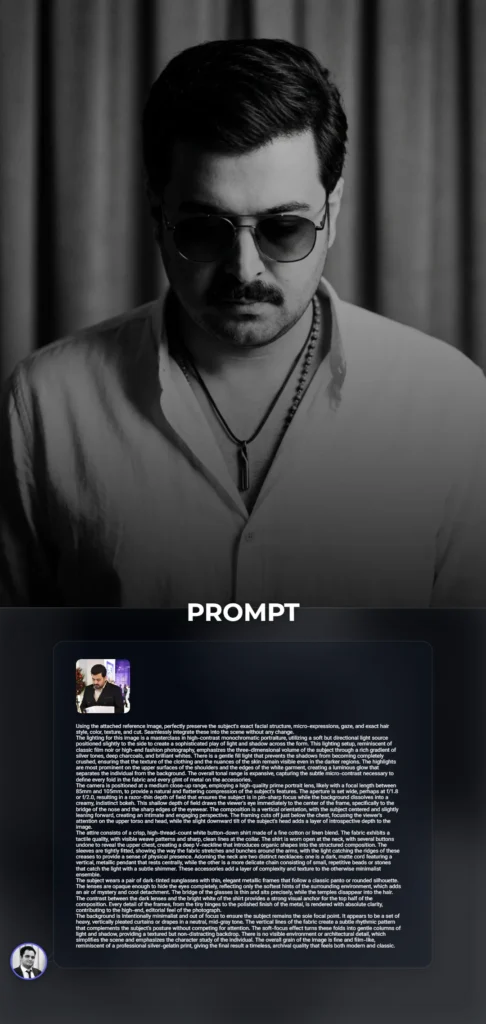
High-Contrast Noir Monochromatic Portrait with Editorial Fashion AestheticUsing the attached reference image, perfectly preserve the subject's exact facial structure, micro-expressions, gaze, and exact hair style, color, texture, and cut. Seamlessly integrate these into the scene without any change.
The lighting for this image is a masterclass in high-contrast monochromatic portraiture, utilizing a soft but directional light source positioned slightly to the side to create a sophisticated play of light and shadow across the form. This lighting setup, reminiscent of classic film noir or high-end fashion photography, emphasizes the three-dimensional volume of the subject through a rich gradient of silver tones, deep charcoals, and brilliant whites. There is a gentle fill light that prevents the shadows from becoming completely crushed, ensuring that the texture of the clothing and the nuances of the skin remain visible even in the darker regions. The highlights are most prominent on the upper surfaces of the shoulders and the edges of the white garment, creating a luminous glow that separates the individual from the background. The overall tonal range is expansive, capturing the subtle micro-contrast necessary to define every fold in the fabric and every glint of metal on the accessories.
The camera is positioned at a medium close-up range, employing a high-quality prime portrait lens, likely with a focal length between 85mm and 105mm, to provide a natural and flattering compression of the subject's features. The aperture is set wide, perhaps at f/1.8 or f/2.0, resulting in a razor-thin depth of field that ensures the subject is in pin-sharp focus while the background dissolves into a creamy, indistinct bokeh. This shallow depth of field draws the viewer's eye immediately to the center of the frame, specifically to the bridge of the nose and the sharp edges of the eyewear. The composition is a vertical orientation, with the subject centered and slightly leaning forward, creating an intimate and engaging perspective. The framing cuts off just below the chest, focusing the viewer's attention on the upper torso and head, while the slight downward tilt of the subject's head adds a layer of introspective depth to the image.
The attire consists of a crisp, high-thread-count white button-down shirt made of a fine cotton or linen blend. The fabric exhibits a tactile quality, with visible weave patterns and sharp, clean lines at the collar. The shirt is worn open at the neck, with several buttons undone to reveal the upper chest, creating a deep V-neckline that introduces organic shapes into the structured composition. The sleeves are tightly fitted, showing the way the fabric stretches and bunches around the arms, with the light catching the ridges of these creases to provide a sense of physical presence. Adorning the neck are two distinct necklaces: one is a dark, matte cord featuring a vertical, metallic pendant that rests centrally, while the other is a more delicate chain consisting of small, repetitive beads or stones that catch the light with a subtle shimmer. These accessories add a layer of complexity and texture to the otherwise minimalist ensemble.
The subject wears a pair of dark-tinted sunglasses with thin, elegant metallic frames that follow a classic panto or rounded silhouette. The lenses are opaque enough to hide the eyes completely, reflecting only the softest hints of the surrounding environment, which adds an air of mystery and cool detachment. The bridge of the glasses is thin and sits precisely, while the temples disappear into the hair. The contrast between the dark lenses and the bright white of the shirt provides a strong visual anchor for the top half of the composition. Every detail of the frames, from the tiny hinges to the polished finish of the metal, is rendered with absolute clarity, contributing to the high-end, editorial feel of the photograph.
The background is intentionally minimalist and out of focus to ensure the subject remains the sole focal point. It appears to be a set of heavy, vertically pleated curtains or drapes in a neutral, mid-gray tone. The vertical lines of the fabric create a subtle rhythmic pattern that complements the subject's posture without competing for attention. The soft-focus effect turns these folds into gentle columns of light and shadow, providing a textured but non-distracting backdrop. There is no visible environment or architectural detail, which simplifies the scene and emphasizes the character study of the individual. The overall grain of the image is fine and film-like, reminiscent of a professional silver-gelatin print, giving the final result a timeless, archival quality that feels both modern and classic.