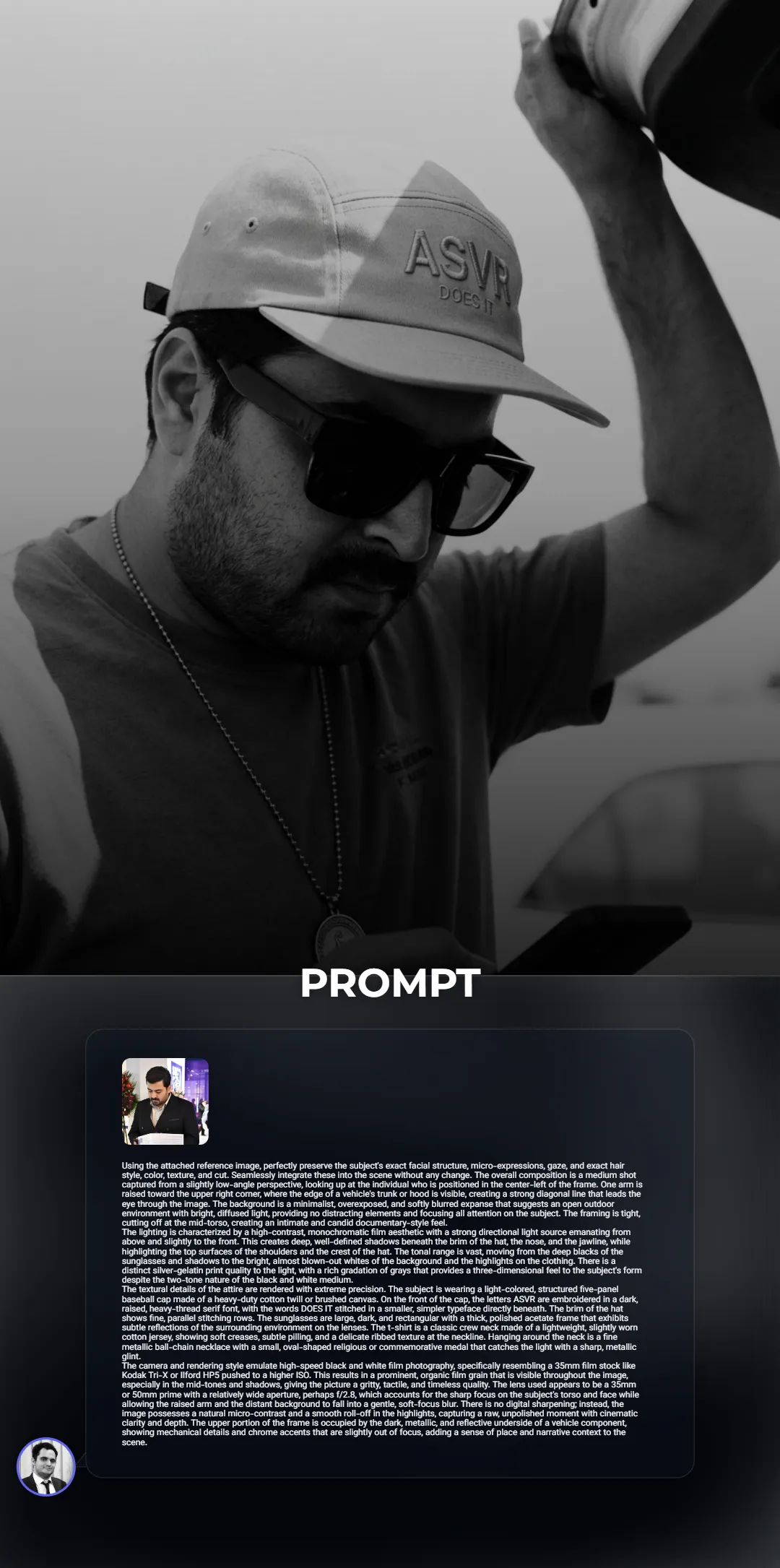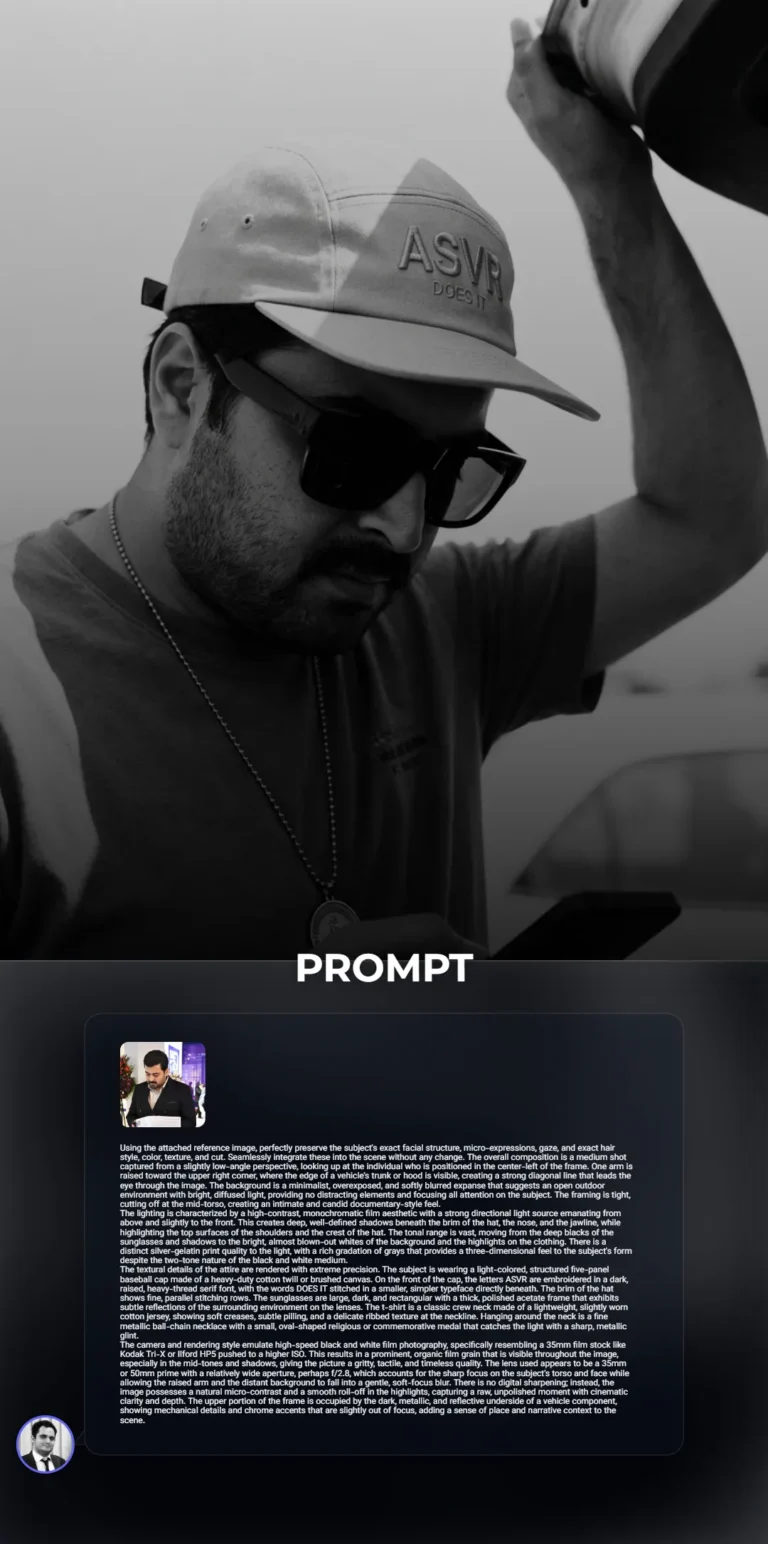
Cinematic B&W Documentary Portrait with ASVR Branding and Film GrainUsing the attached reference image, perfectly preserve the subject's exact facial structure, micro-expressions, gaze, and exact hair style, color, texture, and cut. Seamlessly integrate these into the scene without any change. The overall composition is a medium shot captured from a slightly low-angle perspective, looking up at the individual who is positioned in the center-left of the frame. One arm is raised toward the upper right corner, where the edge of a vehicle's trunk or hood is visible, creating a strong diagonal line that leads the eye through the image. The background is a minimalist, overexposed, and softly blurred expanse that suggests an open outdoor environment with bright, diffused light, providing no distracting elements and focusing all attention on the subject. The framing is tight, cutting off at the mid-torso, creating an intimate and candid documentary-style feel.
The lighting is characterized by a high-contrast, monochromatic film aesthetic with a strong directional light source emanating from above and slightly to the front. This creates deep, well-defined shadows beneath the brim of the hat, the nose, and the jawline, while highlighting the top surfaces of the shoulders and the crest of the hat. The tonal range is vast, moving from the deep blacks of the sunglasses and shadows to the bright, almost blown-out whites of the background and the highlights on the clothing. There is a distinct silver-gelatin print quality to the light, with a rich gradation of grays that provides a three-dimensional feel to the subject's form despite the two-tone nature of the black and white medium.
The textural details of the attire are rendered with extreme precision. The subject is wearing a light-colored, structured five-panel baseball cap made of a heavy-duty cotton twill or brushed canvas. On the front of the cap, the letters ASVR are embroidered in a dark, raised, heavy-thread serif font, with the words DOES IT stitched in a smaller, simpler typeface directly beneath. The brim of the hat shows fine, parallel stitching rows. The sunglasses are large, dark, and rectangular with a thick, polished acetate frame that exhibits subtle reflections of the surrounding environment on the lenses. The t-shirt is a classic crew neck made of a lightweight, slightly worn cotton jersey, showing soft creases, subtle pilling, and a delicate ribbed texture at the neckline. Hanging around the neck is a fine metallic ball-chain necklace with a small, oval-shaped religious or commemorative medal that catches the light with a sharp, metallic glint.
The camera and rendering style emulate high-speed black and white film photography, specifically resembling a 35mm film stock like Kodak Tri-X or Ilford HP5 pushed to a higher ISO. This results in a prominent, organic film grain that is visible throughout the image, especially in the mid-tones and shadows, giving the picture a gritty, tactile, and timeless quality. The lens used appears to be a 35mm or 50mm prime with a relatively wide aperture, perhaps f/2.8, which accounts for the sharp focus on the subject's torso and face while allowing the raised arm and the distant background to fall into a gentle, soft-focus blur. There is no digital sharpening; instead, the image possesses a natural micro-contrast and a smooth roll-off in the highlights, capturing a raw, unpolished moment with cinematic clarity and depth. The upper portion of the frame is occupied by the dark, metallic, and reflective underside of a vehicle component, showing mechanical details and chrome accents that are slightly out of focus, adding a sense of place and narrative context to the scene.
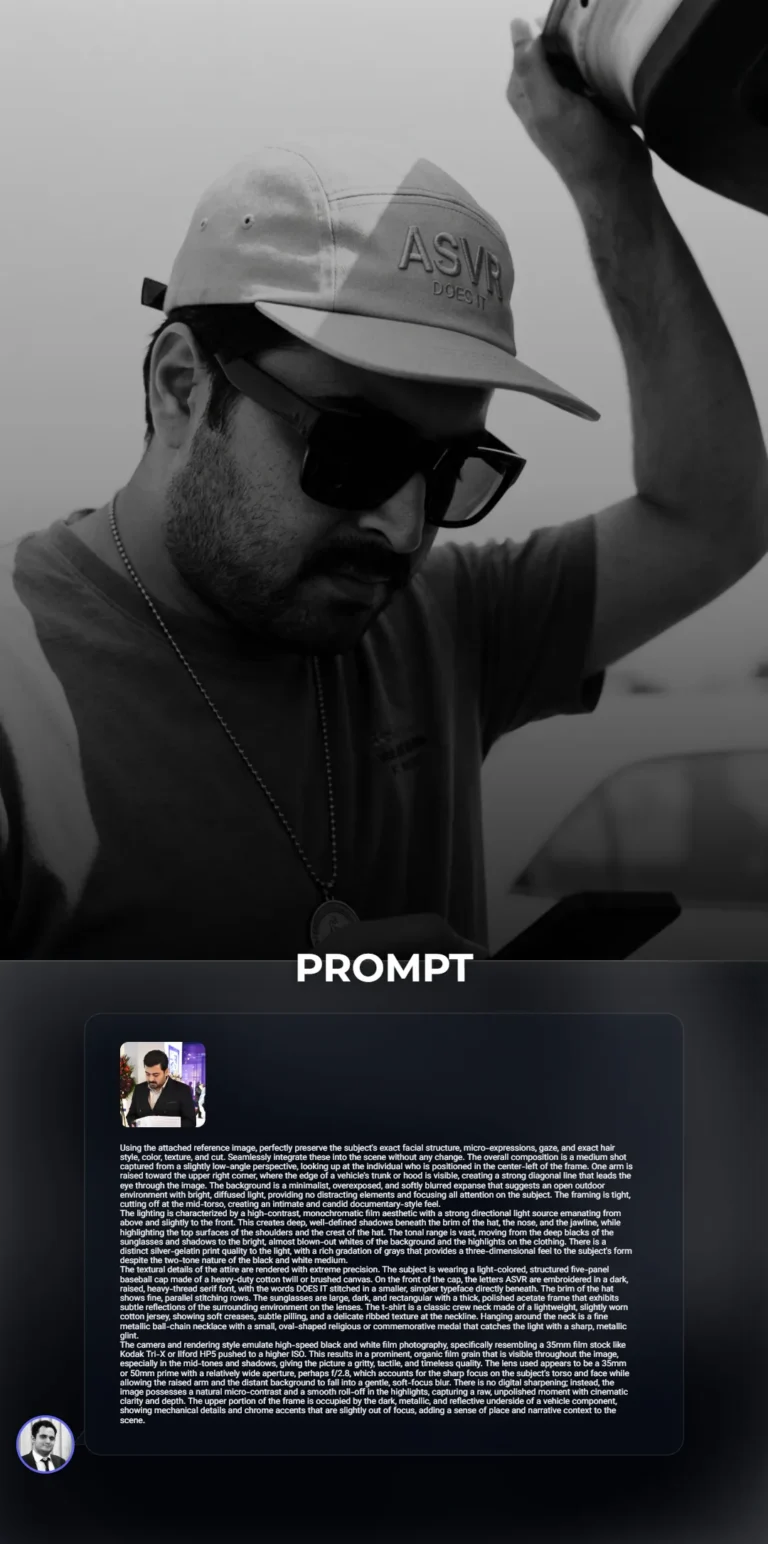
Cinematic B&W Documentary Portrait with ASVR Branding and Film GrainUsing the attached reference image, perfectly preserve the subject's exact facial structure, micro-expressions, gaze, and exact hair style, color, texture, and cut. Seamlessly integrate these into the scene without any change. The overall composition is a medium shot captured from a slightly low-angle perspective, looking up at the individual who is positioned in the center-left of the frame. One arm is raised toward the upper right corner, where the edge of a vehicle's trunk or hood is visible, creating a strong diagonal line that leads the eye through the image. The background is a minimalist, overexposed, and softly blurred expanse that suggests an open outdoor environment with bright, diffused light, providing no distracting elements and focusing all attention on the subject. The framing is tight, cutting off at the mid-torso, creating an intimate and candid documentary-style feel.
The lighting is characterized by a high-contrast, monochromatic film aesthetic with a strong directional light source emanating from above and slightly to the front. This creates deep, well-defined shadows beneath the brim of the hat, the nose, and the jawline, while highlighting the top surfaces of the shoulders and the crest of the hat. The tonal range is vast, moving from the deep blacks of the sunglasses and shadows to the bright, almost blown-out whites of the background and the highlights on the clothing. There is a distinct silver-gelatin print quality to the light, with a rich gradation of grays that provides a three-dimensional feel to the subject's form despite the two-tone nature of the black and white medium.
The textural details of the attire are rendered with extreme precision. The subject is wearing a light-colored, structured five-panel baseball cap made of a heavy-duty cotton twill or brushed canvas. On the front of the cap, the letters ASVR are embroidered in a dark, raised, heavy-thread serif font, with the words DOES IT stitched in a smaller, simpler typeface directly beneath. The brim of the hat shows fine, parallel stitching rows. The sunglasses are large, dark, and rectangular with a thick, polished acetate frame that exhibits subtle reflections of the surrounding environment on the lenses. The t-shirt is a classic crew neck made of a lightweight, slightly worn cotton jersey, showing soft creases, subtle pilling, and a delicate ribbed texture at the neckline. Hanging around the neck is a fine metallic ball-chain necklace with a small, oval-shaped religious or commemorative medal that catches the light with a sharp, metallic glint.
The camera and rendering style emulate high-speed black and white film photography, specifically resembling a 35mm film stock like Kodak Tri-X or Ilford HP5 pushed to a higher ISO. This results in a prominent, organic film grain that is visible throughout the image, especially in the mid-tones and shadows, giving the picture a gritty, tactile, and timeless quality. The lens used appears to be a 35mm or 50mm prime with a relatively wide aperture, perhaps f/2.8, which accounts for the sharp focus on the subject's torso and face while allowing the raised arm and the distant background to fall into a gentle, soft-focus blur. There is no digital sharpening; instead, the image possesses a natural micro-contrast and a smooth roll-off in the highlights, capturing a raw, unpolished moment with cinematic clarity and depth. The upper portion of the frame is occupied by the dark, metallic, and reflective underside of a vehicle component, showing mechanical details and chrome accents that are slightly out of focus, adding a sense of place and narrative context to the scene.
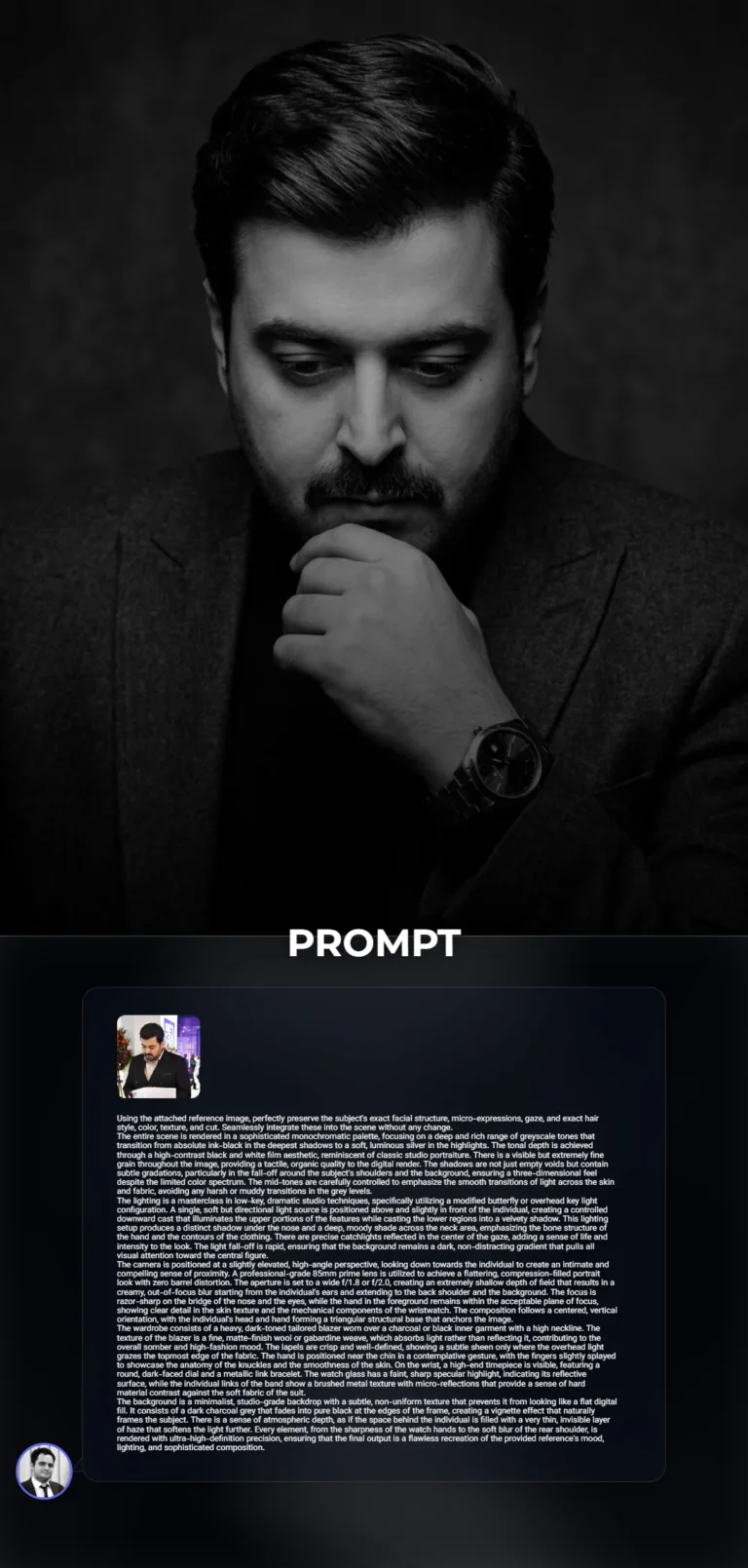
Professional Monochromatic Studio Portrait Prompt for High-End Cinematic Reference Face PreservationUsing the attached reference image, perfectly preserve the subject's exact facial structure, micro-expressions, gaze, and exact hair style, color, texture, and cut. Seamlessly integrate these into the scene without any change.
The entire scene is rendered in a sophisticated monochromatic palette, focusing on a deep and rich range of greyscale tones that transition from absolute ink-black in the deepest shadows to a soft, luminous silver in the highlights. The tonal depth is achieved through a high-contrast black and white film aesthetic, reminiscent of classic studio portraiture. There is a visible but extremely fine grain throughout the image, providing a tactile, organic quality to the digital render. The shadows are not just empty voids but contain subtle gradations, particularly in the fall-off around the subject's shoulders and the background, ensuring a three-dimensional feel despite the limited color spectrum. The mid-tones are carefully controlled to emphasize the smooth transitions of light across the skin and fabric, avoiding any harsh or muddy transitions in the grey levels.
The lighting is a masterclass in low-key, dramatic studio techniques, specifically utilizing a modified butterfly or overhead key light configuration. A single, soft but directional light source is positioned above and slightly in front of the individual, creating a controlled downward cast that illuminates the upper portions of the features while casting the lower regions into a velvety shadow. This lighting setup produces a distinct shadow under the nose and a deep, moody shade across the neck area, emphasizing the bone structure of the hand and the contours of the clothing. There are precise catchlights reflected in the center of the gaze, adding a sense of life and intensity to the look. The light fall-off is rapid, ensuring that the background remains a dark, non-distracting gradient that pulls all visual attention toward the central figure.
The camera is positioned at a slightly elevated, high-angle perspective, looking down towards the individual to create an intimate and compelling sense of proximity. A professional-grade 85mm prime lens is utilized to achieve a flattering, compression-filled portrait look with zero barrel distortion. The aperture is set to a wide f/1.8 or f/2.0, creating an extremely shallow depth of field that results in a creamy, out-of-focus blur starting from the individual's ears and extending to the back shoulder and the background. The focus is razor-sharp on the bridge of the nose and the eyes, while the hand in the foreground remains within the acceptable plane of focus, showing clear detail in the skin texture and the mechanical components of the wristwatch. The composition follows a centered, vertical orientation, with the individual's head and hand forming a triangular structural base that anchors the image.
The wardrobe consists of a heavy, dark-toned tailored blazer worn over a charcoal or black inner garment with a high neckline. The texture of the blazer is a fine, matte-finish wool or gabardine weave, which absorbs light rather than reflecting it, contributing to the overall somber and high-fashion mood. The lapels are crisp and well-defined, showing a subtle sheen only where the overhead light grazes the topmost edge of the fabric. The hand is positioned near the chin in a contemplative gesture, with the fingers slightly splayed to showcase the anatomy of the knuckles and the smoothness of the skin. On the wrist, a high-end timepiece is visible, featuring a round, dark-faced dial and a metallic link bracelet. The watch glass has a faint, sharp specular highlight, indicating its reflective surface, while the individual links of the band show a brushed metal texture with micro-reflections that provide a sense of hard material contrast against the soft fabric of the suit.
The background is a minimalist, studio-grade backdrop with a subtle, non-uniform texture that prevents it from looking like a flat digital fill. It consists of a dark charcoal grey that fades into pure black at the edges of the frame, creating a vignette effect that naturally frames the subject. There is a sense of atmospheric depth, as if the space behind the individual is filled with a very thin, invisible layer of haze that softens the light further. Every element, from the sharpness of the watch hands to the soft blur of the rear shoulder, is rendered with ultra-high-definition precision, ensuring that the final output is a flawless recreation of the provided reference's mood, lighting, and sophisticated composition.
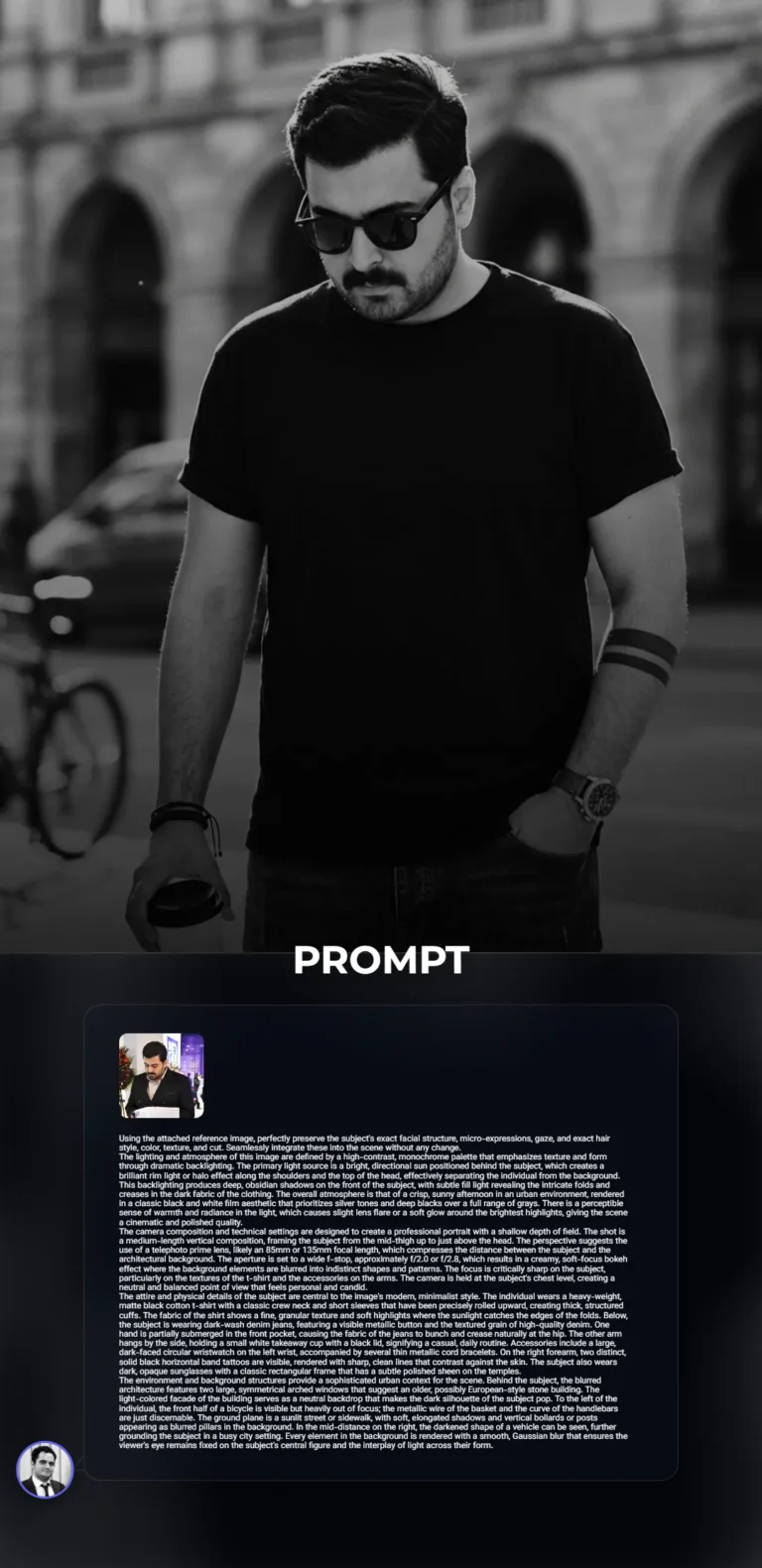
Cinematic B&W Urban Portrait - Backlit Minimalist Street StyleUsing the attached reference image, perfectly preserve the subject's exact facial structure, micro-expressions, gaze, and exact hair style, color, texture, and cut. Seamlessly integrate these into the scene without any change.
The lighting and atmosphere of this image are defined by a high-contrast, monochrome palette that emphasizes texture and form through dramatic backlighting. The primary light source is a bright, directional sun positioned behind the subject, which creates a brilliant rim light or halo effect along the shoulders and the top of the head, effectively separating the individual from the background. This backlighting produces deep, obsidian shadows on the front of the subject, with subtle fill light revealing the intricate folds and creases in the dark fabric of the clothing. The overall atmosphere is that of a crisp, sunny afternoon in an urban environment, rendered in a classic black and white film aesthetic that prioritizes silver tones and deep blacks over a full range of grays. There is a perceptible sense of warmth and radiance in the light, which causes slight lens flare or a soft glow around the brightest highlights, giving the scene a cinematic and polished quality.
The camera composition and technical settings are designed to create a professional portrait with a shallow depth of field. The shot is a medium-length vertical composition, framing the subject from the mid-thigh up to just above the head. The perspective suggests the use of a telephoto prime lens, likely an 85mm or 135mm focal length, which compresses the distance between the subject and the architectural background. The aperture is set to a wide f-stop, approximately f/2.0 or f/2.8, which results in a creamy, soft-focus bokeh effect where the background elements are blurred into indistinct shapes and patterns. The focus is critically sharp on the subject, particularly on the textures of the t-shirt and the accessories on the arms. The camera is held at the subject's chest level, creating a neutral and balanced point of view that feels personal and candid.
The attire and physical details of the subject are central to the image's modern, minimalist style. The individual wears a heavy-weight, matte black cotton t-shirt with a classic crew neck and short sleeves that have been precisely rolled upward, creating thick, structured cuffs. The fabric of the shirt shows a fine, granular texture and soft highlights where the sunlight catches the edges of the folds. Below, the subject is wearing dark-wash denim jeans, featuring a visible metallic button and the textured grain of high-quality denim. One hand is partially submerged in the front pocket, causing the fabric of the jeans to bunch and crease naturally at the hip. The other arm hangs by the side, holding a small white takeaway cup with a black lid, signifying a casual, daily routine. Accessories include a large, dark-faced circular wristwatch on the left wrist, accompanied by several thin metallic cord bracelets. On the right forearm, two distinct, solid black horizontal band tattoos are visible, rendered with sharp, clean lines that contrast against the skin. The subject also wears dark, opaque sunglasses with a classic rectangular frame that has a subtle polished sheen on the temples.
The environment and background structures provide a sophisticated urban context for the scene. Behind the subject, the blurred architecture features two large, symmetrical arched windows that suggest an older, possibly European-style stone building. The light-colored facade of the building serves as a neutral backdrop that makes the dark silhouette of the subject pop. To the left of the individual, the front half of a bicycle is visible but heavily out of focus; the metallic wire of the basket and the curve of the handlebars are just discernable. The ground plane is a sunlit street or sidewalk, with soft, elongated shadows and vertical bollards or posts appearing as blurred pillars in the background. In the mid-distance on the right, the darkened shape of a vehicle can be seen, further grounding the subject in a busy city setting. Every element in the background is rendered with a smooth, Gaussian blur that ensures the viewer's eye remains fixed on the subject's central figure and the interplay of light across their form.

Cinematic Urban Portrait with Dramatic Backlight and Lens FlareUsing the attached reference image, perfectly preserve the subject's exact facial structure, micro-expressions, gaze, and exact hair style, color, texture, and cut. Seamlessly integrate these into the scene without any change.
The camera settings and composition for this shot are technical and precise to create a high-end cinematic aesthetic. The shot is captured using a full-frame digital sensor paired with a high-quality 85mm prime lens set to a wide aperture of f/1.8. This configuration ensures a shallow depth of field where the subject remains in razor-sharp focus while the architectural background melts into a soft, creamy bokeh. The camera is positioned at a slightly low angle, approximately at the subject's chest height, looking upward to provide a sense of stature and presence. The framing is a medium-close portrait, focusing on the upper torso and head, with the subject positioned slightly off-center to the left of the frame, adhering to a modified rule of thirds that emphasizes the direction of the light.
The lighting environment is characterized by intense, dramatic backlighting originating from a powerful light source in the upper left corner, simulating the harsh glow of a low-hanging sun. This creates a brilliant rim light effect that outlines the silhouette of the individual, causing a luminous halo effect along the edges of the clothing and head. The direct light hits the lens at an angle that produces a significant, multi-colored lens flare consisting of a large wash of magenta and white light in the top corner, accompanied by several translucent circular and hexagonal orbs that dance across the bottom right of the frame. The fill light on the front of the subject is soft and subtle, likely a reflection from a nearby wall, ensuring that the shadows on the face are deep but still retain micro-details without being crushed into pure black.
The environment is an urban alleyway or a narrow street flanked by aged, weathered architecture. On the right side of the frame, a tall building facade constructed from large, rectangular stone blocks or concrete slabs features prominent horizontal lines that create a strong sense of linear perspective, leading the viewer's eye toward the vanishing point in the background. The texture of the walls is gritty and tactile, showing signs of industrial aging, moisture stains, and uneven surfaces. In the background to the left, there is a hint of dark, out-of-focus foliage and the blurred silhouette of other structures, providing an organic contrast to the hard lines of the masonry. The ground is a neutral, out-of-focus grey pavement that provides a stable base for the composition.
The clothing worn by the subject is a study in material texture and layering. The base layer is a dark, heavy-gauge ribbed knit turtleneck sweater. The thick, vertical ridges of the knit are prominent where the light catches the collar, showing the individual fibers and the density of the wool. Over the sweater, the subject wears a utilitarian, tactical-style jacket in a dark, matte charcoal or black finish. The jacket features structured elements such as epaulets on the shoulders and a high-standing collar that frames the neck. Across the chest area, the word PLEIN is visible in a tonal, embossed matte finish that catches the light with a subtle sheen, distinct from the fabric of the jacket itself. The material of the jacket appears to be a durable synthetic or heavy cotton canvas with visible stitching and micro-creases that suggest movement and wear.
The overall color palette and post-processing style are sophisticated, employing a high-contrast cinematic grade. The shadows are infused with a cool, desaturated teal and blue-green tint, which provides a dramatic counterpoint to the warm, vibrant highlights of the sun flare. The saturation is pulled back slightly across the entire image to enhance the gritty, urban mood, while the dynamic range is pushed to capture the extreme difference between the sun-bleached highlights and the deep, rich blacks of the clothing. There is a subtle layer of film grain applied to the final image to give it a tactile, analog quality, and the sharpening is localized to the subject's features and the textures of the clothing to make them pop against the dreamlike, blurred background.

Dramatic Monochrome Chiaroscuro Cinematic PortraitUsing the attached reference image, perfectly preserve the subject's exact facial structure, micro-expressions, gaze, and exact hair style, color, texture, and cut. Seamlessly integrate these into the scene without any change.
The photographic style must be a masterful execution of high-contrast monochrome cinematography, specifically emulating the aesthetic of a mid-20th-century silver gelatin print. The color palette is strictly limited to a sophisticated spectrum of blacks, whites, and varying degrees of charcoal and slate grays. There should be an intentional application of fine, organic film grain throughout the entire frame, avoiding any digital smoothness to maintain an authentic, raw, and tactile analog quality. The tonal range should be pushed to create a dramatic chiaroscuro effect, where the highlights are crisp and luminous without blowing out, and the shadows are deep, rich, and ink-like, providing a sense of profound depth and three-dimensionality to the subject.
The lighting is the primary architectural element of this composition, featuring a singular, directional light source positioned at a high angle to the right of the camera. This light must cast a sharp, defined illumination across the side of the subject's face and the prominent anatomy of the neck, while leaving the opposite side in a heavy, atmospheric shadow. The light should catch the subtle textures of the skin and the fabric of the clothing, creating a brilliant rim-light effect along the contours of the individual's silhouette. The transition between the brightest highlights and the deepest shadows must be deliberate and sculpted, emphasizing the physical presence of the individual against the more neutral, softly lit background.
The composition is a tight, intimate bust-length portrait captured from a slightly low-angle perspective to emphasize the dramatic upward tilt of the head. The individual is positioned in a three-quarter profile, with the neck elongated and the chin pointed toward the upper right corner of the frame, suggesting a moment of intense introspection, surrender, or yearning. The framing should be slightly off-center to allow for a sense of dynamic movement within the stillness of the pose. The negative space provided by the background should be utilized to balance the heavy, dark mass of the subject's torso and jacket, ensuring that the viewer's focus is drawn immediately to the illuminated portions of the skin and the sharp lines of the posture.
The technical camera settings should simulate a professional portrait setup using a 105mm telephoto prime lens to provide a subtle compression of the features and a flattering perspective. The aperture should be set to approximately f/4.0, ensuring that the subject's entire profile remains in tack-sharp focus while allowing the background to fall into a gentle, non-distracting blur. The shutter speed should be fast enough to capture the stillness of the moment with absolute clarity, and the simulated ISO should be high enough to introduce that characteristic silver halide grain that defines the filmic look. Every micro-detail, from the tiny pores on the skin to the individual fibers of the clothing, must be rendered with high-fidelity precision within the focal plane.
The wardrobe consists of a heavy, structured jacket crafted from a dark, rugged textile such as a high-density denim or a thick canvas. The fabric must exhibit a rich, matte texture that absorbs light, with visible weaving patterns and subtle distressing along the seams. The collar of the jacket is turned up slightly, framing the base of the neck and adding a layer of architectural complexity to the lower third of the image. The deep black of the garment should act as a solid anchor for the composition, providing a stark contrast against the pale, neutral background. The background itself should be a minimalist, non-descript wall with a very fine, plaster-like texture, catching just enough light to appear as a soft, luminous gray that gradients slightly darker toward the edges of the frame to create a subtle vignette effect.

Professional Monochromatic Studio Portrait Prompt for High-End Cinematic Reference Face PreservationUsing the attached reference image, perfectly preserve the subject's exact facial structure, micro-expressions, gaze, and exact hair style, color, texture, and cut. Seamlessly integrate these into the scene without any change.
The entire scene is rendered in a sophisticated monochromatic palette, focusing on a deep and rich range of greyscale tones that transition from absolute ink-black in the deepest shadows to a soft, luminous silver in the highlights. The tonal depth is achieved through a high-contrast black and white film aesthetic, reminiscent of classic studio portraiture. There is a visible but extremely fine grain throughout the image, providing a tactile, organic quality to the digital render. The shadows are not just empty voids but contain subtle gradations, particularly in the fall-off around the subject's shoulders and the background, ensuring a three-dimensional feel despite the limited color spectrum. The mid-tones are carefully controlled to emphasize the smooth transitions of light across the skin and fabric, avoiding any harsh or muddy transitions in the grey levels.
The lighting is a masterclass in low-key, dramatic studio techniques, specifically utilizing a modified butterfly or overhead key light configuration. A single, soft but directional light source is positioned above and slightly in front of the individual, creating a controlled downward cast that illuminates the upper portions of the features while casting the lower regions into a velvety shadow. This lighting setup produces a distinct shadow under the nose and a deep, moody shade across the neck area, emphasizing the bone structure of the hand and the contours of the clothing. There are precise catchlights reflected in the center of the gaze, adding a sense of life and intensity to the look. The light fall-off is rapid, ensuring that the background remains a dark, non-distracting gradient that pulls all visual attention toward the central figure.
The camera is positioned at a slightly elevated, high-angle perspective, looking down towards the individual to create an intimate and compelling sense of proximity. A professional-grade 85mm prime lens is utilized to achieve a flattering, compression-filled portrait look with zero barrel distortion. The aperture is set to a wide f/1.8 or f/2.0, creating an extremely shallow depth of field that results in a creamy, out-of-focus blur starting from the individual's ears and extending to the back shoulder and the background. The focus is razor-sharp on the bridge of the nose and the eyes, while the hand in the foreground remains within the acceptable plane of focus, showing clear detail in the skin texture and the mechanical components of the wristwatch. The composition follows a centered, vertical orientation, with the individual's head and hand forming a triangular structural base that anchors the image.
The wardrobe consists of a heavy, dark-toned tailored blazer worn over a charcoal or black inner garment with a high neckline. The texture of the blazer is a fine, matte-finish wool or gabardine weave, which absorbs light rather than reflecting it, contributing to the overall somber and high-fashion mood. The lapels are crisp and well-defined, showing a subtle sheen only where the overhead light grazes the topmost edge of the fabric. The hand is positioned near the chin in a contemplative gesture, with the fingers slightly splayed to showcase the anatomy of the knuckles and the smoothness of the skin. On the wrist, a high-end timepiece is visible, featuring a round, dark-faced dial and a metallic link bracelet. The watch glass has a faint, sharp specular highlight, indicating its reflective surface, while the individual links of the band show a brushed metal texture with micro-reflections that provide a sense of hard material contrast against the soft fabric of the suit.
The background is a minimalist, studio-grade backdrop with a subtle, non-uniform texture that prevents it from looking like a flat digital fill. It consists of a dark charcoal grey that fades into pure black at the edges of the frame, creating a vignette effect that naturally frames the subject. There is a sense of atmospheric depth, as if the space behind the individual is filled with a very thin, invisible layer of haze that softens the light further. Every element, from the sharpness of the watch hands to the soft blur of the rear shoulder, is rendered with ultra-high-definition precision, ensuring that the final output is a flawless recreation of the provided reference's mood, lighting, and sophisticated composition.
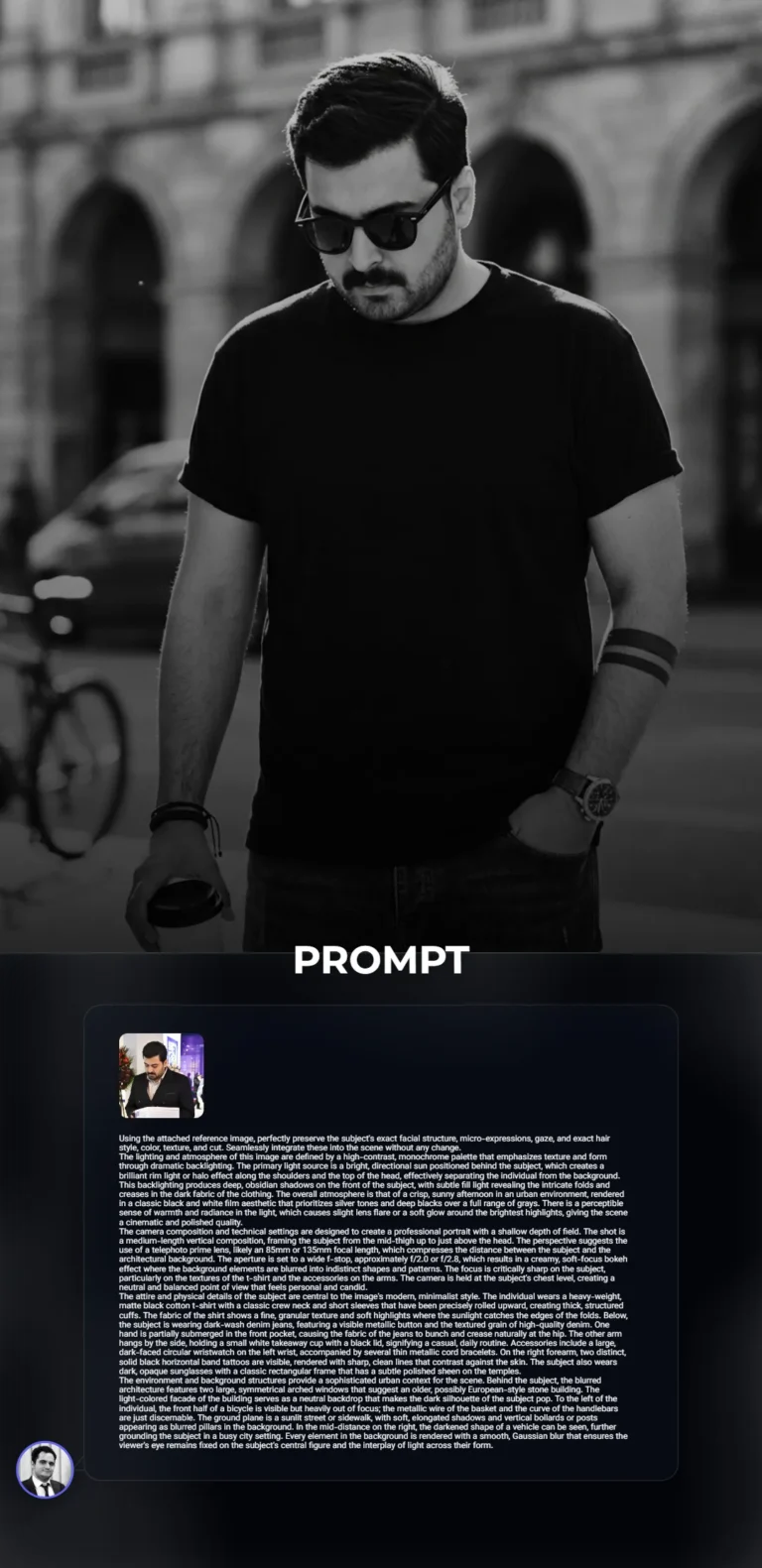
Cinematic B&W Urban Portrait - Backlit Minimalist Street StyleUsing the attached reference image, perfectly preserve the subject's exact facial structure, micro-expressions, gaze, and exact hair style, color, texture, and cut. Seamlessly integrate these into the scene without any change.
The lighting and atmosphere of this image are defined by a high-contrast, monochrome palette that emphasizes texture and form through dramatic backlighting. The primary light source is a bright, directional sun positioned behind the subject, which creates a brilliant rim light or halo effect along the shoulders and the top of the head, effectively separating the individual from the background. This backlighting produces deep, obsidian shadows on the front of the subject, with subtle fill light revealing the intricate folds and creases in the dark fabric of the clothing. The overall atmosphere is that of a crisp, sunny afternoon in an urban environment, rendered in a classic black and white film aesthetic that prioritizes silver tones and deep blacks over a full range of grays. There is a perceptible sense of warmth and radiance in the light, which causes slight lens flare or a soft glow around the brightest highlights, giving the scene a cinematic and polished quality.
The camera composition and technical settings are designed to create a professional portrait with a shallow depth of field. The shot is a medium-length vertical composition, framing the subject from the mid-thigh up to just above the head. The perspective suggests the use of a telephoto prime lens, likely an 85mm or 135mm focal length, which compresses the distance between the subject and the architectural background. The aperture is set to a wide f-stop, approximately f/2.0 or f/2.8, which results in a creamy, soft-focus bokeh effect where the background elements are blurred into indistinct shapes and patterns. The focus is critically sharp on the subject, particularly on the textures of the t-shirt and the accessories on the arms. The camera is held at the subject's chest level, creating a neutral and balanced point of view that feels personal and candid.
The attire and physical details of the subject are central to the image's modern, minimalist style. The individual wears a heavy-weight, matte black cotton t-shirt with a classic crew neck and short sleeves that have been precisely rolled upward, creating thick, structured cuffs. The fabric of the shirt shows a fine, granular texture and soft highlights where the sunlight catches the edges of the folds. Below, the subject is wearing dark-wash denim jeans, featuring a visible metallic button and the textured grain of high-quality denim. One hand is partially submerged in the front pocket, causing the fabric of the jeans to bunch and crease naturally at the hip. The other arm hangs by the side, holding a small white takeaway cup with a black lid, signifying a casual, daily routine. Accessories include a large, dark-faced circular wristwatch on the left wrist, accompanied by several thin metallic cord bracelets. On the right forearm, two distinct, solid black horizontal band tattoos are visible, rendered with sharp, clean lines that contrast against the skin. The subject also wears dark, opaque sunglasses with a classic rectangular frame that has a subtle polished sheen on the temples.
The environment and background structures provide a sophisticated urban context for the scene. Behind the subject, the blurred architecture features two large, symmetrical arched windows that suggest an older, possibly European-style stone building. The light-colored facade of the building serves as a neutral backdrop that makes the dark silhouette of the subject pop. To the left of the individual, the front half of a bicycle is visible but heavily out of focus; the metallic wire of the basket and the curve of the handlebars are just discernable. The ground plane is a sunlit street or sidewalk, with soft, elongated shadows and vertical bollards or posts appearing as blurred pillars in the background. In the mid-distance on the right, the darkened shape of a vehicle can be seen, further grounding the subject in a busy city setting. Every element in the background is rendered with a smooth, Gaussian blur that ensures the viewer's eye remains fixed on the subject's central figure and the interplay of light across their form.
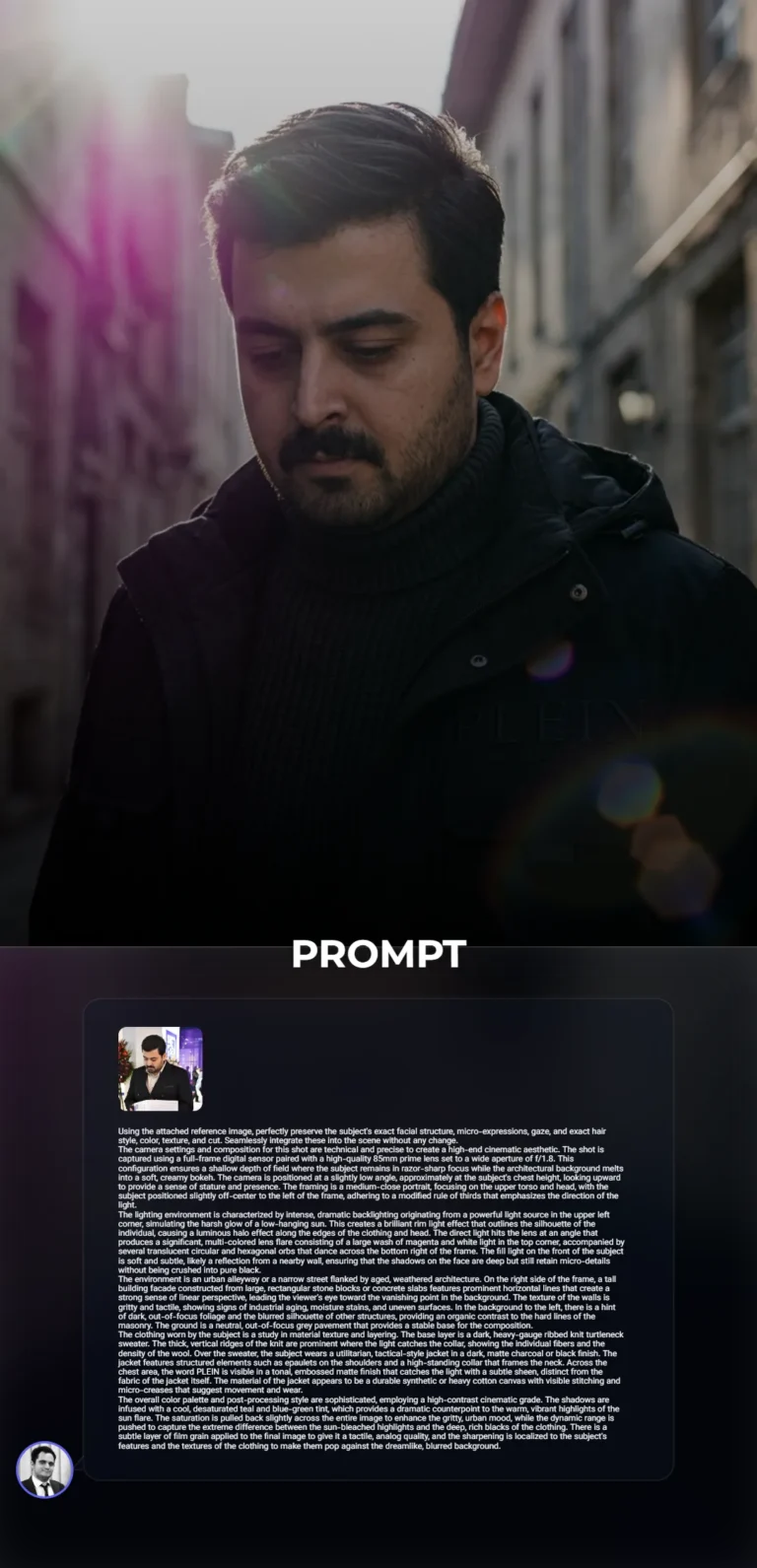
Cinematic Urban Portrait with Dramatic Backlight and Lens FlareUsing the attached reference image, perfectly preserve the subject's exact facial structure, micro-expressions, gaze, and exact hair style, color, texture, and cut. Seamlessly integrate these into the scene without any change.
The camera settings and composition for this shot are technical and precise to create a high-end cinematic aesthetic. The shot is captured using a full-frame digital sensor paired with a high-quality 85mm prime lens set to a wide aperture of f/1.8. This configuration ensures a shallow depth of field where the subject remains in razor-sharp focus while the architectural background melts into a soft, creamy bokeh. The camera is positioned at a slightly low angle, approximately at the subject's chest height, looking upward to provide a sense of stature and presence. The framing is a medium-close portrait, focusing on the upper torso and head, with the subject positioned slightly off-center to the left of the frame, adhering to a modified rule of thirds that emphasizes the direction of the light.
The lighting environment is characterized by intense, dramatic backlighting originating from a powerful light source in the upper left corner, simulating the harsh glow of a low-hanging sun. This creates a brilliant rim light effect that outlines the silhouette of the individual, causing a luminous halo effect along the edges of the clothing and head. The direct light hits the lens at an angle that produces a significant, multi-colored lens flare consisting of a large wash of magenta and white light in the top corner, accompanied by several translucent circular and hexagonal orbs that dance across the bottom right of the frame. The fill light on the front of the subject is soft and subtle, likely a reflection from a nearby wall, ensuring that the shadows on the face are deep but still retain micro-details without being crushed into pure black.
The environment is an urban alleyway or a narrow street flanked by aged, weathered architecture. On the right side of the frame, a tall building facade constructed from large, rectangular stone blocks or concrete slabs features prominent horizontal lines that create a strong sense of linear perspective, leading the viewer's eye toward the vanishing point in the background. The texture of the walls is gritty and tactile, showing signs of industrial aging, moisture stains, and uneven surfaces. In the background to the left, there is a hint of dark, out-of-focus foliage and the blurred silhouette of other structures, providing an organic contrast to the hard lines of the masonry. The ground is a neutral, out-of-focus grey pavement that provides a stable base for the composition.
The clothing worn by the subject is a study in material texture and layering. The base layer is a dark, heavy-gauge ribbed knit turtleneck sweater. The thick, vertical ridges of the knit are prominent where the light catches the collar, showing the individual fibers and the density of the wool. Over the sweater, the subject wears a utilitarian, tactical-style jacket in a dark, matte charcoal or black finish. The jacket features structured elements such as epaulets on the shoulders and a high-standing collar that frames the neck. Across the chest area, the word PLEIN is visible in a tonal, embossed matte finish that catches the light with a subtle sheen, distinct from the fabric of the jacket itself. The material of the jacket appears to be a durable synthetic or heavy cotton canvas with visible stitching and micro-creases that suggest movement and wear.
The overall color palette and post-processing style are sophisticated, employing a high-contrast cinematic grade. The shadows are infused with a cool, desaturated teal and blue-green tint, which provides a dramatic counterpoint to the warm, vibrant highlights of the sun flare. The saturation is pulled back slightly across the entire image to enhance the gritty, urban mood, while the dynamic range is pushed to capture the extreme difference between the sun-bleached highlights and the deep, rich blacks of the clothing. There is a subtle layer of film grain applied to the final image to give it a tactile, analog quality, and the sharpening is localized to the subject's features and the textures of the clothing to make them pop against the dreamlike, blurred background.
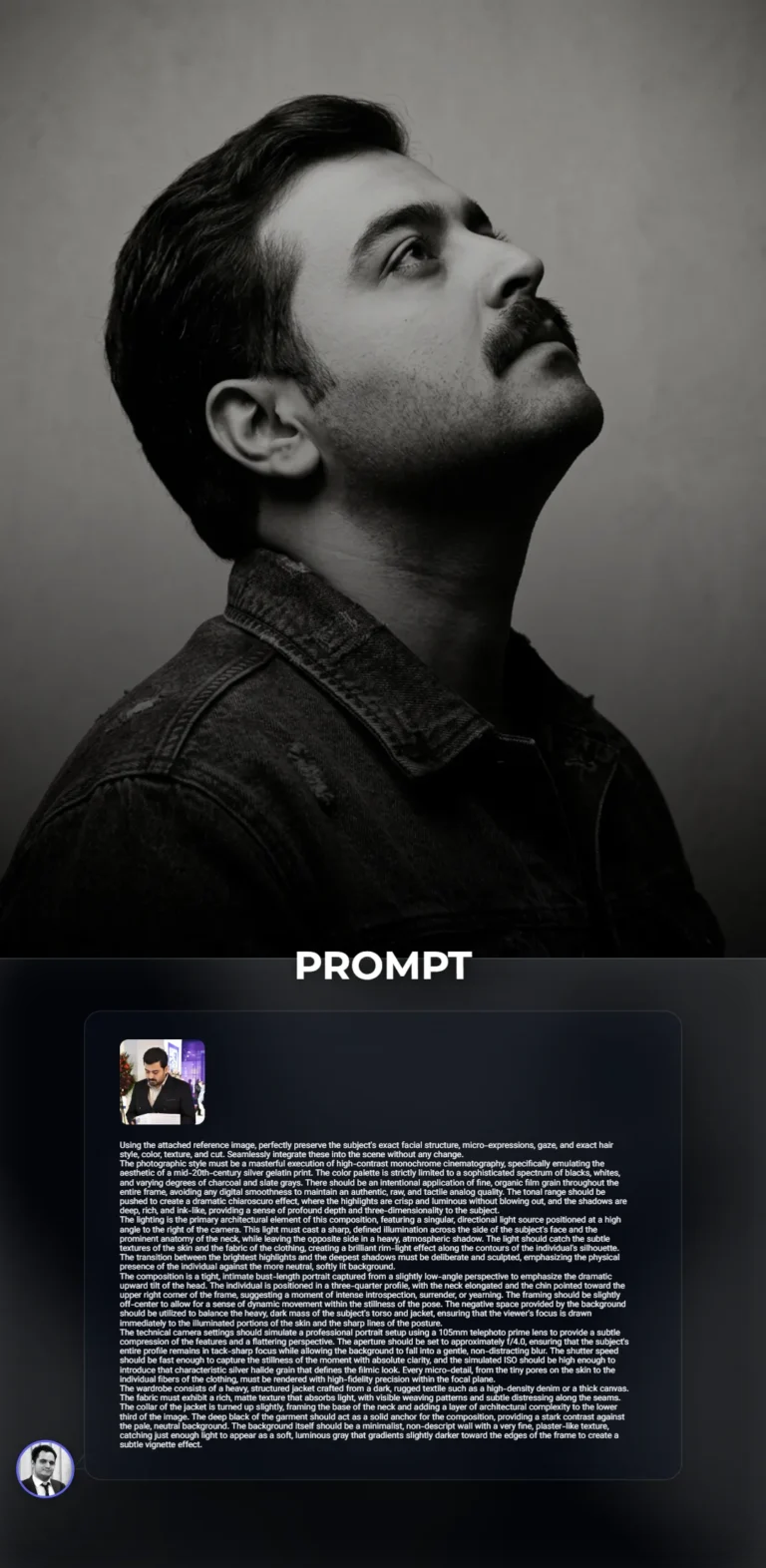
Dramatic Monochrome Chiaroscuro Cinematic PortraitUsing the attached reference image, perfectly preserve the subject's exact facial structure, micro-expressions, gaze, and exact hair style, color, texture, and cut. Seamlessly integrate these into the scene without any change.
The photographic style must be a masterful execution of high-contrast monochrome cinematography, specifically emulating the aesthetic of a mid-20th-century silver gelatin print. The color palette is strictly limited to a sophisticated spectrum of blacks, whites, and varying degrees of charcoal and slate grays. There should be an intentional application of fine, organic film grain throughout the entire frame, avoiding any digital smoothness to maintain an authentic, raw, and tactile analog quality. The tonal range should be pushed to create a dramatic chiaroscuro effect, where the highlights are crisp and luminous without blowing out, and the shadows are deep, rich, and ink-like, providing a sense of profound depth and three-dimensionality to the subject.
The lighting is the primary architectural element of this composition, featuring a singular, directional light source positioned at a high angle to the right of the camera. This light must cast a sharp, defined illumination across the side of the subject's face and the prominent anatomy of the neck, while leaving the opposite side in a heavy, atmospheric shadow. The light should catch the subtle textures of the skin and the fabric of the clothing, creating a brilliant rim-light effect along the contours of the individual's silhouette. The transition between the brightest highlights and the deepest shadows must be deliberate and sculpted, emphasizing the physical presence of the individual against the more neutral, softly lit background.
The composition is a tight, intimate bust-length portrait captured from a slightly low-angle perspective to emphasize the dramatic upward tilt of the head. The individual is positioned in a three-quarter profile, with the neck elongated and the chin pointed toward the upper right corner of the frame, suggesting a moment of intense introspection, surrender, or yearning. The framing should be slightly off-center to allow for a sense of dynamic movement within the stillness of the pose. The negative space provided by the background should be utilized to balance the heavy, dark mass of the subject's torso and jacket, ensuring that the viewer's focus is drawn immediately to the illuminated portions of the skin and the sharp lines of the posture.
The technical camera settings should simulate a professional portrait setup using a 105mm telephoto prime lens to provide a subtle compression of the features and a flattering perspective. The aperture should be set to approximately f/4.0, ensuring that the subject's entire profile remains in tack-sharp focus while allowing the background to fall into a gentle, non-distracting blur. The shutter speed should be fast enough to capture the stillness of the moment with absolute clarity, and the simulated ISO should be high enough to introduce that characteristic silver halide grain that defines the filmic look. Every micro-detail, from the tiny pores on the skin to the individual fibers of the clothing, must be rendered with high-fidelity precision within the focal plane.
The wardrobe consists of a heavy, structured jacket crafted from a dark, rugged textile such as a high-density denim or a thick canvas. The fabric must exhibit a rich, matte texture that absorbs light, with visible weaving patterns and subtle distressing along the seams. The collar of the jacket is turned up slightly, framing the base of the neck and adding a layer of architectural complexity to the lower third of the image. The deep black of the garment should act as a solid anchor for the composition, providing a stark contrast against the pale, neutral background. The background itself should be a minimalist, non-descript wall with a very fine, plaster-like texture, catching just enough light to appear as a soft, luminous gray that gradients slightly darker toward the edges of the frame to create a subtle vignette effect.
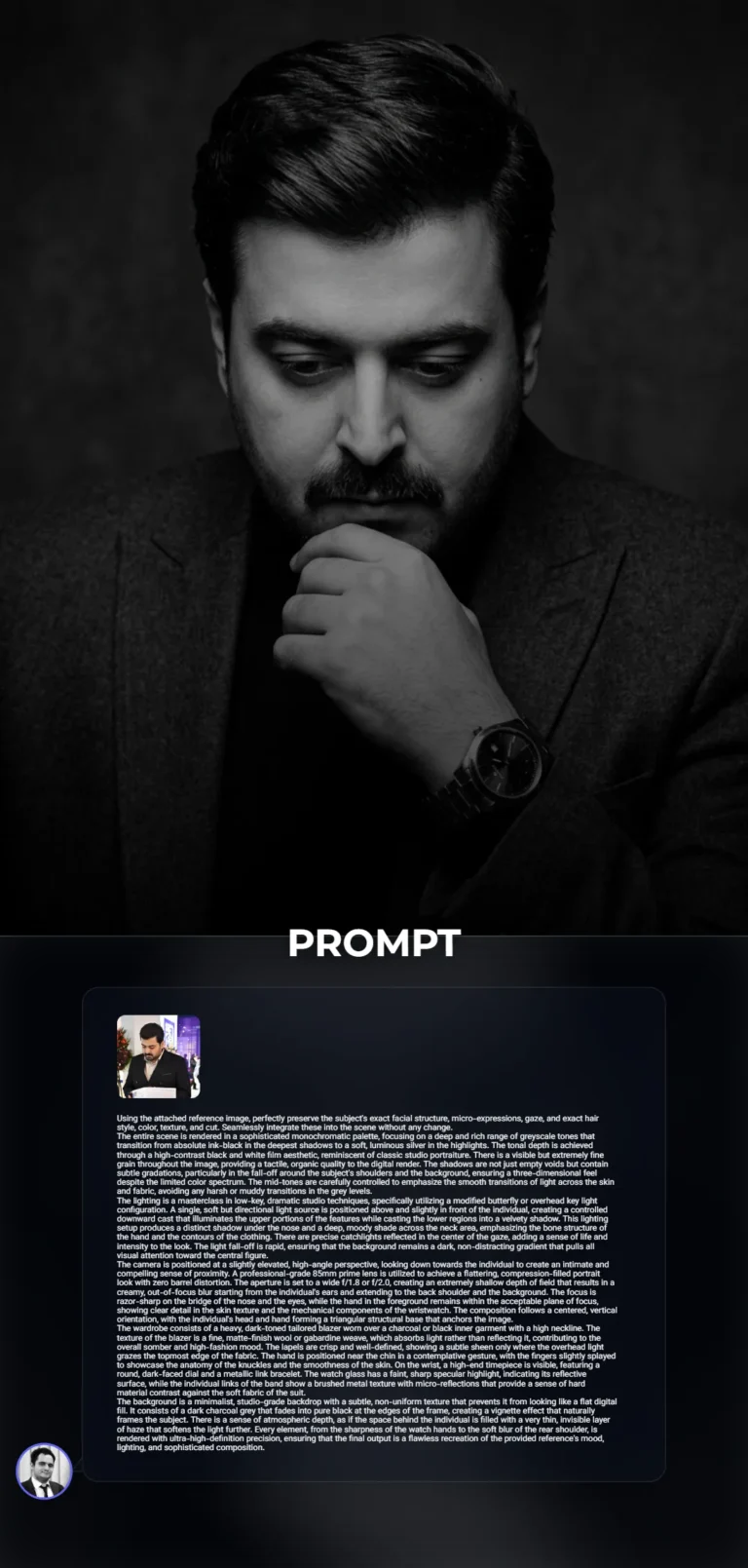
Professional Monochromatic Studio Portrait Prompt for High-End Cinematic Reference Face PreservationUsing the attached reference image, perfectly preserve the subject's exact facial structure, micro-expressions, gaze, and exact hair style, color, texture, and cut. Seamlessly integrate these into the scene without any change.
The entire scene is rendered in a sophisticated monochromatic palette, focusing on a deep and rich range of greyscale tones that transition from absolute ink-black in the deepest shadows to a soft, luminous silver in the highlights. The tonal depth is achieved through a high-contrast black and white film aesthetic, reminiscent of classic studio portraiture. There is a visible but extremely fine grain throughout the image, providing a tactile, organic quality to the digital render. The shadows are not just empty voids but contain subtle gradations, particularly in the fall-off around the subject's shoulders and the background, ensuring a three-dimensional feel despite the limited color spectrum. The mid-tones are carefully controlled to emphasize the smooth transitions of light across the skin and fabric, avoiding any harsh or muddy transitions in the grey levels.
The lighting is a masterclass in low-key, dramatic studio techniques, specifically utilizing a modified butterfly or overhead key light configuration. A single, soft but directional light source is positioned above and slightly in front of the individual, creating a controlled downward cast that illuminates the upper portions of the features while casting the lower regions into a velvety shadow. This lighting setup produces a distinct shadow under the nose and a deep, moody shade across the neck area, emphasizing the bone structure of the hand and the contours of the clothing. There are precise catchlights reflected in the center of the gaze, adding a sense of life and intensity to the look. The light fall-off is rapid, ensuring that the background remains a dark, non-distracting gradient that pulls all visual attention toward the central figure.
The camera is positioned at a slightly elevated, high-angle perspective, looking down towards the individual to create an intimate and compelling sense of proximity. A professional-grade 85mm prime lens is utilized to achieve a flattering, compression-filled portrait look with zero barrel distortion. The aperture is set to a wide f/1.8 or f/2.0, creating an extremely shallow depth of field that results in a creamy, out-of-focus blur starting from the individual's ears and extending to the back shoulder and the background. The focus is razor-sharp on the bridge of the nose and the eyes, while the hand in the foreground remains within the acceptable plane of focus, showing clear detail in the skin texture and the mechanical components of the wristwatch. The composition follows a centered, vertical orientation, with the individual's head and hand forming a triangular structural base that anchors the image.
The wardrobe consists of a heavy, dark-toned tailored blazer worn over a charcoal or black inner garment with a high neckline. The texture of the blazer is a fine, matte-finish wool or gabardine weave, which absorbs light rather than reflecting it, contributing to the overall somber and high-fashion mood. The lapels are crisp and well-defined, showing a subtle sheen only where the overhead light grazes the topmost edge of the fabric. The hand is positioned near the chin in a contemplative gesture, with the fingers slightly splayed to showcase the anatomy of the knuckles and the smoothness of the skin. On the wrist, a high-end timepiece is visible, featuring a round, dark-faced dial and a metallic link bracelet. The watch glass has a faint, sharp specular highlight, indicating its reflective surface, while the individual links of the band show a brushed metal texture with micro-reflections that provide a sense of hard material contrast against the soft fabric of the suit.
The background is a minimalist, studio-grade backdrop with a subtle, non-uniform texture that prevents it from looking like a flat digital fill. It consists of a dark charcoal grey that fades into pure black at the edges of the frame, creating a vignette effect that naturally frames the subject. There is a sense of atmospheric depth, as if the space behind the individual is filled with a very thin, invisible layer of haze that softens the light further. Every element, from the sharpness of the watch hands to the soft blur of the rear shoulder, is rendered with ultra-high-definition precision, ensuring that the final output is a flawless recreation of the provided reference's mood, lighting, and sophisticated composition.
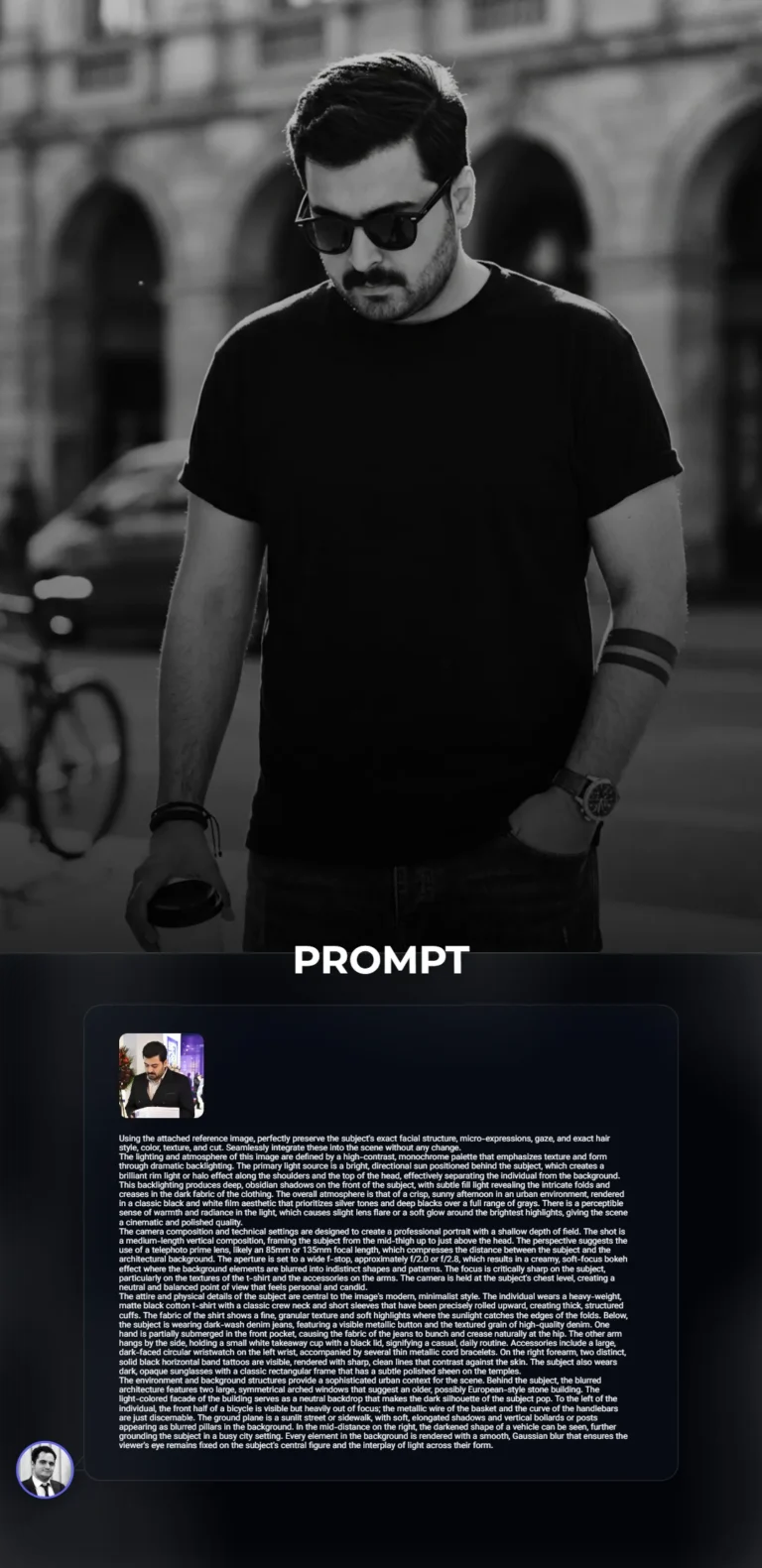
Cinematic B&W Urban Portrait - Backlit Minimalist Street StyleUsing the attached reference image, perfectly preserve the subject's exact facial structure, micro-expressions, gaze, and exact hair style, color, texture, and cut. Seamlessly integrate these into the scene without any change.
The lighting and atmosphere of this image are defined by a high-contrast, monochrome palette that emphasizes texture and form through dramatic backlighting. The primary light source is a bright, directional sun positioned behind the subject, which creates a brilliant rim light or halo effect along the shoulders and the top of the head, effectively separating the individual from the background. This backlighting produces deep, obsidian shadows on the front of the subject, with subtle fill light revealing the intricate folds and creases in the dark fabric of the clothing. The overall atmosphere is that of a crisp, sunny afternoon in an urban environment, rendered in a classic black and white film aesthetic that prioritizes silver tones and deep blacks over a full range of grays. There is a perceptible sense of warmth and radiance in the light, which causes slight lens flare or a soft glow around the brightest highlights, giving the scene a cinematic and polished quality.
The camera composition and technical settings are designed to create a professional portrait with a shallow depth of field. The shot is a medium-length vertical composition, framing the subject from the mid-thigh up to just above the head. The perspective suggests the use of a telephoto prime lens, likely an 85mm or 135mm focal length, which compresses the distance between the subject and the architectural background. The aperture is set to a wide f-stop, approximately f/2.0 or f/2.8, which results in a creamy, soft-focus bokeh effect where the background elements are blurred into indistinct shapes and patterns. The focus is critically sharp on the subject, particularly on the textures of the t-shirt and the accessories on the arms. The camera is held at the subject's chest level, creating a neutral and balanced point of view that feels personal and candid.
The attire and physical details of the subject are central to the image's modern, minimalist style. The individual wears a heavy-weight, matte black cotton t-shirt with a classic crew neck and short sleeves that have been precisely rolled upward, creating thick, structured cuffs. The fabric of the shirt shows a fine, granular texture and soft highlights where the sunlight catches the edges of the folds. Below, the subject is wearing dark-wash denim jeans, featuring a visible metallic button and the textured grain of high-quality denim. One hand is partially submerged in the front pocket, causing the fabric of the jeans to bunch and crease naturally at the hip. The other arm hangs by the side, holding a small white takeaway cup with a black lid, signifying a casual, daily routine. Accessories include a large, dark-faced circular wristwatch on the left wrist, accompanied by several thin metallic cord bracelets. On the right forearm, two distinct, solid black horizontal band tattoos are visible, rendered with sharp, clean lines that contrast against the skin. The subject also wears dark, opaque sunglasses with a classic rectangular frame that has a subtle polished sheen on the temples.
The environment and background structures provide a sophisticated urban context for the scene. Behind the subject, the blurred architecture features two large, symmetrical arched windows that suggest an older, possibly European-style stone building. The light-colored facade of the building serves as a neutral backdrop that makes the dark silhouette of the subject pop. To the left of the individual, the front half of a bicycle is visible but heavily out of focus; the metallic wire of the basket and the curve of the handlebars are just discernable. The ground plane is a sunlit street or sidewalk, with soft, elongated shadows and vertical bollards or posts appearing as blurred pillars in the background. In the mid-distance on the right, the darkened shape of a vehicle can be seen, further grounding the subject in a busy city setting. Every element in the background is rendered with a smooth, Gaussian blur that ensures the viewer's eye remains fixed on the subject's central figure and the interplay of light across their form.
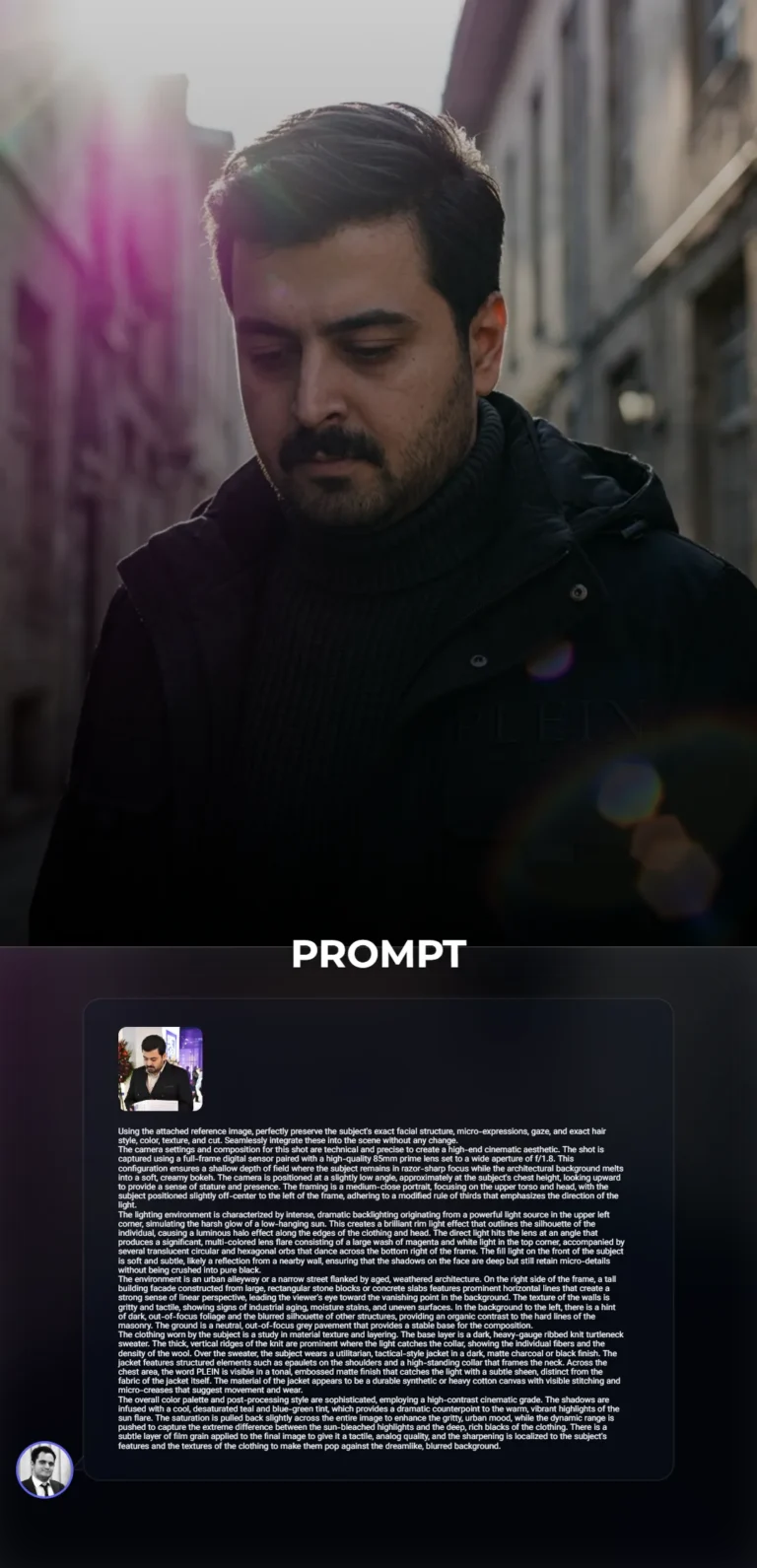
Cinematic Urban Portrait with Dramatic Backlight and Lens FlareUsing the attached reference image, perfectly preserve the subject's exact facial structure, micro-expressions, gaze, and exact hair style, color, texture, and cut. Seamlessly integrate these into the scene without any change.
The camera settings and composition for this shot are technical and precise to create a high-end cinematic aesthetic. The shot is captured using a full-frame digital sensor paired with a high-quality 85mm prime lens set to a wide aperture of f/1.8. This configuration ensures a shallow depth of field where the subject remains in razor-sharp focus while the architectural background melts into a soft, creamy bokeh. The camera is positioned at a slightly low angle, approximately at the subject's chest height, looking upward to provide a sense of stature and presence. The framing is a medium-close portrait, focusing on the upper torso and head, with the subject positioned slightly off-center to the left of the frame, adhering to a modified rule of thirds that emphasizes the direction of the light.
The lighting environment is characterized by intense, dramatic backlighting originating from a powerful light source in the upper left corner, simulating the harsh glow of a low-hanging sun. This creates a brilliant rim light effect that outlines the silhouette of the individual, causing a luminous halo effect along the edges of the clothing and head. The direct light hits the lens at an angle that produces a significant, multi-colored lens flare consisting of a large wash of magenta and white light in the top corner, accompanied by several translucent circular and hexagonal orbs that dance across the bottom right of the frame. The fill light on the front of the subject is soft and subtle, likely a reflection from a nearby wall, ensuring that the shadows on the face are deep but still retain micro-details without being crushed into pure black.
The environment is an urban alleyway or a narrow street flanked by aged, weathered architecture. On the right side of the frame, a tall building facade constructed from large, rectangular stone blocks or concrete slabs features prominent horizontal lines that create a strong sense of linear perspective, leading the viewer's eye toward the vanishing point in the background. The texture of the walls is gritty and tactile, showing signs of industrial aging, moisture stains, and uneven surfaces. In the background to the left, there is a hint of dark, out-of-focus foliage and the blurred silhouette of other structures, providing an organic contrast to the hard lines of the masonry. The ground is a neutral, out-of-focus grey pavement that provides a stable base for the composition.
The clothing worn by the subject is a study in material texture and layering. The base layer is a dark, heavy-gauge ribbed knit turtleneck sweater. The thick, vertical ridges of the knit are prominent where the light catches the collar, showing the individual fibers and the density of the wool. Over the sweater, the subject wears a utilitarian, tactical-style jacket in a dark, matte charcoal or black finish. The jacket features structured elements such as epaulets on the shoulders and a high-standing collar that frames the neck. Across the chest area, the word PLEIN is visible in a tonal, embossed matte finish that catches the light with a subtle sheen, distinct from the fabric of the jacket itself. The material of the jacket appears to be a durable synthetic or heavy cotton canvas with visible stitching and micro-creases that suggest movement and wear.
The overall color palette and post-processing style are sophisticated, employing a high-contrast cinematic grade. The shadows are infused with a cool, desaturated teal and blue-green tint, which provides a dramatic counterpoint to the warm, vibrant highlights of the sun flare. The saturation is pulled back slightly across the entire image to enhance the gritty, urban mood, while the dynamic range is pushed to capture the extreme difference between the sun-bleached highlights and the deep, rich blacks of the clothing. There is a subtle layer of film grain applied to the final image to give it a tactile, analog quality, and the sharpening is localized to the subject's features and the textures of the clothing to make them pop against the dreamlike, blurred background.
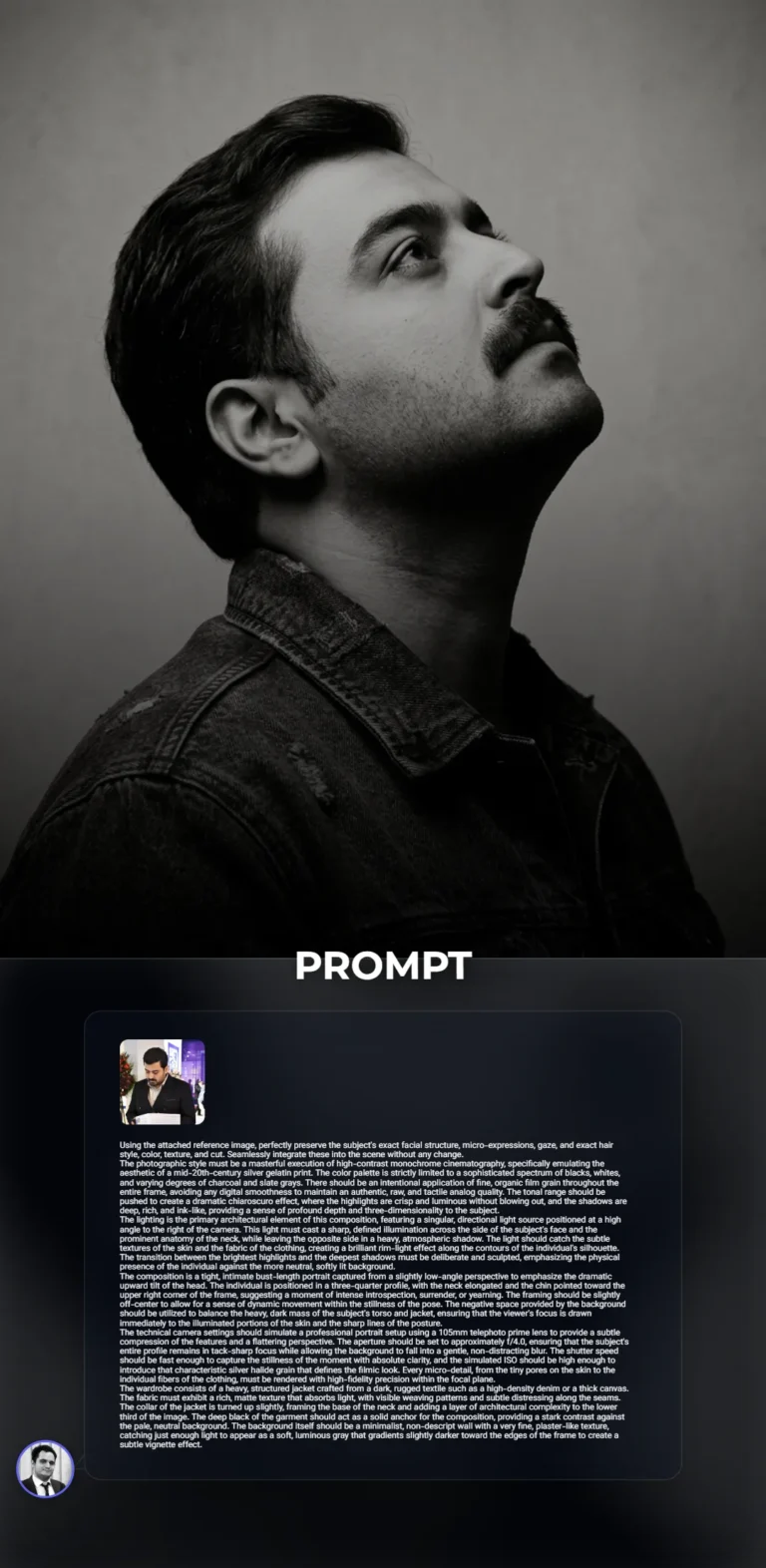
Dramatic Monochrome Chiaroscuro Cinematic PortraitUsing the attached reference image, perfectly preserve the subject's exact facial structure, micro-expressions, gaze, and exact hair style, color, texture, and cut. Seamlessly integrate these into the scene without any change.
The photographic style must be a masterful execution of high-contrast monochrome cinematography, specifically emulating the aesthetic of a mid-20th-century silver gelatin print. The color palette is strictly limited to a sophisticated spectrum of blacks, whites, and varying degrees of charcoal and slate grays. There should be an intentional application of fine, organic film grain throughout the entire frame, avoiding any digital smoothness to maintain an authentic, raw, and tactile analog quality. The tonal range should be pushed to create a dramatic chiaroscuro effect, where the highlights are crisp and luminous without blowing out, and the shadows are deep, rich, and ink-like, providing a sense of profound depth and three-dimensionality to the subject.
The lighting is the primary architectural element of this composition, featuring a singular, directional light source positioned at a high angle to the right of the camera. This light must cast a sharp, defined illumination across the side of the subject's face and the prominent anatomy of the neck, while leaving the opposite side in a heavy, atmospheric shadow. The light should catch the subtle textures of the skin and the fabric of the clothing, creating a brilliant rim-light effect along the contours of the individual's silhouette. The transition between the brightest highlights and the deepest shadows must be deliberate and sculpted, emphasizing the physical presence of the individual against the more neutral, softly lit background.
The composition is a tight, intimate bust-length portrait captured from a slightly low-angle perspective to emphasize the dramatic upward tilt of the head. The individual is positioned in a three-quarter profile, with the neck elongated and the chin pointed toward the upper right corner of the frame, suggesting a moment of intense introspection, surrender, or yearning. The framing should be slightly off-center to allow for a sense of dynamic movement within the stillness of the pose. The negative space provided by the background should be utilized to balance the heavy, dark mass of the subject's torso and jacket, ensuring that the viewer's focus is drawn immediately to the illuminated portions of the skin and the sharp lines of the posture.
The technical camera settings should simulate a professional portrait setup using a 105mm telephoto prime lens to provide a subtle compression of the features and a flattering perspective. The aperture should be set to approximately f/4.0, ensuring that the subject's entire profile remains in tack-sharp focus while allowing the background to fall into a gentle, non-distracting blur. The shutter speed should be fast enough to capture the stillness of the moment with absolute clarity, and the simulated ISO should be high enough to introduce that characteristic silver halide grain that defines the filmic look. Every micro-detail, from the tiny pores on the skin to the individual fibers of the clothing, must be rendered with high-fidelity precision within the focal plane.
The wardrobe consists of a heavy, structured jacket crafted from a dark, rugged textile such as a high-density denim or a thick canvas. The fabric must exhibit a rich, matte texture that absorbs light, with visible weaving patterns and subtle distressing along the seams. The collar of the jacket is turned up slightly, framing the base of the neck and adding a layer of architectural complexity to the lower third of the image. The deep black of the garment should act as a solid anchor for the composition, providing a stark contrast against the pale, neutral background. The background itself should be a minimalist, non-descript wall with a very fine, plaster-like texture, catching just enough light to appear as a soft, luminous gray that gradients slightly darker toward the edges of the frame to create a subtle vignette effect.
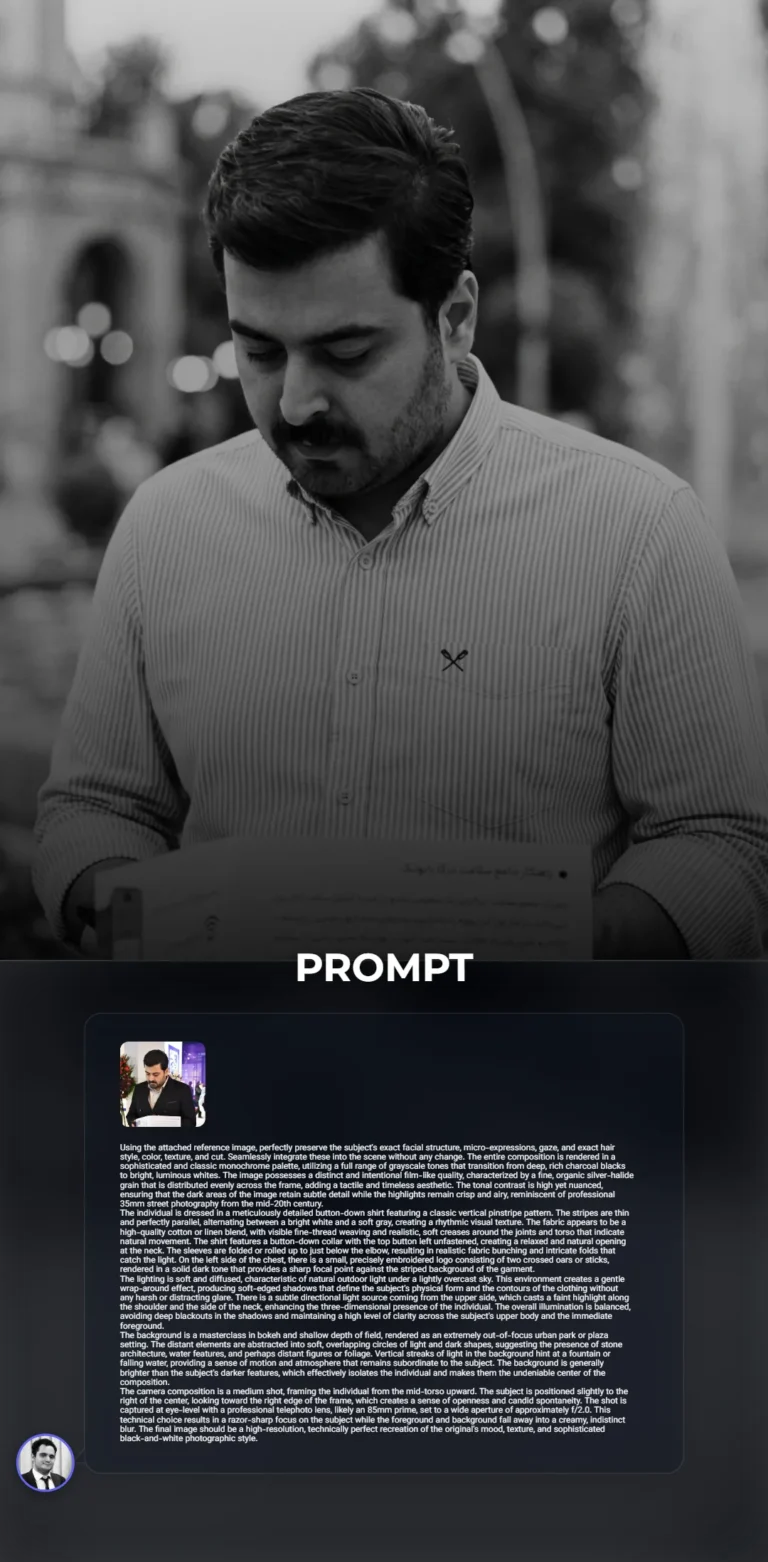
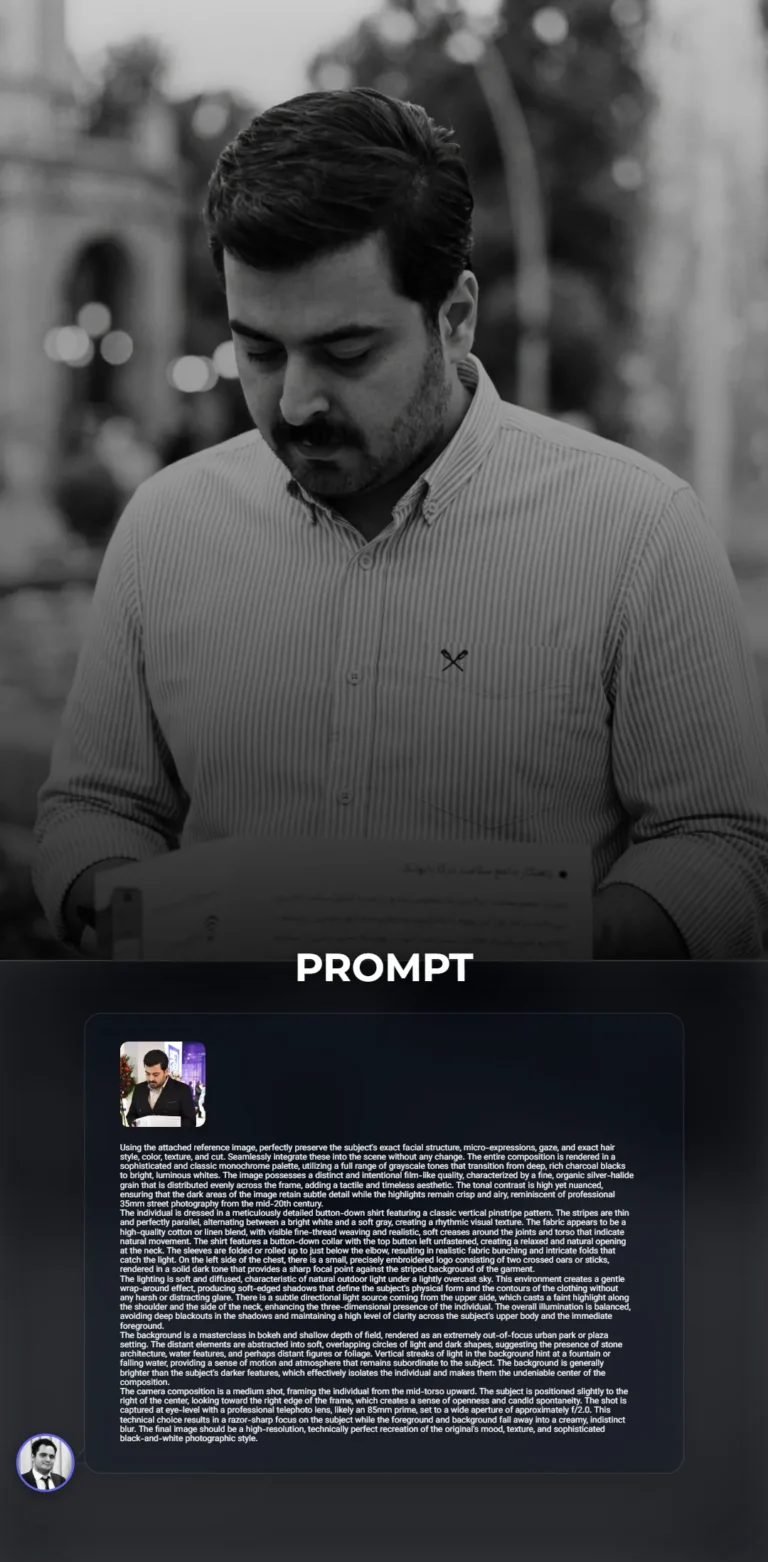
Classic Monochrome Pinstripe Portrait with Cinematic Film GrainUsing the attached reference image, perfectly preserve the subject's exact facial structure, micro-expressions, gaze, and exact hair style, color, texture, and cut. Seamlessly integrate these into the scene without any change. The entire composition is rendered in a sophisticated and classic monochrome palette, utilizing a full range of grayscale tones that transition from deep, rich charcoal blacks to bright, luminous whites. The image possesses a distinct and intentional film-like quality, characterized by a fine, organic silver-halide grain that is distributed evenly across the frame, adding a tactile and timeless aesthetic. The tonal contrast is high yet nuanced, ensuring that the dark areas of the image retain subtle detail while the highlights remain crisp and airy, reminiscent of professional 35mm street photography from the mid-20th century.
The individual is dressed in a meticulously detailed button-down shirt featuring a classic vertical pinstripe pattern. The stripes are thin and perfectly parallel, alternating between a bright white and a soft gray, creating a rhythmic visual texture. The fabric appears to be a high-quality cotton or linen blend, with visible fine-thread weaving and realistic, soft creases around the joints and torso that indicate natural movement. The shirt features a button-down collar with the top button left unfastened, creating a relaxed and natural opening at the neck. The sleeves are folded or rolled up to just below the elbow, resulting in realistic fabric bunching and intricate folds that catch the light. On the left side of the chest, there is a small, precisely embroidered logo consisting of two crossed oars or sticks, rendered in a solid dark tone that provides a sharp focal point against the striped background of the garment.
The lighting is soft and diffused, characteristic of natural outdoor light under a lightly overcast sky. This environment creates a gentle wrap-around effect, producing soft-edged shadows that define the subject's physical form and the contours of the clothing without any harsh or distracting glare. There is a subtle directional light source coming from the upper side, which casts a faint highlight along the shoulder and the side of the neck, enhancing the three-dimensional presence of the individual. The overall illumination is balanced, avoiding deep blackouts in the shadows and maintaining a high level of clarity across the subject's upper body and the immediate foreground.
The background is a masterclass in bokeh and shallow depth of field, rendered as an extremely out-of-focus urban park or plaza setting. The distant elements are abstracted into soft, overlapping circles of light and dark shapes, suggesting the presence of stone architecture, water features, and perhaps distant figures or foliage. Vertical streaks of light in the background hint at a fountain or falling water, providing a sense of motion and atmosphere that remains subordinate to the subject. The background is generally brighter than the subject's darker features, which effectively isolates the individual and makes them the undeniable center of the composition.
The camera composition is a medium shot, framing the individual from the mid-torso upward. The subject is positioned slightly to the right of the center, looking toward the right edge of the frame, which creates a sense of openness and candid spontaneity. The shot is captured at eye-level with a professional telephoto lens, likely an 85mm prime, set to a wide aperture of approximately f/2.0. This technical choice results in a razor-sharp focus on the subject while the foreground and background fall away into a creamy, indistinct blur. The final image should be a high-resolution, technically perfect recreation of the original's mood, texture, and sophisticated black-and-white photographic style.

Professional Photographer with Vintage Rangefinder Camera at Coastal Golden HourUsing the attached reference image, perfectly preserve the subject's exact facial structure, micro-expressions, gaze, and exact hair style, color, texture, and cut. Seamlessly integrate these into the scene without any change. The composition of the image must be a vertical medium-full shot with the subject positioned centrally in the frame, maintaining a significant amount of negative space above them to emphasize the vastness of the sky. The horizon line should be positioned low, approximately one-third of the way from the bottom of the frame, perfectly horizontal, bisecting the deep blue water and the lighter blue sky. The camera should be positioned at a slight low angle, looking up at the subject to give them a sense of presence against the environment. The lens used should emulate a 35mm or 50mm prime focal length, providing a natural perspective without distortion, while maintaining a deep depth of field that keeps the subject in sharp focus while the distant horizon remains clearly defined but slightly softened by atmospheric perspective.
The lighting must be hard, direct, and directional sunlight, originating from the subject's right side, creating high-contrast shadows that define the contours of the subject and the equipment. This harsh light should cast a sharp shadow from the camera and the subject's hands onto their chest and the hoodie, and create a distinct highlight along the right side of the subject's form. The color temperature of the light should be warm and golden, reminiscent of late afternoon sun, which enriches the earth tones of the clothing and adds a vibrant, saturated quality to the blues in the background. The sky should exhibit a soft gradient from a deeper, more saturated cerulean blue at the top to a paler, more washed-out azure near the horizon, populated by very faint, wispy, horizontal white clouds that are almost translucent.
The subject is wearing a coordinated outfit of casual, high-quality garments with rich tactile textures. The upper garment is a heavy-weight, oversized cotton-jersey hoodie in a muted taupe or earthy mushroom-grey color. The fabric of the hoodie should show visible grain and a soft, matte finish, with thick ribbed cuffs at the wrists and a large kangaroo pocket at the front. The hood is draped naturally behind the neck. On their head is a well-worn, faded black or dark charcoal baseball cap with a low profile and a curved brim; a tiny, subtle white embroidered text is visible on the front of the crown. The lower garment consists of dark, charcoal-black trousers made of a structured, possibly wool or heavy twill material, featuring subtle pleats or folds near the waistline.
The subject is actively engaged in the act of photography, holding a vintage-style silver and black rangefinder camera up to their right eye. The camera should have a metallic, brushed aluminum or chrome finish on the top and bottom plates, with a black textured leatherette grip wrapping around the body. The lens of the camera should show realistic glass reflections and a circular aperture opening. A cognac-brown, weathered leather camera strap is intricately wrapped around the subject's right hand and wrist, showing signs of wear and a soft, organic texture with visible stitching. The subject's hands are positioned with precision, fingers gripping the camera body and the lens barrel, with the skin texture showing natural details under the bright sunlight.
The environment is a serene coastal setting. Below the subject, in the very bottom left corner, a small section of dark, jagged, and textured volcanic or wet rocks is visible, providing a grounded element to the composition. The water is a deep, rich indigo blue, characterized by very fine, shimmering ripples and small wavelets that catch the light, creating a rhythmic pattern across the surface. The overall aesthetic must perfectly replicate 35mm film photography, featuring a fine, organic film grain throughout the image, a slight crushing of the deepest shadows, and a highlight roll-off that is smooth and natural. The color palette should be harmonious, dominated by the contrast between the warm, neutral tones of the subject's attire and the cool, expansive blues of the natural background.
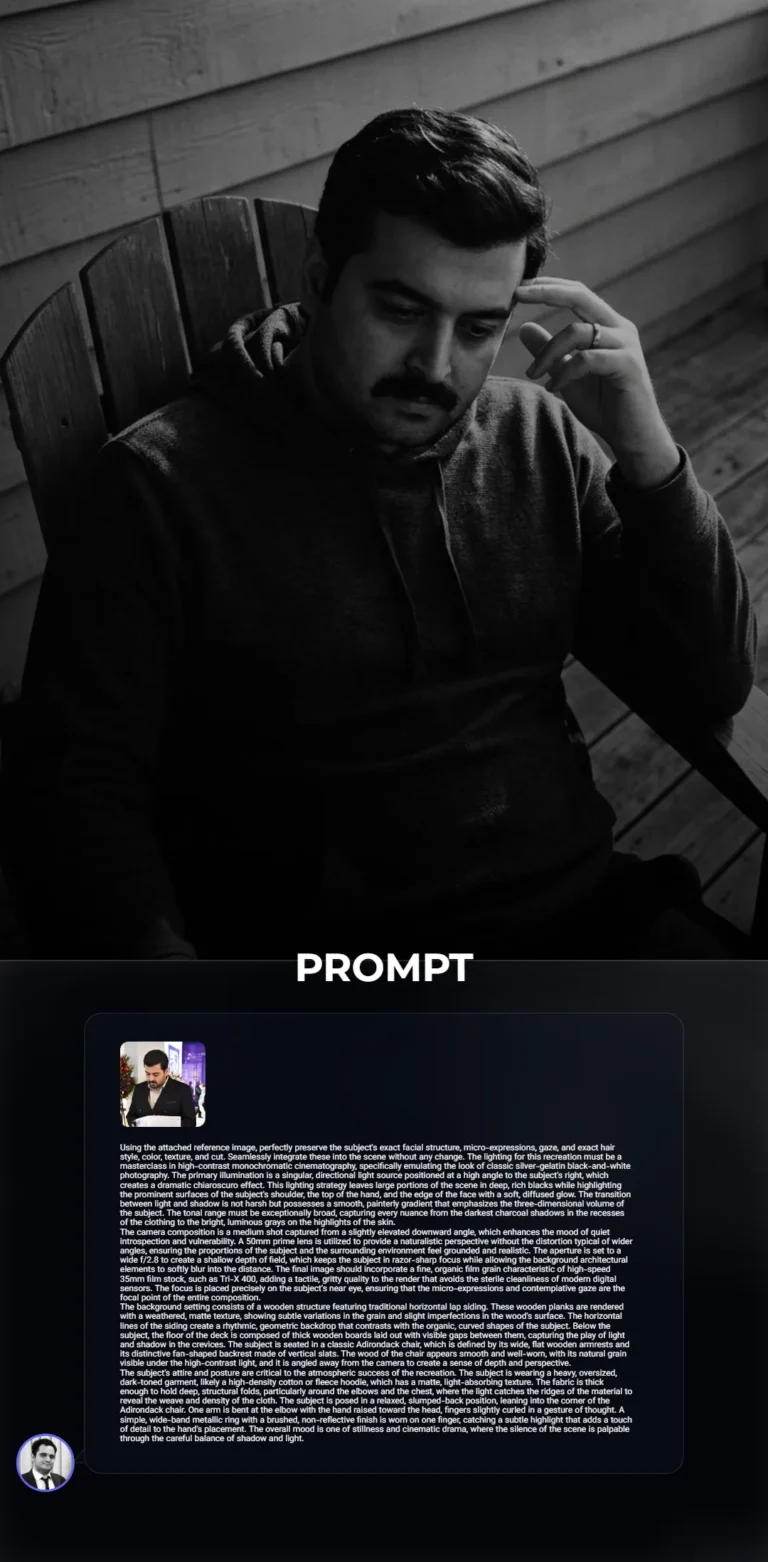
Cinematic Chiaroscuro Monochromatic Portrait with Silver-Gelatin AestheticsUsing the attached reference image, perfectly preserve the subject's exact facial structure, micro-expressions, gaze, and exact hair style, color, texture, and cut. Seamlessly integrate these into the scene without any change. The lighting for this recreation must be a masterclass in high-contrast monochromatic cinematography, specifically emulating the look of classic silver-gelatin black-and-white photography. The primary illumination is a singular, directional light source positioned at a high angle to the subject's right, which creates a dramatic chiaroscuro effect. This lighting strategy leaves large portions of the scene in deep, rich blacks while highlighting the prominent surfaces of the subject's shoulder, the top of the hand, and the edge of the face with a soft, diffused glow. The transition between light and shadow is not harsh but possesses a smooth, painterly gradient that emphasizes the three-dimensional volume of the subject. The tonal range must be exceptionally broad, capturing every nuance from the darkest charcoal shadows in the recesses of the clothing to the bright, luminous grays on the highlights of the skin.
The camera composition is a medium shot captured from a slightly elevated downward angle, which enhances the mood of quiet introspection and vulnerability. A 50mm prime lens is utilized to provide a naturalistic perspective without the distortion typical of wider angles, ensuring the proportions of the subject and the surrounding environment feel grounded and realistic. The aperture is set to a wide f/2.8 to create a shallow depth of field, which keeps the subject in razor-sharp focus while allowing the background architectural elements to softly blur into the distance. The final image should incorporate a fine, organic film grain characteristic of high-speed 35mm film stock, such as Tri-X 400, adding a tactile, gritty quality to the render that avoids the sterile cleanliness of modern digital sensors. The focus is placed precisely on the subject's near eye, ensuring that the micro-expressions and contemplative gaze are the focal point of the entire composition.
The background setting consists of a wooden structure featuring traditional horizontal lap siding. These wooden planks are rendered with a weathered, matte texture, showing subtle variations in the grain and slight imperfections in the wood's surface. The horizontal lines of the siding create a rhythmic, geometric backdrop that contrasts with the organic, curved shapes of the subject. Below the subject, the floor of the deck is composed of thick wooden boards laid out with visible gaps between them, capturing the play of light and shadow in the crevices. The subject is seated in a classic Adirondack chair, which is defined by its wide, flat wooden armrests and its distinctive fan-shaped backrest made of vertical slats. The wood of the chair appears smooth and well-worn, with its natural grain visible under the high-contrast light, and it is angled away from the camera to create a sense of depth and perspective.
The subject's attire and posture are critical to the atmospheric success of the recreation. The subject is wearing a heavy, oversized, dark-toned garment, likely a high-density cotton or fleece hoodie, which has a matte, light-absorbing texture. The fabric is thick enough to hold deep, structural folds, particularly around the elbows and the chest, where the light catches the ridges of the material to reveal the weave and density of the cloth. The subject is posed in a relaxed, slumped-back position, leaning into the corner of the Adirondack chair. One arm is bent at the elbow with the hand raised toward the head, fingers slightly curled in a gesture of thought. A simple, wide-band metallic ring with a brushed, non-reflective finish is worn on one finger, catching a subtle highlight that adds a touch of detail to the hand's placement. The overall mood is one of stillness and cinematic drama, where the silence of the scene is palpable through the careful balance of shadow and light.
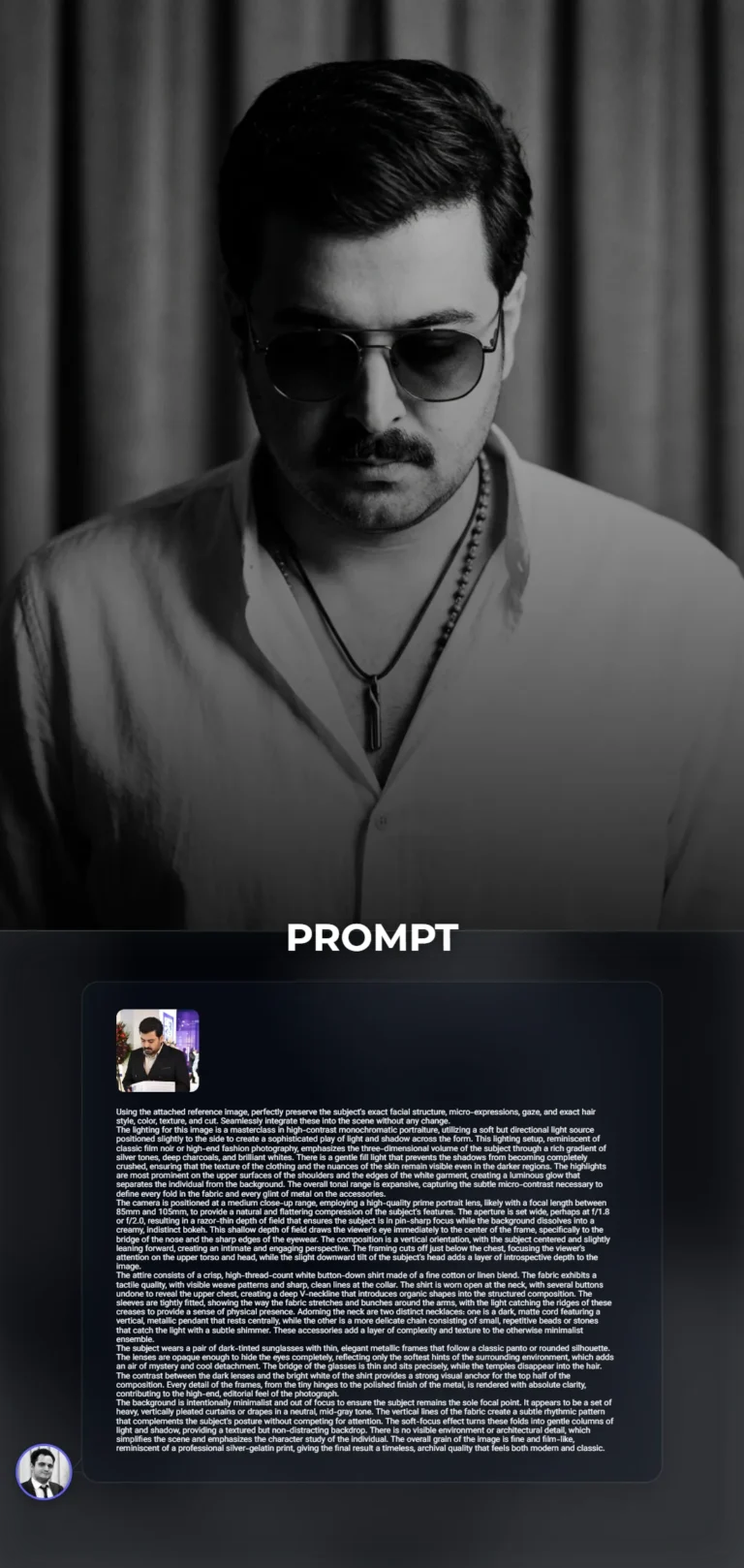
High-Contrast Noir Monochromatic Portrait with Editorial Fashion AestheticUsing the attached reference image, perfectly preserve the subject's exact facial structure, micro-expressions, gaze, and exact hair style, color, texture, and cut. Seamlessly integrate these into the scene without any change.
The lighting for this image is a masterclass in high-contrast monochromatic portraiture, utilizing a soft but directional light source positioned slightly to the side to create a sophisticated play of light and shadow across the form. This lighting setup, reminiscent of classic film noir or high-end fashion photography, emphasizes the three-dimensional volume of the subject through a rich gradient of silver tones, deep charcoals, and brilliant whites. There is a gentle fill light that prevents the shadows from becoming completely crushed, ensuring that the texture of the clothing and the nuances of the skin remain visible even in the darker regions. The highlights are most prominent on the upper surfaces of the shoulders and the edges of the white garment, creating a luminous glow that separates the individual from the background. The overall tonal range is expansive, capturing the subtle micro-contrast necessary to define every fold in the fabric and every glint of metal on the accessories.
The camera is positioned at a medium close-up range, employing a high-quality prime portrait lens, likely with a focal length between 85mm and 105mm, to provide a natural and flattering compression of the subject's features. The aperture is set wide, perhaps at f/1.8 or f/2.0, resulting in a razor-thin depth of field that ensures the subject is in pin-sharp focus while the background dissolves into a creamy, indistinct bokeh. This shallow depth of field draws the viewer's eye immediately to the center of the frame, specifically to the bridge of the nose and the sharp edges of the eyewear. The composition is a vertical orientation, with the subject centered and slightly leaning forward, creating an intimate and engaging perspective. The framing cuts off just below the chest, focusing the viewer's attention on the upper torso and head, while the slight downward tilt of the subject's head adds a layer of introspective depth to the image.
The attire consists of a crisp, high-thread-count white button-down shirt made of a fine cotton or linen blend. The fabric exhibits a tactile quality, with visible weave patterns and sharp, clean lines at the collar. The shirt is worn open at the neck, with several buttons undone to reveal the upper chest, creating a deep V-neckline that introduces organic shapes into the structured composition. The sleeves are tightly fitted, showing the way the fabric stretches and bunches around the arms, with the light catching the ridges of these creases to provide a sense of physical presence. Adorning the neck are two distinct necklaces: one is a dark, matte cord featuring a vertical, metallic pendant that rests centrally, while the other is a more delicate chain consisting of small, repetitive beads or stones that catch the light with a subtle shimmer. These accessories add a layer of complexity and texture to the otherwise minimalist ensemble.
The subject wears a pair of dark-tinted sunglasses with thin, elegant metallic frames that follow a classic panto or rounded silhouette. The lenses are opaque enough to hide the eyes completely, reflecting only the softest hints of the surrounding environment, which adds an air of mystery and cool detachment. The bridge of the glasses is thin and sits precisely, while the temples disappear into the hair. The contrast between the dark lenses and the bright white of the shirt provides a strong visual anchor for the top half of the composition. Every detail of the frames, from the tiny hinges to the polished finish of the metal, is rendered with absolute clarity, contributing to the high-end, editorial feel of the photograph.
The background is intentionally minimalist and out of focus to ensure the subject remains the sole focal point. It appears to be a set of heavy, vertically pleated curtains or drapes in a neutral, mid-gray tone. The vertical lines of the fabric create a subtle rhythmic pattern that complements the subject's posture without competing for attention. The soft-focus effect turns these folds into gentle columns of light and shadow, providing a textured but non-distracting backdrop. There is no visible environment or architectural detail, which simplifies the scene and emphasizes the character study of the individual. The overall grain of the image is fine and film-like, reminiscent of a professional silver-gelatin print, giving the final result a timeless, archival quality that feels both modern and classic.
Classic Monochrome Pinstripe Portrait with Cinematic Film GrainUsing the attached reference image, perfectly preserve the subject's exact facial structure, micro-expressions, gaze, and exact hair style, color, texture, and cut. Seamlessly integrate these into the scene without any change. The entire composition is rendered in a sophisticated and classic monochrome palette, utilizing a full range of grayscale tones that transition from deep, rich charcoal blacks to bright, luminous whites. The image possesses a distinct and intentional film-like quality, characterized by a fine, organic silver-halide grain that is distributed evenly across the frame, adding a tactile and timeless aesthetic. The tonal contrast is high yet nuanced, ensuring that the dark areas of the image retain subtle detail while the highlights remain crisp and airy, reminiscent of professional 35mm street photography from the mid-20th century.
The individual is dressed in a meticulously detailed button-down shirt featuring a classic vertical pinstripe pattern. The stripes are thin and perfectly parallel, alternating between a bright white and a soft gray, creating a rhythmic visual texture. The fabric appears to be a high-quality cotton or linen blend, with visible fine-thread weaving and realistic, soft creases around the joints and torso that indicate natural movement. The shirt features a button-down collar with the top button left unfastened, creating a relaxed and natural opening at the neck. The sleeves are folded or rolled up to just below the elbow, resulting in realistic fabric bunching and intricate folds that catch the light. On the left side of the chest, there is a small, precisely embroidered logo consisting of two crossed oars or sticks, rendered in a solid dark tone that provides a sharp focal point against the striped background of the garment.
The lighting is soft and diffused, characteristic of natural outdoor light under a lightly overcast sky. This environment creates a gentle wrap-around effect, producing soft-edged shadows that define the subject's physical form and the contours of the clothing without any harsh or distracting glare. There is a subtle directional light source coming from the upper side, which casts a faint highlight along the shoulder and the side of the neck, enhancing the three-dimensional presence of the individual. The overall illumination is balanced, avoiding deep blackouts in the shadows and maintaining a high level of clarity across the subject's upper body and the immediate foreground.
The background is a masterclass in bokeh and shallow depth of field, rendered as an extremely out-of-focus urban park or plaza setting. The distant elements are abstracted into soft, overlapping circles of light and dark shapes, suggesting the presence of stone architecture, water features, and perhaps distant figures or foliage. Vertical streaks of light in the background hint at a fountain or falling water, providing a sense of motion and atmosphere that remains subordinate to the subject. The background is generally brighter than the subject's darker features, which effectively isolates the individual and makes them the undeniable center of the composition.
The camera composition is a medium shot, framing the individual from the mid-torso upward. The subject is positioned slightly to the right of the center, looking toward the right edge of the frame, which creates a sense of openness and candid spontaneity. The shot is captured at eye-level with a professional telephoto lens, likely an 85mm prime, set to a wide aperture of approximately f/2.0. This technical choice results in a razor-sharp focus on the subject while the foreground and background fall away into a creamy, indistinct blur. The final image should be a high-resolution, technically perfect recreation of the original's mood, texture, and sophisticated black-and-white photographic style.

Professional Photographer with Vintage Rangefinder Camera at Coastal Golden HourUsing the attached reference image, perfectly preserve the subject's exact facial structure, micro-expressions, gaze, and exact hair style, color, texture, and cut. Seamlessly integrate these into the scene without any change. The composition of the image must be a vertical medium-full shot with the subject positioned centrally in the frame, maintaining a significant amount of negative space above them to emphasize the vastness of the sky. The horizon line should be positioned low, approximately one-third of the way from the bottom of the frame, perfectly horizontal, bisecting the deep blue water and the lighter blue sky. The camera should be positioned at a slight low angle, looking up at the subject to give them a sense of presence against the environment. The lens used should emulate a 35mm or 50mm prime focal length, providing a natural perspective without distortion, while maintaining a deep depth of field that keeps the subject in sharp focus while the distant horizon remains clearly defined but slightly softened by atmospheric perspective.
The lighting must be hard, direct, and directional sunlight, originating from the subject's right side, creating high-contrast shadows that define the contours of the subject and the equipment. This harsh light should cast a sharp shadow from the camera and the subject's hands onto their chest and the hoodie, and create a distinct highlight along the right side of the subject's form. The color temperature of the light should be warm and golden, reminiscent of late afternoon sun, which enriches the earth tones of the clothing and adds a vibrant, saturated quality to the blues in the background. The sky should exhibit a soft gradient from a deeper, more saturated cerulean blue at the top to a paler, more washed-out azure near the horizon, populated by very faint, wispy, horizontal white clouds that are almost translucent.
The subject is wearing a coordinated outfit of casual, high-quality garments with rich tactile textures. The upper garment is a heavy-weight, oversized cotton-jersey hoodie in a muted taupe or earthy mushroom-grey color. The fabric of the hoodie should show visible grain and a soft, matte finish, with thick ribbed cuffs at the wrists and a large kangaroo pocket at the front. The hood is draped naturally behind the neck. On their head is a well-worn, faded black or dark charcoal baseball cap with a low profile and a curved brim; a tiny, subtle white embroidered text is visible on the front of the crown. The lower garment consists of dark, charcoal-black trousers made of a structured, possibly wool or heavy twill material, featuring subtle pleats or folds near the waistline.
The subject is actively engaged in the act of photography, holding a vintage-style silver and black rangefinder camera up to their right eye. The camera should have a metallic, brushed aluminum or chrome finish on the top and bottom plates, with a black textured leatherette grip wrapping around the body. The lens of the camera should show realistic glass reflections and a circular aperture opening. A cognac-brown, weathered leather camera strap is intricately wrapped around the subject's right hand and wrist, showing signs of wear and a soft, organic texture with visible stitching. The subject's hands are positioned with precision, fingers gripping the camera body and the lens barrel, with the skin texture showing natural details under the bright sunlight.
The environment is a serene coastal setting. Below the subject, in the very bottom left corner, a small section of dark, jagged, and textured volcanic or wet rocks is visible, providing a grounded element to the composition. The water is a deep, rich indigo blue, characterized by very fine, shimmering ripples and small wavelets that catch the light, creating a rhythmic pattern across the surface. The overall aesthetic must perfectly replicate 35mm film photography, featuring a fine, organic film grain throughout the image, a slight crushing of the deepest shadows, and a highlight roll-off that is smooth and natural. The color palette should be harmonious, dominated by the contrast between the warm, neutral tones of the subject's attire and the cool, expansive blues of the natural background.