
PeymanaiKodak Tri-X
Kodak Tri-X

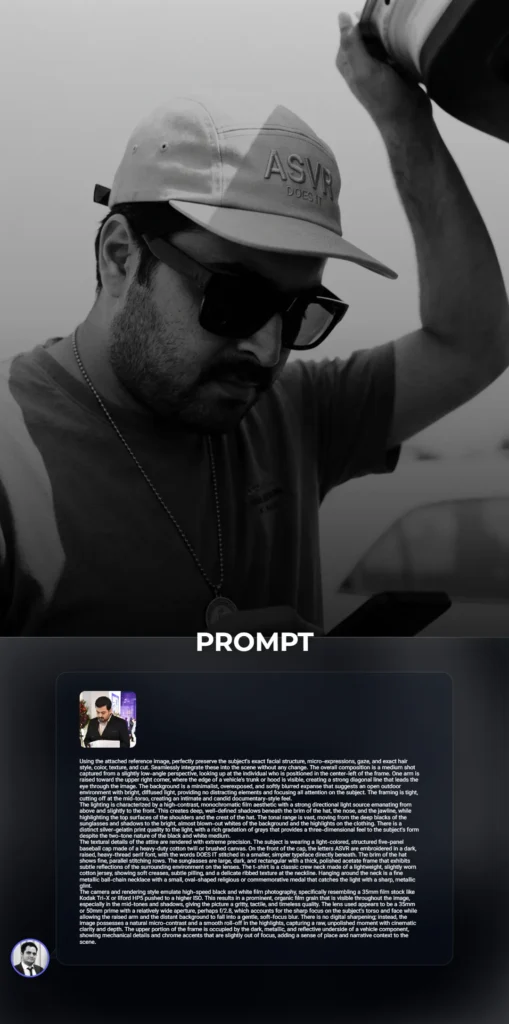
Cinematic B&W Documentary Portrait with ASVR Branding and Film GrainUsing the attached reference image, perfectly preserve the subject's exact facial structure, micro-expressions, gaze, and exact hair style, color, texture, and cut. Seamlessly integrate these into the scene without any change. The overall composition is a medium shot captured from a slightly low-angle perspective, looking up at the individual who is positioned in the center-left of the frame. One arm is raised toward the upper right corner, where the edge of a vehicle's trunk or hood is visible, creating a strong diagonal line that leads the eye through the image. The background is a minimalist, overexposed, and softly blurred expanse that suggests an open outdoor environment with bright, diffused light, providing no distracting elements and focusing all attention on the subject. The framing is tight, cutting off at the mid-torso, creating an intimate and candid documentary-style feel.
The lighting is characterized by a high-contrast, monochromatic film aesthetic with a strong directional light source emanating from above and slightly to the front. This creates deep, well-defined shadows beneath the brim of the hat, the nose, and the jawline, while highlighting the top surfaces of the shoulders and the crest of the hat. The tonal range is vast, moving from the deep blacks of the sunglasses and shadows to the bright, almost blown-out whites of the background and the highlights on the clothing. There is a distinct silver-gelatin print quality to the light, with a rich gradation of grays that provides a three-dimensional feel to the subject's form despite the two-tone nature of the black and white medium.
The textural details of the attire are rendered with extreme precision. The subject is wearing a light-colored, structured five-panel baseball cap made of a heavy-duty cotton twill or brushed canvas. On the front of the cap, the letters ASVR are embroidered in a dark, raised, heavy-thread serif font, with the words DOES IT stitched in a smaller, simpler typeface directly beneath. The brim of the hat shows fine, parallel stitching rows. The sunglasses are large, dark, and rectangular with a thick, polished acetate frame that exhibits subtle reflections of the surrounding environment on the lenses. The t-shirt is a classic crew neck made of a lightweight, slightly worn cotton jersey, showing soft creases, subtle pilling, and a delicate ribbed texture at the neckline. Hanging around the neck is a fine metallic ball-chain necklace with a small, oval-shaped religious or commemorative medal that catches the light with a sharp, metallic glint.
The camera and rendering style emulate high-speed black and white film photography, specifically resembling a 35mm film stock like Kodak Tri-X or Ilford HP5 pushed to a higher ISO. This results in a prominent, organic film grain that is visible throughout the image, especially in the mid-tones and shadows, giving the picture a gritty, tactile, and timeless quality. The lens used appears to be a 35mm or 50mm prime with a relatively wide aperture, perhaps f/2.8, which accounts for the sharp focus on the subject's torso and face while allowing the raised arm and the distant background to fall into a gentle, soft-focus blur. There is no digital sharpening; instead, the image possesses a natural micro-contrast and a smooth roll-off in the highlights, capturing a raw, unpolished moment with cinematic clarity and depth. The upper portion of the frame is occupied by the dark, metallic, and reflective underside of a vehicle component, showing mechanical details and chrome accents that are slightly out of focus, adding a sense of place and narrative context to the scene.
Cinematic B&W Documentary Portrait with ASVR Branding and Film GrainUsing the attached reference image, perfectly preserve the subject's exact facial structure, micro-expressions, gaze, and exact hair style, color, texture, and cut. Seamlessly integrate these into the scene without any change. The overall composition is a medium shot captured from a slightly low-angle perspective, looking up at the individual who is positioned in the center-left of the frame. One arm is raised toward the upper right corner, where the edge of a vehicle's trunk or hood is visible, creating a strong diagonal line that leads the eye through the image. The background is a minimalist, overexposed, and softly blurred expanse that suggests an open outdoor environment with bright, diffused light, providing no distracting elements and focusing all attention on the subject. The framing is tight, cutting off at the mid-torso, creating an intimate and candid documentary-style feel.
The lighting is characterized by a high-contrast, monochromatic film aesthetic with a strong directional light source emanating from above and slightly to the front. This creates deep, well-defined shadows beneath the brim of the hat, the nose, and the jawline, while highlighting the top surfaces of the shoulders and the crest of the hat. The tonal range is vast, moving from the deep blacks of the sunglasses and shadows to the bright, almost blown-out whites of the background and the highlights on the clothing. There is a distinct silver-gelatin print quality to the light, with a rich gradation of grays that provides a three-dimensional feel to the subject's form despite the two-tone nature of the black and white medium.
The textural details of the attire are rendered with extreme precision. The subject is wearing a light-colored, structured five-panel baseball cap made of a heavy-duty cotton twill or brushed canvas. On the front of the cap, the letters ASVR are embroidered in a dark, raised, heavy-thread serif font, with the words DOES IT stitched in a smaller, simpler typeface directly beneath. The brim of the hat shows fine, parallel stitching rows. The sunglasses are large, dark, and rectangular with a thick, polished acetate frame that exhibits subtle reflections of the surrounding environment on the lenses. The t-shirt is a classic crew neck made of a lightweight, slightly worn cotton jersey, showing soft creases, subtle pilling, and a delicate ribbed texture at the neckline. Hanging around the neck is a fine metallic ball-chain necklace with a small, oval-shaped religious or commemorative medal that catches the light with a sharp, metallic glint.
The camera and rendering style emulate high-speed black and white film photography, specifically resembling a 35mm film stock like Kodak Tri-X or Ilford HP5 pushed to a higher ISO. This results in a prominent, organic film grain that is visible throughout the image, especially in the mid-tones and shadows, giving the picture a gritty, tactile, and timeless quality. The lens used appears to be a 35mm or 50mm prime with a relatively wide aperture, perhaps f/2.8, which accounts for the sharp focus on the subject's torso and face while allowing the raised arm and the distant background to fall into a gentle, soft-focus blur. There is no digital sharpening; instead, the image possesses a natural micro-contrast and a smooth roll-off in the highlights, capturing a raw, unpolished moment with cinematic clarity and depth. The upper portion of the frame is occupied by the dark, metallic, and reflective underside of a vehicle component, showing mechanical details and chrome accents that are slightly out of focus, adding a sense of place and narrative context to the scene.