
Peymanairealistic texture
realistic texture

Fuck Reality Conceptual Macro Portrait with Floral Medical TapeUsing the attached reference image, perfectly preserve the subject's exact facial structure, micro-expressions, gaze, and exact hair style, color, texture, and cut. Seamlessly integrate these into the scene without any change.
The camera composition is an extreme close-up portrait, framed vertically to emphasize the central vertical axis of the subject and the intensity of the gaze. A high-end professional 100mm macro lens or an 85mm prime lens is utilized with a wide aperture setting of approximately f/2.2 to create a very shallow depth of field. This technical choice ensures that while the eyes and the central portion of the face are in razor-sharp focus, the edges of the subject and the lower chest area fall into a soft, creamy bokeh. The focus is critically sharp on the irises and the intricate texture of the medical tape across the mouth, capturing every microscopic fiber, skin pore, and the fine lines of the skin. The image possesses a high dynamic range, preserving immense detail in both the subtle highlights of the skin and the deep, saturated blacks of the ink on the tape and the tattoos on the chest.
The lighting setup is a masterclass in soft, diffused studio illumination, employing a large octa-softbox or a beauty dish positioned directly in front of and slightly above the subject to minimize harsh shadows and create a flattering, even glow across the skin. This front-facing light source produces distinct, crisp, circular catchlights in the centers of the pupils, adding a sense of life and depth to the eyes. There is a very subtle, natural fall-off of light toward the periphery of the frame and under the chin, which helps to define the contours of the face without creating high-contrast edges. The color temperature is strictly neutral, calibrated to approximately 5500K, which perfectly renders the natural tones of the skin and the vibrant, organic colors of the floral elements without any unwanted warm or cool color casts.
The central prop is a strip of white, semi-translucent medical paper tape applied horizontally across the mouth area. The tape possesses a distinct matte, fibrous texture with slight crinkling and fraying at the edges where it adheres to the skin, showing the tension of the application. Hand-written in bold, black permanent marker in a slightly messy, hand-lettered style are the words FUCK REALITY in all capital letters. The ink shows a realistic, slight bleed into the paper fibers of the tape, especially at the ends of the strokes. Tucked intentionally beneath the top and bottom edges of this tape are several fresh, vibrant flowers, specifically small pink and lavender asters or daisies with bright yellow centers and delicate green stems. These flowers are arranged in a chaotic but aesthetically balanced asymmetrically pattern, with one tiny, closed flower bud positioned just below the lower lash line of one eye, perfectly mimicking the appearance of a teardrop. The petals exhibit a soft, velvety texture and realistic translucency where the soft studio light permeates the organic tissue.
The lower portion of the frame reveals the subject's upper chest and collarbone area, adorned with delicate jewelry and intricate body art. A thin, polished gold chain necklace is visible, featuring a small, square-cut diamond or gemstone pendant that sits centrally, catching the light with a sharp, brilliant glint. The upper chest area is covered in extensive, high-quality illustrative tattoo work rendered in dark black and grey ink with fine-line detailing and smooth shading. On the left side of the chest, a detailed representation of a wolf head is visible, while the right side features complex floral patterns, both of which are aesthetically softened by the shallow depth of field. Small, simple gold stud earrings are visible on the earlobes, providing a subtle metallic highlight. The background is a completely neutral, non-distracting soft beige or muted grey, entirely devoid of any objects or patterns, which serves to further isolate the subject and amplify the emotional and visual impact of the portrait.
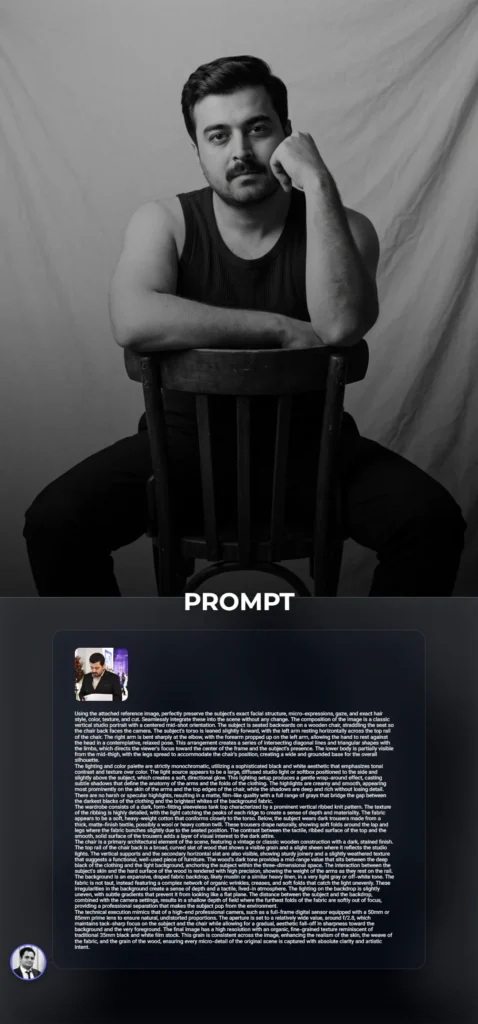
Cinematic Black and White Studio Portrait on Vintage Wooden ChairUsing the attached reference image, perfectly preserve the subject's exact facial structure, micro-expressions, gaze, and exact hair style, color, texture, and cut. Seamlessly integrate these into the scene without any change. The composition of the image is a classic vertical studio portrait with a centered mid-shot orientation. The subject is seated backwards on a wooden chair, straddling the seat so the chair back faces the camera. The subject's torso is leaned slightly forward, with the left arm resting horizontally across the top rail of the chair. The right arm is bent sharply at the elbow, with the forearm propped up on the left arm, allowing the hand to rest against the head in a contemplative, relaxed pose. This arrangement creates a series of intersecting diagonal lines and triangular shapes with the limbs, which directs the viewer's focus toward the center of the frame and the subject's presence. The lower body is partially visible from the mid-thigh, with the legs spread to accommodate the chair's position, creating a wide and grounded base for the overall silhouette.
The lighting and color palette are strictly monochromatic, utilizing a sophisticated black and white aesthetic that emphasizes tonal contrast and texture over color. The light source appears to be a large, diffused studio light or softbox positioned to the side and slightly above the subject, which creates a soft, directional glow. This lighting setup produces a gentle wrap-around effect, casting subtle shadows that define the anatomy of the arms and the folds of the clothing. The highlights are creamy and smooth, appearing most prominently on the skin of the arms and the top edges of the chair, while the shadows are deep and rich without losing detail. There are no harsh or specular highlights, resulting in a matte, film-like quality with a full range of grays that bridge the gap between the darkest blacks of the clothing and the brightest whites of the background fabric.
The wardrobe consists of a dark, form-fitting sleeveless tank top characterized by a prominent vertical ribbed knit pattern. The texture of the ribbing is highly detailed, with the light catching the peaks of each ridge to create a sense of depth and materiality. The fabric appears to be a soft, heavy-weight cotton that conforms closely to the torso. Below, the subject wears dark trousers made from a thick, matte-finish textile, possibly a wool or heavy cotton twill. These trousers drape naturally, showing soft folds around the lap and legs where the fabric bunches slightly due to the seated position. The contrast between the tactile, ribbed surface of the top and the smooth, solid surface of the trousers adds a layer of visual interest to the dark attire.
The chair is a primary architectural element of the scene, featuring a vintage or classic wooden construction with a dark, stained finish. The top rail of the chair back is a broad, curved slat of wood that shows a visible grain and a slight sheen where it reflects the studio lights. The vertical supports and the secondary horizontal slat are also visible, showing sturdy joinery and a slightly weathered texture that suggests a functional, well-used piece of furniture. The wood's dark tone provides a mid-range value that sits between the deep black of the clothing and the light background, anchoring the subject within the three-dimensional space. The interaction between the subject's skin and the hard surface of the wood is rendered with high precision, showing the weight of the arms as they rest on the rail.
The background is an expansive, draped fabric backdrop, likely muslin or a similar heavy linen, in a very light gray or off-white tone. The fabric is not taut, instead featuring a complex network of organic wrinkles, creases, and soft folds that catch the light unevenly. These irregularities in the background create a sense of depth and a tactile, lived-in atmosphere. The lighting on the backdrop is slightly uneven, with subtle gradients that prevent it from looking like a flat plane. The distance between the subject and the backdrop, combined with the camera settings, results in a shallow depth of field where the furthest folds of the fabric are softly out of focus, providing a professional separation that makes the subject pop from the environment.
The technical execution mimics that of a high-end professional camera, such as a full-frame digital sensor equipped with a 50mm or 85mm prime lens to ensure natural, undistorted proportions. The aperture is set to a relatively wide value, around f/2.8, which maintains tack-sharp focus on the subject and the chair while allowing for a gradual, aesthetic fall-off in sharpness toward the background and the very foreground. The final image has a high resolution with an organic, fine-grained texture reminiscent of traditional 35mm black and white film stock. This grain is consistent across the image, enhancing the realism of the skin, the weave of the fabric, and the grain of the wood, ensuring every micro-detail of the original scene is captured with absolute clarity and artistic intent.

Cinematic Chiaroscuro Monochromatic Portrait with Silver-Gelatin AestheticsUsing the attached reference image, perfectly preserve the subject's exact facial structure, micro-expressions, gaze, and exact hair style, color, texture, and cut. Seamlessly integrate these into the scene without any change. The lighting for this recreation must be a masterclass in high-contrast monochromatic cinematography, specifically emulating the look of classic silver-gelatin black-and-white photography. The primary illumination is a singular, directional light source positioned at a high angle to the subject's right, which creates a dramatic chiaroscuro effect. This lighting strategy leaves large portions of the scene in deep, rich blacks while highlighting the prominent surfaces of the subject's shoulder, the top of the hand, and the edge of the face with a soft, diffused glow. The transition between light and shadow is not harsh but possesses a smooth, painterly gradient that emphasizes the three-dimensional volume of the subject. The tonal range must be exceptionally broad, capturing every nuance from the darkest charcoal shadows in the recesses of the clothing to the bright, luminous grays on the highlights of the skin.
The camera composition is a medium shot captured from a slightly elevated downward angle, which enhances the mood of quiet introspection and vulnerability. A 50mm prime lens is utilized to provide a naturalistic perspective without the distortion typical of wider angles, ensuring the proportions of the subject and the surrounding environment feel grounded and realistic. The aperture is set to a wide f/2.8 to create a shallow depth of field, which keeps the subject in razor-sharp focus while allowing the background architectural elements to softly blur into the distance. The final image should incorporate a fine, organic film grain characteristic of high-speed 35mm film stock, such as Tri-X 400, adding a tactile, gritty quality to the render that avoids the sterile cleanliness of modern digital sensors. The focus is placed precisely on the subject's near eye, ensuring that the micro-expressions and contemplative gaze are the focal point of the entire composition.
The background setting consists of a wooden structure featuring traditional horizontal lap siding. These wooden planks are rendered with a weathered, matte texture, showing subtle variations in the grain and slight imperfections in the wood's surface. The horizontal lines of the siding create a rhythmic, geometric backdrop that contrasts with the organic, curved shapes of the subject. Below the subject, the floor of the deck is composed of thick wooden boards laid out with visible gaps between them, capturing the play of light and shadow in the crevices. The subject is seated in a classic Adirondack chair, which is defined by its wide, flat wooden armrests and its distinctive fan-shaped backrest made of vertical slats. The wood of the chair appears smooth and well-worn, with its natural grain visible under the high-contrast light, and it is angled away from the camera to create a sense of depth and perspective.
The subject's attire and posture are critical to the atmospheric success of the recreation. The subject is wearing a heavy, oversized, dark-toned garment, likely a high-density cotton or fleece hoodie, which has a matte, light-absorbing texture. The fabric is thick enough to hold deep, structural folds, particularly around the elbows and the chest, where the light catches the ridges of the material to reveal the weave and density of the cloth. The subject is posed in a relaxed, slumped-back position, leaning into the corner of the Adirondack chair. One arm is bent at the elbow with the hand raised toward the head, fingers slightly curled in a gesture of thought. A simple, wide-band metallic ring with a brushed, non-reflective finish is worn on one finger, catching a subtle highlight that adds a touch of detail to the hand's placement. The overall mood is one of stillness and cinematic drama, where the silence of the scene is palpable through the careful balance of shadow and light.

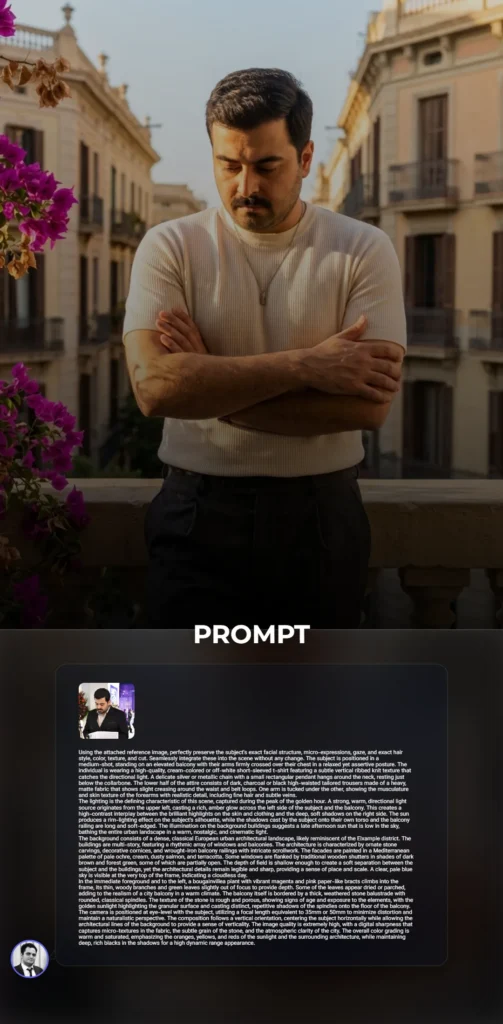
Cinematic Golden Hour Portrait on a Classical European BalconyUsing the attached reference image, perfectly preserve the subject's exact facial structure, micro-expressions, gaze, and exact hair style, color, texture, and cut. Seamlessly integrate these into the scene without any change. The subject is positioned in a medium-shot, standing on an elevated balcony with their arms firmly crossed over their chest in a relaxed yet assertive posture. The individual is wearing a high-quality, cream-colored or off-white short-sleeved t-shirt featuring a subtle vertical ribbed knit texture that catches the directional light. A delicate silver or metallic chain with a small rectangular pendant hangs around the neck, resting just below the collarbone. The lower half of the attire consists of dark, charcoal or black high-waisted tailored trousers made of a heavy, matte fabric that shows slight creasing around the waist and belt loops. One arm is tucked under the other, showing the musculature and skin texture of the forearms with realistic detail, including fine hair and subtle veins.
The lighting is the defining characteristic of this scene, captured during the peak of the golden hour. A strong, warm, directional light source originates from the upper left, casting a rich, amber glow across the left side of the subject and the balcony. This creates a high-contrast interplay between the brilliant highlights on the skin and clothing and the deep, soft shadows on the right side. The sun produces a rim-lighting effect on the subject's silhouette, while the shadows cast by the subject onto their own torso and the balcony railing are long and soft-edged. The illumination on the background buildings suggests a late afternoon sun that is low in the sky, bathing the entire urban landscape in a warm, nostalgic, and cinematic light.
The background consists of a dense, classical European urban architectural landscape, likely reminiscent of the Eixample district. The buildings are multi-story, featuring a rhythmic array of windows and balconies. The architecture is characterized by ornate stone carvings, decorative cornices, and wrought-iron balcony railings with intricate scrollwork. The facades are painted in a Mediterranean palette of pale ochre, cream, dusty salmon, and terracotta. Some windows are flanked by traditional wooden shutters in shades of dark brown and forest green, some of which are partially open. The depth of field is shallow enough to create a soft separation between the subject and the buildings, yet the architectural details remain legible and sharp, providing a sense of place and scale. A clear, pale blue sky is visible at the very top of the frame, indicating a cloudless day.
In the immediate foreground and to the left, a bougainvillea plant with vibrant magenta and pink paper-like bracts climbs into the frame, its thin, woody branches and green leaves slightly out of focus to provide depth. Some of the leaves appear dried or parched, adding to the realism of a city balcony in a warm climate. The balcony itself is bordered by a thick, weathered stone balustrade with rounded, classical spindles. The texture of the stone is rough and porous, showing signs of age and exposure to the elements, with the golden sunlight highlighting the granular surface and casting distinct, repetitive shadows of the spindles onto the floor of the balcony.
The camera is positioned at eye-level with the subject, utilizing a focal length equivalent to 35mm or 50mm to minimize distortion and maintain a naturalistic perspective. The composition follows a vertical orientation, centering the subject horizontally while allowing the architectural lines of the background to provide a sense of verticality. The image quality is extremely high, with a digital sharpness that captures micro-textures in the fabric, the subtle grain of the stone, and the atmospheric clarity of the city. The overall color grading is warm and saturated, emphasizing the oranges, yellows, and reds of the sunlight and the surrounding architecture, while maintaining deep, rich blacks in the shadows for a high dynamic range appearance.
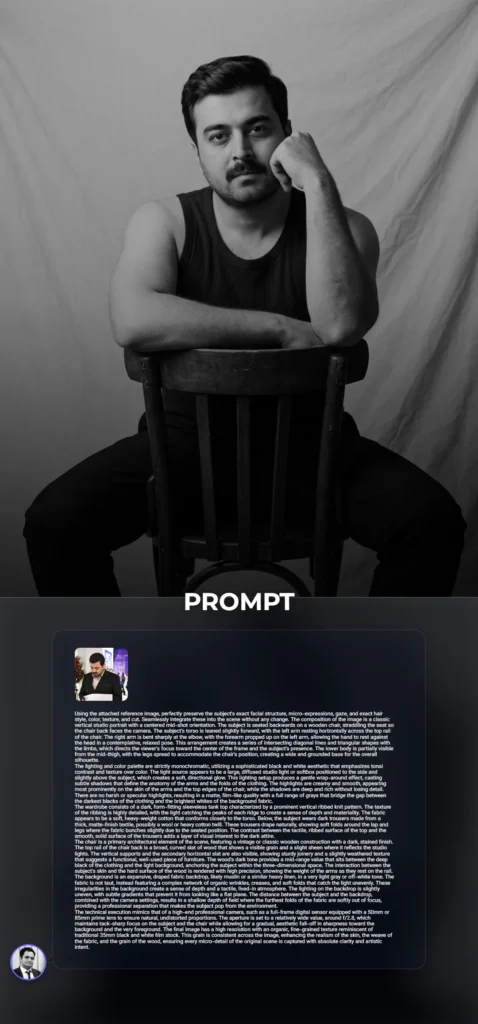
Cinematic Black and White Studio Portrait on Vintage Wooden ChairUsing the attached reference image, perfectly preserve the subject's exact facial structure, micro-expressions, gaze, and exact hair style, color, texture, and cut. Seamlessly integrate these into the scene without any change. The composition of the image is a classic vertical studio portrait with a centered mid-shot orientation. The subject is seated backwards on a wooden chair, straddling the seat so the chair back faces the camera. The subject's torso is leaned slightly forward, with the left arm resting horizontally across the top rail of the chair. The right arm is bent sharply at the elbow, with the forearm propped up on the left arm, allowing the hand to rest against the head in a contemplative, relaxed pose. This arrangement creates a series of intersecting diagonal lines and triangular shapes with the limbs, which directs the viewer's focus toward the center of the frame and the subject's presence. The lower body is partially visible from the mid-thigh, with the legs spread to accommodate the chair's position, creating a wide and grounded base for the overall silhouette.
The lighting and color palette are strictly monochromatic, utilizing a sophisticated black and white aesthetic that emphasizes tonal contrast and texture over color. The light source appears to be a large, diffused studio light or softbox positioned to the side and slightly above the subject, which creates a soft, directional glow. This lighting setup produces a gentle wrap-around effect, casting subtle shadows that define the anatomy of the arms and the folds of the clothing. The highlights are creamy and smooth, appearing most prominently on the skin of the arms and the top edges of the chair, while the shadows are deep and rich without losing detail. There are no harsh or specular highlights, resulting in a matte, film-like quality with a full range of grays that bridge the gap between the darkest blacks of the clothing and the brightest whites of the background fabric.
The wardrobe consists of a dark, form-fitting sleeveless tank top characterized by a prominent vertical ribbed knit pattern. The texture of the ribbing is highly detailed, with the light catching the peaks of each ridge to create a sense of depth and materiality. The fabric appears to be a soft, heavy-weight cotton that conforms closely to the torso. Below, the subject wears dark trousers made from a thick, matte-finish textile, possibly a wool or heavy cotton twill. These trousers drape naturally, showing soft folds around the lap and legs where the fabric bunches slightly due to the seated position. The contrast between the tactile, ribbed surface of the top and the smooth, solid surface of the trousers adds a layer of visual interest to the dark attire.
The chair is a primary architectural element of the scene, featuring a vintage or classic wooden construction with a dark, stained finish. The top rail of the chair back is a broad, curved slat of wood that shows a visible grain and a slight sheen where it reflects the studio lights. The vertical supports and the secondary horizontal slat are also visible, showing sturdy joinery and a slightly weathered texture that suggests a functional, well-used piece of furniture. The wood's dark tone provides a mid-range value that sits between the deep black of the clothing and the light background, anchoring the subject within the three-dimensional space. The interaction between the subject's skin and the hard surface of the wood is rendered with high precision, showing the weight of the arms as they rest on the rail.
The background is an expansive, draped fabric backdrop, likely muslin or a similar heavy linen, in a very light gray or off-white tone. The fabric is not taut, instead featuring a complex network of organic wrinkles, creases, and soft folds that catch the light unevenly. These irregularities in the background create a sense of depth and a tactile, lived-in atmosphere. The lighting on the backdrop is slightly uneven, with subtle gradients that prevent it from looking like a flat plane. The distance between the subject and the backdrop, combined with the camera settings, results in a shallow depth of field where the furthest folds of the fabric are softly out of focus, providing a professional separation that makes the subject pop from the environment.
The technical execution mimics that of a high-end professional camera, such as a full-frame digital sensor equipped with a 50mm or 85mm prime lens to ensure natural, undistorted proportions. The aperture is set to a relatively wide value, around f/2.8, which maintains tack-sharp focus on the subject and the chair while allowing for a gradual, aesthetic fall-off in sharpness toward the background and the very foreground. The final image has a high resolution with an organic, fine-grained texture reminiscent of traditional 35mm black and white film stock. This grain is consistent across the image, enhancing the realism of the skin, the weave of the fabric, and the grain of the wood, ensuring every micro-detail of the original scene is captured with absolute clarity and artistic intent.

Cinematic Chiaroscuro Monochromatic Portrait with Silver-Gelatin AestheticsUsing the attached reference image, perfectly preserve the subject's exact facial structure, micro-expressions, gaze, and exact hair style, color, texture, and cut. Seamlessly integrate these into the scene without any change. The lighting for this recreation must be a masterclass in high-contrast monochromatic cinematography, specifically emulating the look of classic silver-gelatin black-and-white photography. The primary illumination is a singular, directional light source positioned at a high angle to the subject's right, which creates a dramatic chiaroscuro effect. This lighting strategy leaves large portions of the scene in deep, rich blacks while highlighting the prominent surfaces of the subject's shoulder, the top of the hand, and the edge of the face with a soft, diffused glow. The transition between light and shadow is not harsh but possesses a smooth, painterly gradient that emphasizes the three-dimensional volume of the subject. The tonal range must be exceptionally broad, capturing every nuance from the darkest charcoal shadows in the recesses of the clothing to the bright, luminous grays on the highlights of the skin.
The camera composition is a medium shot captured from a slightly elevated downward angle, which enhances the mood of quiet introspection and vulnerability. A 50mm prime lens is utilized to provide a naturalistic perspective without the distortion typical of wider angles, ensuring the proportions of the subject and the surrounding environment feel grounded and realistic. The aperture is set to a wide f/2.8 to create a shallow depth of field, which keeps the subject in razor-sharp focus while allowing the background architectural elements to softly blur into the distance. The final image should incorporate a fine, organic film grain characteristic of high-speed 35mm film stock, such as Tri-X 400, adding a tactile, gritty quality to the render that avoids the sterile cleanliness of modern digital sensors. The focus is placed precisely on the subject's near eye, ensuring that the micro-expressions and contemplative gaze are the focal point of the entire composition.
The background setting consists of a wooden structure featuring traditional horizontal lap siding. These wooden planks are rendered with a weathered, matte texture, showing subtle variations in the grain and slight imperfections in the wood's surface. The horizontal lines of the siding create a rhythmic, geometric backdrop that contrasts with the organic, curved shapes of the subject. Below the subject, the floor of the deck is composed of thick wooden boards laid out with visible gaps between them, capturing the play of light and shadow in the crevices. The subject is seated in a classic Adirondack chair, which is defined by its wide, flat wooden armrests and its distinctive fan-shaped backrest made of vertical slats. The wood of the chair appears smooth and well-worn, with its natural grain visible under the high-contrast light, and it is angled away from the camera to create a sense of depth and perspective.
The subject's attire and posture are critical to the atmospheric success of the recreation. The subject is wearing a heavy, oversized, dark-toned garment, likely a high-density cotton or fleece hoodie, which has a matte, light-absorbing texture. The fabric is thick enough to hold deep, structural folds, particularly around the elbows and the chest, where the light catches the ridges of the material to reveal the weave and density of the cloth. The subject is posed in a relaxed, slumped-back position, leaning into the corner of the Adirondack chair. One arm is bent at the elbow with the hand raised toward the head, fingers slightly curled in a gesture of thought. A simple, wide-band metallic ring with a brushed, non-reflective finish is worn on one finger, catching a subtle highlight that adds a touch of detail to the hand's placement. The overall mood is one of stillness and cinematic drama, where the silence of the scene is palpable through the careful balance of shadow and light.

Cinematic Golden Hour Portrait on a Classical European BalconyUsing the attached reference image, perfectly preserve the subject's exact facial structure, micro-expressions, gaze, and exact hair style, color, texture, and cut. Seamlessly integrate these into the scene without any change. The subject is positioned in a medium-shot, standing on an elevated balcony with their arms firmly crossed over their chest in a relaxed yet assertive posture. The individual is wearing a high-quality, cream-colored or off-white short-sleeved t-shirt featuring a subtle vertical ribbed knit texture that catches the directional light. A delicate silver or metallic chain with a small rectangular pendant hangs around the neck, resting just below the collarbone. The lower half of the attire consists of dark, charcoal or black high-waisted tailored trousers made of a heavy, matte fabric that shows slight creasing around the waist and belt loops. One arm is tucked under the other, showing the musculature and skin texture of the forearms with realistic detail, including fine hair and subtle veins.
The lighting is the defining characteristic of this scene, captured during the peak of the golden hour. A strong, warm, directional light source originates from the upper left, casting a rich, amber glow across the left side of the subject and the balcony. This creates a high-contrast interplay between the brilliant highlights on the skin and clothing and the deep, soft shadows on the right side. The sun produces a rim-lighting effect on the subject's silhouette, while the shadows cast by the subject onto their own torso and the balcony railing are long and soft-edged. The illumination on the background buildings suggests a late afternoon sun that is low in the sky, bathing the entire urban landscape in a warm, nostalgic, and cinematic light.
The background consists of a dense, classical European urban architectural landscape, likely reminiscent of the Eixample district. The buildings are multi-story, featuring a rhythmic array of windows and balconies. The architecture is characterized by ornate stone carvings, decorative cornices, and wrought-iron balcony railings with intricate scrollwork. The facades are painted in a Mediterranean palette of pale ochre, cream, dusty salmon, and terracotta. Some windows are flanked by traditional wooden shutters in shades of dark brown and forest green, some of which are partially open. The depth of field is shallow enough to create a soft separation between the subject and the buildings, yet the architectural details remain legible and sharp, providing a sense of place and scale. A clear, pale blue sky is visible at the very top of the frame, indicating a cloudless day.
In the immediate foreground and to the left, a bougainvillea plant with vibrant magenta and pink paper-like bracts climbs into the frame, its thin, woody branches and green leaves slightly out of focus to provide depth. Some of the leaves appear dried or parched, adding to the realism of a city balcony in a warm climate. The balcony itself is bordered by a thick, weathered stone balustrade with rounded, classical spindles. The texture of the stone is rough and porous, showing signs of age and exposure to the elements, with the golden sunlight highlighting the granular surface and casting distinct, repetitive shadows of the spindles onto the floor of the balcony.
The camera is positioned at eye-level with the subject, utilizing a focal length equivalent to 35mm or 50mm to minimize distortion and maintain a naturalistic perspective. The composition follows a vertical orientation, centering the subject horizontally while allowing the architectural lines of the background to provide a sense of verticality. The image quality is extremely high, with a digital sharpness that captures micro-textures in the fabric, the subtle grain of the stone, and the atmospheric clarity of the city. The overall color grading is warm and saturated, emphasizing the oranges, yellows, and reds of the sunlight and the surrounding architecture, while maintaining deep, rich blacks in the shadows for a high dynamic range appearance.
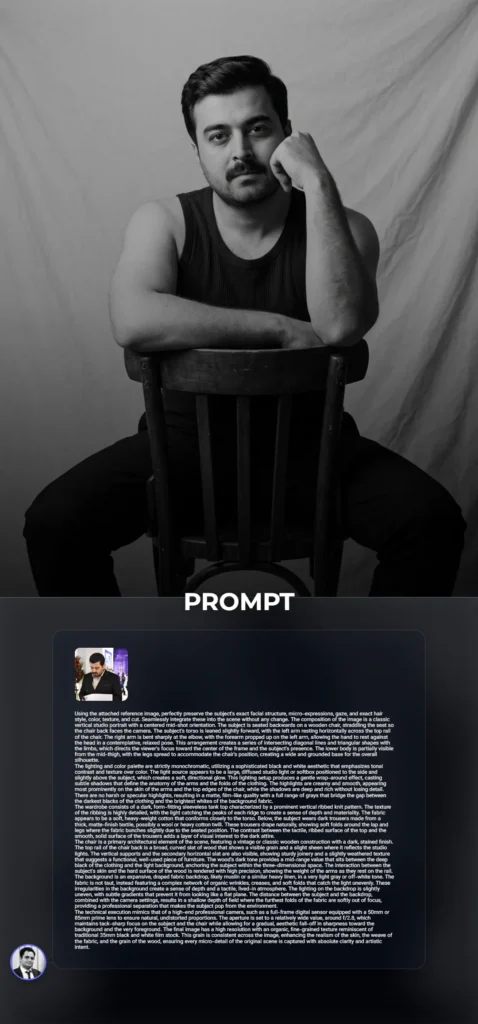
Cinematic Black and White Studio Portrait on Vintage Wooden ChairUsing the attached reference image, perfectly preserve the subject's exact facial structure, micro-expressions, gaze, and exact hair style, color, texture, and cut. Seamlessly integrate these into the scene without any change. The composition of the image is a classic vertical studio portrait with a centered mid-shot orientation. The subject is seated backwards on a wooden chair, straddling the seat so the chair back faces the camera. The subject's torso is leaned slightly forward, with the left arm resting horizontally across the top rail of the chair. The right arm is bent sharply at the elbow, with the forearm propped up on the left arm, allowing the hand to rest against the head in a contemplative, relaxed pose. This arrangement creates a series of intersecting diagonal lines and triangular shapes with the limbs, which directs the viewer's focus toward the center of the frame and the subject's presence. The lower body is partially visible from the mid-thigh, with the legs spread to accommodate the chair's position, creating a wide and grounded base for the overall silhouette.
The lighting and color palette are strictly monochromatic, utilizing a sophisticated black and white aesthetic that emphasizes tonal contrast and texture over color. The light source appears to be a large, diffused studio light or softbox positioned to the side and slightly above the subject, which creates a soft, directional glow. This lighting setup produces a gentle wrap-around effect, casting subtle shadows that define the anatomy of the arms and the folds of the clothing. The highlights are creamy and smooth, appearing most prominently on the skin of the arms and the top edges of the chair, while the shadows are deep and rich without losing detail. There are no harsh or specular highlights, resulting in a matte, film-like quality with a full range of grays that bridge the gap between the darkest blacks of the clothing and the brightest whites of the background fabric.
The wardrobe consists of a dark, form-fitting sleeveless tank top characterized by a prominent vertical ribbed knit pattern. The texture of the ribbing is highly detailed, with the light catching the peaks of each ridge to create a sense of depth and materiality. The fabric appears to be a soft, heavy-weight cotton that conforms closely to the torso. Below, the subject wears dark trousers made from a thick, matte-finish textile, possibly a wool or heavy cotton twill. These trousers drape naturally, showing soft folds around the lap and legs where the fabric bunches slightly due to the seated position. The contrast between the tactile, ribbed surface of the top and the smooth, solid surface of the trousers adds a layer of visual interest to the dark attire.
The chair is a primary architectural element of the scene, featuring a vintage or classic wooden construction with a dark, stained finish. The top rail of the chair back is a broad, curved slat of wood that shows a visible grain and a slight sheen where it reflects the studio lights. The vertical supports and the secondary horizontal slat are also visible, showing sturdy joinery and a slightly weathered texture that suggests a functional, well-used piece of furniture. The wood's dark tone provides a mid-range value that sits between the deep black of the clothing and the light background, anchoring the subject within the three-dimensional space. The interaction between the subject's skin and the hard surface of the wood is rendered with high precision, showing the weight of the arms as they rest on the rail.
The background is an expansive, draped fabric backdrop, likely muslin or a similar heavy linen, in a very light gray or off-white tone. The fabric is not taut, instead featuring a complex network of organic wrinkles, creases, and soft folds that catch the light unevenly. These irregularities in the background create a sense of depth and a tactile, lived-in atmosphere. The lighting on the backdrop is slightly uneven, with subtle gradients that prevent it from looking like a flat plane. The distance between the subject and the backdrop, combined with the camera settings, results in a shallow depth of field where the furthest folds of the fabric are softly out of focus, providing a professional separation that makes the subject pop from the environment.
The technical execution mimics that of a high-end professional camera, such as a full-frame digital sensor equipped with a 50mm or 85mm prime lens to ensure natural, undistorted proportions. The aperture is set to a relatively wide value, around f/2.8, which maintains tack-sharp focus on the subject and the chair while allowing for a gradual, aesthetic fall-off in sharpness toward the background and the very foreground. The final image has a high resolution with an organic, fine-grained texture reminiscent of traditional 35mm black and white film stock. This grain is consistent across the image, enhancing the realism of the skin, the weave of the fabric, and the grain of the wood, ensuring every micro-detail of the original scene is captured with absolute clarity and artistic intent.
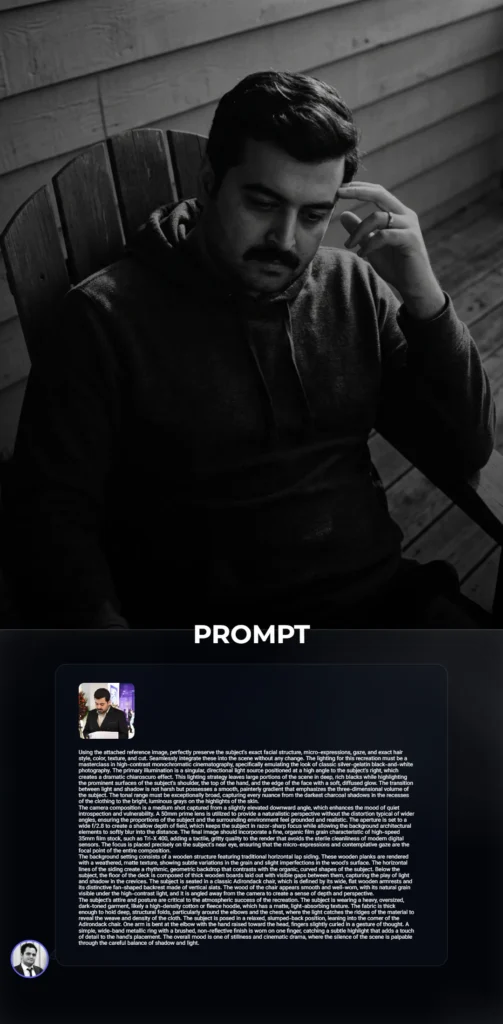
Cinematic Chiaroscuro Monochromatic Portrait with Silver-Gelatin AestheticsUsing the attached reference image, perfectly preserve the subject's exact facial structure, micro-expressions, gaze, and exact hair style, color, texture, and cut. Seamlessly integrate these into the scene without any change. The lighting for this recreation must be a masterclass in high-contrast monochromatic cinematography, specifically emulating the look of classic silver-gelatin black-and-white photography. The primary illumination is a singular, directional light source positioned at a high angle to the subject's right, which creates a dramatic chiaroscuro effect. This lighting strategy leaves large portions of the scene in deep, rich blacks while highlighting the prominent surfaces of the subject's shoulder, the top of the hand, and the edge of the face with a soft, diffused glow. The transition between light and shadow is not harsh but possesses a smooth, painterly gradient that emphasizes the three-dimensional volume of the subject. The tonal range must be exceptionally broad, capturing every nuance from the darkest charcoal shadows in the recesses of the clothing to the bright, luminous grays on the highlights of the skin.
The camera composition is a medium shot captured from a slightly elevated downward angle, which enhances the mood of quiet introspection and vulnerability. A 50mm prime lens is utilized to provide a naturalistic perspective without the distortion typical of wider angles, ensuring the proportions of the subject and the surrounding environment feel grounded and realistic. The aperture is set to a wide f/2.8 to create a shallow depth of field, which keeps the subject in razor-sharp focus while allowing the background architectural elements to softly blur into the distance. The final image should incorporate a fine, organic film grain characteristic of high-speed 35mm film stock, such as Tri-X 400, adding a tactile, gritty quality to the render that avoids the sterile cleanliness of modern digital sensors. The focus is placed precisely on the subject's near eye, ensuring that the micro-expressions and contemplative gaze are the focal point of the entire composition.
The background setting consists of a wooden structure featuring traditional horizontal lap siding. These wooden planks are rendered with a weathered, matte texture, showing subtle variations in the grain and slight imperfections in the wood's surface. The horizontal lines of the siding create a rhythmic, geometric backdrop that contrasts with the organic, curved shapes of the subject. Below the subject, the floor of the deck is composed of thick wooden boards laid out with visible gaps between them, capturing the play of light and shadow in the crevices. The subject is seated in a classic Adirondack chair, which is defined by its wide, flat wooden armrests and its distinctive fan-shaped backrest made of vertical slats. The wood of the chair appears smooth and well-worn, with its natural grain visible under the high-contrast light, and it is angled away from the camera to create a sense of depth and perspective.
The subject's attire and posture are critical to the atmospheric success of the recreation. The subject is wearing a heavy, oversized, dark-toned garment, likely a high-density cotton or fleece hoodie, which has a matte, light-absorbing texture. The fabric is thick enough to hold deep, structural folds, particularly around the elbows and the chest, where the light catches the ridges of the material to reveal the weave and density of the cloth. The subject is posed in a relaxed, slumped-back position, leaning into the corner of the Adirondack chair. One arm is bent at the elbow with the hand raised toward the head, fingers slightly curled in a gesture of thought. A simple, wide-band metallic ring with a brushed, non-reflective finish is worn on one finger, catching a subtle highlight that adds a touch of detail to the hand's placement. The overall mood is one of stillness and cinematic drama, where the silence of the scene is palpable through the careful balance of shadow and light.
Cinematic Golden Hour Portrait on a Classical European BalconyUsing the attached reference image, perfectly preserve the subject's exact facial structure, micro-expressions, gaze, and exact hair style, color, texture, and cut. Seamlessly integrate these into the scene without any change. The subject is positioned in a medium-shot, standing on an elevated balcony with their arms firmly crossed over their chest in a relaxed yet assertive posture. The individual is wearing a high-quality, cream-colored or off-white short-sleeved t-shirt featuring a subtle vertical ribbed knit texture that catches the directional light. A delicate silver or metallic chain with a small rectangular pendant hangs around the neck, resting just below the collarbone. The lower half of the attire consists of dark, charcoal or black high-waisted tailored trousers made of a heavy, matte fabric that shows slight creasing around the waist and belt loops. One arm is tucked under the other, showing the musculature and skin texture of the forearms with realistic detail, including fine hair and subtle veins.
The lighting is the defining characteristic of this scene, captured during the peak of the golden hour. A strong, warm, directional light source originates from the upper left, casting a rich, amber glow across the left side of the subject and the balcony. This creates a high-contrast interplay between the brilliant highlights on the skin and clothing and the deep, soft shadows on the right side. The sun produces a rim-lighting effect on the subject's silhouette, while the shadows cast by the subject onto their own torso and the balcony railing are long and soft-edged. The illumination on the background buildings suggests a late afternoon sun that is low in the sky, bathing the entire urban landscape in a warm, nostalgic, and cinematic light.
The background consists of a dense, classical European urban architectural landscape, likely reminiscent of the Eixample district. The buildings are multi-story, featuring a rhythmic array of windows and balconies. The architecture is characterized by ornate stone carvings, decorative cornices, and wrought-iron balcony railings with intricate scrollwork. The facades are painted in a Mediterranean palette of pale ochre, cream, dusty salmon, and terracotta. Some windows are flanked by traditional wooden shutters in shades of dark brown and forest green, some of which are partially open. The depth of field is shallow enough to create a soft separation between the subject and the buildings, yet the architectural details remain legible and sharp, providing a sense of place and scale. A clear, pale blue sky is visible at the very top of the frame, indicating a cloudless day.
In the immediate foreground and to the left, a bougainvillea plant with vibrant magenta and pink paper-like bracts climbs into the frame, its thin, woody branches and green leaves slightly out of focus to provide depth. Some of the leaves appear dried or parched, adding to the realism of a city balcony in a warm climate. The balcony itself is bordered by a thick, weathered stone balustrade with rounded, classical spindles. The texture of the stone is rough and porous, showing signs of age and exposure to the elements, with the golden sunlight highlighting the granular surface and casting distinct, repetitive shadows of the spindles onto the floor of the balcony.
The camera is positioned at eye-level with the subject, utilizing a focal length equivalent to 35mm or 50mm to minimize distortion and maintain a naturalistic perspective. The composition follows a vertical orientation, centering the subject horizontally while allowing the architectural lines of the background to provide a sense of verticality. The image quality is extremely high, with a digital sharpness that captures micro-textures in the fabric, the subtle grain of the stone, and the atmospheric clarity of the city. The overall color grading is warm and saturated, emphasizing the oranges, yellows, and reds of the sunlight and the surrounding architecture, while maintaining deep, rich blacks in the shadows for a high dynamic range appearance.