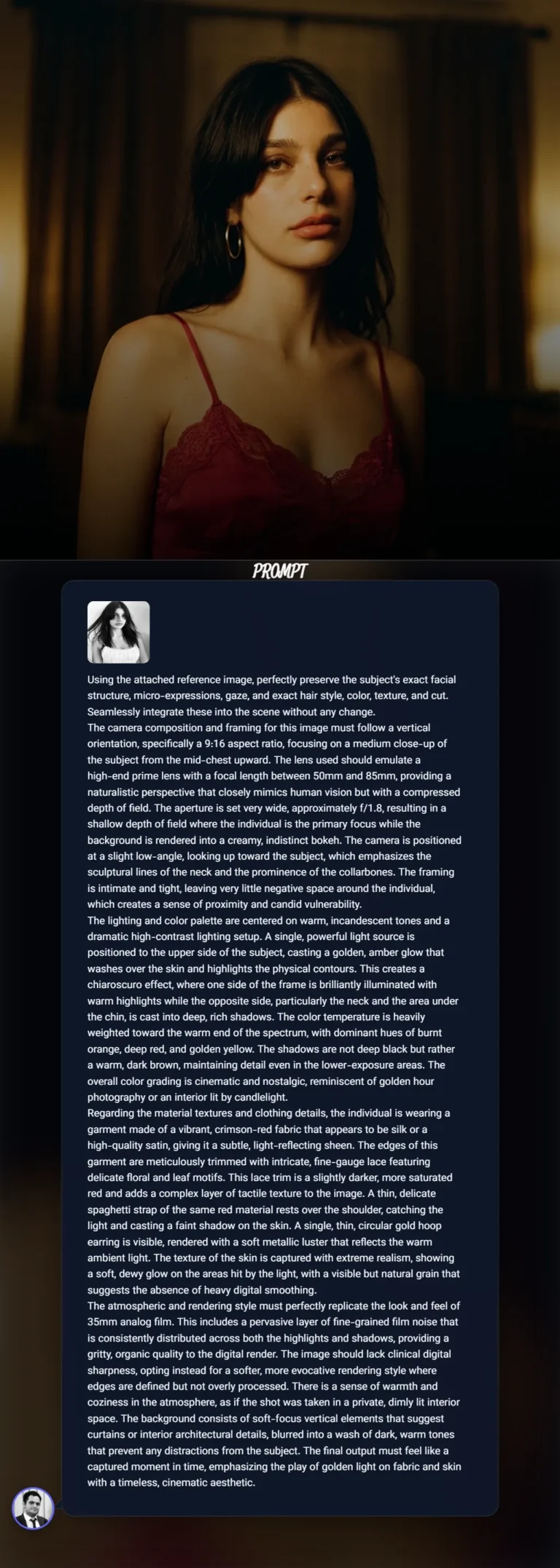
Cinematic 35mm Portrait: Golden Chiaroscuro in Red SilkUsing the attached reference image, perfectly preserve the subject's exact facial structure, micro-expressions, gaze, and exact hair style, color, texture, and cut. Seamlessly integrate these into the scene without any change.
The camera composition and framing for this image must follow a vertical orientation, specifically a 9:16 aspect ratio, focusing on a medium close-up of the subject from the mid-chest upward. The lens used should emulate a high-end prime lens with a focal length between 50mm and 85mm, providing a naturalistic perspective that closely mimics human vision but with a compressed depth of field. The aperture is set very wide, approximately f/1.8, resulting in a shallow depth of field where the individual is the primary focus while the background is rendered into a creamy, indistinct bokeh. The camera is positioned at a slight low-angle, looking up toward the subject, which emphasizes the sculptural lines of the neck and the prominence of the collarbones. The framing is intimate and tight, leaving very little negative space around the individual, which creates a sense of proximity and candid vulnerability.
The lighting and color palette are centered on warm, incandescent tones and a dramatic high-contrast lighting setup. A single, powerful light source is positioned to the upper side of the subject, casting a golden, amber glow that washes over the skin and highlights the physical contours. This creates a chiaroscuro effect, where one side of the frame is brilliantly illuminated with warm highlights while the opposite side, particularly the neck and the area under the chin, is cast into deep, rich shadows. The color temperature is heavily weighted toward the warm end of the spectrum, with dominant hues of burnt orange, deep red, and golden yellow. The shadows are not deep black but rather a warm, dark brown, maintaining detail even in the lower-exposure areas. The overall color grading is cinematic and nostalgic, reminiscent of golden hour photography or an interior lit by candlelight.
Regarding the material textures and clothing details, the individual is wearing a garment made of a vibrant, crimson-red fabric that appears to be silk or a high-quality satin, giving it a subtle, light-reflecting sheen. The edges of this garment are meticulously trimmed with intricate, fine-gauge lace featuring delicate floral and leaf motifs. This lace trim is a slightly darker, more saturated red and adds a complex layer of tactile texture to the image. A thin, delicate spaghetti strap of the same red material rests over the shoulder, catching the light and casting a faint shadow on the skin. A single, thin, circular gold hoop earring is visible, rendered with a soft metallic luster that reflects the warm ambient light. The texture of the skin is captured with extreme realism, showing a soft, dewy glow on the areas hit by the light, with a visible but natural grain that suggests the absence of heavy digital smoothing.
The atmospheric and rendering style must perfectly replicate the look and feel of 35mm analog film. This includes a pervasive layer of fine-grained film noise that is consistently distributed across both the highlights and shadows, providing a gritty, organic quality to the digital render. The image should lack clinical digital sharpness, opting instead for a softer, more evocative rendering style where edges are defined but not overly processed. There is a sense of warmth and coziness in the atmosphere, as if the shot was taken in a private, dimly lit interior space. The background consists of soft-focus vertical elements that suggest curtains or interior architectural details, blurred into a wash of dark, warm tones that prevent any distractions from the subject. The final output must feel like a captured moment in time, emphasizing the play of golden light on fabric and skin with a timeless, cinematic aesthetic.

Hyper-Realistic 100mm Macro Studio Portrait and Skin Texture PromptUsing the attached reference image, perfectly preserve the subject's exact facial structure, micro-expressions, gaze, and exact hair style, color, texture, and cut. Seamlessly integrate these into the scene without any change.
The camera composition is a tightly framed headshot, captured from a straight-on, eye-level perspective that creates an intimate and direct connection with the viewer. The shot is executed with a 100mm macro prime lens, known for its ability to render microscopic details with clinical precision while maintaining a naturalistic compression of depth. The aperture is set to a shallow f/2.8, which ensures the focus is razor-sharp on the anterior plane of the skin surface while allowing the edges of the shoulders and the distant background to fall into a smooth, creamy blur. The shutter speed is high to eliminate any potential motion blur, resulting in a crisp, frozen moment. The image is captured on a full-frame sensor at a high ISO-base setting to ensure maximum dynamic range and a noise-free finish, preserving the subtlest gradients in the highlights and shadows. The framing is so tight that the crown of the head and the lower neck are the boundaries, focusing the viewer entirely on the central anatomical details.
The lighting architecture is designed as a sophisticated studio setup, employing a large octabox as the primary key light, positioned slightly above and to the right of the camera axis. This creates a soft, wrap-around illumination that minimizes harsh shadows while emphasizing the three-dimensional topography of the skin. A secondary white foam core reflector is placed on the opposite side to provide a subtle fill, lifting the shadows in the recesses and ensuring that no detail is lost to total blackness. The light quality is diffused and neutral, with a color temperature calibrated to 5500 Kelvin to mimic natural daylight. This results in highly accurate color reproduction, where the subtle variations in skin tone are rendered with lifelike fidelity. Specular highlights are controlled and soft, appearing as gentle glints on the most prominent surfaces of the skin and the cosmetic applications.
The rendering of surface materials focuses on an extreme level of photorealism, emphasizing the micro-topography of the individual's skin. The digital shader utilizes advanced sub-surface scattering to simulate the way light penetrates the dermal layers and scatters internally, giving the skin a healthy, translucent glow. Every pore, fine line, and minute variation in pigmentation is rendered with 8k resolution clarity. The cosmetic textures are equally detailed, showing the specific grain and matte-to-satin finish of the pigments applied to the skin. The interplay between the moisture of the surface and the dry, powdered areas is clearly distinguishable. The clothing visible at the very bottom of the frame is a lightweight fabric, featuring a crisp white base with a pattern of dark, circular motifs. The weave of the textile is visible under the macro lens, showing the interlacing threads and the soft, organic fold of the collar as it rests against the base of the neck.
The background is a minimalist, non-distracting studio environment, consisting of a flat, neutral-toned wall with a subtle matte texture. The color is a desaturated greyish-white, which serves to provide a clean contrast against the subject and ensures that the color palette of the foreground remains the primary focus. Due to the shallow depth of field, the background texture is softened into a uniform, non-descript field of color, though the slight falloff of light across its surface adds a sense of spatial depth. There is no visible furniture or props, maintaining a purely character-focused aesthetic. The atmosphere is clear and devoid of heavy particulate matter, though a very fine, almost imperceptible grain is maintained to give the final image a traditional film-like quality rather than a sterile digital appearance. The overall color grading is naturalistic, with a slight emphasis on warmth in the mid-tones to enhance the vibrancy of the subject's natural coloration.

Hyper-Realistic Chiaroscuro Macro Portrait with Dripping Primary PaintUsing the attached reference image, perfectly preserve the subject's exact facial structure, micro-expressions, gaze, and exact hair style, color, texture, and cut. Seamlessly integrate these into the scene without any change. The lighting must be executed with a high-contrast, dramatic chiaroscuro technique, utilizing a sharp, directional key light source positioned at a steep forty-five-degree angle to the side. This creates intense specular highlights and deep, velvety shadows that accentuate the three-dimensional topography of the subject's skin and the viscous application of the medium. The light should be calibrated to a daylight-balanced 5600K, ensuring that the primary colors of the paint—vivid cadmium yellow, deep crimson red, rich cobalt blue, and a dense, light-absorbing carbon black—appear with maximum saturation and chromatic purity. The shadows should fall steeply across the contours of the neck and the side of the face, leaving large areas in near-total darkness while highlighting the glistening moisture of the paint and the fine details of the skin.
The material textures are of paramount importance and must be rendered with hyper-realistic precision. The paint should appear as a heavy-body, high-gloss liquid medium, perhaps oil or thick acrylic, with a tangible viscosity. On the forehead and cheeks, the paint must be seen in various stages of movement: thick, bulbous droplets that are caught in a slow-motion descent, trailing thin, elongated ribbons of pigment behind them. Some areas should show the paint merging together without fully mixing, maintaining distinct boundaries between the red, yellow, and blue hues. The texture of the skin beneath must be visible where the paint is absent, showcasing a dense pattern of natural freckles, fine pores, and the subtle translucency of the epidermis. The hand, positioned in the lower right quadrant, is heavily coated in the same multi-colored medium, with the paint filling the creases of the knuckles and gathering under the fingernails. The contact between the paint-covered index finger and the lower lip must look wet and slightly sticky, with the glossy red pigment of the lip blending seamlessly with the external paint.
The camera composition is an extreme macro close-up, utilizing a high-end 100mm f/2.8 macro lens or similar optics to capture a shallow depth of field that keeps the central features and the hand in razor-sharp focus while allowing the periphery to fall into a soft, creamy bokeh. The framing is tight and vertical, centered on the lower half of the face and the hand gesture, creating an intimate and visceral perspective. The aperture should be set precisely to maintain focus from the tip of the nose to the surface of the hand, while the background remains a non-distracting, dark, and moody void with hints of deep teal or blue. The digital sensor should capture the image with a high dynamic range and no visible grain, mimicking the clarity of a medium format camera system. Every ridge of the skin, every bubble in the drying paint, and every individual specular reflection on the wet surfaces must be rendered with absolute clarity.
The color palette is dominated by a high-contrast interaction between the dark, shadowed skin tones and the explosive brightness of the primary-colored paint. The yellow must be an opaque, buttery consistency, the red should have the depth of fresh arterial blood, and the blue should be a vibrant, electric sapphire. These colors are not merely flat surfaces but have volume, casting their own micro-shadows onto the skin below based on their thickness. The overall atmosphere is one of artistic chaos and intense sensory detail, where the stillness of the individual's expression contrasts with the dynamic, flowing nature of the liquid medium. The final image must feel like a high-fashion editorial photograph that has been merged with a contemporary art installation, emphasizing the tactile nature of the substances and the raw, unedited beauty of the subject's natural skin texture against the artificial brilliance of the pigments.
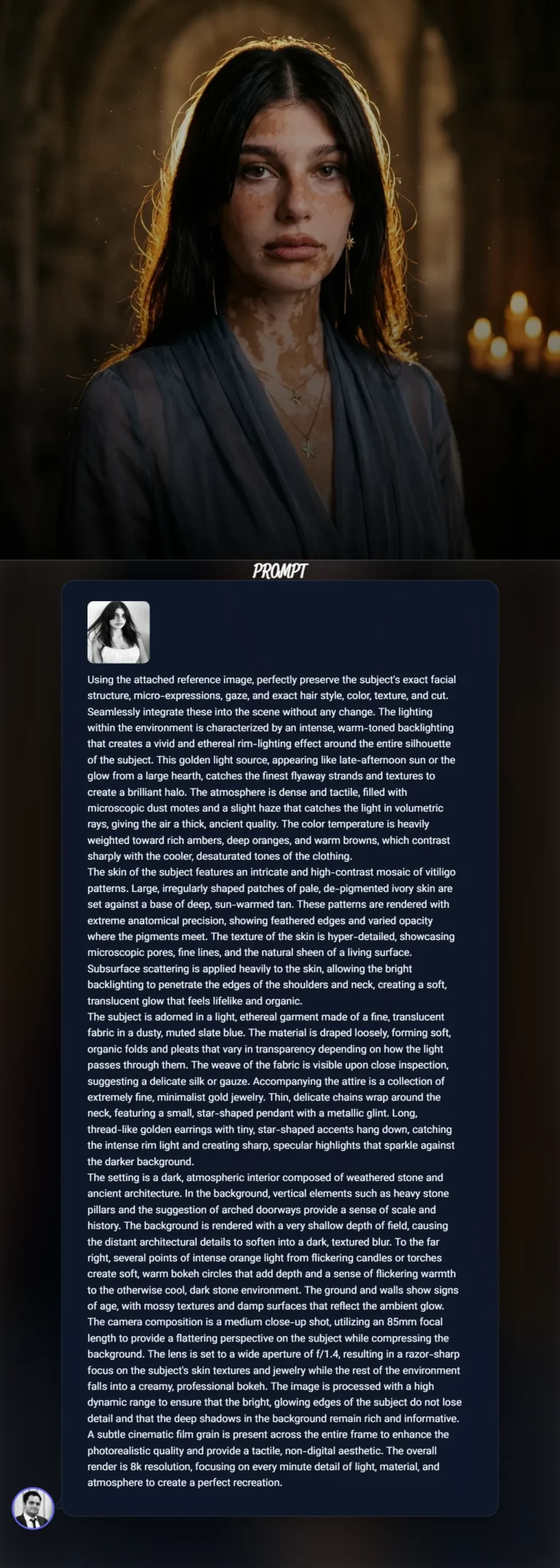
Cinematic Vitiligo Portrait with Golden Rim Lighting and Star JewelryUsing the attached reference image, perfectly preserve the subject's exact facial structure, micro-expressions, gaze, and exact hair style, color, texture, and cut. Seamlessly integrate these into the scene without any change. The lighting within the environment is characterized by an intense, warm-toned backlighting that creates a vivid and ethereal rim-lighting effect around the entire silhouette of the subject. This golden light source, appearing like late-afternoon sun or the glow from a large hearth, catches the finest flyaway strands and textures to create a brilliant halo. The atmosphere is dense and tactile, filled with microscopic dust motes and a slight haze that catches the light in volumetric rays, giving the air a thick, ancient quality. The color temperature is heavily weighted toward rich ambers, deep oranges, and warm browns, which contrast sharply with the cooler, desaturated tones of the clothing.
The skin of the subject features an intricate and high-contrast mosaic of vitiligo patterns. Large, irregularly shaped patches of pale, de-pigmented ivory skin are set against a base of deep, sun-warmed tan. These patterns are rendered with extreme anatomical precision, showing feathered edges and varied opacity where the pigments meet. The texture of the skin is hyper-detailed, showcasing microscopic pores, fine lines, and the natural sheen of a living surface. Subsurface scattering is applied heavily to the skin, allowing the bright backlighting to penetrate the edges of the shoulders and neck, creating a soft, translucent glow that feels lifelike and organic.
The subject is adorned in a light, ethereal garment made of a fine, translucent fabric in a dusty, muted slate blue. The material is draped loosely, forming soft, organic folds and pleats that vary in transparency depending on how the light passes through them. The weave of the fabric is visible upon close inspection, suggesting a delicate silk or gauze. Accompanying the attire is a collection of extremely fine, minimalist gold jewelry. Thin, delicate chains wrap around the neck, featuring a small, star-shaped pendant with a metallic glint. Long, thread-like golden earrings with tiny, star-shaped accents hang down, catching the intense rim light and creating sharp, specular highlights that sparkle against the darker background.
The setting is a dark, atmospheric interior composed of weathered stone and ancient architecture. In the background, vertical elements such as heavy stone pillars and the suggestion of arched doorways provide a sense of scale and history. The background is rendered with a very shallow depth of field, causing the distant architectural details to soften into a dark, textured blur. To the far right, several points of intense orange light from flickering candles or torches create soft, warm bokeh circles that add depth and a sense of flickering warmth to the otherwise cool, dark stone environment. The ground and walls show signs of age, with mossy textures and damp surfaces that reflect the ambient glow.
The camera composition is a medium close-up shot, utilizing an 85mm focal length to provide a flattering perspective on the subject while compressing the background. The lens is set to a wide aperture of f/1.4, resulting in a razor-sharp focus on the subject's skin textures and jewelry while the rest of the environment falls into a creamy, professional bokeh. The image is processed with a high dynamic range to ensure that the bright, glowing edges of the subject do not lose detail and that the deep shadows in the background remain rich and informative. A subtle cinematic film grain is present across the entire frame to enhance the photorealistic quality and provide a tactile, non-digital aesthetic. The overall render is 8k resolution, focusing on every minute detail of light, material, and atmosphere to create a perfect recreation.
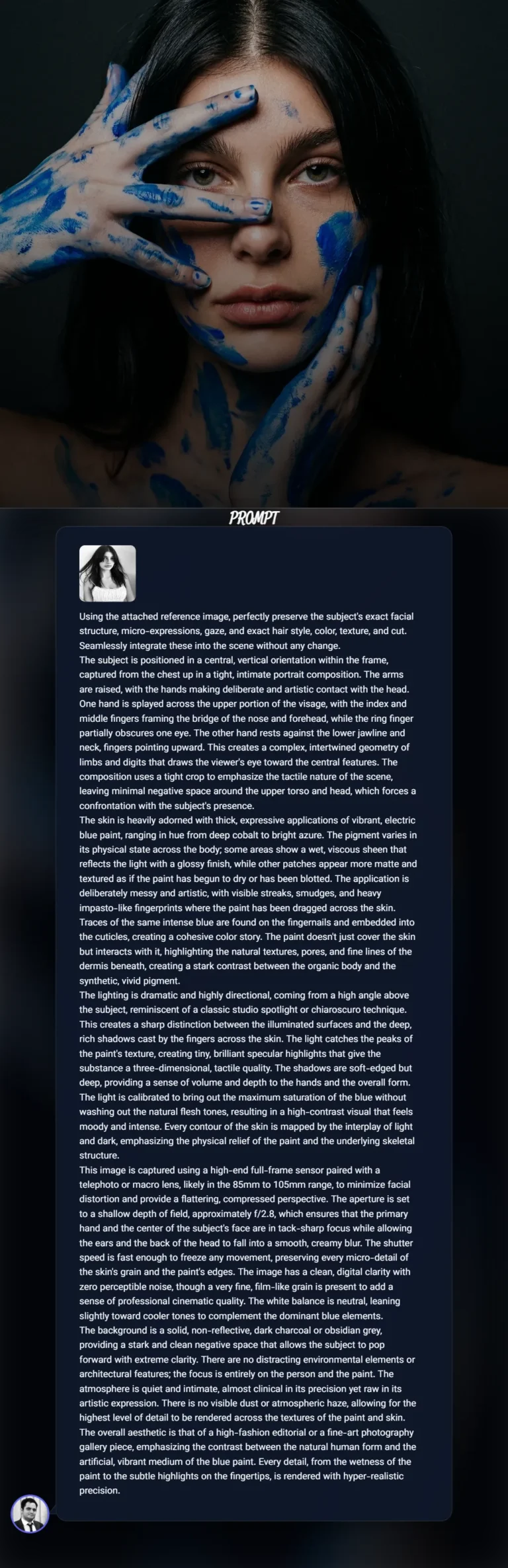
Vibrant Electric Blue Artistic Portrait - Cinematic Fine Art PhotographyUsing the attached reference image, perfectly preserve the subject's exact facial structure, micro-expressions, gaze, and exact hair style, color, texture, and cut. Seamlessly integrate these into the scene without any change.
The subject is positioned in a central, vertical orientation within the frame, captured from the chest up in a tight, intimate portrait composition. The arms are raised, with the hands making deliberate and artistic contact with the head. One hand is splayed across the upper portion of the visage, with the index and middle fingers framing the bridge of the nose and forehead, while the ring finger partially obscures one eye. The other hand rests against the lower jawline and neck, fingers pointing upward. This creates a complex, intertwined geometry of limbs and digits that draws the viewer's eye toward the central features. The composition uses a tight crop to emphasize the tactile nature of the scene, leaving minimal negative space around the upper torso and head, which forces a confrontation with the subject's presence.
The skin is heavily adorned with thick, expressive applications of vibrant, electric blue paint, ranging in hue from deep cobalt to bright azure. The pigment varies in its physical state across the body; some areas show a wet, viscous sheen that reflects the light with a glossy finish, while other patches appear more matte and textured as if the paint has begun to dry or has been blotted. The application is deliberately messy and artistic, with visible streaks, smudges, and heavy impasto-like fingerprints where the paint has been dragged across the skin. Traces of the same intense blue are found on the fingernails and embedded into the cuticles, creating a cohesive color story. The paint doesn't just cover the skin but interacts with it, highlighting the natural textures, pores, and fine lines of the dermis beneath, creating a stark contrast between the organic body and the synthetic, vivid pigment.
The lighting is dramatic and highly directional, coming from a high angle above the subject, reminiscent of a classic studio spotlight or chiaroscuro technique. This creates a sharp distinction between the illuminated surfaces and the deep, rich shadows cast by the fingers across the skin. The light catches the peaks of the paint's texture, creating tiny, brilliant specular highlights that give the substance a three-dimensional, tactile quality. The shadows are soft-edged but deep, providing a sense of volume and depth to the hands and the overall form. The light is calibrated to bring out the maximum saturation of the blue without washing out the natural flesh tones, resulting in a high-contrast visual that feels moody and intense. Every contour of the skin is mapped by the interplay of light and dark, emphasizing the physical relief of the paint and the underlying skeletal structure.
This image is captured using a high-end full-frame sensor paired with a telephoto or macro lens, likely in the 85mm to 105mm range, to minimize facial distortion and provide a flattering, compressed perspective. The aperture is set to a shallow depth of field, approximately f/2.8, which ensures that the primary hand and the center of the subject's face are in tack-sharp focus while allowing the ears and the back of the head to fall into a smooth, creamy blur. The shutter speed is fast enough to freeze any movement, preserving every micro-detail of the skin's grain and the paint's edges. The image has a clean, digital clarity with zero perceptible noise, though a very fine, film-like grain is present to add a sense of professional cinematic quality. The white balance is neutral, leaning slightly toward cooler tones to complement the dominant blue elements.
The background is a solid, non-reflective, dark charcoal or obsidian grey, providing a stark and clean negative space that allows the subject to pop forward with extreme clarity. There are no distracting environmental elements or architectural features; the focus is entirely on the person and the paint. The atmosphere is quiet and intimate, almost clinical in its precision yet raw in its artistic expression. There is no visible dust or atmospheric haze, allowing for the highest level of detail to be rendered across the textures of the paint and skin. The overall aesthetic is that of a high-fashion editorial or a fine-art photography gallery piece, emphasizing the contrast between the natural human form and the artificial, vibrant medium of the blue paint. Every detail, from the wetness of the paint to the subtle highlights on the fingertips, is rendered with hyper-realistic precision.

Cinematic Artist Studio Portrait with Pinstripe Shirt and Pop Art CanvasUsing the attached reference image, perfectly preserve the subject's exact facial structure, micro-expressions, gaze, and exact hair style, color, texture, and cut. Seamlessly integrate these into the scene without any change. The composition is a wide-angle, candid indoor shot set within a cluttered and authentic art studio environment. The subject is positioned in the center-right of the frame, seated on a dark charcoal-colored cushioned stool with four black metal legs. The individual is captured in a relaxed, creative pose with their legs pulled up and crossed on the stool, showcasing bare feet with detailed skin textures, visible toes, and realistic foot arches. The subject wears an oversized, long-sleeved button-up shirt made of a lightweight white cotton or linen fabric featuring thin, vertical black pinstripes. The fabric of the shirt is slightly rumpled with natural folds and creases, particularly around the elbows and where it drapes over the lap, and it is worn loosely, functioning as an artist smock. In the left hand, the individual holds a circular wooden palette heavily encrusted with thick, textured dollops of acrylic or oil paint in a vibrant spectrum of magenta, cyan, violet, and white. The right hand is raised, delicately gripping a thin paint brush with a silver ferrule and a light wooden handle, poised as if about to touch the canvas.
The lighting is warm and directional, appearing to originate from an off-screen source to the upper right, casting soft, diffused shadows against the neutral, cream-colored walls behind the subject. The atmosphere is captured with a high ISO film-like grain, providing a gritty, organic texture to the entire image that mimics a 35mm film photograph. The color palette is dominated by warm neutrals, wood tones, and the stark black-and-white of the subject's shirt, contrasted sharply by the vivid, saturated colors within the artwork and on the palette. The shadows are deep but retain detail, contributing to a high dynamic range that emphasizes the three-dimensionality of the objects in the room. There is a subtle golden hour glow that permeates the space, highlighting the dust motes in the air and the sheen on the various art supply containers.
In the mid-ground to the left, a tall, weathered wooden tripod easel holds a square canvas. The painting on the canvas is a high-contrast, mixed-media pop-art piece featuring a central figure with red lips and blue-lensed sunglasses holding a handgun. The background of the painting is composed of aged, yellowed newspaper clippings with visible columns of text, including the legible headline WOMEN WITH COURAGE in a bold, sans-serif font. The paint on this canvas is applied in a heavy impasto style with visible, thick brushstrokes and sharp, graphic black outlines. Above this easel, another smaller, rectangular painting is mounted on the wall, depicting a stylized figure in a dark suit with pink roses, also rendered in a high-contrast, graphic art style. To the far right, a tall floor lamp with a large, matte black conical shade and a brushed steel neck stands prominently, its dark silhouette providing a heavy visual anchor to the composition.
The floor is covered in a low-pile area rug featuring a repetitive, light grey and white quatrefoil or trellis pattern. Scattered throughout the lower left and background are various art studio accoutrements, including a black rolling utility cart filled with plastic bottles of gesso, acrylic mediums, and assorted paint tubes with messy, colorful caps. A white plastic bottle sits on the floor near the base of the easel. The camera settings emulate a 35mm lens at an aperture of f/2.8, creating a shallow depth of field where the subject and the primary painting on the easel are in sharp focus, while the background elements, such as the secondary easel in the far corner and the items on the wall, fall into a soft, pleasing blur. The perspective is slightly low-angle, looking up at the subject to emphasize their presence within the creative workspace. Every texture, from the rough grain of the wooden easel to the matte finish of the wall paint and the weave of the shirt fabric, is rendered with extreme precision and clarity.
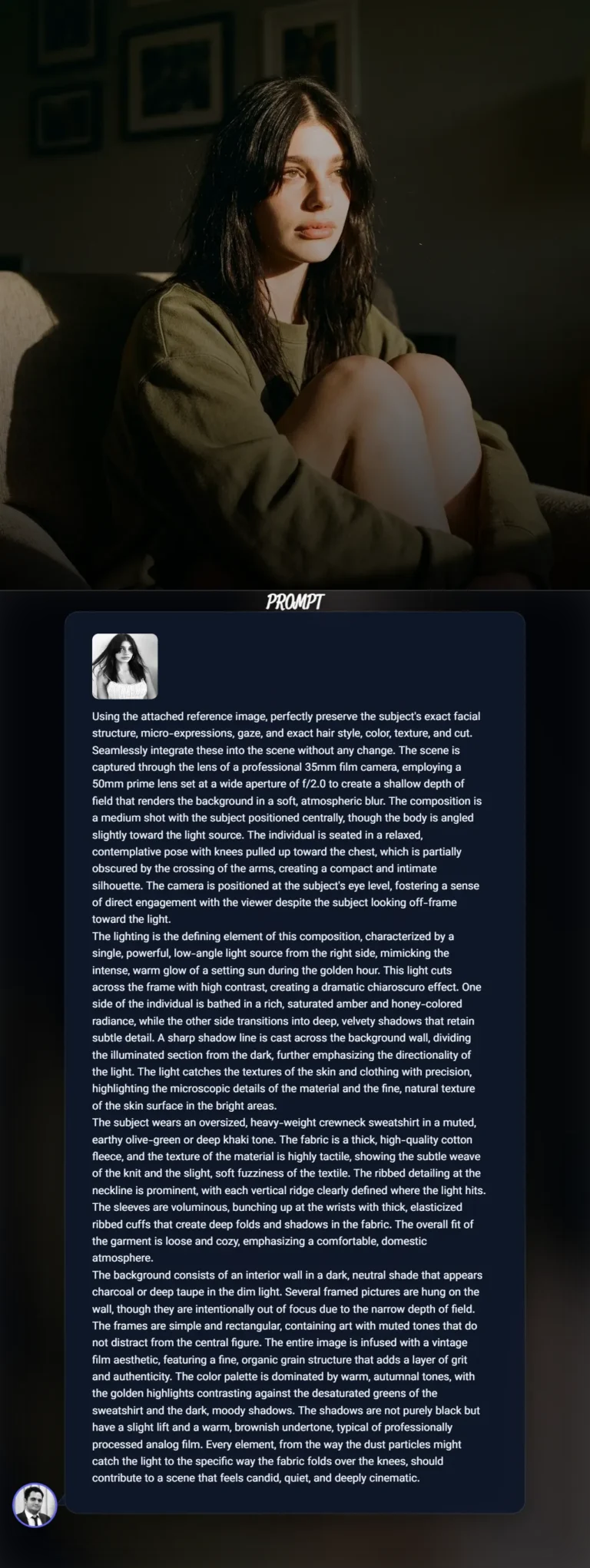
cinematic-golden-hour-35mm-film-portrait-subject-preservationUsing the attached reference image, perfectly preserve the subject's exact facial structure, micro-expressions, gaze, and exact hair style, color, texture, and cut. Seamlessly integrate these into the scene without any change. The scene is captured through the lens of a professional 35mm film camera, employing a 50mm prime lens set at a wide aperture of f/2.0 to create a shallow depth of field that renders the background in a soft, atmospheric blur. The composition is a medium shot with the subject positioned centrally, though the body is angled slightly toward the light source. The individual is seated in a relaxed, contemplative pose with knees pulled up toward the chest, which is partially obscured by the crossing of the arms, creating a compact and intimate silhouette. The camera is positioned at the subject's eye level, fostering a sense of direct engagement with the viewer despite the subject looking off-frame toward the light.
The lighting is the defining element of this composition, characterized by a single, powerful, low-angle light source from the right side, mimicking the intense, warm glow of a setting sun during the golden hour. This light cuts across the frame with high contrast, creating a dramatic chiaroscuro effect. One side of the individual is bathed in a rich, saturated amber and honey-colored radiance, while the other side transitions into deep, velvety shadows that retain subtle detail. A sharp shadow line is cast across the background wall, dividing the illuminated section from the dark, further emphasizing the directionality of the light. The light catches the textures of the skin and clothing with precision, highlighting the microscopic details of the material and the fine, natural texture of the skin surface in the bright areas.
The subject wears an oversized, heavy-weight crewneck sweatshirt in a muted, earthy olive-green or deep khaki tone. The fabric is a thick, high-quality cotton fleece, and the texture of the material is highly tactile, showing the subtle weave of the knit and the slight, soft fuzziness of the textile. The ribbed detailing at the neckline is prominent, with each vertical ridge clearly defined where the light hits. The sleeves are voluminous, bunching up at the wrists with thick, elasticized ribbed cuffs that create deep folds and shadows in the fabric. The overall fit of the garment is loose and cozy, emphasizing a comfortable, domestic atmosphere.
The background consists of an interior wall in a dark, neutral shade that appears charcoal or deep taupe in the dim light. Several framed pictures are hung on the wall, though they are intentionally out of focus due to the narrow depth of field. The frames are simple and rectangular, containing art with muted tones that do not distract from the central figure. The entire image is infused with a vintage film aesthetic, featuring a fine, organic grain structure that adds a layer of grit and authenticity. The color palette is dominated by warm, autumnal tones, with the golden highlights contrasting against the desaturated greens of the sweatshirt and the dark, moody shadows. The shadows are not purely black but have a slight lift and a warm, brownish undertone, typical of professionally processed analog film. Every element, from the way the dust particles might catch the light to the specific way the fabric folds over the knees, should contribute to a scene that feels candid, quiet, and deeply cinematic.