Peymanaistudio lighting
studio lighting

Fuck Reality Conceptual Macro Portrait with Floral Medical TapeUsing the attached reference image, perfectly preserve the subject's exact facial structure, micro-expressions, gaze, and exact hair style, color, texture, and cut. Seamlessly integrate these into the scene without any change.
The camera composition is an extreme close-up portrait, framed vertically to emphasize the central vertical axis of the subject and the intensity of the gaze. A high-end professional 100mm macro lens or an 85mm prime lens is utilized with a wide aperture setting of approximately f/2.2 to create a very shallow depth of field. This technical choice ensures that while the eyes and the central portion of the face are in razor-sharp focus, the edges of the subject and the lower chest area fall into a soft, creamy bokeh. The focus is critically sharp on the irises and the intricate texture of the medical tape across the mouth, capturing every microscopic fiber, skin pore, and the fine lines of the skin. The image possesses a high dynamic range, preserving immense detail in both the subtle highlights of the skin and the deep, saturated blacks of the ink on the tape and the tattoos on the chest.
The lighting setup is a masterclass in soft, diffused studio illumination, employing a large octa-softbox or a beauty dish positioned directly in front of and slightly above the subject to minimize harsh shadows and create a flattering, even glow across the skin. This front-facing light source produces distinct, crisp, circular catchlights in the centers of the pupils, adding a sense of life and depth to the eyes. There is a very subtle, natural fall-off of light toward the periphery of the frame and under the chin, which helps to define the contours of the face without creating high-contrast edges. The color temperature is strictly neutral, calibrated to approximately 5500K, which perfectly renders the natural tones of the skin and the vibrant, organic colors of the floral elements without any unwanted warm or cool color casts.
The central prop is a strip of white, semi-translucent medical paper tape applied horizontally across the mouth area. The tape possesses a distinct matte, fibrous texture with slight crinkling and fraying at the edges where it adheres to the skin, showing the tension of the application. Hand-written in bold, black permanent marker in a slightly messy, hand-lettered style are the words FUCK REALITY in all capital letters. The ink shows a realistic, slight bleed into the paper fibers of the tape, especially at the ends of the strokes. Tucked intentionally beneath the top and bottom edges of this tape are several fresh, vibrant flowers, specifically small pink and lavender asters or daisies with bright yellow centers and delicate green stems. These flowers are arranged in a chaotic but aesthetically balanced asymmetrically pattern, with one tiny, closed flower bud positioned just below the lower lash line of one eye, perfectly mimicking the appearance of a teardrop. The petals exhibit a soft, velvety texture and realistic translucency where the soft studio light permeates the organic tissue.
The lower portion of the frame reveals the subject's upper chest and collarbone area, adorned with delicate jewelry and intricate body art. A thin, polished gold chain necklace is visible, featuring a small, square-cut diamond or gemstone pendant that sits centrally, catching the light with a sharp, brilliant glint. The upper chest area is covered in extensive, high-quality illustrative tattoo work rendered in dark black and grey ink with fine-line detailing and smooth shading. On the left side of the chest, a detailed representation of a wolf head is visible, while the right side features complex floral patterns, both of which are aesthetically softened by the shallow depth of field. Small, simple gold stud earrings are visible on the earlobes, providing a subtle metallic highlight. The background is a completely neutral, non-distracting soft beige or muted grey, entirely devoid of any objects or patterns, which serves to further isolate the subject and amplify the emotional and visual impact of the portrait.

Hyper-Realistic 100mm Macro Studio Portrait and Skin Texture PromptUsing the attached reference image, perfectly preserve the subject's exact facial structure, micro-expressions, gaze, and exact hair style, color, texture, and cut. Seamlessly integrate these into the scene without any change.
The camera composition is a tightly framed headshot, captured from a straight-on, eye-level perspective that creates an intimate and direct connection with the viewer. The shot is executed with a 100mm macro prime lens, known for its ability to render microscopic details with clinical precision while maintaining a naturalistic compression of depth. The aperture is set to a shallow f/2.8, which ensures the focus is razor-sharp on the anterior plane of the skin surface while allowing the edges of the shoulders and the distant background to fall into a smooth, creamy blur. The shutter speed is high to eliminate any potential motion blur, resulting in a crisp, frozen moment. The image is captured on a full-frame sensor at a high ISO-base setting to ensure maximum dynamic range and a noise-free finish, preserving the subtlest gradients in the highlights and shadows. The framing is so tight that the crown of the head and the lower neck are the boundaries, focusing the viewer entirely on the central anatomical details.
The lighting architecture is designed as a sophisticated studio setup, employing a large octabox as the primary key light, positioned slightly above and to the right of the camera axis. This creates a soft, wrap-around illumination that minimizes harsh shadows while emphasizing the three-dimensional topography of the skin. A secondary white foam core reflector is placed on the opposite side to provide a subtle fill, lifting the shadows in the recesses and ensuring that no detail is lost to total blackness. The light quality is diffused and neutral, with a color temperature calibrated to 5500 Kelvin to mimic natural daylight. This results in highly accurate color reproduction, where the subtle variations in skin tone are rendered with lifelike fidelity. Specular highlights are controlled and soft, appearing as gentle glints on the most prominent surfaces of the skin and the cosmetic applications.
The rendering of surface materials focuses on an extreme level of photorealism, emphasizing the micro-topography of the individual's skin. The digital shader utilizes advanced sub-surface scattering to simulate the way light penetrates the dermal layers and scatters internally, giving the skin a healthy, translucent glow. Every pore, fine line, and minute variation in pigmentation is rendered with 8k resolution clarity. The cosmetic textures are equally detailed, showing the specific grain and matte-to-satin finish of the pigments applied to the skin. The interplay between the moisture of the surface and the dry, powdered areas is clearly distinguishable. The clothing visible at the very bottom of the frame is a lightweight fabric, featuring a crisp white base with a pattern of dark, circular motifs. The weave of the textile is visible under the macro lens, showing the interlacing threads and the soft, organic fold of the collar as it rests against the base of the neck.
The background is a minimalist, non-distracting studio environment, consisting of a flat, neutral-toned wall with a subtle matte texture. The color is a desaturated greyish-white, which serves to provide a clean contrast against the subject and ensures that the color palette of the foreground remains the primary focus. Due to the shallow depth of field, the background texture is softened into a uniform, non-descript field of color, though the slight falloff of light across its surface adds a sense of spatial depth. There is no visible furniture or props, maintaining a purely character-focused aesthetic. The atmosphere is clear and devoid of heavy particulate matter, though a very fine, almost imperceptible grain is maintained to give the final image a traditional film-like quality rather than a sterile digital appearance. The overall color grading is naturalistic, with a slight emphasis on warmth in the mid-tones to enhance the vibrancy of the subject's natural coloration.

Heroic Cinematic Portrait with Rembrandt Lighting and 8K DetailUsing the attached reference image, perfectly preserve the subject's exact facial structure, micro-expressions, gaze, and exact hair style, color, texture, and cut. Seamlessly integrate these into the scene without any change. The composition is a heroic low-angle portrait, captured from a slightly upward perspective to instill a sense of importance and gravitas. The camera is positioned below the eye line of the subject, tilting upward to emphasize the jawline and neck. The framing is a tight bust shot, focusing on the head and shoulders, with the individual turned three-quarters toward the light source while their gaze is directed upward and slightly off-camera toward an unseen horizon. The camera settings emulate a high-end full-frame digital camera paired with a prime 85mm lens, set to a wide aperture of f/2.2 to create a shallow depth of field that keeps the subject in razor-sharp focus while the background falls into a soft, indiscernible blur. The lighting is a masterclass in cinematic low-key techniques, specifically utilizing a dramatic Rembrandt lighting setup. A single, powerful key light with a warm, golden-amber temperature of approximately 3200K is positioned to the side and slightly above the subject, casting a brilliant highlight across one side of the face and neck while leaving the opposite side in deep, rich shadow. This creates a high-contrast chiaroscuro effect, where the transition from light to shadow is soft but definitive, highlighting the tactile textures of the skin and the subtle contours of the throat. The background is a deep, dark charcoal that transitions into a subtle, cool-toned navy blue gradient, providing a stark color contrast to the warm golden light hitting the subject. The individual is wearing a minimalist, matte black crew-neck t-shirt made of a high-quality jersey cotton, where the fine weave of the fabric is visible under the intense light, absorbing the shadows deeply. Resting on the bridge of the nose are circular, thin-framed spectacles with a delicate metallic wire finish that glints under the studio lights; the lenses are clean and transparent, reflecting a soft, pinpoint catchlight from the main light source. In the ears are modern, glossy white wireless earbuds with a high-shine polycarbonate finish that creates a sharp specular highlight, contrasting against the matte textures of the skin and clothing. The overall atmosphere is moody, sophisticated, and intensely focused, with every detail from the micro-pores of the skin to the subtle reflections in the eyewear rendered in breathtaking 8k resolution with zero noise and perfect color grading.
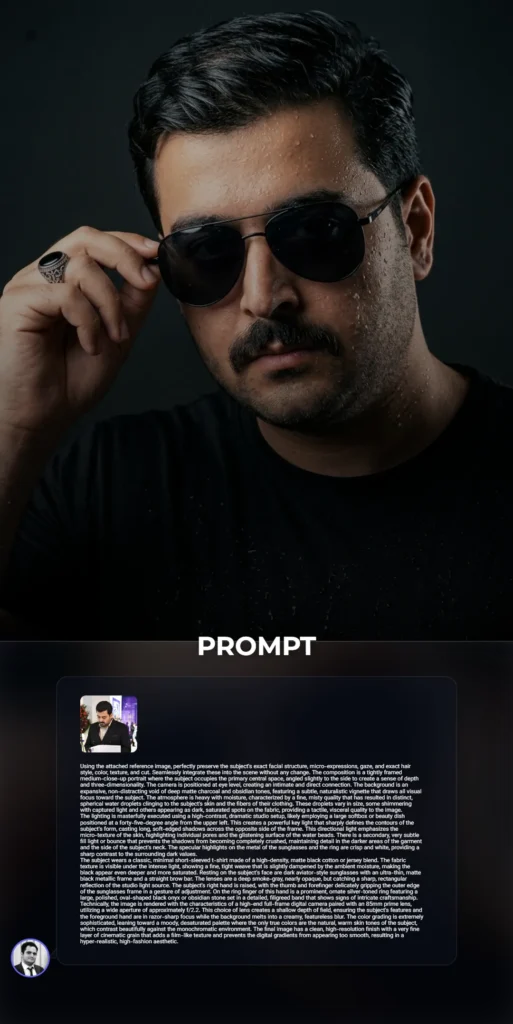
Cinematic Hyper-Realistic Moody Fashion Portrait with Water DropletsUsing the attached reference image, perfectly preserve the subject's exact facial structure, micro-expressions, gaze, and exact hair style, color, texture, and cut. Seamlessly integrate these into the scene without any change. The composition is a tightly framed medium-close-up portrait where the subject occupies the primary central space, angled slightly to the side to create a sense of depth and three-dimensionality. The camera is positioned at eye level, creating an intimate and direct connection. The background is an expansive, non-distracting void of deep matte charcoal and obsidian tones, featuring a subtle, naturalistic vignette that draws all visual focus toward the subject. The atmosphere is heavy with moisture, characterized by a fine, misty quality that has resulted in distinct, spherical water droplets clinging to the subject's skin and the fibers of their clothing. These droplets vary in size, some shimmering with captured light and others appearing as dark, saturated spots on the fabric, providing a tactile, visceral quality to the image.
The lighting is masterfully executed using a high-contrast, dramatic studio setup, likely employing a large softbox or beauty dish positioned at a forty-five-degree angle from the upper left. This creates a powerful key light that sharply defines the contours of the subject's form, casting long, soft-edged shadows across the opposite side of the frame. This directional light emphasizes the micro-texture of the skin, highlighting individual pores and the glistening surface of the water beads. There is a secondary, very subtle fill light or bounce that prevents the shadows from becoming completely crushed, maintaining detail in the darker areas of the garment and the side of the subject's neck. The specular highlights on the metal of the sunglasses and the ring are crisp and white, providing a sharp contrast to the surrounding dark values.
The subject wears a classic, minimal short-sleeved t-shirt made of a high-density, matte black cotton or jersey blend. The fabric texture is visible under the intense light, showing a fine, tight weave that is slightly dampened by the ambient moisture, making the black appear even deeper and more saturated. Resting on the subject's face are dark aviator-style sunglasses with an ultra-thin, matte black metallic frame and a straight brow bar. The lenses are a deep smoke-gray, nearly opaque, but catching a sharp, rectangular reflection of the studio light source. The subject's right hand is raised, with the thumb and forefinger delicately gripping the outer edge of the sunglasses frame in a gesture of adjustment. On the ring finger of this hand is a prominent, ornate silver-toned ring featuring a large, polished, oval-shaped black onyx or obsidian stone set in a detailed, filigreed band that shows signs of intricate craftsmanship.
Technically, the image is rendered with the characteristics of a high-end full-frame digital camera paired with an 85mm prime lens, utilizing a wide aperture of approximately f/2.2. This choice of lens creates a shallow depth of field, ensuring the subject's features and the foreground hand are in razor-sharp focus while the background melts into a creamy, featureless blur. The color grading is extremely sophisticated, leaning toward a moody, desaturated palette where the only true colors are the natural, warm skin tones of the subject, which contrast beautifully against the monochromatic environment. The final image has a clean, high-resolution finish with a very fine layer of cinematic grain that adds a film-like texture and prevents the digital gradients from appearing too smooth, resulting in a hyper-realistic, high-fashion aesthetic.
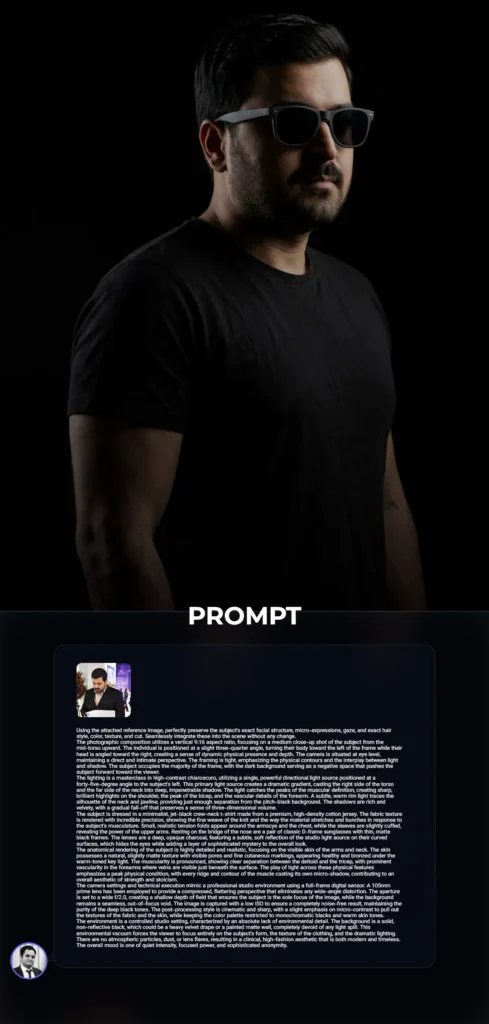
Cinematic Chiaroscuro Portrait: High-Contrast Studio Photography PromptUsing the attached reference image, perfectly preserve the subject's exact facial structure, micro-expressions, gaze, and exact hair style, color, texture, and cut. Seamlessly integrate these into the scene without any change.
The photographic composition utilizes a vertical 9:16 aspect ratio, focusing on a medium close-up shot of the subject from the mid-torso upward. The individual is positioned at a slight three-quarter angle, turning their body toward the left of the frame while their head is angled toward the right, creating a sense of dynamic physical presence and depth. The camera is situated at eye level, maintaining a direct and intimate perspective. The framing is tight, emphasizing the physical contours and the interplay between light and shadow. The subject occupies the majority of the frame, with the dark background serving as a negative space that pushes the subject forward toward the viewer.
The lighting is a masterclass in high-contrast chiaroscuro, utilizing a single, powerful directional light source positioned at a forty-five-degree angle to the subject's left. This primary light source creates a dramatic gradient, casting the right side of the torso and the far side of the neck into deep, impenetrable shadow. The light catches the peaks of the muscular definition, creating sharp, brilliant highlights on the shoulder, the peak of the bicep, and the vascular details of the forearm. A subtle, warm rim light traces the silhouette of the neck and jawline, providing just enough separation from the pitch-black background. The shadows are rich and velvety, with a gradual fall-off that preserves a sense of three-dimensional volume.
The subject is dressed in a minimalist, jet-black crew-neck t-shirt made from a premium, high-density cotton jersey. The fabric texture is rendered with incredible precision, showing the fine weave of the knit and the way the material stretches and bunches in response to the subject's musculature. Small, realistic tension folds appear around the armscye and the chest, while the sleeves are slightly cuffed, revealing the power of the upper arms. Resting on the bridge of the nose are a pair of classic D-frame sunglasses with thin, matte black frames. The lenses are a deep, opaque charcoal, featuring a subtle, soft reflection of the studio light source on their curved surfaces, which hides the eyes while adding a layer of sophisticated mystery to the overall look.
The anatomical rendering of the subject is highly detailed and realistic, focusing on the visible skin of the arms and neck. The skin possesses a natural, slightly matte texture with visible pores and fine cutaneous markings, appearing healthy and bronzed under the warm-toned key light. The muscularity is pronounced, showing clear separation between the deltoid and the tricep, with prominent vascularity in the forearms where veins are visible just beneath the surface. The play of light across these physical features emphasizes a peak physical condition, with every ridge and contour of the muscle casting its own micro-shadow, contributing to an overall aesthetic of strength and stoicism.
The camera settings and technical execution mimic a professional studio environment using a full-frame digital sensor. A 105mm prime lens has been employed to provide a compressed, flattering perspective that eliminates any wide-angle distortion. The aperture is set to a wide f/2.0, creating a shallow depth of field that ensures the subject is the sole focus of the image, while the background remains a seamless, out-of-focus void. The image is captured with a low ISO to ensure a completely noise-free result, maintaining the purity of the deep black tones. The post-processing style is cinematic and sharp, with a slight emphasis on micro-contrast to pull out the textures of the fabric and the skin, while keeping the color palette restricted to monochromatic blacks and warm skin tones.
The environment is a controlled studio setting, characterized by an absolute lack of environmental detail. The background is a solid, non-reflective black, which could be a heavy velvet drape or a painted matte wall, completely devoid of any light spill. This environmental vacuum forces the viewer to focus entirely on the subject's form, the texture of the clothing, and the dramatic lighting. There are no atmospheric particles, dust, or lens flares, resulting in a clinical, high-fashion aesthetic that is both modern and timeless. The overall mood is one of quiet intensity, focused power, and sophisticated anonymity.
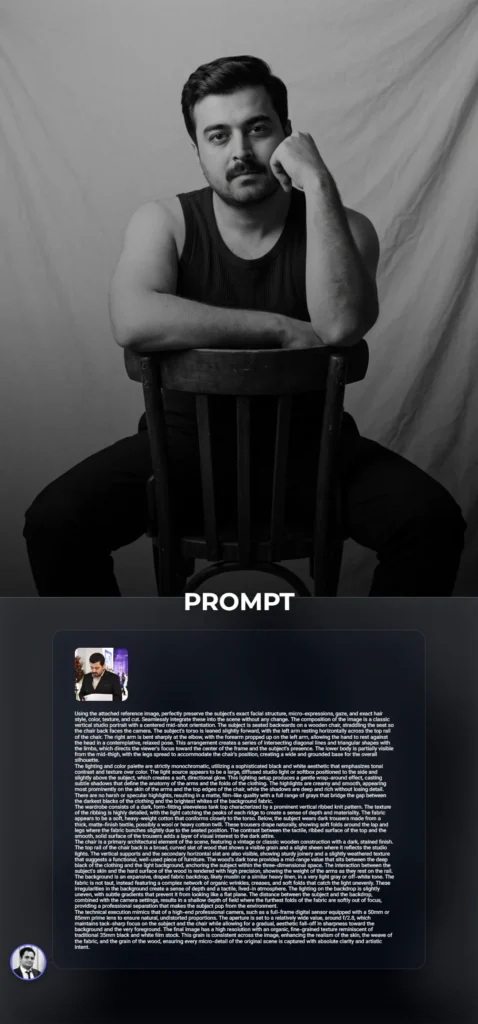
Cinematic Black and White Studio Portrait on Vintage Wooden ChairUsing the attached reference image, perfectly preserve the subject's exact facial structure, micro-expressions, gaze, and exact hair style, color, texture, and cut. Seamlessly integrate these into the scene without any change. The composition of the image is a classic vertical studio portrait with a centered mid-shot orientation. The subject is seated backwards on a wooden chair, straddling the seat so the chair back faces the camera. The subject's torso is leaned slightly forward, with the left arm resting horizontally across the top rail of the chair. The right arm is bent sharply at the elbow, with the forearm propped up on the left arm, allowing the hand to rest against the head in a contemplative, relaxed pose. This arrangement creates a series of intersecting diagonal lines and triangular shapes with the limbs, which directs the viewer's focus toward the center of the frame and the subject's presence. The lower body is partially visible from the mid-thigh, with the legs spread to accommodate the chair's position, creating a wide and grounded base for the overall silhouette.
The lighting and color palette are strictly monochromatic, utilizing a sophisticated black and white aesthetic that emphasizes tonal contrast and texture over color. The light source appears to be a large, diffused studio light or softbox positioned to the side and slightly above the subject, which creates a soft, directional glow. This lighting setup produces a gentle wrap-around effect, casting subtle shadows that define the anatomy of the arms and the folds of the clothing. The highlights are creamy and smooth, appearing most prominently on the skin of the arms and the top edges of the chair, while the shadows are deep and rich without losing detail. There are no harsh or specular highlights, resulting in a matte, film-like quality with a full range of grays that bridge the gap between the darkest blacks of the clothing and the brightest whites of the background fabric.
The wardrobe consists of a dark, form-fitting sleeveless tank top characterized by a prominent vertical ribbed knit pattern. The texture of the ribbing is highly detailed, with the light catching the peaks of each ridge to create a sense of depth and materiality. The fabric appears to be a soft, heavy-weight cotton that conforms closely to the torso. Below, the subject wears dark trousers made from a thick, matte-finish textile, possibly a wool or heavy cotton twill. These trousers drape naturally, showing soft folds around the lap and legs where the fabric bunches slightly due to the seated position. The contrast between the tactile, ribbed surface of the top and the smooth, solid surface of the trousers adds a layer of visual interest to the dark attire.
The chair is a primary architectural element of the scene, featuring a vintage or classic wooden construction with a dark, stained finish. The top rail of the chair back is a broad, curved slat of wood that shows a visible grain and a slight sheen where it reflects the studio lights. The vertical supports and the secondary horizontal slat are also visible, showing sturdy joinery and a slightly weathered texture that suggests a functional, well-used piece of furniture. The wood's dark tone provides a mid-range value that sits between the deep black of the clothing and the light background, anchoring the subject within the three-dimensional space. The interaction between the subject's skin and the hard surface of the wood is rendered with high precision, showing the weight of the arms as they rest on the rail.
The background is an expansive, draped fabric backdrop, likely muslin or a similar heavy linen, in a very light gray or off-white tone. The fabric is not taut, instead featuring a complex network of organic wrinkles, creases, and soft folds that catch the light unevenly. These irregularities in the background create a sense of depth and a tactile, lived-in atmosphere. The lighting on the backdrop is slightly uneven, with subtle gradients that prevent it from looking like a flat plane. The distance between the subject and the backdrop, combined with the camera settings, results in a shallow depth of field where the furthest folds of the fabric are softly out of focus, providing a professional separation that makes the subject pop from the environment.
The technical execution mimics that of a high-end professional camera, such as a full-frame digital sensor equipped with a 50mm or 85mm prime lens to ensure natural, undistorted proportions. The aperture is set to a relatively wide value, around f/2.8, which maintains tack-sharp focus on the subject and the chair while allowing for a gradual, aesthetic fall-off in sharpness toward the background and the very foreground. The final image has a high resolution with an organic, fine-grained texture reminiscent of traditional 35mm black and white film stock. This grain is consistent across the image, enhancing the realism of the skin, the weave of the fabric, and the grain of the wood, ensuring every micro-detail of the original scene is captured with absolute clarity and artistic intent.

Futuristic Monochromatic High-Fashion Portrait with Parametric ArchitectureUsing the attached reference image, perfectly preserve the subject's exact facial structure, micro-expressions, gaze, and exact hair style, color, texture, and cut. Seamlessly integrate these into the scene without any change. The setting consists of an ultra-modern, minimalist, and surreal architectural environment characterized by fluid, organic, and undulating wave-like structures that wrap around the subject in a complex, multi-layered arrangement. These architectural forms are reminiscent of parametric design, featuring smooth, sinuous curves and sweeping surfaces that transition seamlessly from bright, pristine whites to deep, velvety shadows. The geometry of the background is non-linear, suggesting a sculptural or liquid-inspired interior where walls and ceiling meld into one continuous, flowing form. The material of these structures appears as a semi-matte, high-grade architectural composite, catching the light in a way that emphasizes the three-dimensional volume and the graceful curvature of every fold and crest.
The lighting is a sophisticated, high-end studio arrangement that employs a high-key approach while maintaining a sense of dramatic contrast. A primary, large-scale diffused light source is positioned at an elevated three-quarter angle, casting a soft, even glow across the scene. This illumination creates delicate gradations of gray across the white background elements, highlighting the peaks of the waves and allowing the troughs to fall into a gentle, soft-focus shade. The light quality is highly directional yet soft-edged, ensuring there are no harsh glares or distracting specular highlights on the subject or the environment. This specific lighting setup emphasizes the textures of the clothing, particularly the way the light grazes the surface of the fabric to reveal its subtle weave and density.
The subject's attire is a masterclass in monochromatic minimalism. The individual is wearing a high-quality, long-sleeved black turtleneck sweater made from a fine-gauge knit material, possibly a blend of wool and cashmere, which exhibits a deep, light-absorbing matte finish. The fabric of the turtleneck is thick and structured, holding its shape perfectly around the neck and torso. Complementing the sweater are dark charcoal or black tailored trousers that feature a smooth, refined textile finish. The subject’s posture is poised and contemplative, with hands tucked naturally into the pockets of the trousers, creating a relaxed yet sophisticated silhouette. The fit of the clothing is precise, highlighting a lean and athletic frame without being overly tight, allowing for natural folds and creases to form at the elbows and the waistline where the sweater meets the trousers.
The camera composition is a vertical medium-full shot, capturing the subject from the mid-thigh upwards. The framing is centered on the subject, who is positioned in a three-quarter profile view, looking away from the camera toward the left of the frame. This creates a sense of introspection and mystery. The lens used is a high-resolution prime lens, likely a 50mm or 85mm, to provide a natural perspective with minimal distortion and a slight compression of space that brings the subject and the complex background into a harmonious relationship. The aperture is set to a moderate f/2.8 or f/4.0, which ensures the subject is in razor-sharp focus from the texture of the sweater to the edges of the clothing, while allowing the farthest layers of the undulating background to fall into a creamy, aesthetic bokeh. This depth of field emphasizes the subject as the focal point against the intricate architectural geometry.
The color palette is strictly achromatic and monochromatic, consisting of a sophisticated range of blacks, whites, and an infinite spectrum of grays. There is no hint of color, focusing entirely on form, light, and shadow. The blacks are deep and rich, providing a solid anchor for the composition, while the whites are clean and luminous. The overall image quality is characterized by a high-definition, digital photographic look with zero noise, exceptional clarity, and a smooth, professional finish. The atmosphere is one of quiet elegance, futurism, and high-fashion editorial styling, where every element of the composition, from the sweep of the background walls to the fold of the sleeves, is meticulously placed to create a visually stunning and balanced portrait.

Cinematic High-Fashion Portrait of Subject with White Long-Haired CatUsing the attached reference image, perfectly preserve the subject's exact facial structure, micro-expressions, gaze, and exact hair style, color, texture, and cut. Seamlessly integrate these into the scene without any change. The subject is positioned in a central, close-up frame, filling most of the vertical space from the chest upward. The individual is leaning in close to a white long-haired cat, creating an intimate and warm portrait. One hand is raised toward the temple, fingers gently grasping the edge of a black knit beanie, while the other hand cradles the cat’s lower body, with fingers delicately holding one of the cat's front paws to reveal the soft pink paw pads. The cat is positioned in the lower-left foreground, looking directly toward the viewer with large, luminous blue eyes. The composition focuses heavily on the interaction between the individual and the animal, creating an atmosphere of gentle affection and calm.
The scene is illuminated by professional studio lighting that is soft and directional, likely from a large softbox positioned slightly to the camera's left. This creates a gentle gradient across the skin, highlighting the facial contours and forehead while casting soft, cinematic shadows on the opposite side. The lighting is meticulously balanced to prevent harsh highlights, maintaining a smooth, matte quality on the skin and the cat’s fur. Sharp, tiny catchlights are reflected in both the subject's and the cat's eyes, giving them a lifelike, sparkling appearance. The overall atmosphere is quiet, modern, and high-fashion, with a clean and sophisticated tonal range that emphasizes clarity and texture.
The individual wears a black t-shirt made of a high-quality, matte cotton jersey fabric, which shows subtle folds and a fine grain where it meets the neck. A black, ribbed knit beanie sits atop the head, showing a distinct tactile weave and soft woolen fibers with a slight fuzziness to the material. The accessories are captured with high precision: a medium-gauge silver chain necklace hangs around the neck, ending in a polished, teardrop-shaped silver pendant that catches the soft studio light. On the hand holding the cat, there is a large, chunky silver ring with an oxidized, textured finish and a smaller, two-toned ring consisting of a silver band and a thin gold inset. A simple, polished silver hoop earring is visible on the ear, reflecting the surrounding environment.
The cat is a striking white long-hair breed with fur that is exceptionally bright and clean. Individual strands are visible, showing a mix of fine undercoat and longer guard hairs that create a soft, ethereal halo around its body against the dark clothing. The cat’s eyes are a deep, clear cerulean blue with dark pupils. Its nose is a soft, pale pink, matching the color of the articulated paw pads held by the subject. The fur around the cat’s face is dense and plush, transitioning into longer, wispy whiskers that extend outward. The contrast between the brilliant white fur and the subject's dark clothing and beanie is sharp and intentional, drawing the eye to the center of the frame.
The image is captured as if through a high-resolution full-frame camera using a portrait-length lens, such as an 85mm prime, with a wide aperture of approximately f/2.0. This choice of lens creates a shallow depth of field, resulting in a creamy, out-of-focus background while keeping the subject's features and the cat’s face in razor-sharp focus. The camera is positioned at eye level, fostering a direct connection with the viewer. The framing is a tight vertical portrait, cutting off just below the chest and at the top of the beanie, emphasizing the proximity and emotional bond.
The background is a minimalist, dark charcoal grey studio backdrop with a subtle, mottled texture reminiscent of hand-painted canvas or fine concrete. It is significantly darker than the subject, providing a neutral stage that allows the white cat and the skin tones to stand out prominently. The color palette is highly controlled and sophisticated, dominated by monochromatic tones of black, grey, and white, with the only warmth coming from the natural skin tones and the soft pink accents on the cat’s nose and paws. The rendering is crisp and clean, with a slight filmic grain that adds to the professional editorial quality of the photograph.

Urban Studio Portrait with Intense Orange Rim LightingUsing the attached reference image, perfectly preserve the subject's exact facial structure, micro-expressions, gaze, and exact hair style, color, texture, and cut. Seamlessly integrate these into the scene without any change. The scene is set against a monochromatic, high-intensity orange background that possesses a luminous, saturated quality, creating a vibrant and energetic atmosphere. This backdrop is not perfectly flat but features a subtle, soft-box glow emanating from behind the individual, creating a gentle gradient that is slightly brighter in the center and deepens toward the edges of the frame. The lighting is a sophisticated dual-tone studio arrangement, characterized by a dramatic red-orange rim light that sharply defines the silhouette on the right side of the frame, catching the edges of the clothing and the individual's skin with a fiery, saturated glow. A softer, more neutral key light illuminates the subject from the front-left, ensuring that the textures of the garments and the intricacies of the tattoos are clearly visible while maintaining deep, cinematic shadows that provide a three-dimensional depth to the composition.
The subject is wearing an oversized, heavyweight black cotton t-shirt with a thick, ribbed crew-neck collar. The fabric of the shirt has a matte finish that absorbs light, contrasted sharply by a large, centered graphic in a crisp, bone-white hue. This graphic consists of abstract, jagged, flame-like shapes or distorted, organic lettering that reaches upward across the chest. The sleeves are wide and drop-shouldered, ending mid-forearm to reveal a series of detailed tattoos. On the individual's right forearm, there is an intricate, dark ink illustration of a bird or phoenix with spread wings, while the left hand and fingers are adorned with complex, fine-line patterns and shading. A specific piece of script-style calligraphy is visible on the side of the neck, following the natural curve of the anatomy. The individual's hands are positioned in the lower center of the frame, with one hand gently grasping the fingers of the other in a candid, contemplative gesture.
Accessory details are critical for accuracy, including the thin-framed, round-lens spectacles that have a subtle tortoiseshell or metallic brown finish, catching a bright glint of the studio lights on the lenses. The individual wears a thick, polished silver curb-link chain bracelet on the left wrist, and multiple heavy, ornate metallic rings on the fingers, including a dark signet ring on the right hand and a silver-toned band on the left. The camera composition is a waist-up medium shot, utilizing a professional 85mm prime lens to achieve a shallow depth of field. This ensures the mid-plane of the subject is in razor-sharp focus, while the hands in the foreground and the extreme background exhibit a very soft, aesthetic blur. The digital rendering must be of the highest quality, with no visible noise, emphasizing the clean lines, the high-contrast color palette of orange, black, and white, and the tactile textures of the fabric and ink. The overall mood is one of modern, urban intensity, captured with a high-shutter speed to freeze the subtle micro-expression and the stillness of the pose.

Dramatic Monochrome Chiaroscuro Cinematic PortraitUsing the attached reference image, perfectly preserve the subject's exact facial structure, micro-expressions, gaze, and exact hair style, color, texture, and cut. Seamlessly integrate these into the scene without any change.
The photographic style must be a masterful execution of high-contrast monochrome cinematography, specifically emulating the aesthetic of a mid-20th-century silver gelatin print. The color palette is strictly limited to a sophisticated spectrum of blacks, whites, and varying degrees of charcoal and slate grays. There should be an intentional application of fine, organic film grain throughout the entire frame, avoiding any digital smoothness to maintain an authentic, raw, and tactile analog quality. The tonal range should be pushed to create a dramatic chiaroscuro effect, where the highlights are crisp and luminous without blowing out, and the shadows are deep, rich, and ink-like, providing a sense of profound depth and three-dimensionality to the subject.
The lighting is the primary architectural element of this composition, featuring a singular, directional light source positioned at a high angle to the right of the camera. This light must cast a sharp, defined illumination across the side of the subject's face and the prominent anatomy of the neck, while leaving the opposite side in a heavy, atmospheric shadow. The light should catch the subtle textures of the skin and the fabric of the clothing, creating a brilliant rim-light effect along the contours of the individual's silhouette. The transition between the brightest highlights and the deepest shadows must be deliberate and sculpted, emphasizing the physical presence of the individual against the more neutral, softly lit background.
The composition is a tight, intimate bust-length portrait captured from a slightly low-angle perspective to emphasize the dramatic upward tilt of the head. The individual is positioned in a three-quarter profile, with the neck elongated and the chin pointed toward the upper right corner of the frame, suggesting a moment of intense introspection, surrender, or yearning. The framing should be slightly off-center to allow for a sense of dynamic movement within the stillness of the pose. The negative space provided by the background should be utilized to balance the heavy, dark mass of the subject's torso and jacket, ensuring that the viewer's focus is drawn immediately to the illuminated portions of the skin and the sharp lines of the posture.
The technical camera settings should simulate a professional portrait setup using a 105mm telephoto prime lens to provide a subtle compression of the features and a flattering perspective. The aperture should be set to approximately f/4.0, ensuring that the subject's entire profile remains in tack-sharp focus while allowing the background to fall into a gentle, non-distracting blur. The shutter speed should be fast enough to capture the stillness of the moment with absolute clarity, and the simulated ISO should be high enough to introduce that characteristic silver halide grain that defines the filmic look. Every micro-detail, from the tiny pores on the skin to the individual fibers of the clothing, must be rendered with high-fidelity precision within the focal plane.
The wardrobe consists of a heavy, structured jacket crafted from a dark, rugged textile such as a high-density denim or a thick canvas. The fabric must exhibit a rich, matte texture that absorbs light, with visible weaving patterns and subtle distressing along the seams. The collar of the jacket is turned up slightly, framing the base of the neck and adding a layer of architectural complexity to the lower third of the image. The deep black of the garment should act as a solid anchor for the composition, providing a stark contrast against the pale, neutral background. The background itself should be a minimalist, non-descript wall with a very fine, plaster-like texture, catching just enough light to appear as a soft, luminous gray that gradients slightly darker toward the edges of the frame to create a subtle vignette effect.
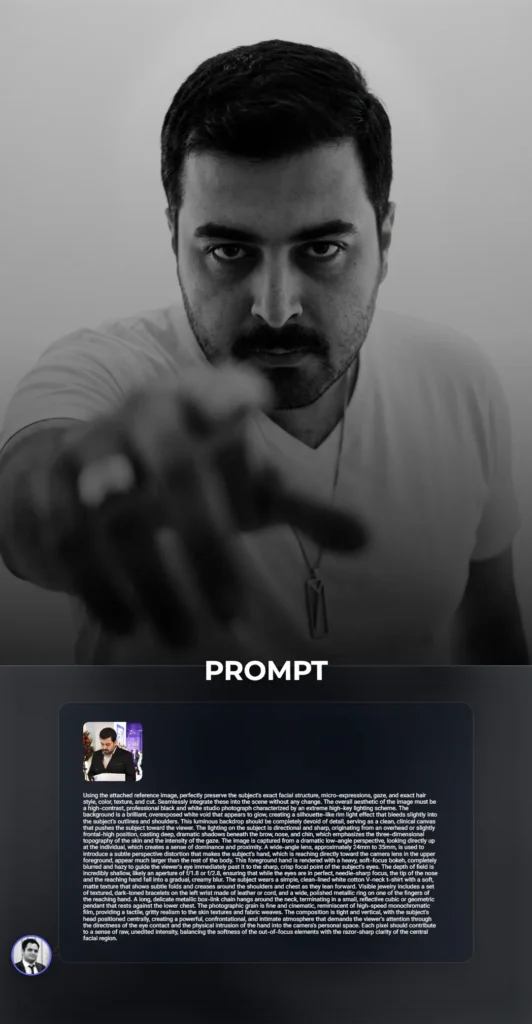
High-Key Black and White Intense Portrait with Reaching HandUsing the attached reference image, perfectly preserve the subject's exact facial structure, micro-expressions, gaze, and exact hair style, color, texture, and cut. Seamlessly integrate these into the scene without any change. The overall aesthetic of the image must be a high-contrast, professional black and white studio photograph characterized by an extreme high-key lighting scheme. The background is a brilliant, overexposed white void that appears to glow, creating a silhouette-like rim light effect that bleeds slightly into the subject's outlines and shoulders. This luminous backdrop should be completely devoid of detail, serving as a clean, clinical canvas that pushes the subject toward the viewer. The lighting on the subject is directional and sharp, originating from an overhead or slightly frontal-high position, casting deep, dramatic shadows beneath the brow, nose, and chin, which emphasizes the three-dimensional topography of the skin and the intensity of the gaze. The image is captured from a dramatic low-angle perspective, looking directly up at the individual, which creates a sense of dominance and proximity. A wide-angle lens, approximately 24mm to 35mm, is used to introduce a subtle perspective distortion that makes the subject's hand, which is reaching directly toward the camera lens in the upper foreground, appear much larger than the rest of the body. This foreground hand is rendered with a heavy, soft-focus bokeh, completely blurred and hazy to guide the viewer's eye immediately past it to the sharp, crisp focal point of the subject's eyes. The depth of field is incredibly shallow, likely an aperture of f/1.8 or f/2.8, ensuring that while the eyes are in perfect, needle-sharp focus, the tip of the nose and the reaching hand fall into a gradual, creamy blur. The subject wears a simple, clean-lined white cotton V-neck t-shirt with a soft, matte texture that shows subtle folds and creases around the shoulders and chest as they lean forward. Visible jewelry includes a set of textured, dark-toned bracelets on the left wrist made of leather or cord, and a wide, polished metallic ring on one of the fingers of the reaching hand. A long, delicate metallic box-link chain hangs around the neck, terminating in a small, reflective cubic or geometric pendant that rests against the lower chest. The photographic grain is fine and cinematic, reminiscent of high-speed monochromatic film, providing a tactile, gritty realism to the skin textures and fabric weaves. The composition is tight and vertical, with the subject's head positioned centrally, creating a powerful, confrontational, and intimate atmosphere that demands the viewer's attention through the directness of the eye contact and the physical intrusion of the hand into the camera's personal space. Each pixel should contribute to a sense of raw, unedited intensity, balancing the softness of the out-of-focus elements with the razor-sharp clarity of the central facial region.

Heroic Cinematic Portrait with Rembrandt Lighting and 8K DetailUsing the attached reference image, perfectly preserve the subject's exact facial structure, micro-expressions, gaze, and exact hair style, color, texture, and cut. Seamlessly integrate these into the scene without any change. The composition is a heroic low-angle portrait, captured from a slightly upward perspective to instill a sense of importance and gravitas. The camera is positioned below the eye line of the subject, tilting upward to emphasize the jawline and neck. The framing is a tight bust shot, focusing on the head and shoulders, with the individual turned three-quarters toward the light source while their gaze is directed upward and slightly off-camera toward an unseen horizon. The camera settings emulate a high-end full-frame digital camera paired with a prime 85mm lens, set to a wide aperture of f/2.2 to create a shallow depth of field that keeps the subject in razor-sharp focus while the background falls into a soft, indiscernible blur. The lighting is a masterclass in cinematic low-key techniques, specifically utilizing a dramatic Rembrandt lighting setup. A single, powerful key light with a warm, golden-amber temperature of approximately 3200K is positioned to the side and slightly above the subject, casting a brilliant highlight across one side of the face and neck while leaving the opposite side in deep, rich shadow. This creates a high-contrast chiaroscuro effect, where the transition from light to shadow is soft but definitive, highlighting the tactile textures of the skin and the subtle contours of the throat. The background is a deep, dark charcoal that transitions into a subtle, cool-toned navy blue gradient, providing a stark color contrast to the warm golden light hitting the subject. The individual is wearing a minimalist, matte black crew-neck t-shirt made of a high-quality jersey cotton, where the fine weave of the fabric is visible under the intense light, absorbing the shadows deeply. Resting on the bridge of the nose are circular, thin-framed spectacles with a delicate metallic wire finish that glints under the studio lights; the lenses are clean and transparent, reflecting a soft, pinpoint catchlight from the main light source. In the ears are modern, glossy white wireless earbuds with a high-shine polycarbonate finish that creates a sharp specular highlight, contrasting against the matte textures of the skin and clothing. The overall atmosphere is moody, sophisticated, and intensely focused, with every detail from the micro-pores of the skin to the subtle reflections in the eyewear rendered in breathtaking 8k resolution with zero noise and perfect color grading.
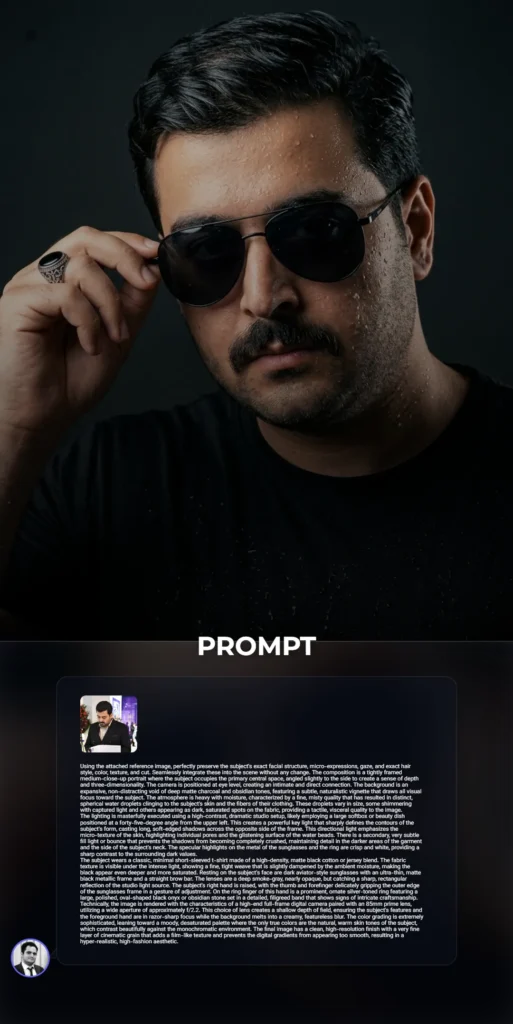
Cinematic Hyper-Realistic Moody Fashion Portrait with Water DropletsUsing the attached reference image, perfectly preserve the subject's exact facial structure, micro-expressions, gaze, and exact hair style, color, texture, and cut. Seamlessly integrate these into the scene without any change. The composition is a tightly framed medium-close-up portrait where the subject occupies the primary central space, angled slightly to the side to create a sense of depth and three-dimensionality. The camera is positioned at eye level, creating an intimate and direct connection. The background is an expansive, non-distracting void of deep matte charcoal and obsidian tones, featuring a subtle, naturalistic vignette that draws all visual focus toward the subject. The atmosphere is heavy with moisture, characterized by a fine, misty quality that has resulted in distinct, spherical water droplets clinging to the subject's skin and the fibers of their clothing. These droplets vary in size, some shimmering with captured light and others appearing as dark, saturated spots on the fabric, providing a tactile, visceral quality to the image.
The lighting is masterfully executed using a high-contrast, dramatic studio setup, likely employing a large softbox or beauty dish positioned at a forty-five-degree angle from the upper left. This creates a powerful key light that sharply defines the contours of the subject's form, casting long, soft-edged shadows across the opposite side of the frame. This directional light emphasizes the micro-texture of the skin, highlighting individual pores and the glistening surface of the water beads. There is a secondary, very subtle fill light or bounce that prevents the shadows from becoming completely crushed, maintaining detail in the darker areas of the garment and the side of the subject's neck. The specular highlights on the metal of the sunglasses and the ring are crisp and white, providing a sharp contrast to the surrounding dark values.
The subject wears a classic, minimal short-sleeved t-shirt made of a high-density, matte black cotton or jersey blend. The fabric texture is visible under the intense light, showing a fine, tight weave that is slightly dampened by the ambient moisture, making the black appear even deeper and more saturated. Resting on the subject's face are dark aviator-style sunglasses with an ultra-thin, matte black metallic frame and a straight brow bar. The lenses are a deep smoke-gray, nearly opaque, but catching a sharp, rectangular reflection of the studio light source. The subject's right hand is raised, with the thumb and forefinger delicately gripping the outer edge of the sunglasses frame in a gesture of adjustment. On the ring finger of this hand is a prominent, ornate silver-toned ring featuring a large, polished, oval-shaped black onyx or obsidian stone set in a detailed, filigreed band that shows signs of intricate craftsmanship.
Technically, the image is rendered with the characteristics of a high-end full-frame digital camera paired with an 85mm prime lens, utilizing a wide aperture of approximately f/2.2. This choice of lens creates a shallow depth of field, ensuring the subject's features and the foreground hand are in razor-sharp focus while the background melts into a creamy, featureless blur. The color grading is extremely sophisticated, leaning toward a moody, desaturated palette where the only true colors are the natural, warm skin tones of the subject, which contrast beautifully against the monochromatic environment. The final image has a clean, high-resolution finish with a very fine layer of cinematic grain that adds a film-like texture and prevents the digital gradients from appearing too smooth, resulting in a hyper-realistic, high-fashion aesthetic.
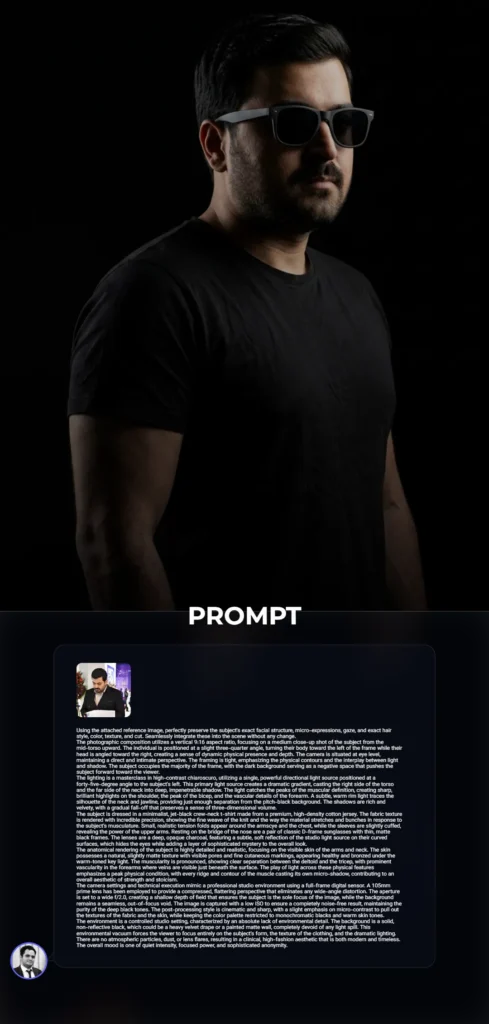
Cinematic Chiaroscuro Portrait: High-Contrast Studio Photography PromptUsing the attached reference image, perfectly preserve the subject's exact facial structure, micro-expressions, gaze, and exact hair style, color, texture, and cut. Seamlessly integrate these into the scene without any change.
The photographic composition utilizes a vertical 9:16 aspect ratio, focusing on a medium close-up shot of the subject from the mid-torso upward. The individual is positioned at a slight three-quarter angle, turning their body toward the left of the frame while their head is angled toward the right, creating a sense of dynamic physical presence and depth. The camera is situated at eye level, maintaining a direct and intimate perspective. The framing is tight, emphasizing the physical contours and the interplay between light and shadow. The subject occupies the majority of the frame, with the dark background serving as a negative space that pushes the subject forward toward the viewer.
The lighting is a masterclass in high-contrast chiaroscuro, utilizing a single, powerful directional light source positioned at a forty-five-degree angle to the subject's left. This primary light source creates a dramatic gradient, casting the right side of the torso and the far side of the neck into deep, impenetrable shadow. The light catches the peaks of the muscular definition, creating sharp, brilliant highlights on the shoulder, the peak of the bicep, and the vascular details of the forearm. A subtle, warm rim light traces the silhouette of the neck and jawline, providing just enough separation from the pitch-black background. The shadows are rich and velvety, with a gradual fall-off that preserves a sense of three-dimensional volume.
The subject is dressed in a minimalist, jet-black crew-neck t-shirt made from a premium, high-density cotton jersey. The fabric texture is rendered with incredible precision, showing the fine weave of the knit and the way the material stretches and bunches in response to the subject's musculature. Small, realistic tension folds appear around the armscye and the chest, while the sleeves are slightly cuffed, revealing the power of the upper arms. Resting on the bridge of the nose are a pair of classic D-frame sunglasses with thin, matte black frames. The lenses are a deep, opaque charcoal, featuring a subtle, soft reflection of the studio light source on their curved surfaces, which hides the eyes while adding a layer of sophisticated mystery to the overall look.
The anatomical rendering of the subject is highly detailed and realistic, focusing on the visible skin of the arms and neck. The skin possesses a natural, slightly matte texture with visible pores and fine cutaneous markings, appearing healthy and bronzed under the warm-toned key light. The muscularity is pronounced, showing clear separation between the deltoid and the tricep, with prominent vascularity in the forearms where veins are visible just beneath the surface. The play of light across these physical features emphasizes a peak physical condition, with every ridge and contour of the muscle casting its own micro-shadow, contributing to an overall aesthetic of strength and stoicism.
The camera settings and technical execution mimic a professional studio environment using a full-frame digital sensor. A 105mm prime lens has been employed to provide a compressed, flattering perspective that eliminates any wide-angle distortion. The aperture is set to a wide f/2.0, creating a shallow depth of field that ensures the subject is the sole focus of the image, while the background remains a seamless, out-of-focus void. The image is captured with a low ISO to ensure a completely noise-free result, maintaining the purity of the deep black tones. The post-processing style is cinematic and sharp, with a slight emphasis on micro-contrast to pull out the textures of the fabric and the skin, while keeping the color palette restricted to monochromatic blacks and warm skin tones.
The environment is a controlled studio setting, characterized by an absolute lack of environmental detail. The background is a solid, non-reflective black, which could be a heavy velvet drape or a painted matte wall, completely devoid of any light spill. This environmental vacuum forces the viewer to focus entirely on the subject's form, the texture of the clothing, and the dramatic lighting. There are no atmospheric particles, dust, or lens flares, resulting in a clinical, high-fashion aesthetic that is both modern and timeless. The overall mood is one of quiet intensity, focused power, and sophisticated anonymity.
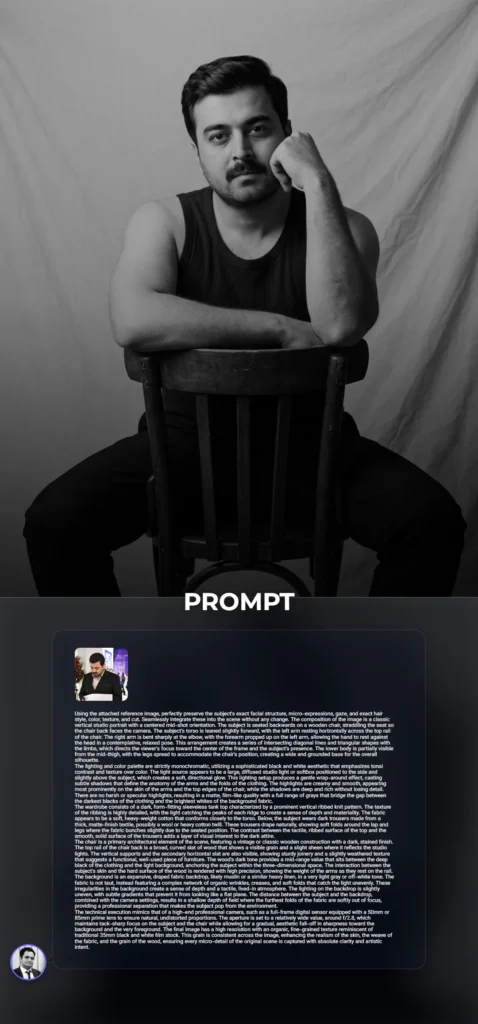
Cinematic Black and White Studio Portrait on Vintage Wooden ChairUsing the attached reference image, perfectly preserve the subject's exact facial structure, micro-expressions, gaze, and exact hair style, color, texture, and cut. Seamlessly integrate these into the scene without any change. The composition of the image is a classic vertical studio portrait with a centered mid-shot orientation. The subject is seated backwards on a wooden chair, straddling the seat so the chair back faces the camera. The subject's torso is leaned slightly forward, with the left arm resting horizontally across the top rail of the chair. The right arm is bent sharply at the elbow, with the forearm propped up on the left arm, allowing the hand to rest against the head in a contemplative, relaxed pose. This arrangement creates a series of intersecting diagonal lines and triangular shapes with the limbs, which directs the viewer's focus toward the center of the frame and the subject's presence. The lower body is partially visible from the mid-thigh, with the legs spread to accommodate the chair's position, creating a wide and grounded base for the overall silhouette.
The lighting and color palette are strictly monochromatic, utilizing a sophisticated black and white aesthetic that emphasizes tonal contrast and texture over color. The light source appears to be a large, diffused studio light or softbox positioned to the side and slightly above the subject, which creates a soft, directional glow. This lighting setup produces a gentle wrap-around effect, casting subtle shadows that define the anatomy of the arms and the folds of the clothing. The highlights are creamy and smooth, appearing most prominently on the skin of the arms and the top edges of the chair, while the shadows are deep and rich without losing detail. There are no harsh or specular highlights, resulting in a matte, film-like quality with a full range of grays that bridge the gap between the darkest blacks of the clothing and the brightest whites of the background fabric.
The wardrobe consists of a dark, form-fitting sleeveless tank top characterized by a prominent vertical ribbed knit pattern. The texture of the ribbing is highly detailed, with the light catching the peaks of each ridge to create a sense of depth and materiality. The fabric appears to be a soft, heavy-weight cotton that conforms closely to the torso. Below, the subject wears dark trousers made from a thick, matte-finish textile, possibly a wool or heavy cotton twill. These trousers drape naturally, showing soft folds around the lap and legs where the fabric bunches slightly due to the seated position. The contrast between the tactile, ribbed surface of the top and the smooth, solid surface of the trousers adds a layer of visual interest to the dark attire.
The chair is a primary architectural element of the scene, featuring a vintage or classic wooden construction with a dark, stained finish. The top rail of the chair back is a broad, curved slat of wood that shows a visible grain and a slight sheen where it reflects the studio lights. The vertical supports and the secondary horizontal slat are also visible, showing sturdy joinery and a slightly weathered texture that suggests a functional, well-used piece of furniture. The wood's dark tone provides a mid-range value that sits between the deep black of the clothing and the light background, anchoring the subject within the three-dimensional space. The interaction between the subject's skin and the hard surface of the wood is rendered with high precision, showing the weight of the arms as they rest on the rail.
The background is an expansive, draped fabric backdrop, likely muslin or a similar heavy linen, in a very light gray or off-white tone. The fabric is not taut, instead featuring a complex network of organic wrinkles, creases, and soft folds that catch the light unevenly. These irregularities in the background create a sense of depth and a tactile, lived-in atmosphere. The lighting on the backdrop is slightly uneven, with subtle gradients that prevent it from looking like a flat plane. The distance between the subject and the backdrop, combined with the camera settings, results in a shallow depth of field where the furthest folds of the fabric are softly out of focus, providing a professional separation that makes the subject pop from the environment.
The technical execution mimics that of a high-end professional camera, such as a full-frame digital sensor equipped with a 50mm or 85mm prime lens to ensure natural, undistorted proportions. The aperture is set to a relatively wide value, around f/2.8, which maintains tack-sharp focus on the subject and the chair while allowing for a gradual, aesthetic fall-off in sharpness toward the background and the very foreground. The final image has a high resolution with an organic, fine-grained texture reminiscent of traditional 35mm black and white film stock. This grain is consistent across the image, enhancing the realism of the skin, the weave of the fabric, and the grain of the wood, ensuring every micro-detail of the original scene is captured with absolute clarity and artistic intent.

Futuristic Monochromatic High-Fashion Portrait with Parametric ArchitectureUsing the attached reference image, perfectly preserve the subject's exact facial structure, micro-expressions, gaze, and exact hair style, color, texture, and cut. Seamlessly integrate these into the scene without any change. The setting consists of an ultra-modern, minimalist, and surreal architectural environment characterized by fluid, organic, and undulating wave-like structures that wrap around the subject in a complex, multi-layered arrangement. These architectural forms are reminiscent of parametric design, featuring smooth, sinuous curves and sweeping surfaces that transition seamlessly from bright, pristine whites to deep, velvety shadows. The geometry of the background is non-linear, suggesting a sculptural or liquid-inspired interior where walls and ceiling meld into one continuous, flowing form. The material of these structures appears as a semi-matte, high-grade architectural composite, catching the light in a way that emphasizes the three-dimensional volume and the graceful curvature of every fold and crest.
The lighting is a sophisticated, high-end studio arrangement that employs a high-key approach while maintaining a sense of dramatic contrast. A primary, large-scale diffused light source is positioned at an elevated three-quarter angle, casting a soft, even glow across the scene. This illumination creates delicate gradations of gray across the white background elements, highlighting the peaks of the waves and allowing the troughs to fall into a gentle, soft-focus shade. The light quality is highly directional yet soft-edged, ensuring there are no harsh glares or distracting specular highlights on the subject or the environment. This specific lighting setup emphasizes the textures of the clothing, particularly the way the light grazes the surface of the fabric to reveal its subtle weave and density.
The subject's attire is a masterclass in monochromatic minimalism. The individual is wearing a high-quality, long-sleeved black turtleneck sweater made from a fine-gauge knit material, possibly a blend of wool and cashmere, which exhibits a deep, light-absorbing matte finish. The fabric of the turtleneck is thick and structured, holding its shape perfectly around the neck and torso. Complementing the sweater are dark charcoal or black tailored trousers that feature a smooth, refined textile finish. The subject’s posture is poised and contemplative, with hands tucked naturally into the pockets of the trousers, creating a relaxed yet sophisticated silhouette. The fit of the clothing is precise, highlighting a lean and athletic frame without being overly tight, allowing for natural folds and creases to form at the elbows and the waistline where the sweater meets the trousers.
The camera composition is a vertical medium-full shot, capturing the subject from the mid-thigh upwards. The framing is centered on the subject, who is positioned in a three-quarter profile view, looking away from the camera toward the left of the frame. This creates a sense of introspection and mystery. The lens used is a high-resolution prime lens, likely a 50mm or 85mm, to provide a natural perspective with minimal distortion and a slight compression of space that brings the subject and the complex background into a harmonious relationship. The aperture is set to a moderate f/2.8 or f/4.0, which ensures the subject is in razor-sharp focus from the texture of the sweater to the edges of the clothing, while allowing the farthest layers of the undulating background to fall into a creamy, aesthetic bokeh. This depth of field emphasizes the subject as the focal point against the intricate architectural geometry.
The color palette is strictly achromatic and monochromatic, consisting of a sophisticated range of blacks, whites, and an infinite spectrum of grays. There is no hint of color, focusing entirely on form, light, and shadow. The blacks are deep and rich, providing a solid anchor for the composition, while the whites are clean and luminous. The overall image quality is characterized by a high-definition, digital photographic look with zero noise, exceptional clarity, and a smooth, professional finish. The atmosphere is one of quiet elegance, futurism, and high-fashion editorial styling, where every element of the composition, from the sweep of the background walls to the fold of the sleeves, is meticulously placed to create a visually stunning and balanced portrait.

Cinematic High-Fashion Portrait of Subject with White Long-Haired CatUsing the attached reference image, perfectly preserve the subject's exact facial structure, micro-expressions, gaze, and exact hair style, color, texture, and cut. Seamlessly integrate these into the scene without any change. The subject is positioned in a central, close-up frame, filling most of the vertical space from the chest upward. The individual is leaning in close to a white long-haired cat, creating an intimate and warm portrait. One hand is raised toward the temple, fingers gently grasping the edge of a black knit beanie, while the other hand cradles the cat’s lower body, with fingers delicately holding one of the cat's front paws to reveal the soft pink paw pads. The cat is positioned in the lower-left foreground, looking directly toward the viewer with large, luminous blue eyes. The composition focuses heavily on the interaction between the individual and the animal, creating an atmosphere of gentle affection and calm.
The scene is illuminated by professional studio lighting that is soft and directional, likely from a large softbox positioned slightly to the camera's left. This creates a gentle gradient across the skin, highlighting the facial contours and forehead while casting soft, cinematic shadows on the opposite side. The lighting is meticulously balanced to prevent harsh highlights, maintaining a smooth, matte quality on the skin and the cat’s fur. Sharp, tiny catchlights are reflected in both the subject's and the cat's eyes, giving them a lifelike, sparkling appearance. The overall atmosphere is quiet, modern, and high-fashion, with a clean and sophisticated tonal range that emphasizes clarity and texture.
The individual wears a black t-shirt made of a high-quality, matte cotton jersey fabric, which shows subtle folds and a fine grain where it meets the neck. A black, ribbed knit beanie sits atop the head, showing a distinct tactile weave and soft woolen fibers with a slight fuzziness to the material. The accessories are captured with high precision: a medium-gauge silver chain necklace hangs around the neck, ending in a polished, teardrop-shaped silver pendant that catches the soft studio light. On the hand holding the cat, there is a large, chunky silver ring with an oxidized, textured finish and a smaller, two-toned ring consisting of a silver band and a thin gold inset. A simple, polished silver hoop earring is visible on the ear, reflecting the surrounding environment.
The cat is a striking white long-hair breed with fur that is exceptionally bright and clean. Individual strands are visible, showing a mix of fine undercoat and longer guard hairs that create a soft, ethereal halo around its body against the dark clothing. The cat’s eyes are a deep, clear cerulean blue with dark pupils. Its nose is a soft, pale pink, matching the color of the articulated paw pads held by the subject. The fur around the cat’s face is dense and plush, transitioning into longer, wispy whiskers that extend outward. The contrast between the brilliant white fur and the subject's dark clothing and beanie is sharp and intentional, drawing the eye to the center of the frame.
The image is captured as if through a high-resolution full-frame camera using a portrait-length lens, such as an 85mm prime, with a wide aperture of approximately f/2.0. This choice of lens creates a shallow depth of field, resulting in a creamy, out-of-focus background while keeping the subject's features and the cat’s face in razor-sharp focus. The camera is positioned at eye level, fostering a direct connection with the viewer. The framing is a tight vertical portrait, cutting off just below the chest and at the top of the beanie, emphasizing the proximity and emotional bond.
The background is a minimalist, dark charcoal grey studio backdrop with a subtle, mottled texture reminiscent of hand-painted canvas or fine concrete. It is significantly darker than the subject, providing a neutral stage that allows the white cat and the skin tones to stand out prominently. The color palette is highly controlled and sophisticated, dominated by monochromatic tones of black, grey, and white, with the only warmth coming from the natural skin tones and the soft pink accents on the cat’s nose and paws. The rendering is crisp and clean, with a slight filmic grain that adds to the professional editorial quality of the photograph.

Urban Studio Portrait with Intense Orange Rim LightingUsing the attached reference image, perfectly preserve the subject's exact facial structure, micro-expressions, gaze, and exact hair style, color, texture, and cut. Seamlessly integrate these into the scene without any change. The scene is set against a monochromatic, high-intensity orange background that possesses a luminous, saturated quality, creating a vibrant and energetic atmosphere. This backdrop is not perfectly flat but features a subtle, soft-box glow emanating from behind the individual, creating a gentle gradient that is slightly brighter in the center and deepens toward the edges of the frame. The lighting is a sophisticated dual-tone studio arrangement, characterized by a dramatic red-orange rim light that sharply defines the silhouette on the right side of the frame, catching the edges of the clothing and the individual's skin with a fiery, saturated glow. A softer, more neutral key light illuminates the subject from the front-left, ensuring that the textures of the garments and the intricacies of the tattoos are clearly visible while maintaining deep, cinematic shadows that provide a three-dimensional depth to the composition.
The subject is wearing an oversized, heavyweight black cotton t-shirt with a thick, ribbed crew-neck collar. The fabric of the shirt has a matte finish that absorbs light, contrasted sharply by a large, centered graphic in a crisp, bone-white hue. This graphic consists of abstract, jagged, flame-like shapes or distorted, organic lettering that reaches upward across the chest. The sleeves are wide and drop-shouldered, ending mid-forearm to reveal a series of detailed tattoos. On the individual's right forearm, there is an intricate, dark ink illustration of a bird or phoenix with spread wings, while the left hand and fingers are adorned with complex, fine-line patterns and shading. A specific piece of script-style calligraphy is visible on the side of the neck, following the natural curve of the anatomy. The individual's hands are positioned in the lower center of the frame, with one hand gently grasping the fingers of the other in a candid, contemplative gesture.
Accessory details are critical for accuracy, including the thin-framed, round-lens spectacles that have a subtle tortoiseshell or metallic brown finish, catching a bright glint of the studio lights on the lenses. The individual wears a thick, polished silver curb-link chain bracelet on the left wrist, and multiple heavy, ornate metallic rings on the fingers, including a dark signet ring on the right hand and a silver-toned band on the left. The camera composition is a waist-up medium shot, utilizing a professional 85mm prime lens to achieve a shallow depth of field. This ensures the mid-plane of the subject is in razor-sharp focus, while the hands in the foreground and the extreme background exhibit a very soft, aesthetic blur. The digital rendering must be of the highest quality, with no visible noise, emphasizing the clean lines, the high-contrast color palette of orange, black, and white, and the tactile textures of the fabric and ink. The overall mood is one of modern, urban intensity, captured with a high-shutter speed to freeze the subtle micro-expression and the stillness of the pose.

Dramatic Monochrome Chiaroscuro Cinematic PortraitUsing the attached reference image, perfectly preserve the subject's exact facial structure, micro-expressions, gaze, and exact hair style, color, texture, and cut. Seamlessly integrate these into the scene without any change.
The photographic style must be a masterful execution of high-contrast monochrome cinematography, specifically emulating the aesthetic of a mid-20th-century silver gelatin print. The color palette is strictly limited to a sophisticated spectrum of blacks, whites, and varying degrees of charcoal and slate grays. There should be an intentional application of fine, organic film grain throughout the entire frame, avoiding any digital smoothness to maintain an authentic, raw, and tactile analog quality. The tonal range should be pushed to create a dramatic chiaroscuro effect, where the highlights are crisp and luminous without blowing out, and the shadows are deep, rich, and ink-like, providing a sense of profound depth and three-dimensionality to the subject.
The lighting is the primary architectural element of this composition, featuring a singular, directional light source positioned at a high angle to the right of the camera. This light must cast a sharp, defined illumination across the side of the subject's face and the prominent anatomy of the neck, while leaving the opposite side in a heavy, atmospheric shadow. The light should catch the subtle textures of the skin and the fabric of the clothing, creating a brilliant rim-light effect along the contours of the individual's silhouette. The transition between the brightest highlights and the deepest shadows must be deliberate and sculpted, emphasizing the physical presence of the individual against the more neutral, softly lit background.
The composition is a tight, intimate bust-length portrait captured from a slightly low-angle perspective to emphasize the dramatic upward tilt of the head. The individual is positioned in a three-quarter profile, with the neck elongated and the chin pointed toward the upper right corner of the frame, suggesting a moment of intense introspection, surrender, or yearning. The framing should be slightly off-center to allow for a sense of dynamic movement within the stillness of the pose. The negative space provided by the background should be utilized to balance the heavy, dark mass of the subject's torso and jacket, ensuring that the viewer's focus is drawn immediately to the illuminated portions of the skin and the sharp lines of the posture.
The technical camera settings should simulate a professional portrait setup using a 105mm telephoto prime lens to provide a subtle compression of the features and a flattering perspective. The aperture should be set to approximately f/4.0, ensuring that the subject's entire profile remains in tack-sharp focus while allowing the background to fall into a gentle, non-distracting blur. The shutter speed should be fast enough to capture the stillness of the moment with absolute clarity, and the simulated ISO should be high enough to introduce that characteristic silver halide grain that defines the filmic look. Every micro-detail, from the tiny pores on the skin to the individual fibers of the clothing, must be rendered with high-fidelity precision within the focal plane.
The wardrobe consists of a heavy, structured jacket crafted from a dark, rugged textile such as a high-density denim or a thick canvas. The fabric must exhibit a rich, matte texture that absorbs light, with visible weaving patterns and subtle distressing along the seams. The collar of the jacket is turned up slightly, framing the base of the neck and adding a layer of architectural complexity to the lower third of the image. The deep black of the garment should act as a solid anchor for the composition, providing a stark contrast against the pale, neutral background. The background itself should be a minimalist, non-descript wall with a very fine, plaster-like texture, catching just enough light to appear as a soft, luminous gray that gradients slightly darker toward the edges of the frame to create a subtle vignette effect.

High-Key Black and White Intense Portrait with Reaching HandUsing the attached reference image, perfectly preserve the subject's exact facial structure, micro-expressions, gaze, and exact hair style, color, texture, and cut. Seamlessly integrate these into the scene without any change. The overall aesthetic of the image must be a high-contrast, professional black and white studio photograph characterized by an extreme high-key lighting scheme. The background is a brilliant, overexposed white void that appears to glow, creating a silhouette-like rim light effect that bleeds slightly into the subject's outlines and shoulders. This luminous backdrop should be completely devoid of detail, serving as a clean, clinical canvas that pushes the subject toward the viewer. The lighting on the subject is directional and sharp, originating from an overhead or slightly frontal-high position, casting deep, dramatic shadows beneath the brow, nose, and chin, which emphasizes the three-dimensional topography of the skin and the intensity of the gaze. The image is captured from a dramatic low-angle perspective, looking directly up at the individual, which creates a sense of dominance and proximity. A wide-angle lens, approximately 24mm to 35mm, is used to introduce a subtle perspective distortion that makes the subject's hand, which is reaching directly toward the camera lens in the upper foreground, appear much larger than the rest of the body. This foreground hand is rendered with a heavy, soft-focus bokeh, completely blurred and hazy to guide the viewer's eye immediately past it to the sharp, crisp focal point of the subject's eyes. The depth of field is incredibly shallow, likely an aperture of f/1.8 or f/2.8, ensuring that while the eyes are in perfect, needle-sharp focus, the tip of the nose and the reaching hand fall into a gradual, creamy blur. The subject wears a simple, clean-lined white cotton V-neck t-shirt with a soft, matte texture that shows subtle folds and creases around the shoulders and chest as they lean forward. Visible jewelry includes a set of textured, dark-toned bracelets on the left wrist made of leather or cord, and a wide, polished metallic ring on one of the fingers of the reaching hand. A long, delicate metallic box-link chain hangs around the neck, terminating in a small, reflective cubic or geometric pendant that rests against the lower chest. The photographic grain is fine and cinematic, reminiscent of high-speed monochromatic film, providing a tactile, gritty realism to the skin textures and fabric weaves. The composition is tight and vertical, with the subject's head positioned centrally, creating a powerful, confrontational, and intimate atmosphere that demands the viewer's attention through the directness of the eye contact and the physical intrusion of the hand into the camera's personal space. Each pixel should contribute to a sense of raw, unedited intensity, balancing the softness of the out-of-focus elements with the razor-sharp clarity of the central facial region.
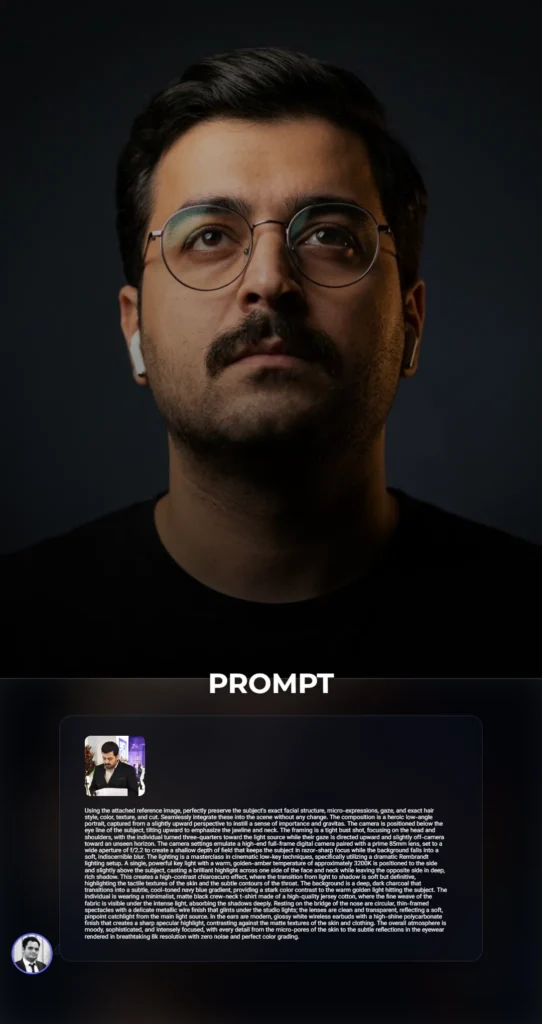
Heroic Cinematic Portrait with Rembrandt Lighting and 8K DetailUsing the attached reference image, perfectly preserve the subject's exact facial structure, micro-expressions, gaze, and exact hair style, color, texture, and cut. Seamlessly integrate these into the scene without any change. The composition is a heroic low-angle portrait, captured from a slightly upward perspective to instill a sense of importance and gravitas. The camera is positioned below the eye line of the subject, tilting upward to emphasize the jawline and neck. The framing is a tight bust shot, focusing on the head and shoulders, with the individual turned three-quarters toward the light source while their gaze is directed upward and slightly off-camera toward an unseen horizon. The camera settings emulate a high-end full-frame digital camera paired with a prime 85mm lens, set to a wide aperture of f/2.2 to create a shallow depth of field that keeps the subject in razor-sharp focus while the background falls into a soft, indiscernible blur. The lighting is a masterclass in cinematic low-key techniques, specifically utilizing a dramatic Rembrandt lighting setup. A single, powerful key light with a warm, golden-amber temperature of approximately 3200K is positioned to the side and slightly above the subject, casting a brilliant highlight across one side of the face and neck while leaving the opposite side in deep, rich shadow. This creates a high-contrast chiaroscuro effect, where the transition from light to shadow is soft but definitive, highlighting the tactile textures of the skin and the subtle contours of the throat. The background is a deep, dark charcoal that transitions into a subtle, cool-toned navy blue gradient, providing a stark color contrast to the warm golden light hitting the subject. The individual is wearing a minimalist, matte black crew-neck t-shirt made of a high-quality jersey cotton, where the fine weave of the fabric is visible under the intense light, absorbing the shadows deeply. Resting on the bridge of the nose are circular, thin-framed spectacles with a delicate metallic wire finish that glints under the studio lights; the lenses are clean and transparent, reflecting a soft, pinpoint catchlight from the main light source. In the ears are modern, glossy white wireless earbuds with a high-shine polycarbonate finish that creates a sharp specular highlight, contrasting against the matte textures of the skin and clothing. The overall atmosphere is moody, sophisticated, and intensely focused, with every detail from the micro-pores of the skin to the subtle reflections in the eyewear rendered in breathtaking 8k resolution with zero noise and perfect color grading.
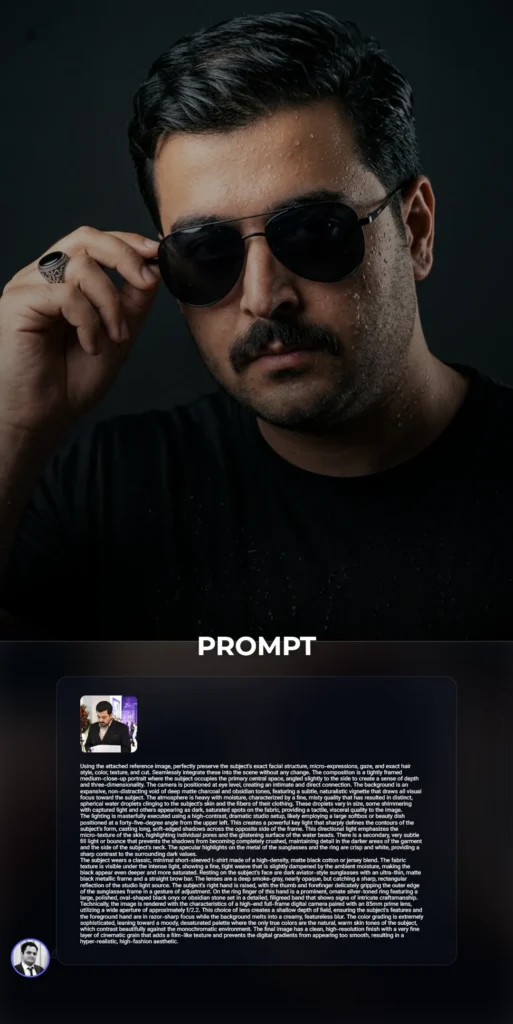
Cinematic Hyper-Realistic Moody Fashion Portrait with Water DropletsUsing the attached reference image, perfectly preserve the subject's exact facial structure, micro-expressions, gaze, and exact hair style, color, texture, and cut. Seamlessly integrate these into the scene without any change. The composition is a tightly framed medium-close-up portrait where the subject occupies the primary central space, angled slightly to the side to create a sense of depth and three-dimensionality. The camera is positioned at eye level, creating an intimate and direct connection. The background is an expansive, non-distracting void of deep matte charcoal and obsidian tones, featuring a subtle, naturalistic vignette that draws all visual focus toward the subject. The atmosphere is heavy with moisture, characterized by a fine, misty quality that has resulted in distinct, spherical water droplets clinging to the subject's skin and the fibers of their clothing. These droplets vary in size, some shimmering with captured light and others appearing as dark, saturated spots on the fabric, providing a tactile, visceral quality to the image.
The lighting is masterfully executed using a high-contrast, dramatic studio setup, likely employing a large softbox or beauty dish positioned at a forty-five-degree angle from the upper left. This creates a powerful key light that sharply defines the contours of the subject's form, casting long, soft-edged shadows across the opposite side of the frame. This directional light emphasizes the micro-texture of the skin, highlighting individual pores and the glistening surface of the water beads. There is a secondary, very subtle fill light or bounce that prevents the shadows from becoming completely crushed, maintaining detail in the darker areas of the garment and the side of the subject's neck. The specular highlights on the metal of the sunglasses and the ring are crisp and white, providing a sharp contrast to the surrounding dark values.
The subject wears a classic, minimal short-sleeved t-shirt made of a high-density, matte black cotton or jersey blend. The fabric texture is visible under the intense light, showing a fine, tight weave that is slightly dampened by the ambient moisture, making the black appear even deeper and more saturated. Resting on the subject's face are dark aviator-style sunglasses with an ultra-thin, matte black metallic frame and a straight brow bar. The lenses are a deep smoke-gray, nearly opaque, but catching a sharp, rectangular reflection of the studio light source. The subject's right hand is raised, with the thumb and forefinger delicately gripping the outer edge of the sunglasses frame in a gesture of adjustment. On the ring finger of this hand is a prominent, ornate silver-toned ring featuring a large, polished, oval-shaped black onyx or obsidian stone set in a detailed, filigreed band that shows signs of intricate craftsmanship.
Technically, the image is rendered with the characteristics of a high-end full-frame digital camera paired with an 85mm prime lens, utilizing a wide aperture of approximately f/2.2. This choice of lens creates a shallow depth of field, ensuring the subject's features and the foreground hand are in razor-sharp focus while the background melts into a creamy, featureless blur. The color grading is extremely sophisticated, leaning toward a moody, desaturated palette where the only true colors are the natural, warm skin tones of the subject, which contrast beautifully against the monochromatic environment. The final image has a clean, high-resolution finish with a very fine layer of cinematic grain that adds a film-like texture and prevents the digital gradients from appearing too smooth, resulting in a hyper-realistic, high-fashion aesthetic.
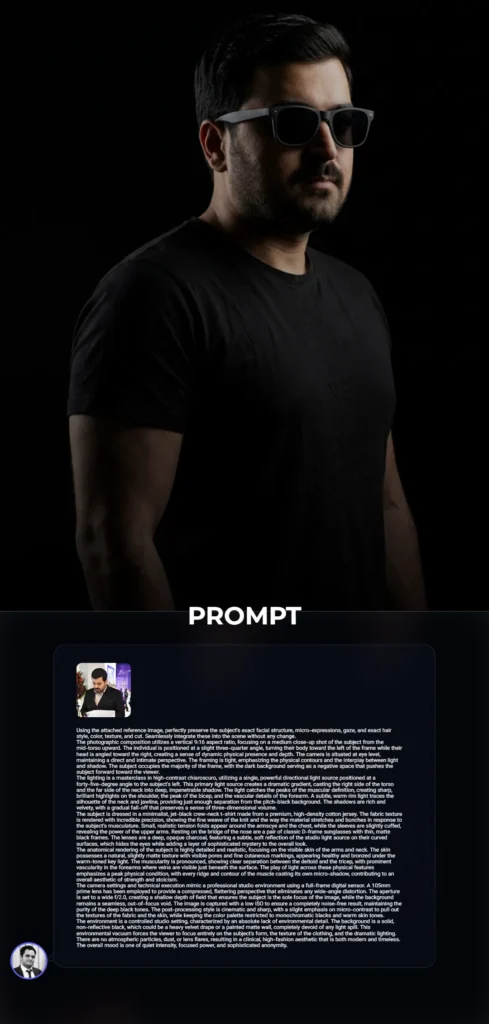
Cinematic Chiaroscuro Portrait: High-Contrast Studio Photography PromptUsing the attached reference image, perfectly preserve the subject's exact facial structure, micro-expressions, gaze, and exact hair style, color, texture, and cut. Seamlessly integrate these into the scene without any change.
The photographic composition utilizes a vertical 9:16 aspect ratio, focusing on a medium close-up shot of the subject from the mid-torso upward. The individual is positioned at a slight three-quarter angle, turning their body toward the left of the frame while their head is angled toward the right, creating a sense of dynamic physical presence and depth. The camera is situated at eye level, maintaining a direct and intimate perspective. The framing is tight, emphasizing the physical contours and the interplay between light and shadow. The subject occupies the majority of the frame, with the dark background serving as a negative space that pushes the subject forward toward the viewer.
The lighting is a masterclass in high-contrast chiaroscuro, utilizing a single, powerful directional light source positioned at a forty-five-degree angle to the subject's left. This primary light source creates a dramatic gradient, casting the right side of the torso and the far side of the neck into deep, impenetrable shadow. The light catches the peaks of the muscular definition, creating sharp, brilliant highlights on the shoulder, the peak of the bicep, and the vascular details of the forearm. A subtle, warm rim light traces the silhouette of the neck and jawline, providing just enough separation from the pitch-black background. The shadows are rich and velvety, with a gradual fall-off that preserves a sense of three-dimensional volume.
The subject is dressed in a minimalist, jet-black crew-neck t-shirt made from a premium, high-density cotton jersey. The fabric texture is rendered with incredible precision, showing the fine weave of the knit and the way the material stretches and bunches in response to the subject's musculature. Small, realistic tension folds appear around the armscye and the chest, while the sleeves are slightly cuffed, revealing the power of the upper arms. Resting on the bridge of the nose are a pair of classic D-frame sunglasses with thin, matte black frames. The lenses are a deep, opaque charcoal, featuring a subtle, soft reflection of the studio light source on their curved surfaces, which hides the eyes while adding a layer of sophisticated mystery to the overall look.
The anatomical rendering of the subject is highly detailed and realistic, focusing on the visible skin of the arms and neck. The skin possesses a natural, slightly matte texture with visible pores and fine cutaneous markings, appearing healthy and bronzed under the warm-toned key light. The muscularity is pronounced, showing clear separation between the deltoid and the tricep, with prominent vascularity in the forearms where veins are visible just beneath the surface. The play of light across these physical features emphasizes a peak physical condition, with every ridge and contour of the muscle casting its own micro-shadow, contributing to an overall aesthetic of strength and stoicism.
The camera settings and technical execution mimic a professional studio environment using a full-frame digital sensor. A 105mm prime lens has been employed to provide a compressed, flattering perspective that eliminates any wide-angle distortion. The aperture is set to a wide f/2.0, creating a shallow depth of field that ensures the subject is the sole focus of the image, while the background remains a seamless, out-of-focus void. The image is captured with a low ISO to ensure a completely noise-free result, maintaining the purity of the deep black tones. The post-processing style is cinematic and sharp, with a slight emphasis on micro-contrast to pull out the textures of the fabric and the skin, while keeping the color palette restricted to monochromatic blacks and warm skin tones.
The environment is a controlled studio setting, characterized by an absolute lack of environmental detail. The background is a solid, non-reflective black, which could be a heavy velvet drape or a painted matte wall, completely devoid of any light spill. This environmental vacuum forces the viewer to focus entirely on the subject's form, the texture of the clothing, and the dramatic lighting. There are no atmospheric particles, dust, or lens flares, resulting in a clinical, high-fashion aesthetic that is both modern and timeless. The overall mood is one of quiet intensity, focused power, and sophisticated anonymity.
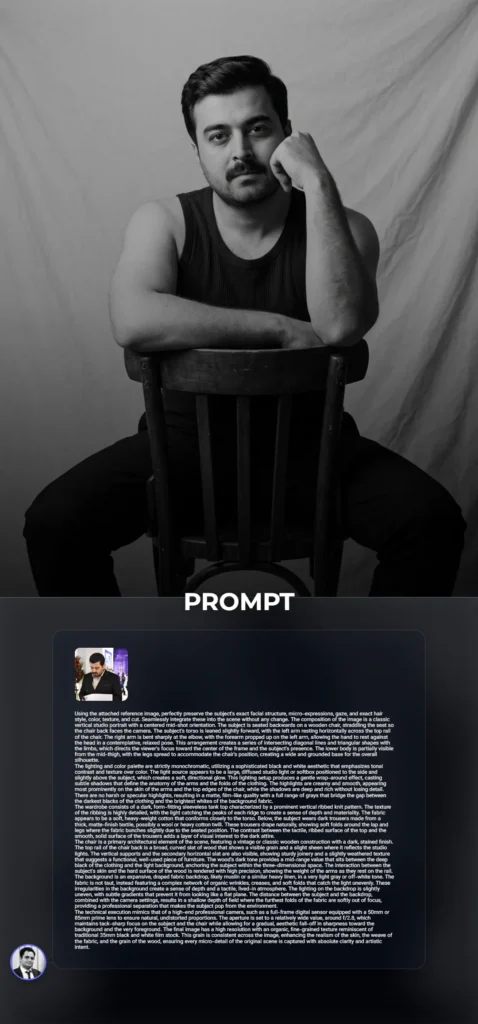
Cinematic Black and White Studio Portrait on Vintage Wooden ChairUsing the attached reference image, perfectly preserve the subject's exact facial structure, micro-expressions, gaze, and exact hair style, color, texture, and cut. Seamlessly integrate these into the scene without any change. The composition of the image is a classic vertical studio portrait with a centered mid-shot orientation. The subject is seated backwards on a wooden chair, straddling the seat so the chair back faces the camera. The subject's torso is leaned slightly forward, with the left arm resting horizontally across the top rail of the chair. The right arm is bent sharply at the elbow, with the forearm propped up on the left arm, allowing the hand to rest against the head in a contemplative, relaxed pose. This arrangement creates a series of intersecting diagonal lines and triangular shapes with the limbs, which directs the viewer's focus toward the center of the frame and the subject's presence. The lower body is partially visible from the mid-thigh, with the legs spread to accommodate the chair's position, creating a wide and grounded base for the overall silhouette.
The lighting and color palette are strictly monochromatic, utilizing a sophisticated black and white aesthetic that emphasizes tonal contrast and texture over color. The light source appears to be a large, diffused studio light or softbox positioned to the side and slightly above the subject, which creates a soft, directional glow. This lighting setup produces a gentle wrap-around effect, casting subtle shadows that define the anatomy of the arms and the folds of the clothing. The highlights are creamy and smooth, appearing most prominently on the skin of the arms and the top edges of the chair, while the shadows are deep and rich without losing detail. There are no harsh or specular highlights, resulting in a matte, film-like quality with a full range of grays that bridge the gap between the darkest blacks of the clothing and the brightest whites of the background fabric.
The wardrobe consists of a dark, form-fitting sleeveless tank top characterized by a prominent vertical ribbed knit pattern. The texture of the ribbing is highly detailed, with the light catching the peaks of each ridge to create a sense of depth and materiality. The fabric appears to be a soft, heavy-weight cotton that conforms closely to the torso. Below, the subject wears dark trousers made from a thick, matte-finish textile, possibly a wool or heavy cotton twill. These trousers drape naturally, showing soft folds around the lap and legs where the fabric bunches slightly due to the seated position. The contrast between the tactile, ribbed surface of the top and the smooth, solid surface of the trousers adds a layer of visual interest to the dark attire.
The chair is a primary architectural element of the scene, featuring a vintage or classic wooden construction with a dark, stained finish. The top rail of the chair back is a broad, curved slat of wood that shows a visible grain and a slight sheen where it reflects the studio lights. The vertical supports and the secondary horizontal slat are also visible, showing sturdy joinery and a slightly weathered texture that suggests a functional, well-used piece of furniture. The wood's dark tone provides a mid-range value that sits between the deep black of the clothing and the light background, anchoring the subject within the three-dimensional space. The interaction between the subject's skin and the hard surface of the wood is rendered with high precision, showing the weight of the arms as they rest on the rail.
The background is an expansive, draped fabric backdrop, likely muslin or a similar heavy linen, in a very light gray or off-white tone. The fabric is not taut, instead featuring a complex network of organic wrinkles, creases, and soft folds that catch the light unevenly. These irregularities in the background create a sense of depth and a tactile, lived-in atmosphere. The lighting on the backdrop is slightly uneven, with subtle gradients that prevent it from looking like a flat plane. The distance between the subject and the backdrop, combined with the camera settings, results in a shallow depth of field where the furthest folds of the fabric are softly out of focus, providing a professional separation that makes the subject pop from the environment.
The technical execution mimics that of a high-end professional camera, such as a full-frame digital sensor equipped with a 50mm or 85mm prime lens to ensure natural, undistorted proportions. The aperture is set to a relatively wide value, around f/2.8, which maintains tack-sharp focus on the subject and the chair while allowing for a gradual, aesthetic fall-off in sharpness toward the background and the very foreground. The final image has a high resolution with an organic, fine-grained texture reminiscent of traditional 35mm black and white film stock. This grain is consistent across the image, enhancing the realism of the skin, the weave of the fabric, and the grain of the wood, ensuring every micro-detail of the original scene is captured with absolute clarity and artistic intent.

Futuristic Monochromatic High-Fashion Portrait with Parametric ArchitectureUsing the attached reference image, perfectly preserve the subject's exact facial structure, micro-expressions, gaze, and exact hair style, color, texture, and cut. Seamlessly integrate these into the scene without any change. The setting consists of an ultra-modern, minimalist, and surreal architectural environment characterized by fluid, organic, and undulating wave-like structures that wrap around the subject in a complex, multi-layered arrangement. These architectural forms are reminiscent of parametric design, featuring smooth, sinuous curves and sweeping surfaces that transition seamlessly from bright, pristine whites to deep, velvety shadows. The geometry of the background is non-linear, suggesting a sculptural or liquid-inspired interior where walls and ceiling meld into one continuous, flowing form. The material of these structures appears as a semi-matte, high-grade architectural composite, catching the light in a way that emphasizes the three-dimensional volume and the graceful curvature of every fold and crest.
The lighting is a sophisticated, high-end studio arrangement that employs a high-key approach while maintaining a sense of dramatic contrast. A primary, large-scale diffused light source is positioned at an elevated three-quarter angle, casting a soft, even glow across the scene. This illumination creates delicate gradations of gray across the white background elements, highlighting the peaks of the waves and allowing the troughs to fall into a gentle, soft-focus shade. The light quality is highly directional yet soft-edged, ensuring there are no harsh glares or distracting specular highlights on the subject or the environment. This specific lighting setup emphasizes the textures of the clothing, particularly the way the light grazes the surface of the fabric to reveal its subtle weave and density.
The subject's attire is a masterclass in monochromatic minimalism. The individual is wearing a high-quality, long-sleeved black turtleneck sweater made from a fine-gauge knit material, possibly a blend of wool and cashmere, which exhibits a deep, light-absorbing matte finish. The fabric of the turtleneck is thick and structured, holding its shape perfectly around the neck and torso. Complementing the sweater are dark charcoal or black tailored trousers that feature a smooth, refined textile finish. The subject’s posture is poised and contemplative, with hands tucked naturally into the pockets of the trousers, creating a relaxed yet sophisticated silhouette. The fit of the clothing is precise, highlighting a lean and athletic frame without being overly tight, allowing for natural folds and creases to form at the elbows and the waistline where the sweater meets the trousers.
The camera composition is a vertical medium-full shot, capturing the subject from the mid-thigh upwards. The framing is centered on the subject, who is positioned in a three-quarter profile view, looking away from the camera toward the left of the frame. This creates a sense of introspection and mystery. The lens used is a high-resolution prime lens, likely a 50mm or 85mm, to provide a natural perspective with minimal distortion and a slight compression of space that brings the subject and the complex background into a harmonious relationship. The aperture is set to a moderate f/2.8 or f/4.0, which ensures the subject is in razor-sharp focus from the texture of the sweater to the edges of the clothing, while allowing the farthest layers of the undulating background to fall into a creamy, aesthetic bokeh. This depth of field emphasizes the subject as the focal point against the intricate architectural geometry.
The color palette is strictly achromatic and monochromatic, consisting of a sophisticated range of blacks, whites, and an infinite spectrum of grays. There is no hint of color, focusing entirely on form, light, and shadow. The blacks are deep and rich, providing a solid anchor for the composition, while the whites are clean and luminous. The overall image quality is characterized by a high-definition, digital photographic look with zero noise, exceptional clarity, and a smooth, professional finish. The atmosphere is one of quiet elegance, futurism, and high-fashion editorial styling, where every element of the composition, from the sweep of the background walls to the fold of the sleeves, is meticulously placed to create a visually stunning and balanced portrait.

Cinematic High-Fashion Portrait of Subject with White Long-Haired CatUsing the attached reference image, perfectly preserve the subject's exact facial structure, micro-expressions, gaze, and exact hair style, color, texture, and cut. Seamlessly integrate these into the scene without any change. The subject is positioned in a central, close-up frame, filling most of the vertical space from the chest upward. The individual is leaning in close to a white long-haired cat, creating an intimate and warm portrait. One hand is raised toward the temple, fingers gently grasping the edge of a black knit beanie, while the other hand cradles the cat’s lower body, with fingers delicately holding one of the cat's front paws to reveal the soft pink paw pads. The cat is positioned in the lower-left foreground, looking directly toward the viewer with large, luminous blue eyes. The composition focuses heavily on the interaction between the individual and the animal, creating an atmosphere of gentle affection and calm.
The scene is illuminated by professional studio lighting that is soft and directional, likely from a large softbox positioned slightly to the camera's left. This creates a gentle gradient across the skin, highlighting the facial contours and forehead while casting soft, cinematic shadows on the opposite side. The lighting is meticulously balanced to prevent harsh highlights, maintaining a smooth, matte quality on the skin and the cat’s fur. Sharp, tiny catchlights are reflected in both the subject's and the cat's eyes, giving them a lifelike, sparkling appearance. The overall atmosphere is quiet, modern, and high-fashion, with a clean and sophisticated tonal range that emphasizes clarity and texture.
The individual wears a black t-shirt made of a high-quality, matte cotton jersey fabric, which shows subtle folds and a fine grain where it meets the neck. A black, ribbed knit beanie sits atop the head, showing a distinct tactile weave and soft woolen fibers with a slight fuzziness to the material. The accessories are captured with high precision: a medium-gauge silver chain necklace hangs around the neck, ending in a polished, teardrop-shaped silver pendant that catches the soft studio light. On the hand holding the cat, there is a large, chunky silver ring with an oxidized, textured finish and a smaller, two-toned ring consisting of a silver band and a thin gold inset. A simple, polished silver hoop earring is visible on the ear, reflecting the surrounding environment.
The cat is a striking white long-hair breed with fur that is exceptionally bright and clean. Individual strands are visible, showing a mix of fine undercoat and longer guard hairs that create a soft, ethereal halo around its body against the dark clothing. The cat’s eyes are a deep, clear cerulean blue with dark pupils. Its nose is a soft, pale pink, matching the color of the articulated paw pads held by the subject. The fur around the cat’s face is dense and plush, transitioning into longer, wispy whiskers that extend outward. The contrast between the brilliant white fur and the subject's dark clothing and beanie is sharp and intentional, drawing the eye to the center of the frame.
The image is captured as if through a high-resolution full-frame camera using a portrait-length lens, such as an 85mm prime, with a wide aperture of approximately f/2.0. This choice of lens creates a shallow depth of field, resulting in a creamy, out-of-focus background while keeping the subject's features and the cat’s face in razor-sharp focus. The camera is positioned at eye level, fostering a direct connection with the viewer. The framing is a tight vertical portrait, cutting off just below the chest and at the top of the beanie, emphasizing the proximity and emotional bond.
The background is a minimalist, dark charcoal grey studio backdrop with a subtle, mottled texture reminiscent of hand-painted canvas or fine concrete. It is significantly darker than the subject, providing a neutral stage that allows the white cat and the skin tones to stand out prominently. The color palette is highly controlled and sophisticated, dominated by monochromatic tones of black, grey, and white, with the only warmth coming from the natural skin tones and the soft pink accents on the cat’s nose and paws. The rendering is crisp and clean, with a slight filmic grain that adds to the professional editorial quality of the photograph.

Urban Studio Portrait with Intense Orange Rim LightingUsing the attached reference image, perfectly preserve the subject's exact facial structure, micro-expressions, gaze, and exact hair style, color, texture, and cut. Seamlessly integrate these into the scene without any change. The scene is set against a monochromatic, high-intensity orange background that possesses a luminous, saturated quality, creating a vibrant and energetic atmosphere. This backdrop is not perfectly flat but features a subtle, soft-box glow emanating from behind the individual, creating a gentle gradient that is slightly brighter in the center and deepens toward the edges of the frame. The lighting is a sophisticated dual-tone studio arrangement, characterized by a dramatic red-orange rim light that sharply defines the silhouette on the right side of the frame, catching the edges of the clothing and the individual's skin with a fiery, saturated glow. A softer, more neutral key light illuminates the subject from the front-left, ensuring that the textures of the garments and the intricacies of the tattoos are clearly visible while maintaining deep, cinematic shadows that provide a three-dimensional depth to the composition.
The subject is wearing an oversized, heavyweight black cotton t-shirt with a thick, ribbed crew-neck collar. The fabric of the shirt has a matte finish that absorbs light, contrasted sharply by a large, centered graphic in a crisp, bone-white hue. This graphic consists of abstract, jagged, flame-like shapes or distorted, organic lettering that reaches upward across the chest. The sleeves are wide and drop-shouldered, ending mid-forearm to reveal a series of detailed tattoos. On the individual's right forearm, there is an intricate, dark ink illustration of a bird or phoenix with spread wings, while the left hand and fingers are adorned with complex, fine-line patterns and shading. A specific piece of script-style calligraphy is visible on the side of the neck, following the natural curve of the anatomy. The individual's hands are positioned in the lower center of the frame, with one hand gently grasping the fingers of the other in a candid, contemplative gesture.
Accessory details are critical for accuracy, including the thin-framed, round-lens spectacles that have a subtle tortoiseshell or metallic brown finish, catching a bright glint of the studio lights on the lenses. The individual wears a thick, polished silver curb-link chain bracelet on the left wrist, and multiple heavy, ornate metallic rings on the fingers, including a dark signet ring on the right hand and a silver-toned band on the left. The camera composition is a waist-up medium shot, utilizing a professional 85mm prime lens to achieve a shallow depth of field. This ensures the mid-plane of the subject is in razor-sharp focus, while the hands in the foreground and the extreme background exhibit a very soft, aesthetic blur. The digital rendering must be of the highest quality, with no visible noise, emphasizing the clean lines, the high-contrast color palette of orange, black, and white, and the tactile textures of the fabric and ink. The overall mood is one of modern, urban intensity, captured with a high-shutter speed to freeze the subtle micro-expression and the stillness of the pose.
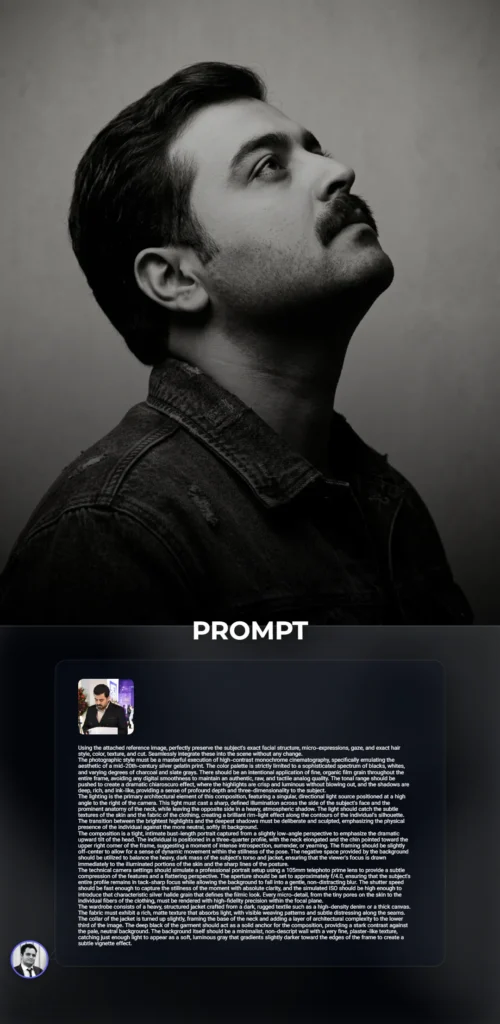
Dramatic Monochrome Chiaroscuro Cinematic PortraitUsing the attached reference image, perfectly preserve the subject's exact facial structure, micro-expressions, gaze, and exact hair style, color, texture, and cut. Seamlessly integrate these into the scene without any change.
The photographic style must be a masterful execution of high-contrast monochrome cinematography, specifically emulating the aesthetic of a mid-20th-century silver gelatin print. The color palette is strictly limited to a sophisticated spectrum of blacks, whites, and varying degrees of charcoal and slate grays. There should be an intentional application of fine, organic film grain throughout the entire frame, avoiding any digital smoothness to maintain an authentic, raw, and tactile analog quality. The tonal range should be pushed to create a dramatic chiaroscuro effect, where the highlights are crisp and luminous without blowing out, and the shadows are deep, rich, and ink-like, providing a sense of profound depth and three-dimensionality to the subject.
The lighting is the primary architectural element of this composition, featuring a singular, directional light source positioned at a high angle to the right of the camera. This light must cast a sharp, defined illumination across the side of the subject's face and the prominent anatomy of the neck, while leaving the opposite side in a heavy, atmospheric shadow. The light should catch the subtle textures of the skin and the fabric of the clothing, creating a brilliant rim-light effect along the contours of the individual's silhouette. The transition between the brightest highlights and the deepest shadows must be deliberate and sculpted, emphasizing the physical presence of the individual against the more neutral, softly lit background.
The composition is a tight, intimate bust-length portrait captured from a slightly low-angle perspective to emphasize the dramatic upward tilt of the head. The individual is positioned in a three-quarter profile, with the neck elongated and the chin pointed toward the upper right corner of the frame, suggesting a moment of intense introspection, surrender, or yearning. The framing should be slightly off-center to allow for a sense of dynamic movement within the stillness of the pose. The negative space provided by the background should be utilized to balance the heavy, dark mass of the subject's torso and jacket, ensuring that the viewer's focus is drawn immediately to the illuminated portions of the skin and the sharp lines of the posture.
The technical camera settings should simulate a professional portrait setup using a 105mm telephoto prime lens to provide a subtle compression of the features and a flattering perspective. The aperture should be set to approximately f/4.0, ensuring that the subject's entire profile remains in tack-sharp focus while allowing the background to fall into a gentle, non-distracting blur. The shutter speed should be fast enough to capture the stillness of the moment with absolute clarity, and the simulated ISO should be high enough to introduce that characteristic silver halide grain that defines the filmic look. Every micro-detail, from the tiny pores on the skin to the individual fibers of the clothing, must be rendered with high-fidelity precision within the focal plane.
The wardrobe consists of a heavy, structured jacket crafted from a dark, rugged textile such as a high-density denim or a thick canvas. The fabric must exhibit a rich, matte texture that absorbs light, with visible weaving patterns and subtle distressing along the seams. The collar of the jacket is turned up slightly, framing the base of the neck and adding a layer of architectural complexity to the lower third of the image. The deep black of the garment should act as a solid anchor for the composition, providing a stark contrast against the pale, neutral background. The background itself should be a minimalist, non-descript wall with a very fine, plaster-like texture, catching just enough light to appear as a soft, luminous gray that gradients slightly darker toward the edges of the frame to create a subtle vignette effect.
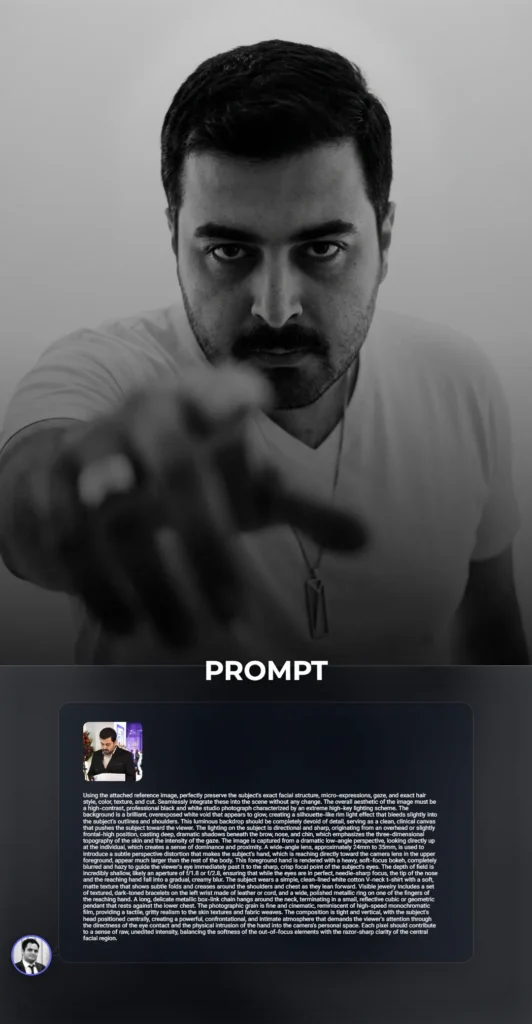
High-Key Black and White Intense Portrait with Reaching HandUsing the attached reference image, perfectly preserve the subject's exact facial structure, micro-expressions, gaze, and exact hair style, color, texture, and cut. Seamlessly integrate these into the scene without any change. The overall aesthetic of the image must be a high-contrast, professional black and white studio photograph characterized by an extreme high-key lighting scheme. The background is a brilliant, overexposed white void that appears to glow, creating a silhouette-like rim light effect that bleeds slightly into the subject's outlines and shoulders. This luminous backdrop should be completely devoid of detail, serving as a clean, clinical canvas that pushes the subject toward the viewer. The lighting on the subject is directional and sharp, originating from an overhead or slightly frontal-high position, casting deep, dramatic shadows beneath the brow, nose, and chin, which emphasizes the three-dimensional topography of the skin and the intensity of the gaze. The image is captured from a dramatic low-angle perspective, looking directly up at the individual, which creates a sense of dominance and proximity. A wide-angle lens, approximately 24mm to 35mm, is used to introduce a subtle perspective distortion that makes the subject's hand, which is reaching directly toward the camera lens in the upper foreground, appear much larger than the rest of the body. This foreground hand is rendered with a heavy, soft-focus bokeh, completely blurred and hazy to guide the viewer's eye immediately past it to the sharp, crisp focal point of the subject's eyes. The depth of field is incredibly shallow, likely an aperture of f/1.8 or f/2.8, ensuring that while the eyes are in perfect, needle-sharp focus, the tip of the nose and the reaching hand fall into a gradual, creamy blur. The subject wears a simple, clean-lined white cotton V-neck t-shirt with a soft, matte texture that shows subtle folds and creases around the shoulders and chest as they lean forward. Visible jewelry includes a set of textured, dark-toned bracelets on the left wrist made of leather or cord, and a wide, polished metallic ring on one of the fingers of the reaching hand. A long, delicate metallic box-link chain hangs around the neck, terminating in a small, reflective cubic or geometric pendant that rests against the lower chest. The photographic grain is fine and cinematic, reminiscent of high-speed monochromatic film, providing a tactile, gritty realism to the skin textures and fabric weaves. The composition is tight and vertical, with the subject's head positioned centrally, creating a powerful, confrontational, and intimate atmosphere that demands the viewer's attention through the directness of the eye contact and the physical intrusion of the hand into the camera's personal space. Each pixel should contribute to a sense of raw, unedited intensity, balancing the softness of the out-of-focus elements with the razor-sharp clarity of the central facial region.